Make My Brand: An AI-Powered Marketing Partner for U.S. Growth Teams
Make My Brand helps U.S. growth teams connect AI, branding, and digital marketing to measurable business outcomes. Its proprietary Brand Development Lifecycle (BDLC) framework integrates strategy, design, development, performance marketing, and AI solutions to support sustainable growth.
Most U.S. growth teams we talk to already have AI. They have the copy tools, the image generators, maybe a chatbot on the website. What they usually don't have is a clear line from any of it to pipeline.
That's the gap Make My Brand (MMB) was set up to close. We're an AI-powered branding and digital growth agency working with enterprises across the U.S., and every engagement runs on a framework we built ourselves, the Brand Development Lifecycle (BDLC). If you're comparing AI marketing agencies in the USA, that framework is likely the biggest difference you'll notice. Each tactic we recommend has to justify itself against a business number, usually pipeline or revenue. A good click-through rate on its own doesn't count.
Our corporate office is in Emeryville, California. We also have teams in Canada and Dubai, plus a development hub that handles most of the build work.
At a Glance
If you only have a minute, here's the short version.
MMB is an AI-powered branding and growth partner for U.S. B2B and enterprise teams. Design, development, growth, AI and staffing all sit under one roof.
The work follows seven BDLC stages, starting at Brand Foundation and ending at Brand Evolution.
The timing matters. Gartner found CMOs are putting 15.3% of their 2026 budgets into AI, yet only 30% think their teams are ready to scale it (Gartner).
We tend to be a good fit for marketing and revenue leaders who want AI speed without handing strategy over to software.
What Do AI Marketing Agencies in the USA Do?
An AI marketing agency uses AI to research, create and optimize marketing faster than a manual team could, with people still making the strategic calls. That's the textbook answer. The more honest one is that the label covers a lot of ground, from shops reselling a writing tool to firms that have rebuilt how they work.
At the serious end, you'll usually see four kinds of work:
Research and strategy. AI speeds up keyword and intent research, audience segmentation and message testing, so strategists start from evidence instead of hunches.
Creative and web. Content drafts, design variations and landing pages come together in days. A brand lead still reviews every piece before it goes live.
Optimization. Predictive analytics and journey mapping show where paid, organic and conversion programs are leaking, and what to test next.
Retention. Onboarding flows, CRM automation across email and SMS, and triggers based on what customers do.
There's a newer piece too. More buyers now ask ChatGPT, Gemini or Perplexity which vendors to look at. So an agency has to help your brand get mentioned and cited in those answers, which is a different job from ranking on page one of Google. You'll hear it called generative engine optimization (GEO) or answer engine optimization (AEO).
How Make My Brand Works as an AI-Powered Growth Partner
We don't start with tools. We start by figuring out where the brand is stuck, then decide where AI helps and where it would just add noise. That diagnosis comes from the Brand Development Lifecycle (BDLC), which breaks brand growth into seven stages:
Brand Foundation: who you are, who you serve and why you exist.
Brand Identity & Visual System: a look and feel people recognize and remember.
Digital Presence Setup: a website and digital footprint that perform from launch day.
Brand Visibility & Launch: awareness and early traction.
Growth & Performance Optimization: the move from awareness to acquisition, retention and scale.
Leadership Positioning & Community: turning growth into authority in your category.
Brand Evolution: getting ready for expansion, an acquisition or a new vertical.
Most clients don't come to us at stage one. Some need a new site, others need demand, and some just need more hands. So we package the work four ways:
Design/Development-as-a-Service for UI/UX, websites and brand design, with AI handling prototyping and layout tests.
Growth-as-a-Service, where organic visibility, performance marketing and content run as one program instead of three separate retainers.
AI-as-a-Service for AI across design, development, QA, marketing, reporting and workflow automation.
Staff-as-a-Service when you need specialists inside your team and can't wait out a hiring cycle.
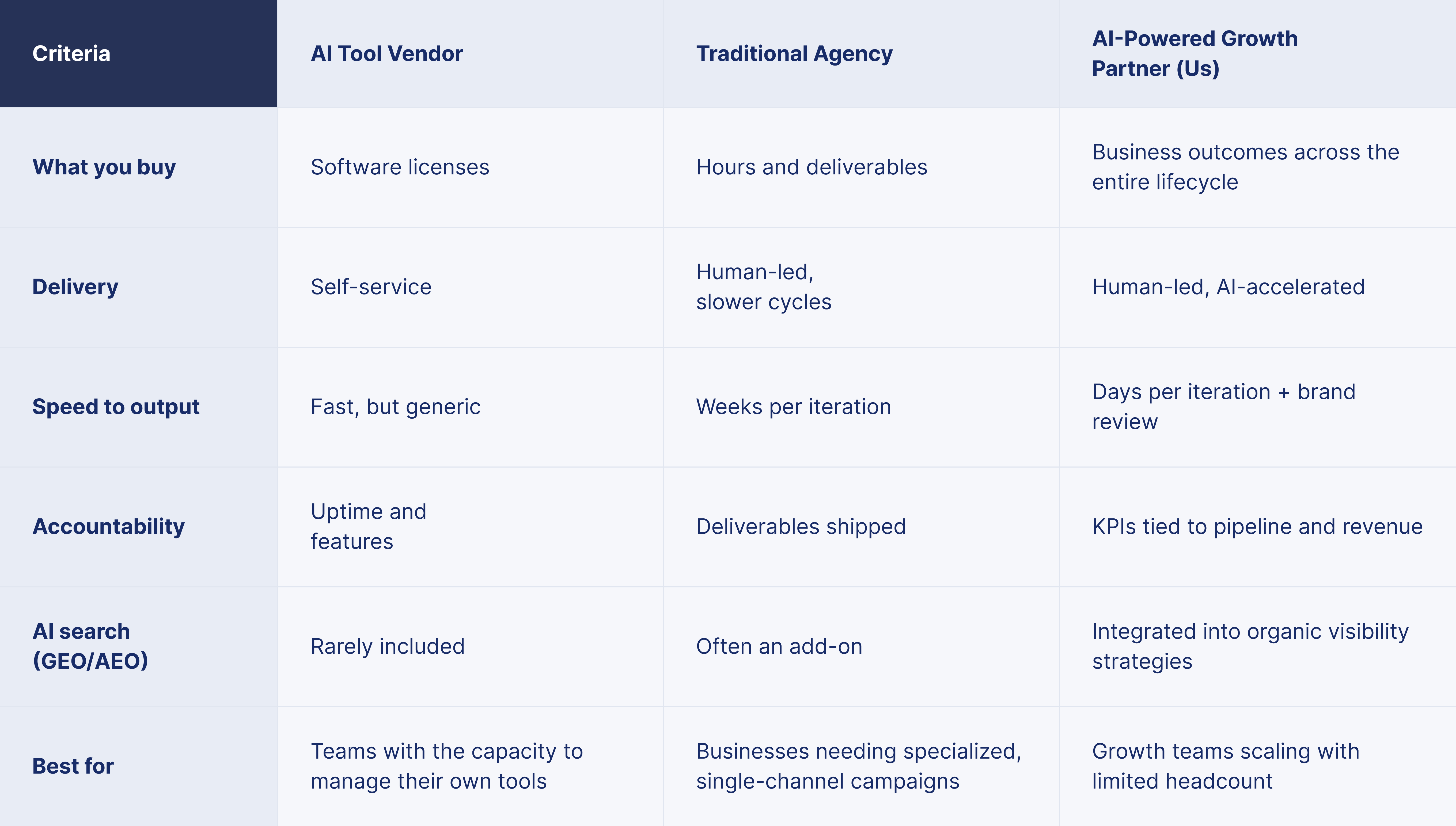
AI Tool Vendor vs. Traditional Agency vs. AI-Powered Growth Partner
Which model makes sense depends on what you're really buying: software, hours or results. Here's a quick side-by-side.
Why U.S. Growth Teams Are Rethinking Their Marketing Partners
Almost every company has access to AI now. Far fewer can show what it has done for revenue. Three studies published this year make that point from different angles.
Budgets are flat, but AI's share is growing. Gartner surveyed 401 marketing leaders across North America and Europe for its 2026 CMO Spend Survey. Marketing budgets came in at 7.8% of company revenue, up a hair from 7.7% in 2025. On average, 15.3% of that budget now goes to AI. Here's the catch: 70% of CMOs say becoming an AI leader is a critical goal, but only 30% describe their AI readiness as mature. And 56% say they don't have the budget to deliver this year's strategy (Gartner, May 2026).
Plenty of AI use, not much profit to show for it. McKinsey's 2026 State of AI survey of 1,719 respondents found nearly nine in ten organizations use AI regularly. Only 37% can point to any EBIT impact. Where revenue gains do show up, marketing and sales is the function cited most often. The small group McKinsey calls high performers, about 6% of respondents, behaves differently. Nearly three-quarters of them have redesigned their workflows around AI. For everyone else, it's roughly one in four (McKinsey, August 2026).
So what should a growth leader do with all this? Buying another tool probably isn't the answer. The teams pulling ahead are changing how the work gets done, tying AI to revenue metrics and making sure they show up when buyers ask an AI for advice. That's the work we think an agency partner should be doing alongside you.
How to Evaluate AI Marketing Agencies in the USA
Nearly every agency pitch mentions AI now, which makes them hard to tell apart. These are the questions we'd ask if we were on your side of the table:
Do they have a framework, or a list of tools? Ask them to walk you through how they'd figure out where your brand stands and what to fix first.
Who owns the strategy? AI can speed up execution. Positioning, messaging and trade-offs still need a senior person willing to put their name on them.
Have they changed how they work? In McKinsey's data, redesigned workflows are the clearest sign a team is getting real value. Bolting AI onto old processes isn't the same thing.
What will they be measured on? Look for KPIs linked to pipeline, revenue and retention, and reports you can check yourself.
Can they help you show up in AI answers? Ask how they track mentions, citations and recommendations in ChatGPT, Gemini, Perplexity and Google AI Mode.
What guardrails are in place? Find out who reviews AI output, how your data is handled and who signs off before anything reaches a customer.
Vague answers are worth noting. They usually mean AI lives in the sales deck more than in the delivery.
Loading FAQs
Please wait while we fetch the questions...
Published on October 27, 2026 by Simran