How to Optimize Your Brand for AI Search Results?
AI search is changing how brands are discovered and trusted online. From AI Overviews to conversational search, visibility now depends on being clear, credible, and extractable. This blog outlines key strategies to help your brand get cited, stay relevant, and win in AI-driven search results.
The era of AI-powered search is no longer emerging- it is already reshaping how users discover, evaluate, and trust information.
Google's AI Overviews and AI Mode are examples of AI-driven experiences that are transforming search from a list of links into a system that reads intent, synthesizes information, and provides straightforward answers. Users are increasingly relying on AI-generated summaries to make decisions, often without visiting multiple websites.
This shift fundamentally changes how brands compete.
Organic visibility is no longer just about ranking on search engine results pages - it is about becoming a trusted, citable source within AI-generated responses.
At Make My Brand, we help businesses adapt to this shift by integrating AI search optimization with traditional SEO strategy, ensuring that content is not only discoverable but also comprehensible, reliable, and extractable by AI systems. Our content writing services are designed to create high-quality, structured, and semantically rich content that aligns with how AI engines interpret and surface information.
This blog explains how AI search differs from traditional search, why this change is happening more quickly, and what companies need to do to remain visible in an AI-first search environment.
AI Search vs Traditional Search
AI-driven search - often referred to as Generative Engine Optimization (GEO), Answer Engine Optimization (AEO), or AI Search Optimization (AISO) - represents a shift from information retrieval to reasoning-based answers.
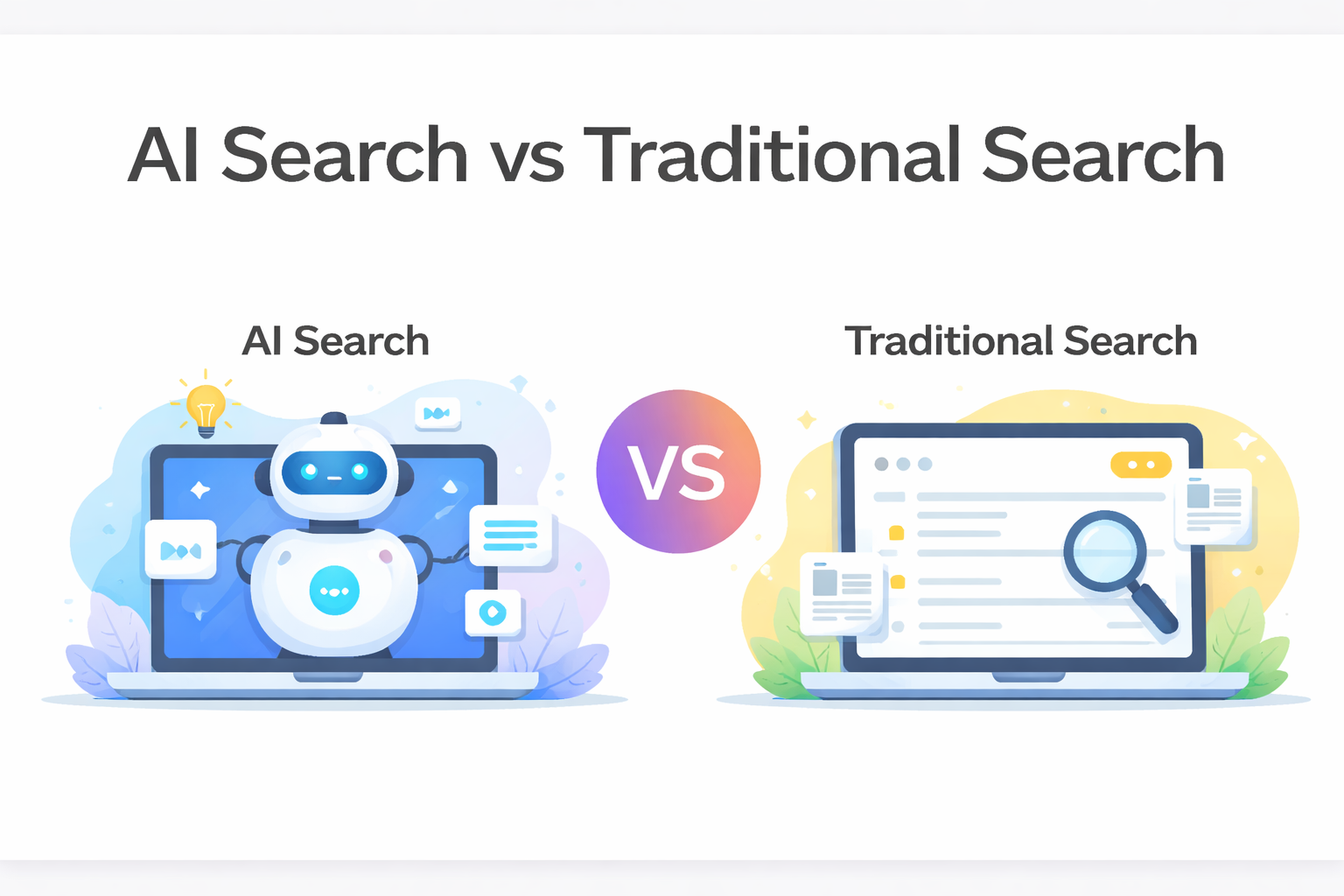
Traditional search:
Matches keywords to indexed pages
Ranks results based on relevance and authority
Requires users to navigate multiple sources
AI search:
Understands intent using large language models
Synthesizes answers from multiple sources
Provides direct, contextual responses with citations
Google’s AI Overviews primarily appear for informational queries, which dominate search behavior.
AI Mode goes further - enabling multi-step, conversational queries, longer synthesized responses, and deeper research journeys within a single interface.
This means brands are no longer competing only for rankings - they are competing for inclusion within AI-generated answers.
The Scale of the Shift
AI search adoption is accelerating rapidly, reshaping how users interact with digital content across platforms.
AI Overviews now appear in a significant share of searches and continue expanding across query types.
AI Overviews appear most frequently for exploratory, informational queries rather than transactional searches.
According to studies, AI-generated results are increasing zero-click behavior and decreasing the need for conventional link-based navigation.
At the same time, AI search is expanding beyond Google:
Conversational platforms like ChatGPT and Gemini
Social platforms integrating AI assistants for example, Meta AI
Visual identity and voice-based search interfaces
Search is no longer a single platform - it is an ecosystem of AI-driven discovery experiences.
From Keywords to Semantic Relevance in AI Search
The transition from keyword matching to semantic comprehension is one of the most significant changes in AI search.
Large language models do not rely on exact keywords - they interpret:
Context
Relationships between concepts
Intent behind queries
This makes semantic relevance a core ranking and citation factor.
What this means for brands:
Cover topics, not just keywords
Use natural language instead of keyword stuffing
Build topical authority clusters around core themes
Use internal linking to connect related concepts
Content that exhibits depth, coherence, and contextual completeness rather than merely keyword optimization is given priority by AI systems.
How Do AI Systems Choose What to Cite?
AI engines evaluate content differently from traditional ranking systems. Research shows that citation likelihood is strongly influenced by:
Structured content and semantic HTML
Clear metadata and formatting
Content freshness
Overall page quality signals
Additionally, AI systems tend to:
Prefer authoritative, well-linked domains
Pull from multiple sources to validate information
Favor content that directly answers user queries
This reinforces one key idea:
Brands don’t just need to rank - they need to be extractable.
Key Strategies for AI Search Optimization
1. People-First, Experience-Driven Content
AI systems value information that displays genuine expertise and first hand experience. This aligns closely with Google’s E-E-A-T framework (Experience, Expertise, Authoritativeness, and Trustworthiness).
Generic, surface-level content is increasingly ignored. Instead, AI models favor:
Original insights and perspectives
Real-world examples and case studies
Clearly defined authors with credible backgrounds
Content should not just answer questions - it should demonstrate why your brand is qualified to answer them.
2. Structure Content for AI Readability
AI systems rely heavily on content structure to understand meaning. Well-structured content is easier to extract, summarize, and reuse.
Best practices:
Use clear H2 and H3 headings that define specific topics
Write concise, self-contained sections
Use bullet points and lists for clarity
Add FAQ-style sections for direct answers
Include summary paragraphs that capture key ideas
Also implement structured data (schema), such as:
FAQ schema
Article schema
Local Business schema
This improves how machines interpret your content and increases the likelihood of being surfaced in AI-driven results.
3. Technical Readiness and Accessibility
AI visibility depends on whether your content can be accessed, indexed, and processed correctly. Core requirements:
Ensure pages are crawlable and not blocked by robots.txt
Maintain fast load speeds and strong Core Web Vitals
Use clean HTML structure and valid code
Ensure mobile responsiveness
Additionally, accessibility is becoming a competitive advantage:
Use descriptive alt text for images (supports visual search and accessibility)
Maintain clear navigation and readable layouts
Ensure content is usable across devices and formats
Accessible, well-structured websites are easier for both users and AI systems to interpret.
4. Optimize for Multimodal Search (Voice, Visual, Conversational)
AI search is increasingly multimodal, combining text, voice, and visual inputs into a single discovery experience. Users now search using:
Voice queries (conversational, question-based)
Images (via tools like Google Lens)
Hybrid inputs (text + image + context)
To adapt:
Write in a natural, conversational tone
Optimize images with context-rich filenames and alt text
Provide clear answers to question-based queries
Include visual content that supports understanding
This expands your visibility across multiple AI-driven entry points.
5. Build Authority Beyond Your Website
AI systems do not evaluate your website in isolation - they assess your overall digital credibility. Strong authority signals include:
Mentions in reputable publications
High-quality backlinks
Expert contributions and thought leadership
Consistent brand presence across platforms
Reviews, testimonials, and case studies
For local and service-based businesses, optimizing your Google Business Profile is critical:
Keep business information accurate and updated
Collect and respond to reviews
Add images and service details
Maintain consistency across directories
AI search integrates local data into responses, making local SEO a critical part of AI visibility.
6. Integrate SEO with AI Optimization
AI optimization is not a replacement for SEO - it is an extension of it. Maintain strong SEO fundamentals:
High-quality, original content
Optimized metadata
Internal linking structure
Crawlability and indexability
Then layer AI-focused improvements:
Answer-focused content blocks
Clear summarization
Structured formatting
Entity and topic clarity
The goal is simple:
Make your content easy to rank, easy to understand, and easy to reuse.
7. Accessibility = AI Readability
Accessibility is no longer just compliance - it directly impacts AI understanding. Best practices:
Proper heading hierarchy
Alt text for images
Clear navigation
Readable content structure
Accessible content is easier for both users and AI systems to interpret.
8. Social Platforms as Search Engines
Search behavior is expanding beyond traditional engines, with social platforms increasingly functioning as discovery and recommendation systems. Platforms like Instagram now function as:
Search engines
Recommendation systems
AI-assisted discovery tools
AI assistants like Meta AI enable users to:
Ask questions
Discover brands
Explore content conversationally
This means your brand must be discoverable across platforms, not just search engines.
9. Rethink KPIs: From Rankings to Visibility and Influence
Traditional SEO metrics such as rankings and clicks are no longer sufficient to measure success in AI search. AI search requires tracking:
Brand mentions in AI-generated responses
Visibility across AI platforms (ChatGPT, Gemini, etc.)
Share of voice in key topics
Engagement quality (time on page, conversions)
AI-driven users often arrive with higher intent - even if overall clicks decrease. The focus shifts from traffic volume → decision influence.
SEO vs AEO vs GEO vs AISO: Understanding the Evolution of Search Optimization
As search evolves, multiple optimization frameworks have emerged. While they are often used interchangeably, each represents a different layer of the same ecosystem.
Comparison Table
Aspect | SEO (Search Engine Optimization) | AEO (Answer Engine Optimization) | GEO (Generative Engine Optimization) | AISO (AI Search Optimization) |
Primary Goal | Rank higher in search engine results pages (SERPs) | Get selected as a direct answer (featured snippets, voice results) | Get cited within AI-generated responses | Maximize visibility across all AI-driven search experiences |
Search Type | Traditional search (Google SERPs) | Answer-based systems (voice assistants, snippets) | Generative AI (ChatGPT, Gemini, AI Overviews) | Unified AI search ecosystem (Google AI, chatbots, multimodal search) |
Focus | Keywords, backlinks, rankings | Direct answers to specific questions | Contextual relevance and citation-worthiness | Holistic optimization for AI understanding + discovery |
User Behavior | Users browse multiple links | Users expect one clear answer | Users consume synthesized responses | Users interact conversationally across platforms |
Content Style | Keyword-optimized, topic-focused | Concise, question-answer format | Context-rich, structured, authoritative | Semantically rich, multimodal, intent-driven |
Optimization Approach | On-page SEO, technical SEO, link building | FAQs, structured answers, schema markup | Semantic depth, topical authority, structured formatting | Combines SEO + AEO + GEO + UX + brand signals |
Key Signals | Backlinks, keywords, site health | Clarity, structure, direct answers | Authority, semantic relevance, extractability | Authority, structure, UX, accessibility, cross-platform presence |
Output Format | List of ranked links | Single answer (snippet/voice) | AI-generated summary with citations | Dynamic responses (text, voice, images, conversation) |
Success Metrics | Rankings, traffic, CTR | Featured snippet wins, voice visibility | AI citations, mentions | Share of voice across AI systems, engagement quality |
How Do They Work Together?
These are not competing strategies - they are evolutionary layers:
SEO is the foundation (crawlability, indexing, authority)
AEO ensures your content answers questions clearly
GEO ensures your content is selected and cited by AI systems
AISO is the umbrella strategy that integrates all of the above
In simple terms:
SEO helps you get found
AEO helps you get chosen
GEO helps you get cited
AISO ensures you stay visible everywhere AI operates
This layered approach is what enables brands to move from visibility → credibility → influence in AI-driven search.
The Future of Search: What Brands Must Do
Search is evolving across three fundamental shifts::
Keywords → Context
Rankings → Recommendations
Traffic → Influence
To stay competitive, brands must:
Create deeply valuable, expert-driven content
Build semantic and topical authority
Structure content for AI extraction
Strengthen brand credibility across platforms
Adapt continuously to evolving AI systems
Conclusion
AI-powered search is no longer a future concept - it is already changing the way people discover and trust information. The companies that thrive will not be those that seek rankings alone, but those who become trusted sources of truth in their industry.
Brands can place themselves at the core of AI-generated solutions through integrating solid SEO foundations with organized, reliable, and AI-ready content.
At Make My Brand, we assist businesses in navigating this shift through the utilization of branding, SEO, and AI search optimization into a cohesive growth plan.
Brands that invest early in AI search optimization will not only capture visibility- but shape how decisions are made.
Now is the time to adapt.
Loading FAQs
Please wait while we fetch the questions...
Published on March 24, 2026 by Simran