AI Search Visibility Audit: 10 Things B2B Brands Must Measure Beyond Google Rankings
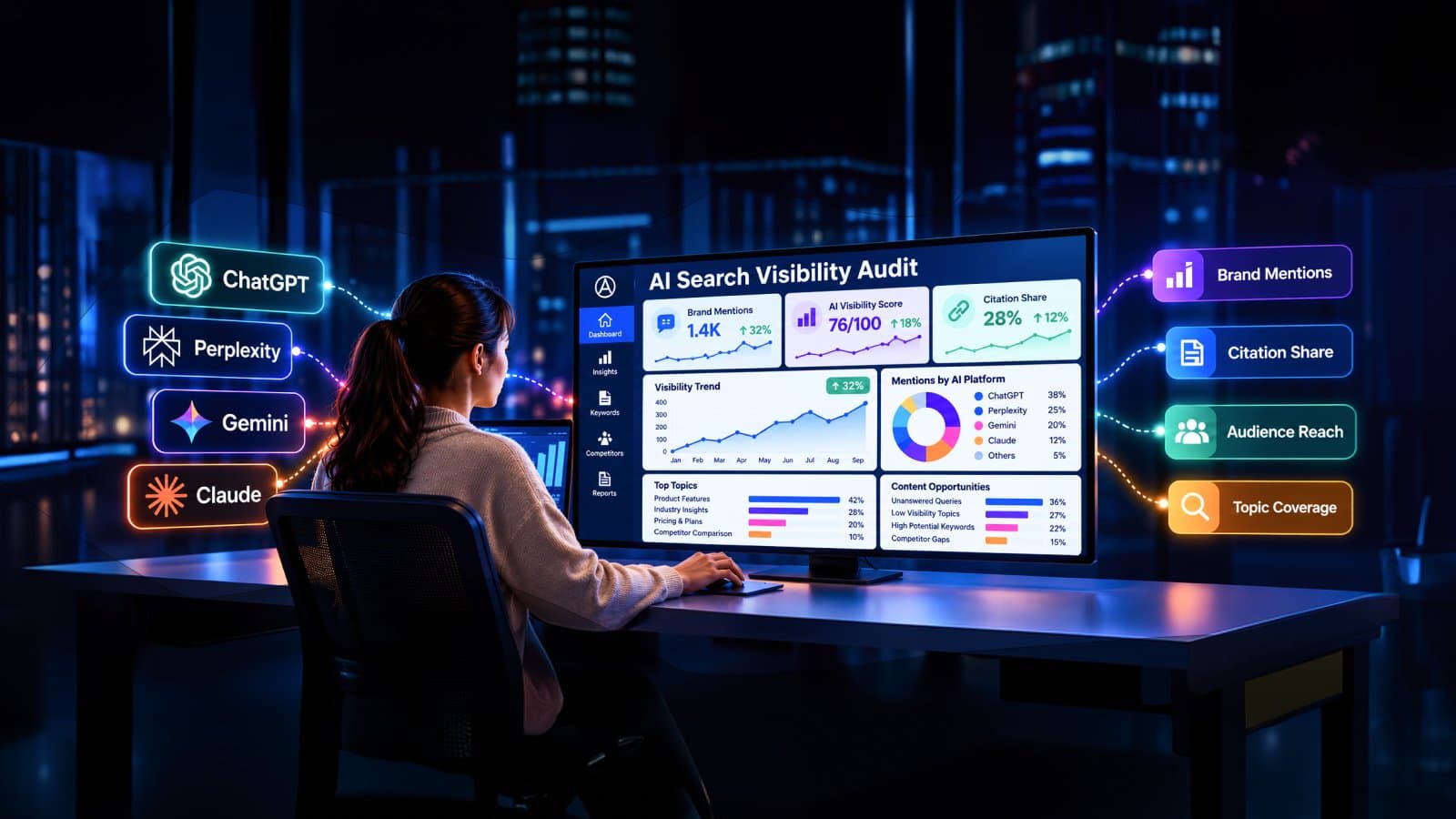
An AI search visibility audit helps B2B brands measure how ChatGPT, Perplexity, Gemini, and Google AI Mode mention, cite, describe, and recommend their businesses. Key metrics include brand mention rate, competitor share of AI voice, citation rate, positioning accuracy, and pipeline contribution.
The MMB Perspective - At Make My Brand, we treat AI search visibility as a brand challenge, not only a search challenge. AI platforms repeat what the market consistently says about you. If your positioning is unclear, your third-party footprint is thin, or your content is hard to extract, keyword optimization alone won't get you into the answer.
That's why AI visibility sits inside our Brand Development Lifecycle (BDLC), connecting brand foundation, visibility, and leadership positioning into one measurable growth system.
Your rank tracker says you're on page one. Your pipeline says something else is going on.
For two decades, B2B marketers have treated Google rankings as the scoreboard for search. That scoreboard still matters, but it no longer shows where buying decisions begin. Today, a VP of Operations building a vendor shortlist is just as likely to ask ChatGPT, Perplexity, or Google's AI Mode for a recommendation as to scroll through ten blue links. If your brand isn't named in that answer, your page-one ranking never gets the chance to work.
That's the gap AI search visibility closes how often, how accurately, and how favorably AI platforms surface your brand when buyers ask questions in your category. It's also why every growth-focused B2B brand needs an AI search visibility audit running alongside its traditional SEO reporting.
What Is an AI Search Visibility Audit?
An AI search visibility audit is a structured assessment of how your brand appears across generative AI platforms, including ChatGPT, Gemini, Perplexity, Claude, Microsoft Copilot, and Google's AI Overviews and AI Mode. Instead of tracking where a URL ranks a keyword, it tracks whether your brand is mentioned, cited, described correctly, and recommended in response to the prompts your buyers use.
Think of it as the measurement layer for generative engine optimization (GEO). You can't optimize what you can't see, and most B2B teams have no baseline for their LLM visibility at all.
Why Google Rankings No Longer Tell the Full Story
The shift in buyer behavior shows up consistently across independent research:
GenAI is now mainstream in B2B buying. Roughly 9 in 10 B2B buyers have adopted generative AI, according to Forrester's Buyers' Journey Survey data.
Shortlists form early. In 6sense's 2025 Buyer Experience Report, 94% of buyers used LLMs during their purchase process, and the winning vendor was already on the Day One shortlist 95% of the time.
US buyers are moving fastest. In Responsive's 2025 buyer study, 48% of US B2B buyers said they use GenAI for vendor discovery, compared with 14% in other regions.
Clicks are thinning. Pew Research Center found Google users clicked a traditional result in 8% of visits when an AI summary appeared, versus 15% without one, and clicked a link inside the summary in just 1% of visits.
The takeaway: if AI tools shape the shortlist before a buyer ever reaches your website, a ranking report measures the end of the journey, not the start.
10 Things to Measure in Your AI Search Visibility Audit
1. Brand Mention Rate
This is the foundation metric. Build a fixed set of 30–50 prompts that mirror real buyer questions, such as "best [category] partners for mid-market SaaS companies," then run them across platforms and record the percentage of answers that name your brand. This becomes your core AI search visibility score.
2. Share of AI Voice vs. Competitors
A mention rate means little in isolation. Track how often your top four or five competitors appear in the same answers. If a rival shows up in 60% of responses and you appear in 15%, you've found your gap, and likely a few deals you never knew you were competing for.
3. Citation Rate and Cited Sources
Being mentioned and being cited are different things. Perplexity, Google AI Overviews, and ChatGPT search often link to sources. Measure how often your own pages are cited, which ones earn those citations, and which competitor or third-party pages are cited instead. Those sources reveal what each model treats as authoritative.
4. Prompt Coverage Across the Buyer Journey
B2B buyers ask different questions at different stages. Map prompts problem framing ("why is our lead quality declining?"), solution exploration ("what is account-based marketing?"), and vendor evaluation ("top ABM agencies in the US"). Many brands appear in educational answers but disappear at the evaluation stage, which is exactly where shortlists are built.
5. Platform-by-Platform Visibility
Each AI platform draws on different sources and retrieval methods, so visibility is rarely consistent. Score each one separately. A brand that performs well in Google AI Overviews can be nearly invisible in ChatGPT, and your buying committee doesn't all use the same tool.
6. Positioning Accuracy
This is where many B2B brands get an unwelcome surprise. Ask each platform to describe your company, services, ideal customer, and differentiators. Log every outdated offering, wrong market, or confused competitor comparison. Inaccurate AI brand visibility can be worse than none, because it puts the wrong story in front of a buyer at the exact moment they're forming an opinion.
7. Recommendation Position and Sentiment
Where you appear inside, the answer matters. Are you the first recommendation or the fifth? Are you introduced with a qualifier like "a smaller option" or "mixed reviews," or framed as a category leader? Track position and tone, not just presence.
8. Third-Party Mention Footprint
AI models learn about brands largely from what others say about them. Ahrefs' study of 75,000 brands found branded web mentions had the strongest correlation (0.664) with brand visibility in Google AI Overviews, well ahead of link-based signals. The same study found that 26% of brands had zero AI Overview mentions. Audit your presence across review platforms, industry publications, analyst coverage, podcasts, and the communities where your category is discussed.
9. Technical Accessibility and Content Extractability
AI systems can't cite what they can't reach or parse. Check robots.txt and firewall or CDN settings for AI crawlers such as OAI-SearchBot, GPTBot, and PerplexityBot. Confirm key pages render without relying on heavy JavaScript, and that content is organized into clear, self-contained answers with consistent company, service, and location details across your site.
10. AI Referral Traffic and Pipeline Contribution
Finally, connect visibility to revenue. Set up a dedicated GA4 channel group for AI referrers such as chatgpt.com, perplexity.ai, gemini.google.com, and copilot.microsoft.com, and track conversions from those sessions. Note that clicks from Google's AI Overviews are reported as regular Google organic traffic, so they won't appear in that group. Add "ChatGPT or another AI assistant" to your "How did you hear about us?" field to capture influence analytics can't see. This is what turns AI search performance into a pipeline KPI rather than a vanity metric.
Your AI Search Visibility Scorecard
Use this table to translate familiar SEO reporting into its AI-era equivalent:
Traditional SEO Metric | AI Search Visibility Metric | What It Tells You |
|---|---|---|
Keyword ranking | Brand mention rate | Whether AI includes you in the answer |
SERP share of voice | Share of AI voice | How you compare with competitors in AI answers |
Backlinks | Third-party mentions and citations | Whether credible sources vouch for you |
Click-through rate | Recommendation position and sentiment | Whether you're positioned to make the shortlist |
Title and meta description | Positioning accuracy | Whether AI tells your story correctly |
Organic sessions | AI referral traffic and self-reported attribution | Whether visibility turns into pipeline |
How to Run Your First Audit
Build your prompt set. Write 30–50 buyer prompts across journey stages and priority services.
Test consistently. Run each prompt several times per platform in a clean, logged-out session. AI answers vary from run to run, so single checks are unreliable.
Benchmark competitors. Score three to five competitors on the same prompts.
Prioritize by revenue impact. Fix evaluation-stage gaps and accuracy errors first.
Re-measure monthly. Track movement against your baseline, and report it alongside rankings.
Measure What Shapes the Shortlist
Google rankings still matter. But for B2B brands, B2B AI search visibility increasingly determines whether you're part of the buying conversation at all. The brands that establish a baseline now will compound that advantage as AI search matures, while others discover the gap only after it shows up in lost pipeline.
Want to know how ChatGPT, Perplexity, and Google's AI describe your brand today? Connect with the Make My Brand team to benchmark your AI search visibility and build a roadmap to close the gaps.
Loading FAQs
Please wait while we fetch the questions...
Published on October 9, 2026 by Simran