Black Friday Marketing Strategy: How to Maximize Brand Visibility, Traffic and Sales
Black Friday Marketing Strategy to boost brand visibility, attract high-intent traffic, and drive profitable sales through SEO, paid advertising, audience segmentation, and conversion optimization. Learn how to maximize campaigns and build lasting customer relationships.
Black Friday creates one of the most concentrated periods of commercial intent in the retail calendar. It also creates one of the noisiest.
Consumers are comparing prices, waiting for offers, switching between marketplaces and brand websites, checking reviews, opening promotional emails, and encountering paid ads from dozens of competing brands within the same week.
That makes Black Friday less of a discounting event and more of a visibility and conversion problem.
A strong Black Friday marketing strategy has to answer three questions at once: How will people discover the offer? Why should they choose your brand over another? And how quickly can they move from interest to purchase?
Black Friday Is Not Just a Sales Event Anymore
The conventional Black Friday model was relatively straightforward: announce a discount, increase advertising, and create urgency around a limited sales window.
Digital buying journeys have made that model considerably more complex.
Your Black Friday sales strategy needs to work across the entire journey rather than focusing on the final promotional message.
Visibility matters before the sale. Positioning matters while customers compare. User experience matters when traffic arrives. Retention matters after the transaction.
This is also why broader brand visibility should be treated as a commercial asset rather than a vanity metric. If customers have already encountered and understood your brand before Black Friday, your offer does not have to introduce the company and close the sale at the same time.
Start the Black Friday Marketing Strategy Before Black Friday
One of the most expensive Black Friday mistakes is waiting for the promotional weekend to start marketing.
By then, paid media costs are competitive, inboxes are crowded, and customers are already receiving offers from brands they know.
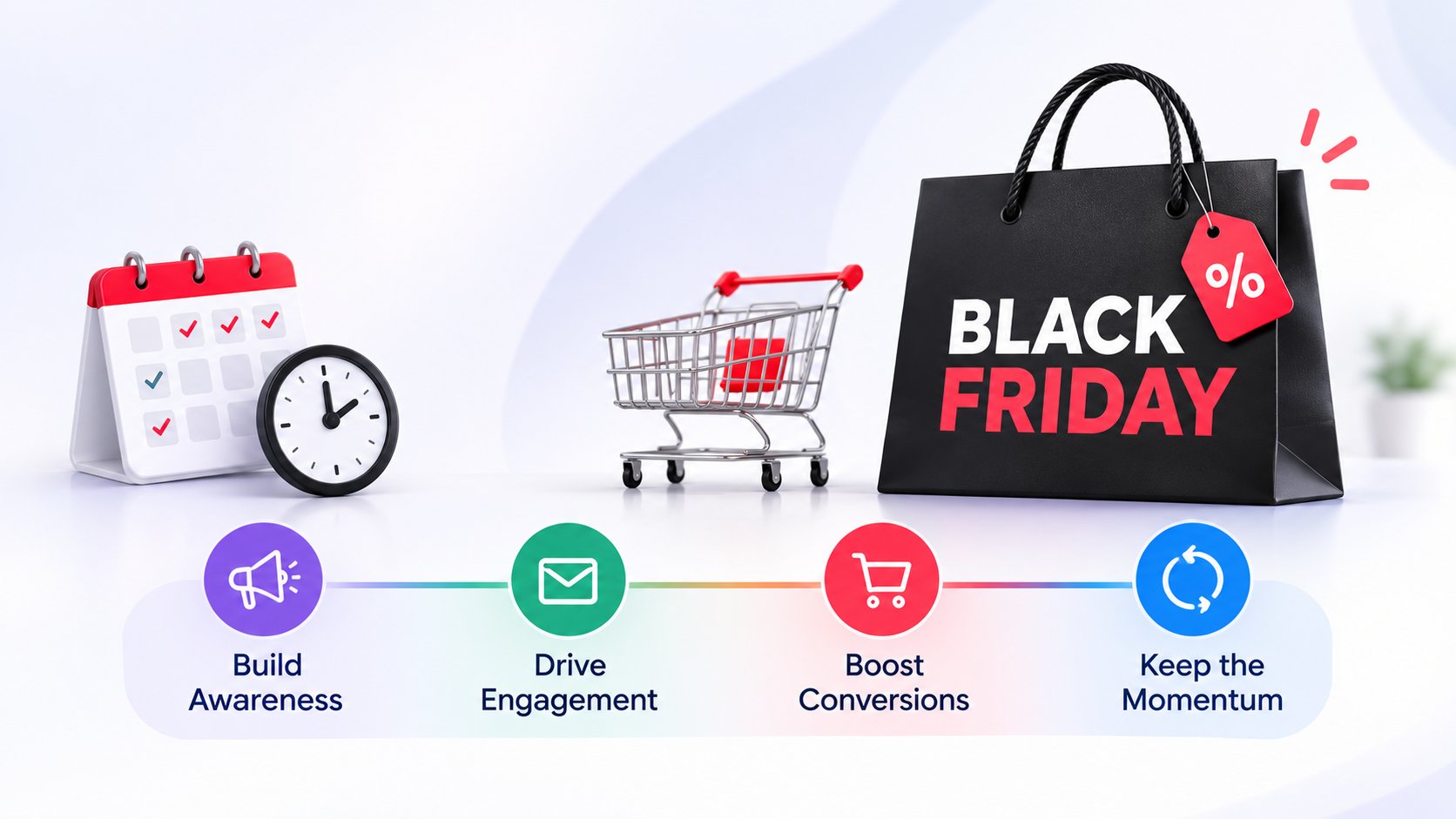
A stronger approach is to divide your Black Friday marketing campaigns into stages.
Early campaigns can build awareness, collect email or SMS subscribers, promote wishlists, identify high-intent audiences, and create remarketing pools.
The next phase can introduce previews, early-access offers, bundles, product education, gift guides, or category-specific landing pages.
Black Friday itself then becomes the conversion phase rather than the beginning of the campaign.
After the sale, brands can move into Cyber Monday, gifting campaigns, upsells, replenishment, loyalty, and holiday-season remarketing.
That longer campaign window gives marketing teams more room to optimize instead of trying to make every decision during the busiest few days of the quarter.
Make the Offer Easy to Understand
A 30% discount is easy to communicate. That does not automatically make it the strongest offer.
Some brands protect margin more effectively through bundles, tiered discounts, gifts with purchase, loyalty benefits, free shipping thresholds, early access, or category-specific offers.
The offer should reflect the product economics and customer behavior rather than copying whatever competitors are doing because strong Black Friday promotion strategies begin with commercial objectives.
Are you trying to:
acquire new customers,
increase average order value,
clear inventory,
reactivate previous customers,
increase repeat purchases,
grow a subscriber base, or
introduce customers to a new product category?
Once the objective is clear, the promotion can be designed around it.
This is where brand strategy becomes relevant too. Deep discounts can generate volume, but they can also weaken perceived value when used carelessly. Your offer still needs to fit your brand identity and brand positioning.
Build Search Visibility Before Search Demand Peaks
Paid media receives much of the attention during Black Friday, but organic discovery can reduce dependence on increasingly expensive auction-based traffic.
A Black Friday SEO strategy should begin weeks, or preferably months, before the event.
Search engines need time to crawl, understand, and rank new pages. Publishing a Black Friday landing page three days before the sale gives the page very little opportunity to build authority.
Brands should instead maintain evergreen Black Friday URLs where practical and update them each year rather than creating and abandoning a new page every season.
Useful search-led assets can include Black Friday category pages, offer hubs, gift guides, product comparisons, buying guides, FAQs, and informational content connected to relevant seasonal intent.
The same principle applies to product pages. Titles, descriptions, internal links, structured information, imagery, reviews, availability, and promotional messaging should all be prepared before demand spikes.
This is where a wider organic visibility strategy becomes valuable. Black Friday search performance is rarely created in November alone. It is usually the result of technical SEO, authority, content, and category visibility built throughout the year.
Do Not Optimize Content Only for “Black Friday”
Seasonal keyword targeting should go beyond one high-volume phrase.
Customers may search for:
“best Black Friday laptop deals”
“Black Friday skincare gift sets”
“Black Friday offers under $100”
“Black Friday deals for runners”
“best gifts for new parents”
The closer the content aligns with an actual buying decision, the more useful it becomes.
Brands should also revisit existing high-performing content. Product guides, comparison pages, category content, and gift-related articles can often be updated to introduce relevant seasonal offers without rebuilding the content ecosystem from scratch.
Make Paid Advertising More Selective, Not Simply Bigger
During Black Friday, most brands increase ad spend.
That does not mean every campaign deserves more budget.
A strong Black Friday advertising strategy should prioritize products, audiences, creatives, and channels based on expected profitability.
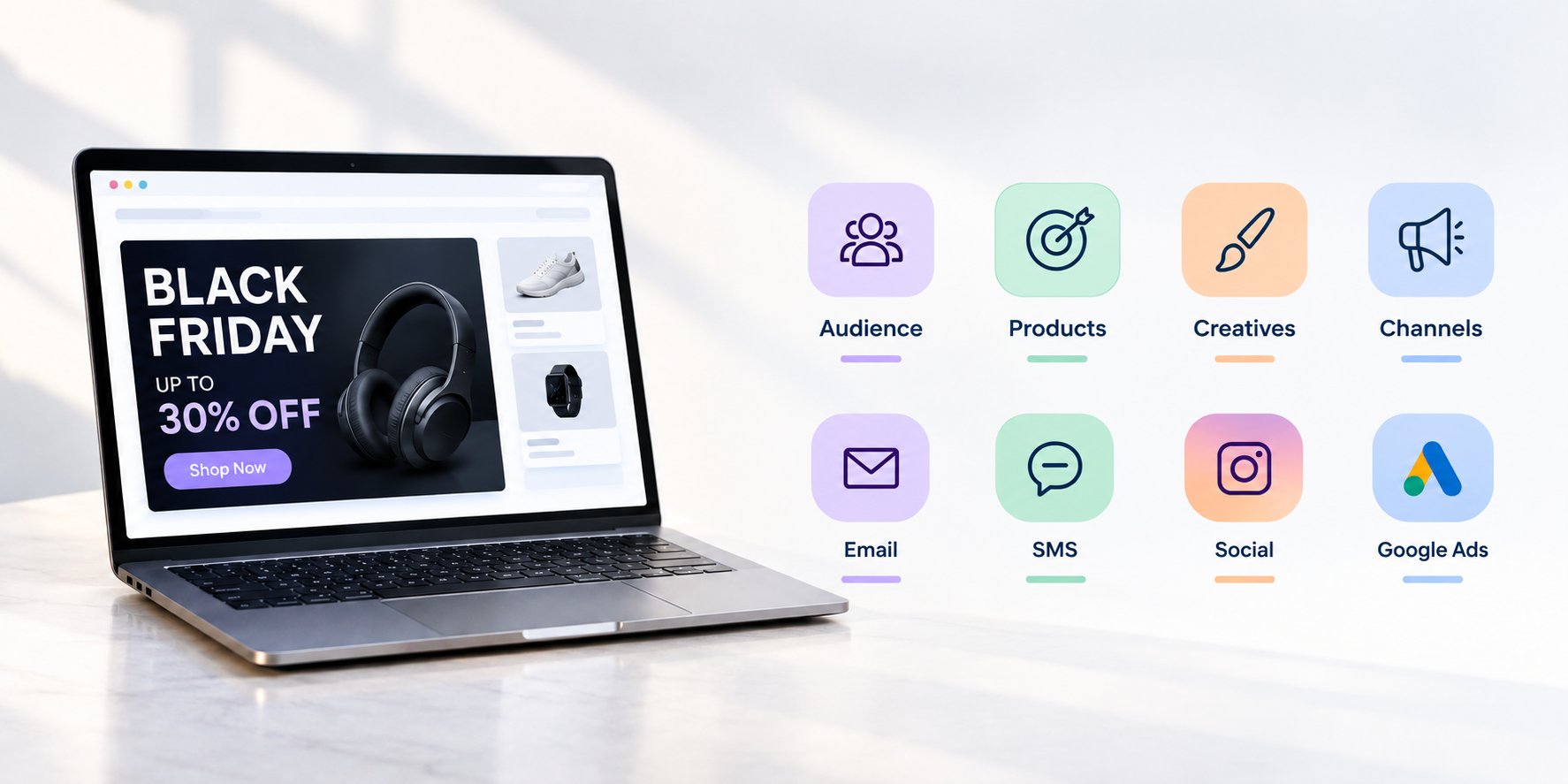
High-intent remarketing audiences may justify aggressive bidding. Existing customers may respond better to email or SMS than paid social. New customer acquisition may require stronger creative and a different offer than campaigns targeting previous website visitors.
Campaign structures should also distinguish between:
prospecting, remarketing, customer retention, product categories, branded search, non-branded search, and promotional campaigns.
Creative fatigue matters as well. Showing the same “30% OFF” graphic repeatedly throughout November makes the campaign easier to ignore.
Refresh creative as the sale progresses. Early messaging can build anticipation. Mid-campaign creative can focus on product value. Final-day ads can introduce genuine urgency.
Good Black Friday digital marketing coordinates these channels instead of running them independently.
A customer who has already opened three promotional emails should not necessarily receive the same message in an Instagram ad, Google ad, and retargeting banner.
Treat Your Landing Page as Part of the Campaign
Driving traffic is only half the job.
A Black Friday campaign can generate record traffic while producing disappointing revenue if customers encounter slow pages, unclear offers, confusing navigation, unavailable products, weak mobile experiences, or unexpected shipping costs.
Your promotional landing page should answer the essential questions quickly:
What is the offer? Which products qualify? When does it expire? Are there exclusions? Is a code required? What are the shipping terms? How quickly can customers find the products most relevant to them?
Mobile performance is especially important because customers often discover offers through social feeds, messaging apps, email, or mobile search.
Brands should test the complete journey before campaigns scale: advertisement to landing page, product discovery, cart, promotional code, checkout, payment, confirmation, and follow-up communication.
Traffic does not create revenue on its own. Conversion infrastructure does.
Use Segmentation Instead of Sending Everyone the Same Offer
Black Friday attracts different kinds of buyers. Treating all of them as one audience leaves considerable revenue on the table.
Email, SMS, paid media, and onsite personalization can use purchase history, browsing behavior, average order value, category interest, loyalty status, and engagement history to create more relevant offers.
Personalization does not have to become complicated. Even basic audience segmentation can make Black Friday marketing ideas considerably more effective than sending one identical campaign to the entire database.
Prepare for AI-Led Product Discovery Too
Black Friday search behavior is no longer confined to Google.
Customers can now ask AI tools questions such as:
“Find the best noise-cancelling headphones under $200 during Black Friday.”
“Compare these three coffee machines and tell me which is the best deal.”
“Which skincare brands have good Black Friday offers for sensitive skin?”
That means product information needs to be clear, structured, current, and easy to understand across the wider web.
Product titles, specifications, pricing, availability, reviews, shipping information, structured data, comparison content, and third-party mentions all contribute to the information environment surrounding the brand.
Your Black Friday strategy therefore needs to think beyond ranking for one seasonal keyword. Customers may increasingly discover offers through systems that interpret and compare information for them.
Measure Profit, Not Just Revenue
A successful Black Friday dashboard should go deeper than sales volume.
Revenue can look excellent while margin, customer acquisition cost, return rates, or fulfillment costs tell a different story.
Evaluate campaign performance through measures such as conversion rate, average order value, customer acquisition cost, return on ad spend, contribution margin, new versus returning customers, abandonment rate, email and SMS revenue, channel-assisted conversions, repeat purchase rate, and post-sale returns.
The most valuable insight may not be which campaign generated the most revenue.
It may be which promotion generated customers who continued buying in December, January, and beyond.
That is where a seasonal campaign becomes part of the larger marketing strategy rather than an isolated sales spike.
The Strongest Black Friday Strategy Starts Before the Discount
Black Friday creates demand, but it does not automatically create preference.
When hundreds of brands compete for attention simultaneously, stronger performance comes from entering the period with visibility already established, audiences already built, conversion paths already tested, and positioning already clear.
That requires SEO before the search surge, content before the consideration stage, audience building before the paid-media auction intensifies, and retention planning before the first transaction happens.
At Make My Brand, we approach seasonal campaigns as part of a wider growth system rather than a few weeks of promotional activity. The objective is not simply to generate a Black Friday sales spike. It is to turn increased demand into stronger acquisition, better customer economics, and sustainable brand growth.
A successful Black Friday marketing strategy therefore should not begin with:
“How big should the discount be?”
It should begin with:
“How do we make sure the right customer sees us, understands us, chooses us, and has a reason to come back after the sale is over?”
Loading FAQs
Please wait while we fetch the questions...
Published on October 21, 2026 by Surbhi Sood