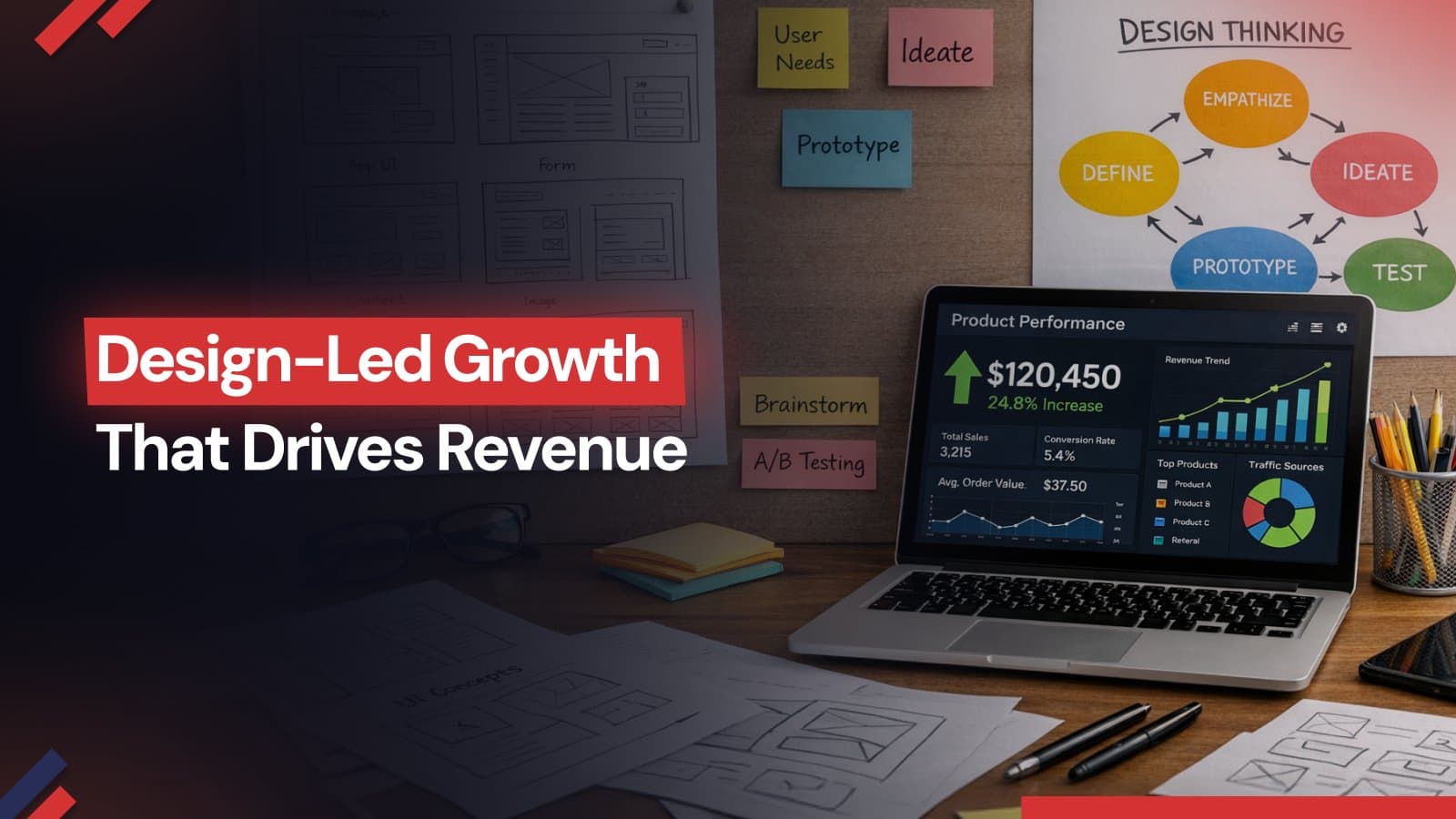
Design-Led Growth: How Strategic Design Drives Revenue
Design is no longer just a visual layer it’s a powerful growth driver. This blog explores how Design-Led Growth transforms user experience into measurable revenue by reducing friction, aligning with user intent, and optimizing every stage of the customer journey.
There was a time when design sat at the end of the pipeline - polishing what marketing created and what product teams built. That model no longer holds. Today, growth is increasingly constrained not by visibility or traffic, but by how effectively experiences convert attention into action.
This is where Design-Led Growth emerges - not as a creative philosophy, but as a measurable revenue strategy.
Modern digital environments are saturated. Users don’t lack options, they lack patience. The brands that win are not those with the loudest messaging, but those that reduce friction, align with intent, and guide decisions effortlessly. Strategic design does exactly that - it compresses the gap between interest and conversion.
At Make My Brand, design is approached as a system that influences behavior across the entire customer lifecycle - not just interfaces, but outcomes.
Why Design Matters in Growth?
Modern research consistently shows that organizations placing design at the center of strategy experience significantly stronger growth outcomes.
A widely cited study by McKinsey & Company found that design-led growth companies achieve 32% higher revenue growth compared to their competitors. This demonstrates that design is no longer a cosmetic function - it is a measurable business driver.
Every pixel on a screen has a purpose- and when aligned with business goals, it directly influences user behavior and revenue outcomes.
The Economics of Design: Where Revenue Is Won or Lost
Design impacts revenue far beyond visual appeal. It operates across four critical stages:
Acquisition: How Design Impacts First Impressions
Users form impressions almost instantly. A clean, intuitive interface builds trust before a single word is read. Poor structure or clutter, on the other hand, leads to immediate drop-offs.
Activation: Reducing Friction Through Design
Every extra step, unclear interaction, or delay creates hesitation. Research shows that simplifying user flows significantly improves engagement and completion rates.
Conversion: How UX Design Drives Revenue
Design directly influences conversion rates. In fact, effective UX improvements can increase conversion rates by up to 400%, while optimized UI elements alone can boost them by 200%.
Retention: How Design Builds Long-Term Value
A well-designed experience doesn’t just convert - it builds habits. Consistency and ease of use increase retention, which directly impacts lifetime value and revenue growth.
Strategic, conversion-focused design operates differently- it focuses on behavior, not just aesthetics.
Design-Led Growth Principles That Drive Revenue
Most design conversations still revolve around aesthetics. Strategic design approach for brands operates differently - it focuses on behavior.
1. Clarity and Purpose
Every visual element - layout, typography, color, and messaging - must guide the user toward a clear action. A high-performing interface answers three questions instantly:
What does this brand offer?
Is it relevant to me?
What should I do next?
When these answers are visually obvious, conversion becomes natural.
2. Designing for User Intent, Not Personas
Static personas are assumptions. Real brand growth comes from designing around live intent signals - what users are trying to do right now. Scroll depth, hesitation points, and navigation patterns reveal more than any demographic profile.
3. Cognitive Load Engineering
Every additional decision reduces the likelihood of action. High-performing interfaces don’t just simplify - they sequence decisions intelligently.
4. Speed as Experience
A delay of even half a second can significantly reduce conversions. Speed is not just technical - it’s perceptual.
5. Data-Driven Iteration
Effective design evolves with time. User testing, behavioral analytics, and interaction data reveal how people behave digitally.
These insights allow teams to refine layouts, improve flows, and align design with real user intent.
Conversion-Focused Design in Action
Conversion-focused design focuses on removing friction and enabling faster decision-making.
Key tactics include:
Clear & Prominent Call-to-action (CTA)
Call-to-actions should be clearly visible to the users. To make intended action stand out, properties like contrast, positioning, and spacing can be used.
The concept is straightforward: people are far more likely to follow through when the next step is obvious.
Minimize Friction
Every additional step or field in a form introduces hesitation. Conversion-focused user interface design services streamline procedures, allowing users to proceed with less effort.
For example, it has been shown that simplifying a complicated signup form to only an email address and password increases trial sign-ups on a variety of SaaS platforms. In the same way, streamlining contact forms or cutting down on checkout stages could considerably boost completion rates.
Small design changes that reduce effort often deliver disproportionately large conversion gains.
User Intent Alignment
An effective design strategy for brands anticipates why someone arrived on the page and immediately addresses that intent. This means replacing vague CTAs like “Contact Sales” with contextual prompts such as:
“See how it works in 10 minutes.”
“Get a custom pricing estimate.”
“Start your free trial.”
When messaging reflects the user’s immediate goal, hesitation decreases and interaction becomes more natural.
Trust Signals
Trust is one of the strongest drivers of conversion. Interfaces that look inconsistent, cluttered, or outdated create subconscious doubt.
Strong conversion-focused design reinforces credibility by incorporating:
Customer logos and recognizable brand associations
Testimonials and user success stories
Security badges and privacy indicators
Consistent typography, spacing, and visual hierarchy
In high-trust industries such as finance or healthcare, these design elements act as reassurance. Thoughtful design quietly signals professionalism and reliability.
CRO and A/B Testing
CRO is an ongoing system of learning and improvement rather than a one-time solution. Effective teams approach design as a test rather than a finished product. Even little adjustments to layout, message, or processes can provide quantifiable results through organized A/B testing.
The true benefit is consistency. Regular testing helps brands build up insights over time, transforming user behavior from guessing into predictable development levers.
Aligning Design with User Intent
Effective design strategy for brands starts with a thorough grasp deep understanding of user behavior and intent. Interfaces naturally direct users toward significant actions when they are based on actual user understanding rather than conjecture.
To learn how people think, what questions they have, and what drives them at various points of the experience, start by creating user personas and journey maps. Interviews, behavior monitoring, and analytics are examples of UX research techniques that assist identify trends that influence more intelligent design choices.
One common strategic technique is to map intent at each level of the funnel. This guarantees that when the user needs it, the interface speaks their language.
Make My Brand, for example, frequently incorporates dynamic call-to-actions that change according to user activity.
Product-Led, Experience-Driven Strategy
The basic principle of a successful product-led strategy is that the product itself propels expansion, conversion, and acquisition. Growth occurs when consumers directly perceive value rather than significantly depending on sales or marketing.
In order to assist consumers achieve significant results in minutes rather than days, high-performing businesses concentrate on cutting time-to-value. This calls for easy onboarding, user-friendly processes, and unambiguous in-product instructions.
Alignment is what makes this unique. Instead of operating in silos, product, marketing, and customer experience teams are centered around actual user behavior and data.
When done well, conversion, retention, and growth become natural results, driven not by pressure but by the product's ability to give continual value.
How to Implement Design-Led Growth?
Implementing Design-Led Growth requires aligning strategy, user experience, and data into a continuous optimization system.
Brand & Business Alignment
Define core KPIs and positioning. Ensure stakeholders agree on goals and messaging.
User Research & Strategy
Conduct UX research, build personas and journeys. Map user intent at each funnel stage.
Experience Design & Systems
Develop design systems and UI-UX design frameworks. This ensures consistency (brand colors, components, copy tone) across all platforms.
Technical Handoff & Builds
Work with development to implement pixel-perfect design. Integrate AI tools (chatbots, personalization engines) and CRO infrastructure (A/B test platforms, analytics).
Testing & Iteration
Launch with analytics, heatmaps, and user feedback in place. Make iterative improvements, e.g., run A/B tests on headlines or form layouts.
Often, small design refinements - such as adjusting form layouts or improving button visibility - can lead to significant improvements in conversion performance.
Measuring What Matters
Throughout this process, design decisions are evaluated through measurable metrics such as:
Conversion rates
Lead quality
Engagement depth
User retention
At Make My Brand, this philosophy is embedded into a Design & Development-as-a-Service approach, where design, optimization, and analytics work together as a single system.
Instead of relying on assumptions, design decisions are guided by behavioral data insights and performance metrices.
Conversion Rate Optimization as a Growth Engine
CRO is the continual process of refining the user experience for better results.
Key strategies include:
Experimentation
Systematically A/B test landing pages, CTAs, images.
Micro-Conversion Focus
Track small wins (e.g., email signups, add-to-carts) and optimize them. Use one-click forms and progressive forms to reduce abandonment.
Behavioral Triggers
Add urgency, such as countdown timers & low-stock alerts, and social proof like “X people viewing this”, as done by many e-commerce sites.
In practice, Make My Brand embeds CRO tools (analytics dashboards, heatmaps, user recordings) into every project. We run continuous tests - for example, swapping a button color or headline, or trying a different hero image - and measuring lift. This data-driven approach has proven time and again that disciplined UX design pays back handsomely.
Major Design Trends Shaping Digital Growth in 2026
Design in 2026 is increasingly driven by performance, inclusivity, and adaptability - where every design decision contributes to user experience and business outcomes.

Minimalism is moving into functional simplicity: fewer distractions, clearer hierarchy, and tighter journeys that help users act faster.
Dark mode remains a standard experience option, but it works best when paired with strong contrast, readability, and accessibility support.
Neuroinclusive design is gaining importance as teams reduce cognitive load with calmer layouts, simpler language, and predictable flows.
Accessibility and inclusion are now part of sustainable design practice, not an afterthought.
Sustainable branding and ethical design is increasingly tied to trust and performance. The latest web sustainability guidelines explicitly warn against manipulative patterns, excessive tracking, and unnecessary journeys.
Humanization is becoming a clear visual direction in 2026, with softer, more organic and emotionally resonant aesthetics replacing overly rigid interfaces.
Frosted glass effects are still popular, but they are being used more subtly to add depth while keeping interfaces clear and usable.
AI-powered UX tools are transforming both workflows and experiences. From AI-assisted design generation to adaptive interfaces, these tools are expected to emerge in 2026, enabling faster iteration and smarter personalization.
Personalization is becoming a baseline expectation, with interfaces adapting content and layouts based on behavior and intent.
Motion design is becoming more purposeful, used to guide attention and explain interactions rather than decorating pages.
Taken together, these trends point to one direction: in 2026, the strongest websites will be the ones that feel clearer, smarter, and more human.
Where Most Brands Fail: The Contrarian Reality
While many organizations invest in redesigns and new interfaces, a surprising number fail to translate design efforts into measurable growth. The problem is rarely the visual design itself - it’s the strategic mistakes behind how design is approached.
Here are some of the most common pitfalls.
Treating Redesign as a One-Time Project
Many companies launch a new interface and assume the job is done.
High-performing businesses really approach design as an ongoing optimization cycle, continuously improving layouts, messages, and processes in response to actual user behavior.
Giving Users Too Many Options
It frequently backfires to try to highlight every feature, service, or product on a single page. Decision fatigue is brought on by having too many alternatives, which makes people put off or give up on taking action.
By directing people toward the most pertinent action rather than offering countless options, effective design places a higher priority on clarity than abundance.
Designing for Stakeholders, Not Users
Internal preferences, such as what the leadership finds appealing in presentations or what rivals are doing, frequently influence design choices.
The most effective digital experiences, however, are not based on internal beliefs but rather on user behavior, incentives, and friction points.
Ignoring the Post-Conversion Experience
Many businesses place a lot of emphasis on getting conversions, but they don't consider what occurs right after. Trust may be rapidly damaged by delayed assistance, misleading dashboards, or poor onboarding.
Design-led businesses make sure the whole customer journey reinforces value and promotes retention by extending the experience beyond the first conversion.
Prioritizing Visual Complexity Over Speed
Many businesses overburden websites with intricate interactions, massive assets, and hefty animations in an attempt to achieve rich design. This results in slower load times that directly impact engagement and conversions.
Design should enhance experience - not compromise it. Fast, responsive interfaces consistently outperform visually heavy ones.
Measuring Vanity Metrics Instead of Revenue Impact
Metrics such as page views, likes, or session duration can appear impressive but often reveal little about real business performance.
Design strategies should ultimately be evaluated through revenue-linked indicators - lead quality, conversion value, retention, and customer lifetime value.
Conclusion
Design-Led Growth is not a trend - it is a structured system for driving predictable, scalable revenue. When design, data, and technology work together, digital experiences evolve from static touchpoints into adaptive growth engines. Design ceases to be a visual layer and begins to function as a growth engine when it is in line with user intent, backed by powerful CTAs, optimized with CRO, and enhanced with data.
This philosophy guides how Make My Brand approaches design across branding, UX, optimization, and digital growth. The focus is not only on making interfaces look refined, but on making them work harder for the business.
For organizations that want design to contribute more directly to revenue, the next step is not another visual refresh. It is a smarter, more intentional system.
Explore how Make My Brand can help turn design into measurable growth.
Loading FAQs
Please wait while we fetch the questions...
Published on March 20, 2026 by Abhishek Vasudev