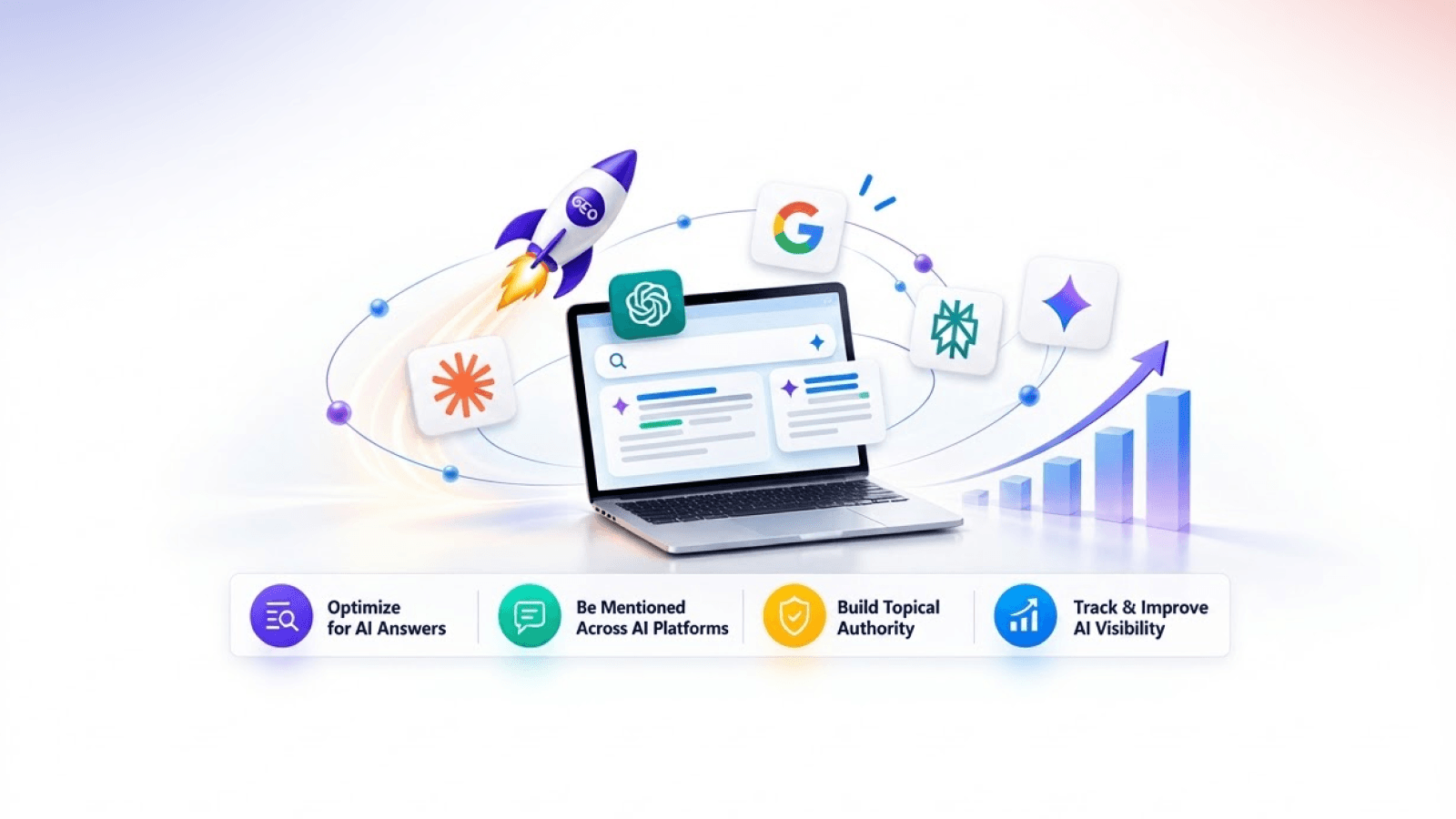
GEO for B2B Brands: How to Build Visibility Across AI Search Engines
GEO for B2B brands helps businesses improve visibility across ChatGPT, Perplexity, Gemini, and Google AI search. Build consistent brand positioning, answer buyer questions, publish credible evidence, strengthen third-party authority, and track AI mentions, citations, recommendations, and leads.
For years, B2B search visibility was largely a rankings problem.
Identify high-value keywords. Build authoritative pages. Earn backlinks. Move up the SERP. Capture the click.
That model still matters, but it is no longer the whole search journey.
A buyer researching a software platform, consulting partner, cybersecurity vendor, or enterprise service provider can now ask ChatGPT, Perplexity, Gemini, or Google AI Mode a highly specific question and receive a synthesized shortlist before visiting a single company website.
For B2B brands, this creates a new visibility requirement.
You do not only need pages that rank. You need a digital presence that AI systems can find, understand, validate, cite, compare, and potentially recommend.
That is where GEO for B2B becomes important.
What Is GEO for B2B?
Generative Engine Optimization for B2B is the practice of improving how a company and its expertise appear within AI-generated search experiences.
Instead of optimizing only for a position on a traditional search results page, B2B GEO focuses on whether platforms such as ChatGPT, Perplexity, Google AI Mode, and other AI search engines:
discover your content,
understand what your company does,
associate your brand with the right topics,
cite your pages as supporting sources,
describe your capabilities accurately, and
include you when buyers request comparisons or recommendations.
The distinction matters because an AI answer is not simply another SERP.
Generative systems can retrieve information from several sources, synthesize it, answer follow-up questions, and narrow options based on the buyer's circumstances. So, GEO should not be treated as an SEO replacement. It is another visibility layer built on top of a strong search foundation.
For a deeper breakdown of how the disciplines work together, see our guide to generative engine optimization.
Why GEO Matters More for B2B Than a Simple Traffic Shift Suggests
For consumer brands, an AI search might influence a quick purchase.
For B2B, the stakes are usually different.
The buying cycle is longer. The product is more complex. More stakeholders are involved. Risk matters. Integration matters. Implementation matters. And the buyer often needs evidence before making contact.
This means AI can influence several stages of the B2B decision process, and also changes what B2B brand visibility means.
Visibility is no longer limited to being present when the prospect clicks a search result. Increasingly, it also means being present while the AI system is helping that prospect build a shortlist.
That is why an effective AI search strategy has to consider the entire discovery and evaluation journey, not merely keyword rankings.
SEO Gets You Indexed. GEO Helps You Become Useful to the Answer.
One of the easiest mistakes is treating GEO as a collection of AI-specific technical hacks.
It is not.
Google has specifically said that there is no special AI markup required for AI Overviews or AI Mode. Core practices such as crawlability, indexability, helpful content, internal linking, structured data where appropriate, and strong page experience still apply.
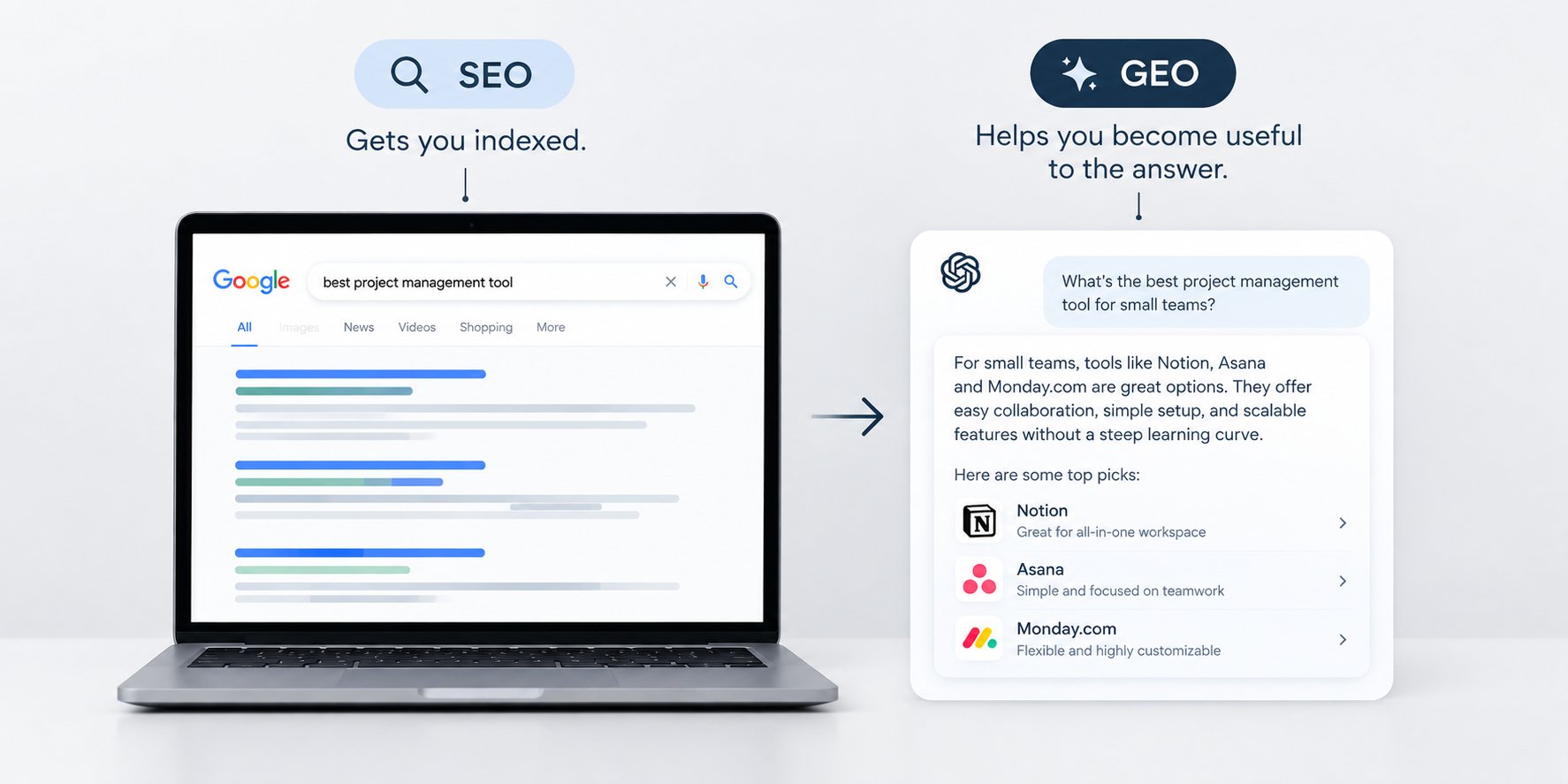
The GEO layer begins when brands ask a different set of questions.
Instead of only:
“Can Google understand and rank this page?”
also ask:
“Can an AI system extract a clear answer from it?”
“Can it connect our brand to this business problem?”
“Can it find evidence supporting our claims?”
“Would another source confirm the same positioning?”
This is the practical difference between SEO visibility and AI visibility.
The Core Components of a B2B GEO Strategy
A strong GEO strategy for B2B brands is less about manipulating generative engines and more about improving the information environment surrounding the company.
1. Make Your B2B Positioning Machine-Readable
Strong GEO begins with entity clarity.
Your homepage, service pages, author profiles, case studies, about page, third-party profiles, and external mentions should consistently communicate what category your brand belongs to and why it matters within that category.
If five sources describe your business five different ways, an AI system has more work to do to determine what you actually specialize in.
2. Build Content Around Buyer Questions, Not Just Keywords
Traditional keyword research remains useful, but B2B AI queries often contain far more context than conventional search phrases.
A strong AI search content strategy should cover the questions that emerge throughout evaluation:
Which solution is suitable for which situation?
What does implementation involve?
What does the service cost?
What are the risks?
What integrations are supported?
How long does deployment take?
What alternatives exist?
What should buyers compare?
What evidence demonstrates expertise?
What regulatory or technical constraints matter?
AI systems are useful precisely because they synthesize these kinds of complex questions.
Your content therefore needs to give them something substantive to synthesize.
3. Create Content That Is Easy to Extract
Being comprehensive does not mean being difficult to navigate.
AI systems, and human B2B buyers, both benefit from content where individual ideas are clearly expressed.
That generally means:
descriptive headings,
direct answers early in sections,
clear definitions,
comparison tables,
FAQs,
numbered processes,
concise summaries,
specific examples,
descriptive anchor text,
and logically separated topics.
A 2,500-word article containing useful information buried inside long narrative passages may be less practical than a well-structured article where each important question has an explicit answer.
This is where modern content optimization strategies move beyond keyword density.
The goal is not simply to insert phrases that machines recognize.
It is to reduce ambiguity.
4. Publish Evidence, Not Just Expertise Claims
B2B marketing is full of unsupported authority statements.
“Industry-leading.”
“Best-in-class.”
“Trusted experts.”
“Proven results.”
AI search does not magically transform those claims into evidence.
Brands seeking stronger B2B AI search visibility should create assets that establish their expertise more concretely. These include case studies with measurable outcomes, original research, benchmarks, technical documentation, implementation frameworks, named subject-matter experts, customer stories, methodologies, proprietary data, product specifications, and detailed use cases.
Specificity gives search engines, generative systems, journalists, analysts, and prospective buyers something they can actually reference.
That is one reason GEO is ultimately connected to brand authority.
5. Build Authority Beyond Your Own Domain
Your website is only one source describing your company.
AI systems may retrieve information from media articles, review sites, industry publications, directories, research papers, partner websites, customer discussions, analyst content, social platforms, and other sources.
Perplexity, for example, says its Pro Search conducts multiple searches and synthesizes information from a diverse collection of sources such as articles, academic material, forums, and videos while providing citations for users to inspect.
ChatGPT Search can similarly retrieve current web information and surface cited sources. OpenAI also states that search placement is not guaranteed and that results are ranked using multiple factors intended to surface relevant and reliable information.
For B2B marketers, the implication is significant.
Your GEO strategy cannot stop at publishing more blog posts.
If an AI system researches your market and finds extensive independent evidence for three competitors but almost nothing about your company outside your own domain, that creates an information imbalance.
PR, expert commentary, legitimate industry listings, review programs, analyst relationships, digital partnerships, original research, guest expertise, and relevant earned mentions therefore become part of the broader GEO ecosystem.
Not because every mention directly “boosts an AI ranking,” but because they create a more credible body of information around the brand.
6. Develop Topic Authority Across the Buying Journey
B2B companies frequently optimize one commercial page around one valuable phrase and expect it to establish category authority.
AI search makes that strategy increasingly fragile.
If your website discusses only the service you want to sell, there may be little evidence that your organization understands the wider decision environment.
A strong content strategy should therefore build interconnected topic clusters around the problems, decisions, questions, and terminology your audience uses.
The objective is topical depth rather than publishing volume.
7. Optimize Commercial Pages for AI Discovery Too
GEO is sometimes discussed as though it belongs exclusively to editorial content.
For B2B companies, that leaves too much valuable information inaccessible.
Service pages should clearly communicate:
Who the service is for.
Industry, company size, use case, region, or operational situation.
What problems it solves.
Specific business or technical challenges.
What is included.
Capabilities, processes, technologies, deliverables, integrations, and scope.
What makes the company credible.
Relevant experience, certifications, results, methodology, or customer evidence.
What implementation looks like.
Process, engagement model, timelines, prerequisites, and dependencies where appropriate.
An AI system answering a commercial question needs facts.
Generic conversion copy gives it far less to work with.
8. Keep Your Brand Information Consistent
GEO is partly a consistency problem.
For stronger AI search visibility, important information should remain consistent across authoritative touchpoints: company name, core services, industry specialization, locations, executive identities, product names, terminology, company descriptions, and differentiators.
This does not mean publishing identical wording everywhere.
It means maintaining semantic consistency.
How to Measure B2B GEO Performance
Traditional SEO gives marketers familiar metrics: rankings, impressions, clicks, organic traffic, backlinks, conversions.
Those metrics still matter. But GEO requires additional questions.
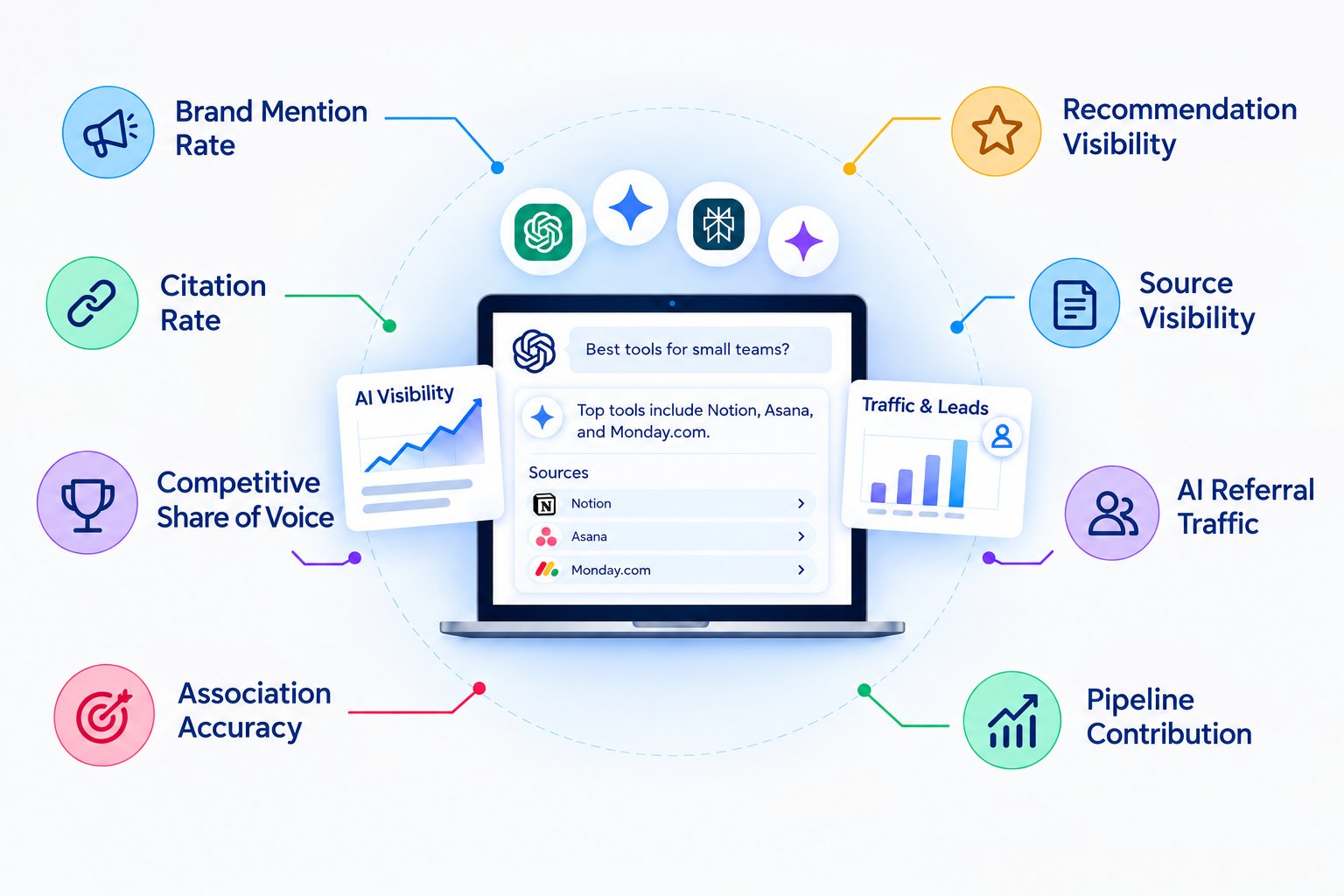
For example:
Brand mention rate: How often does your company appear for strategically important prompts?
Citation rate: How often is your website used as a supporting source?
Competitive share of voice: Which competitors appear more frequently than your brand?
Association accuracy: Does the AI describe your services and positioning correctly?
Recommendation visibility: Are you included when prospects ask for vendors, providers, tools, or alternatives?
Source visibility: Which third-party pages influence the answers?
AI referral traffic: Are ChatGPT, Perplexity, Gemini, and other AI platforms sending visitors?
Pipeline contribution: Are those visitors becoming qualified leads, opportunities, and revenue?
Measurement is improving too. In 2026, Google introduced dedicated Search Generative AI performance reporting in Search Console for visibility within generative Search experiences such as AI Overviews and AI Mode, with worldwide rollout completed by the end of August.
The larger point is that B2B teams need to measure presence inside the answer, not only traffic after the click.
A Practical GEO Framework for B2B Brands
A useful B2B GEO program can be organized into five layers:
Foundation: Technical SEO, crawlability, indexing, site architecture, schema, and performance.
Entity clarity: Consistent positioning, services, audiences, industries, people, and brand terminology.
Answer coverage: Content addressing discovery, consideration, comparison, implementation, and decision-stage questions.
Authority: First-party expertise combined with credible independent references and mentions.
Measurement: AI mentions, citations, recommendation share, referral traffic, positioning accuracy, and business outcomes.
This also explains why AI search optimization cannot be handed entirely to either the SEO team or the content team.
The strongest programs connect brand, search, content, PR, subject-matter expertise, and analytics.
GEO Is Not About Writing for Robots
There is a temptation to respond to every change in search by creating a new checklist.
✓ Use shorter paragraphs.
✓ Add FAQs.
✓ Mention entities.
✓ Add schema.
✓ Publish comparison pages.
Those tactics can be useful, but GEO becomes ineffective when the checklist becomes the strategy.
Google's own recommendation remains remarkably straightforward: create unique, useful, non-commodity content that satisfies real users.
The B2B brands that perform well in generative search are therefore unlikely to be the ones producing the most mechanically “AI-optimized” copy.
They will be the brands providing the clearest expertise, strongest evidence, most useful answers, and most consistent market positioning.
GEO makes those qualities easier for machines to discover.
It does not manufacture them.
From Ranking for Keywords to Being Considered for Decisions
The biggest change created by AI search engines is not that Google suddenly matters less.
It is that more of the buying decision can now happen before the website visit.
AI can help a B2B prospect define the problem, understand the category, compare approaches, identify suppliers, evaluate trade-offs, and build an initial shortlist.
That gives brands a different optimization goal.
Traditional SEO asks:
“Can we rank for this search?”
GEO for B2B asks:
“When an AI system helps a buyer make this decision, does our brand deserve to be part of the answer?”
Building that visibility requires more than adding another acronym to the marketing stack.
It requires a digital presence that is technically discoverable, semantically clear, genuinely useful, externally validated, and consistently authoritative.
For B2B brands, that is what the next generation of organic visibility looks like.
Loading FAQs
Please wait while we fetch the questions...
Published on October 16, 2026 by Surbhi Sood