Responsive Web Design: The Strategic Foundation for SEO, Rankings, and Search Visibility
Learn how responsive web design drives SEO success by improving user experience, strengthening Core Web Vitals, and supporting mobile-first indexing. A performance-driven responsive strategy helps websites rank higher, engage users longer, and scale sustainable organic growth.
Responsive web design plays a critical role in modern SEO by improving page speed, usability, and mobile performance-three pillars of search visibility today. Mobile users are decisively impatient. Industry research consistently shows that over 50% of users abandon pages that take longer than three seconds to load-particularly on mobile devices.
While this statistic originates from earlier Google studies, its relevance has only been intensified as mobile usage continues to grow. Responsive web design helps address this challenge by:
Using fluid layouts that adapt without duplication
Eliminating unnecessary scripts and elements
Serving optimized assets based on screen size and device capabilities
At Make My Brand, responsive design is more than layout—it’s a strategic SEO lever designed to strengthen organic visibility. We combine technical precision with creative execution to build websites that load faster, rank higher, and convert better.
This blog breaks down how responsive web design impacts SEO, highlighting the key technical and user-focused factors that drive lasting digital growth.
Why Responsive Web Design Directly Influences Search Visibility and Rankings?
Responsive web design plays a critical role in how search engines evaluate quality, relevance, and usability. It impacts multiple ranking signals simultaneously, making it one of the most efficient levers for improving organic performance, especially when aligned with comprehensive user experience services.
Key SEO Advantages of Responsive Web Design
The Reality of Mobile-First Indexing
The evolution of search has been dictated by user behavior. Understanding this shift is vital for maintaining market relevance:
Dominant Traffic: According to Statista, in the second quarter of 2025, mobile devices (excluding tablets) accounted for approximately 62.54% of global website traffic.
Google’s Priority: Google has officially completed its transition to mobile-first indexing. This means the search engine predominantly uses the mobile version of a site’s content for indexing and ranking.
When a site utilizes responsive web design, it serves the same HTML code on the same URL regardless of the device. From a technical SEO perspective, this directly supports key website ranking factors such as crawl efficiency, link equity consolidation, and index consistency.
Enhancing Core Web Vitals
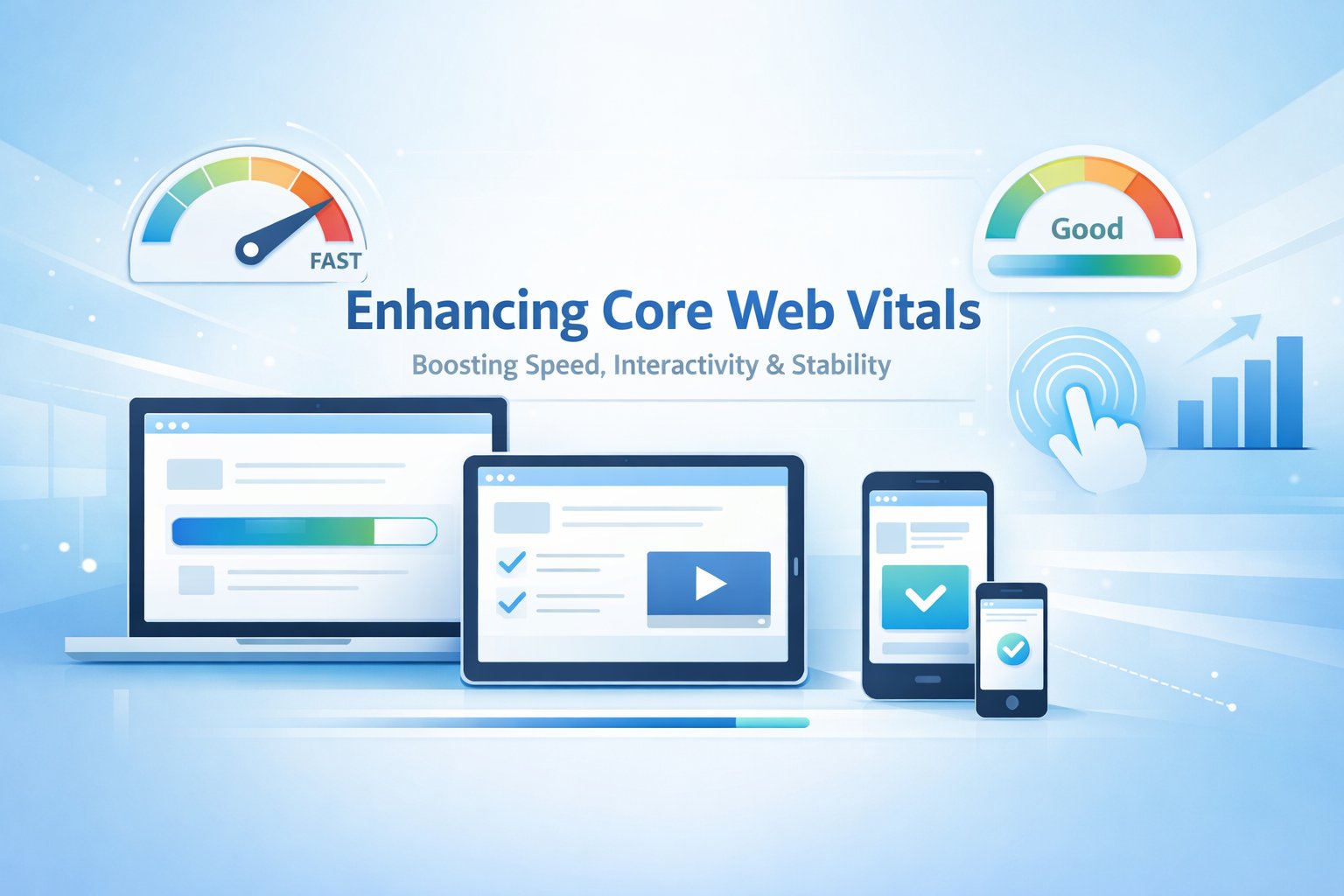
Core Web Vitals are foundational to SEO-friendly design because they measure how efficiently users experience content across devices. Introduced by Google in 2021 as a core ranking signal, these metrics- loading speed, interactivity, and visual stability- are directly shaped by a website’s architectural and performance decisions.
Make My Brand ensures that elements scale proportionally, maintaining visual stability and speed - both of which are now critical website ranking factors.
User Behavior: Dwell Time vs. Bounce Rate
Search engines interpret user behavior as a direct signal of content quality. If a visitor exits immediately because a site is difficult to navigate, the "bounce rate" spikes, signaling to Google that the page lacks value.
Why Responsiveness Matters for Retention:
Readability: No more "pinch-to-zoom" to read text.
Navigation: Intuitive menus designed for touchscreens.
Frictionless UX: Higher engagement leads to increased "dwell time," a testament to the site’s authority.
Responsive web design improves behavioral website ranking factors by increasing dwell time and reducing friction across mobile and desktop experiences.
Consolidating Authority & Eliminating Duplication
Historically, businesses managed two versions of their site: desktop and mobile. This often led to "duplicate content" penalties. Adopting an SEO-friendly design through responsiveness solves this at the root.
Feature | Legacy Separate Mobile Site | Responsive Web Design |
URL Structure | Multiple (Two URLs) | Single (One URL) |
SEO Authority | Diluted between versions | Consolidated |
Maintenance | High (Double the work) | Efficient (Single update) |
User Experience | Inconsistent | Seamless |
Why This Matters for Website Ranking Factors?
Mobile usability and site performance are no longer peripheral considerations - they are fundamental website ranking factors. Google explicitly prioritizes mobile content for indexing and ranking, and industry research consistently shows that websites failing to meet mobile experience standards underperform in organic search.
In simple terms, a website that struggles on mobile - struggles in search.
Responsive web design has moved from being a technical best practice to becoming a strategic requirement for on-page SEO, visibility, and scalable digital growth.
The Mechanics: What Responsive Design Changes that Search Engines Care About
Responsive web design directly impacts how search engines crawl, interpret, and rank content through the following mechanisms:
Unified crawl path
One URL per resource simplifies crawling and ensures the content Google indexes is the same content users get.
Optimized assets
Responsive images (srcset, modern formats), adaptive loading, and critical CSS reduce LCP and improve perceived performance.
Stable layout
Avoiding unexpected shifts prevents poor CLS (Cumulative Layout Shift) scores. Design patterns that reserve space for images, ads, and embeds help here.
Touch-friendly UI
Readable type, tap targets, and intuitive navigation reduce friction and increase dwell time - behavioral signals engines observe indirectly.
Real-World Impact: The Dublin Technology Center Case Study
To understand how responsive architecture translates into measurable growth, consider our work with the Dublin Technology Center. They faced a common challenge: a digital presence that lacked the scalability and responsiveness required to compete in the high-stakes real estate and flexible workspace market.
By deploying our "Growth-as-a-Service" framework, Make My Brand transformed its static presence into a high-converting ecosystem. The results speak to the power of technical excellence:
Zero to 11K+: Organic active users scaled from zero to over 11,000 in less than six months.
Unmatched Performance: We achieved a modular CMS with an average load speed of under 2 seconds.
Engagement Surge: Captured over 62,000 user interactions, proving that when a site responds perfectly to a user's device, engagement follows.
You can explore the full technical breakdown of this transformation at Make My Brand.
Designing for Voice Search and Emerging Devices
Search is no longer limited to screens. Voice assistants and wearable devices are changing how users access information - and websites must be built to respond instantly, clearly, and efficiently.
Voice search queries are typically conversational, intent-focused, and mobile-led. Search engines prioritize pages that load fast, present structured information, and deliver direct answers. A responsive foundation supports this by enabling:
Faster content retrieval across mobile networks
Clear hierarchy for featured snippets and voice responses
Consistent accessibility across devices and interfaces
Wearables introduce even higher expectations. Limited screen space and short interaction windows demand simplicity, speed, and precision. Responsive architectures allow content to adapt without compromise - delivering only what’s essential while maintaining performance.
At Make My Brand, responsive design is approached as an adaptability framework, not a layout decision. This ensures websites remain discoverable as search expands into new formats and devices.
Common Pitfalls to Avoid in Responsive Design
Even well-intentioned responsive builds can fail to deliver SEO friendly design if these common issues are overlooked.
Treating Responsiveness as Just Layout
The mistake: Only adjusting grids and breakpoints without optimizing assets.
The impact: Large images and heavy scripts still load on mobile, slowing pages and hurting Core Web Vitals.
The fix: Implement adaptive loading with srcset, sizes, and next-gen formats like WebP/AVIF.
Duplicate Mobile and Desktop URLs
The mistake: Maintaining separate URLs (m.example.com vs www.example.com) for different devices.
The impact: Link equity gets fragmented, social shares are inconsistent, and SEO signals are split.
The fix: Use a single responsive URL for all devices.
Ignoring Touch and Interaction Design
The mistake: Shrinking desktop elements to fit mobile screens.
The impact: Buttons, menus, and forms become hard to use, increasing bounce rates.
The fix: Design for touch-first interactions, ensuring tap targets and navigation are mobile-friendly.
Overlooking Page Speed Optimizations
The mistake: Focusing solely on responsive visuals without optimizing scripts, fonts, or caching.
The impact: Slow load times, poor Core Web Vitals, and lost traffic.
The fix: Minify assets, defer non-critical scripts, and use lazy loading for images and videos.
Neglecting SEO Fundamentals
The mistake: Assuming a responsive site automatically improves SEO.
The impact: Missing headings, alt text, structured data, or crawlable content can limit search visibility.
The fix: Integrate SEO-first development from the start - semantic HTML, schema, proper heading hierarchy, and image optimization.
Conclusion: Responsive Design Is a Search Visibility Strategy
Responsive web design has evolved from a technical best practice into a core determinant of search visibility. It directly influences how search engines crawl, index, and rank websites - while simultaneously shaping the user behaviors that algorithms increasingly rely on as quality signals. Websites that fail to perform seamlessly across devices don’t just frustrate users - they lose visibility, authority, and growth momentum in organic search.
At Make My Brand, responsive design is treated as an SEO-first system, not just a visual layer. Every build focuses on:
Performance Optimization
Unified URLs for consolidated link equity
Clean, crawlable architecture
The result isn’t just a better design - it’s measurable visibility, stronger engagement, and scalable growth.
Don’t let a poor mobile experience hold your growth back. Get in touch with Make My Brand to optimize your website for speed, usability, and search visibility, backed by ROI-driven marketing strategies that convert performance into results.
Loading FAQs
Please wait while we fetch the questions...
Published on January 28, 2026 by Abhishek Vasudev