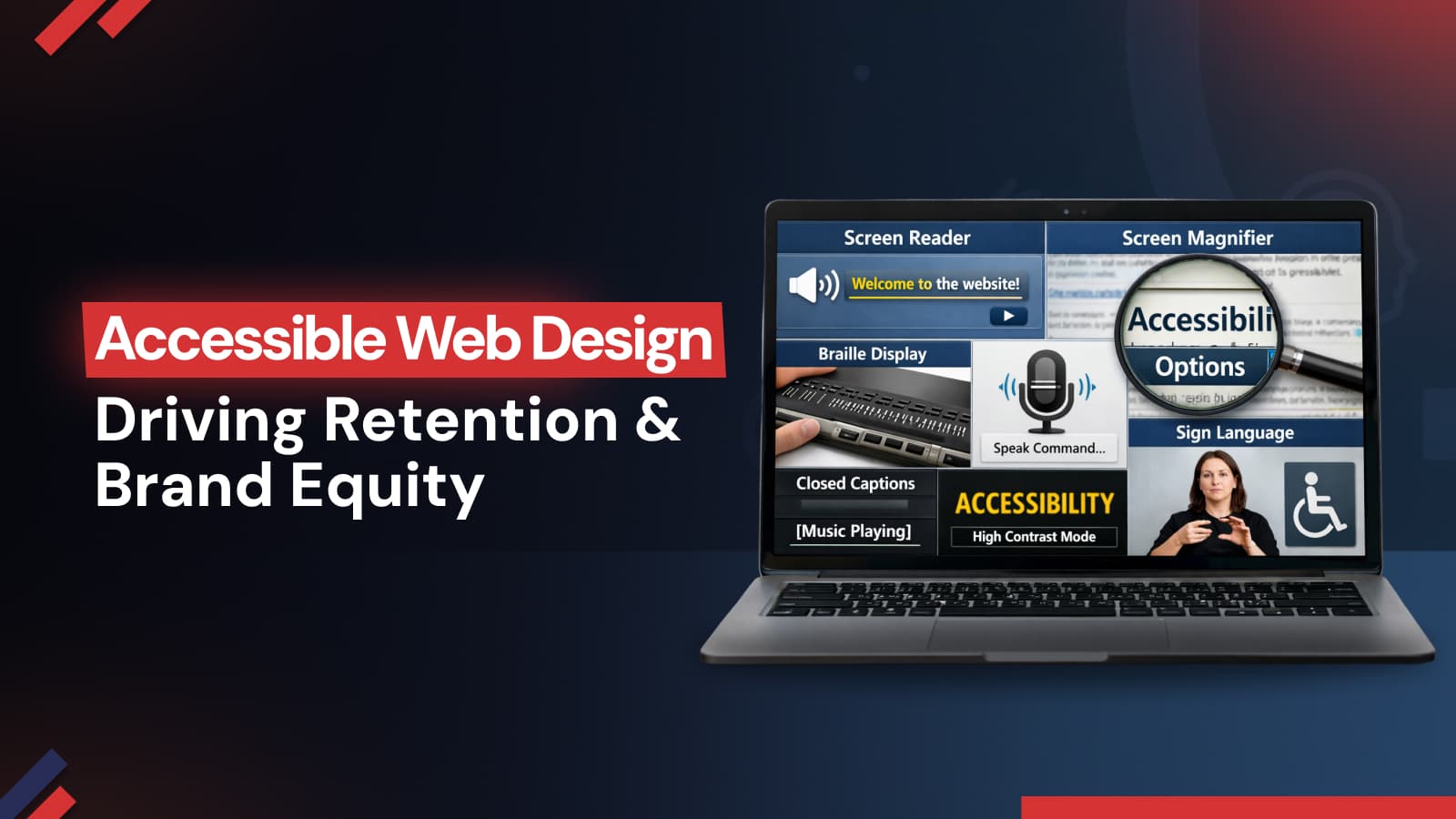
Accessible Web Design as a Strategic Driver of Retention and Brand Equity
Accessible web design is no longer optional—it’s a strategic driver of retention, search visibility, and brand trust. By reducing usability friction and enabling inclusive digital experiences, businesses can expand reach, improve engagement, and strengthen long-term brand equity.
In a digital economy shaped by AI search, rising competition, and shrinking attention spans, accessibility is no longer a technical afterthought. It is infrastructure. An accessible web design is a measurable driver of retention, conversion, and brand equity.
According to the World Health Organization, over 1.3 billion people globally live with some form of disability — nearly 16% of the world’s population. Excluding this segment is not a niche oversight - it is a strategic blind spot. By making a website usable for these users – and by extension for older or temporarily impaired visitors – companies open the door to a huge market segment.
At Make My Brand, accessibility is treated as a strategic growth discipline. In a competitive, AI-first digital economy, accessible web design improves usability for all users while strengthening brand credibility and search performance.
Accessibility is not about accommodation. It is about competitive positioning.
In this blog, we reinforce how accessible digital ecosystems reduce friction, strengthen loyalty, and future-proof brands against evolving search and regulatory standards.
Usability Friction, and the Economics of Retention
User retention is shaped within seconds of interaction. Research cited by Forbes confirms that 88% of users are unlikely to return after a poor website experience. Usability friction remains one of the primary drivers of bounce and abandonment.
Accessibility gaps are usability failures:
Low contrast text
Non-responsive layouts
Confusing navigation
Missing alt attributes
Inaccessible forms
Every barrier increases cognitive load. Every friction point reduces trust.
Retention is not about persuasion of tactics or remarketing budgets. It is about eliminating friction before it costs you the user.
Inaccessible features – like a menu that can’t be navigated by keyboard or a form without clear labels – lead to immediate frustration. In practice, these issues translate into higher bounce rates.
An accessible web design reduces bounce and boosts engagement. Implementing accessibility improvements such as keyboard navigation and readable content “can reduce bounce rates and improve usability,” often resulting in higher conversion rates.
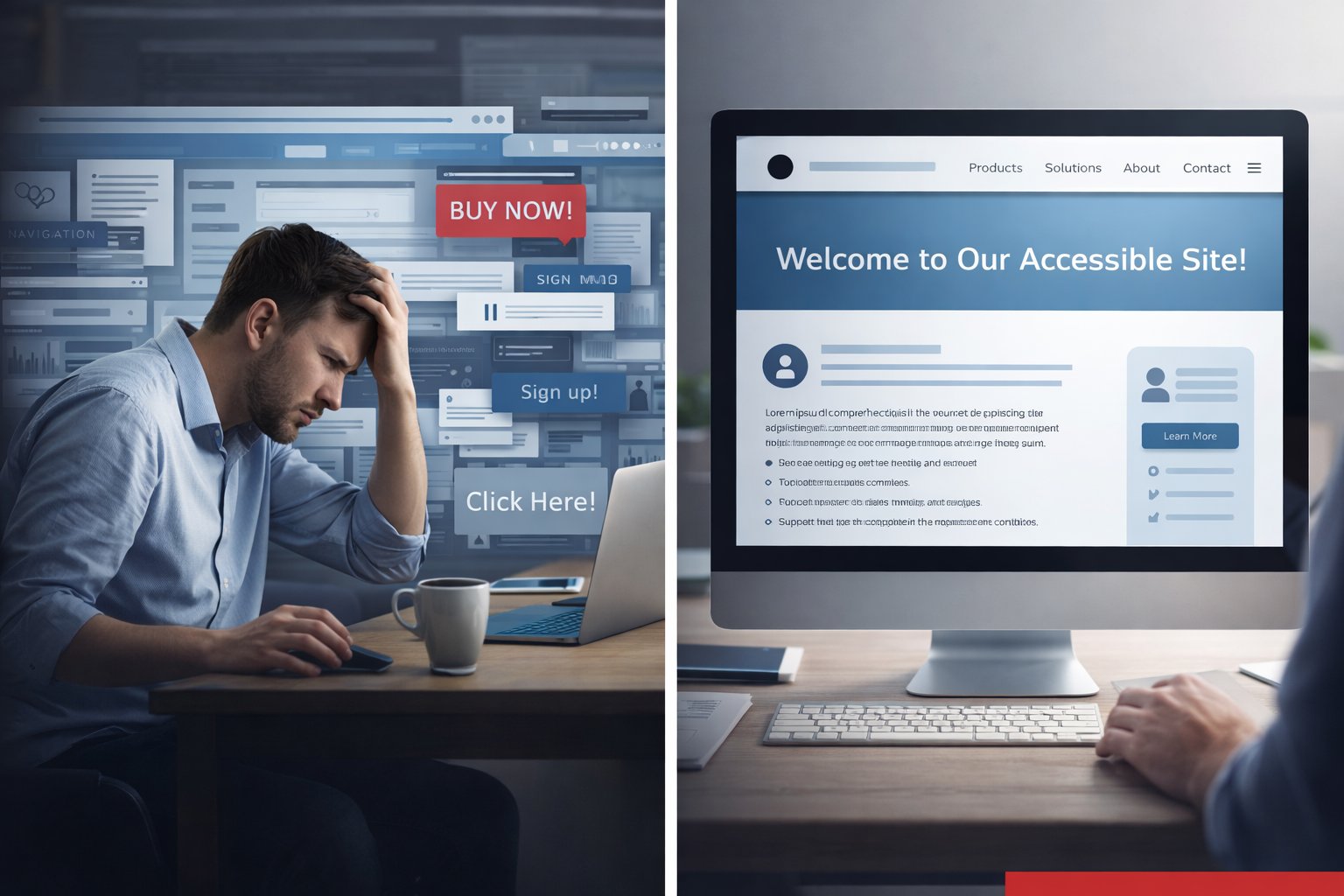
In short, when users can effortlessly interact with the page (for example, understanding form instructions or navigating menus), they are far more likely to stay, explore, and complete desired actions like signing up or making a purchase.
The bottom line: better usability keeps users on your site.
When visitors immediately find relevant information or a clear path to purchase, they are more likely to convert. Conversely, if a disabled or even an able-bodied user encounters a barrier, they simply leave and rarely come back. This dynamic has a real financial impact.
Accessible web design essentially paves a smooth path to action: visitors linger longer, view more pages, and develop trust in the brand, all of which build long-term loyalty.
Accessibility as Strategic Compliance
Web accessibility guidelines like WCAG exist for good reason. Industry audit indicates that 95.9% of top homepages have detectable accessibility violations.
The risks of ignoring accessibility include:
Legal exposure (over 2,000 web accessibility lawsuits filed in 2023)
Brand reputation damage
Lost revenue from excluded users
But forward-thinking organizations treat accessibility not as legal defense - but as strategic investment. Brands that prioritize accessibility early often report strong ROI through:
Increased traffic
Higher retention
Stronger brand differentiation
Improved SEO visibility
Accessibility done early acts as long-term “risk insurance” for digital assets.
Building Brand Trust and Loyalty
In today’s digital market, trust is not built through messaging alone - it is engineered through experience. A website that works seamlessly for everyone signals operational maturity, long-term vision, and customer-first thinking.
When accessibility is embedded into the digital foundation, it reflects foresight rather than reaction. It shows that a brand anticipates diverse user needs, invests in experience quality, and prioritizes frictionless engagement. That level of intentionality strengthens credibility - and credibility drives retention.
Importantly, accessibility should not be viewed merely as a corporate social responsibility initiative. At scale, it becomes a positioning strategy. Enterprise brands understand that inclusive digital ecosystems reduce risk, expand market reach, and reinforce brand authority across stakeholder groups.
Consider how Starbucks introduced its Inclusive Spaces Framework to make physical and digital environments more accessible. While the initiative reflects social commitment, it also demonstrates operational leadership. By integrating accessible ordering systems, optimized acoustics, and adaptive design standards, Starbucks elevated the customer experience while reinforcing its brand as progressive and future-ready.

The same principle applies in digital environments. When organizations invest in accessibility at the infrastructure level - rather than as a retroactive adjustment - they signal strategic discipline. The result is not just compliance, but differentiation.
Accessible digital experiences build confidence. Confidence builds loyalty. And loyalty, ultimately, builds enterprise value.
Performance in Practice: The Make My Brand Approach
At Make My Brand, accessibility is embedded into digital strategy from the outset.
In the Dublin Tech Center transformation, accessibility compliance and user-centric architecture were integrated into the redesign process. The outcome was measurable:
A measurable reduction in bounce rate
Organic traffic growth within six months
Over 600 qualified leads generated
This was not achieved through aggressive ad spend. It was achieved by improving usability, clarity, and performance.
Similarly, in the Knowledger project, Make My Brand developed a cohesive brand and digital ecosystem that communicated innovation while ensuring intuitive navigation for diverse learners. Accessibility became a trust signal — and trust translated into adoption and growth.
These outcomes reinforce a simple principle: retention improves when digital friction decreases.
Inclusive UX as a Long-Term Growth Strategy
Inclusive UX ensures that every user, regardless of ability or context, can engage without friction - increasing lifetime value. An inclusive UX framework strengthens:
Engagement depth
Conversion reliability
Brand perception
Repeat visits
It also prepares organizations for evolving digital behaviors - voice search, AI assistants, aging user demographics, and cross-device interaction. Accessible web design supports inclusive UX across evolving digital environments.
That simplicity increases completion rates and reduces abandonment.
Accessibility in the Era of AI-Driven Discovery
AI search engines evaluate structure, clarity, and contextual signals. Websites built with accessible frameworks provide stronger semantic signals and cleaner content hierarchies.
In an environment where AI summarizes and surfaces answers directly, poorly structured content risks invisibility. Accessible architecture enhances eligibility for AI-generated responses and featured search placements.
Accessibility is no longer peripheral to search strategy. It is central to it.
Conclusion: Accessibility Is a Strategic Growth Decision
Accessibility is no longer a peripheral consideration in digital strategy. It is a defining factor in how users experience, evaluate, and return to a brand.
When accessibility is embedded into digital infrastructure, it reduces friction, strengthens search performance, improves engagement metrics, and reinforces brand trust. It protects against regulatory exposure while simultaneously expanding market reach. Few strategic initiatives deliver both risk mitigation and measurable growth -accessible web design does. Brands that invest in accessibility today position themselves ahead of regulatory pressure, algorithmic change, and shifting consumer expectations.
At Make My Brand, accessibility is treated as a performance driver. By integrating structured UX systems, compliance standards, and scalable design frameworks, Make My Brand builds digital ecosystems that are resilient, discoverable, and engineered for long-term retention.
Ready to turn accessibility into a measurable growth advantage? Let Make My Brand align accessibility with performance.
Loading FAQs
Please wait while we fetch the questions...
Published on March 6, 2026 by Khushpreet Kaur