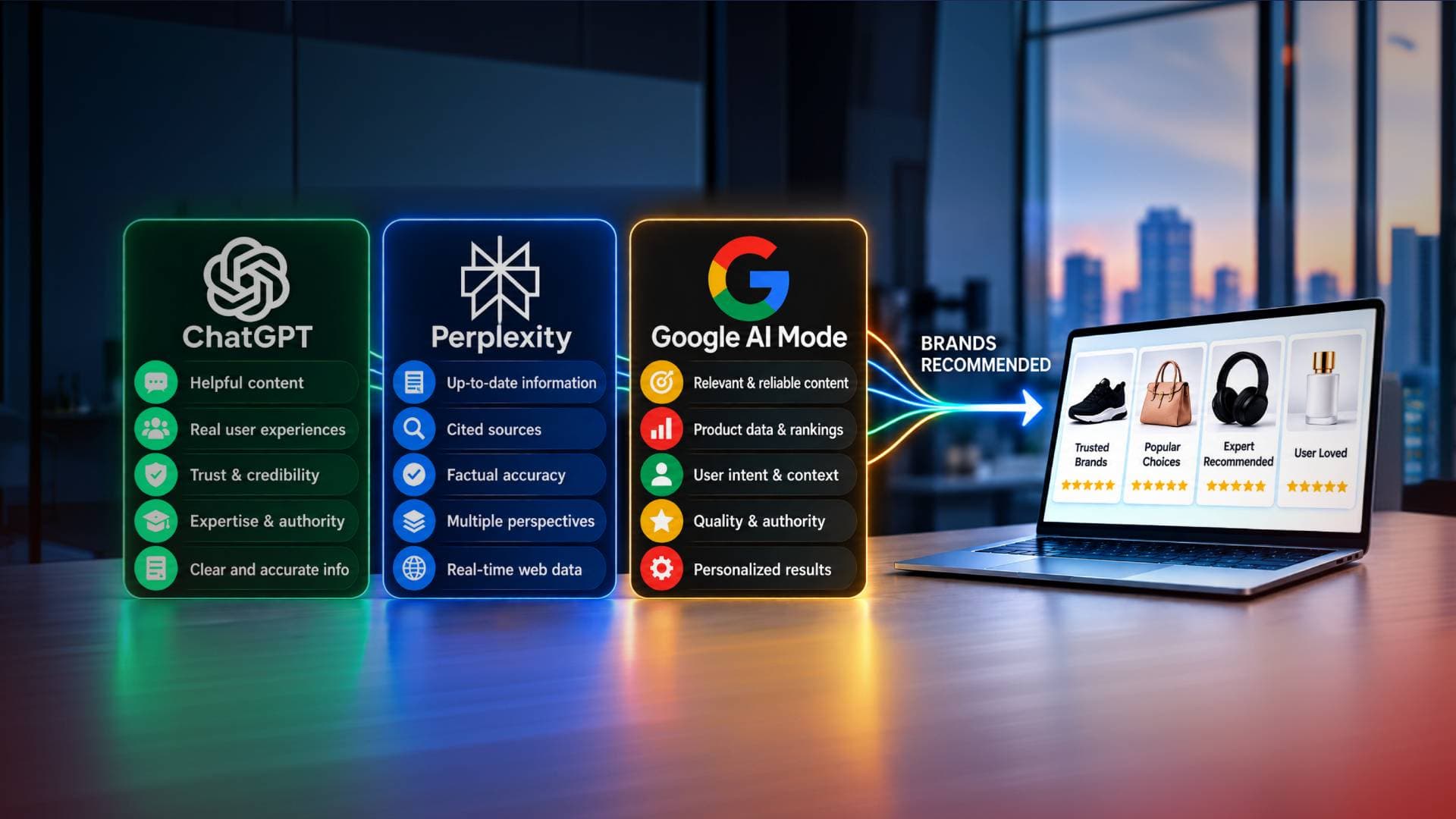
How ChatGPT, Perplexity & Google AI Mode Are Choosing Which Brands to Recommend
Discover how ChatGPT, Perplexity, and Google AI Mode choose which brands to recommend. Learn how clear positioning, credible content, third-party validation, accurate data, and AI search optimization can improve your brand's chances of being included in AI-generated recommendations.
Ranking first on Google used to be one of the clearest signs of digital visibility.
Now a customer can ask:
“Which CRM is best for a 50-person B2B company?”
“What are the most reliable skincare brands for sensitive skin?”
“Which software development companies specialize in healthcare AI?”
And instead of reviewing ten blue links, they may receive a shortlist directly from ChatGPT, Perplexity, or Google AI Mode.
That changes the visibility equation.
Brands are no longer competing only to appear in search results. They are competing to become part of an AI-generated consideration set.
But there is an important distinction marketers need to understand: there is no single published AI brand recommendation algorithm. ChatGPT, Perplexity, and Google AI Mode use different retrieval systems, models, indexes, data sources, and ranking processes. Recommendations can also change depending on the exact prompt, location, available sources, product data, and conversation context.
What is becoming clearer, however, is what makes a brand easier for these systems to retrieve, verify, compare, and include.
And that is where AI search visibility starts becoming a serious brand-growth issue.
AI Recommendations Are Not Just Another Version of Google Rankings
Traditional SEO conditioned marketers to think in positions.
Position 1. Position 3. Page 1.
AI does not necessarily operate that way.
Ask an AI system for “the best accounting platforms for startups,” and it may research several related questions behind the scenes:
Which platforms serve startups?
Which offer the relevant features?
What do credible reviewers say?
How do pricing and integrations compare?
Which options fit the constraints in the user's request?
Google explicitly calls this query fan-out. AI Mode can break a complex question into several related searches, retrieve information across them, and combine the results into one answer. Google also says its generative search features use its existing Search ranking and quality systems to retrieve relevant, current pages.
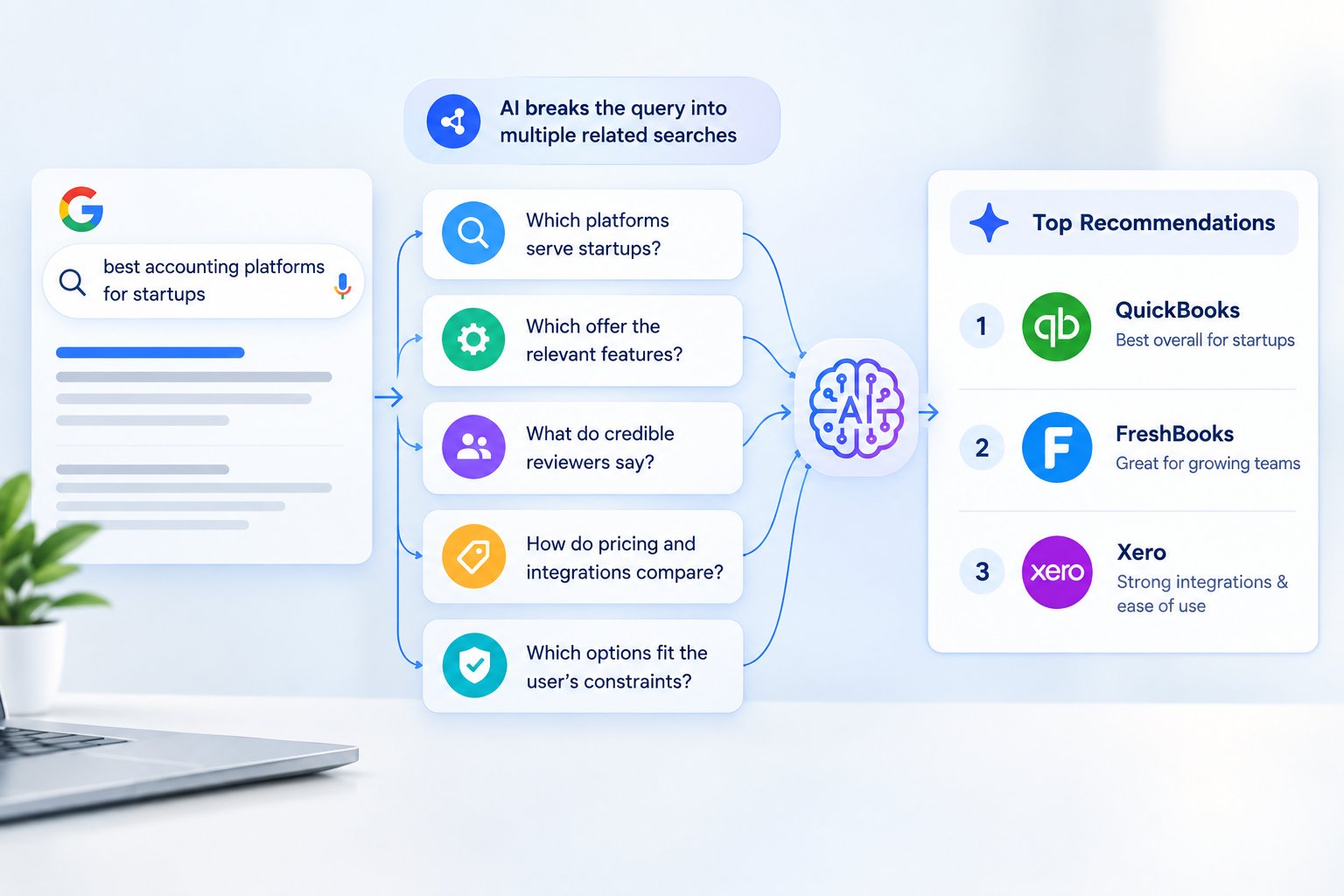
That means the brand being recommended may not simply be the website ranking highest for the original phrase. It may be the brand that appears consistently across the sources and subtopics required to answer the user's actual question.
That difference matters.
So, What Makes a Brand Recommendable to AI?
While the exact algorithms are proprietary, there is enough public information from the platforms themselves to identify several recurring signals.
1. Relevance to the User's Exact Context
The first filter is not brand popularity. It is fit.
If someone asks for “an enterprise CRM,” the recommendation set may look different from a query asking for “a simple CRM for a five-person startup.”
AI search can process considerably more context than a conventional short-form keyword query. ChatGPT can carry context through a conversation; Perplexity supports follow-up research; Google AI Mode can break complex prompts into multiple subtopics.
This makes positioning unusually important.
A website that simply says:
“We deliver innovative digital solutions for businesses.”
gives an AI system very little usable information.
Compare that with:
“We build HIPAA-aware custom healthcare software for U.S. providers, health-tech startups, and enterprise care networks.”
The second statement provides entities, audience, category, geography, and use case.
The clearer your brand is about what it does, who it serves, and where it is relevant, the easier it becomes to match the brand to a specific recommendation query.
This is also why Brand Visibility needs to be treated as more than reach or traffic. A visible brand that cannot be clearly categorized may still disappear when AI begins narrowing options. That also explains why brands fail to grow.
2. Evidence Beyond Your Own Website
Your website can tell AI that your company is excellent.
That does not automatically make it convincing.
Recommendation-oriented queries usually require some form of comparison or validation. AI systems therefore have reasons to pull information from multiple sources rather than simply repeat a company's own claims.
Perplexity says its Pro Search synthesizes information from a diverse set of high-quality sources and exposes citations, so users can verify the evidence. ChatGPT Search similarly retrieves current web information and provides source links, while OpenAI says its shopping research is designed to read reliable sources and avoid low-quality or spammy sites.
For brands, that makes third-party corroboration increasingly valuable.
Industry publications, expert reviews, directories, customer reviews, analyst coverage, credible comparison articles, partnerships, awards and relevant editorial mentions can all help create a broader evidence footprint.
This does not mean buying hundreds of generic mentions.
Google specifically warns against pursuing inauthentic mentions for generative search. Its systems still rely on quality and anti-spam mechanisms.
The objective is not mention volume. It is credible corroboration.
3. Content That Actually Answers Recommendation Questions
Most brand websites are written primarily to sell. AI systems frequently need them to explain.
Suppose someone asks:
“Which payroll software is suitable for a 200-person distributed company with contractors in multiple countries?”
The AI needs much more than a product page saying “simplify global payroll.”
It may need pricing logic, company-size suitability, country support, integrations, limitations, security information, comparisons, implementation requirements, and customer evidence.
That creates a content gap for many businesses.
Their product may genuinely fit the query, but their digital footprint does not contain enough explicit information for an AI system to establish that fit.
This is where a deliberate AI search content strategy becomes important. Brands need content covering the questions customers ask while evaluating options, not simply the keywords used when they first discover a category.
Useful formats include comparison pages, detailed FAQs, buying guides, implementation documentation, original research, customer cases, technical explainers, alternative pages and category-specific use cases.
The goal is not to manufacture content for robots. It is to make the evidence customers need to make a decision explicit enough that machines can retrieve it too.
How ChatGPT Brand Recommendations Work
For general brand recommendations, OpenAI does not publish a simple checklist that determines which companies ChatGPT names.
What is publicly documented is the underlying search behavior.
ChatGPT can decide when current web information is needed, retrieve information from the web, synthesize it and cite relevant sources. OpenAI says ChatGPT Search uses third-party search providers alongside content from publishing partners.
Product discovery is more transparent.
OpenAI states that ChatGPT's product results are organic and ranked based on relevance to the user. When multiple merchants sell the same item, factors can include availability, price, quality, whether the merchant is the primary seller, and other user-experience considerations.
Shopping Research can additionally incorporate constraints such as budget, features and user preferences before researching products across the web.
For marketers, the lesson is bigger than e-commerce:
ChatGPT brand recommendations are becoming increasingly contextual rather than merely categorical.
Being known as a “project management platform” is useful.
Being clearly established as a project management platform suited to remote creative agencies with client collaboration requirements is much more useful when that is exactly what someone asks for.
How Perplexity Chooses Sources and Recommendations
Perplexity operates much closer to an answer engine than a conventional search-results page.
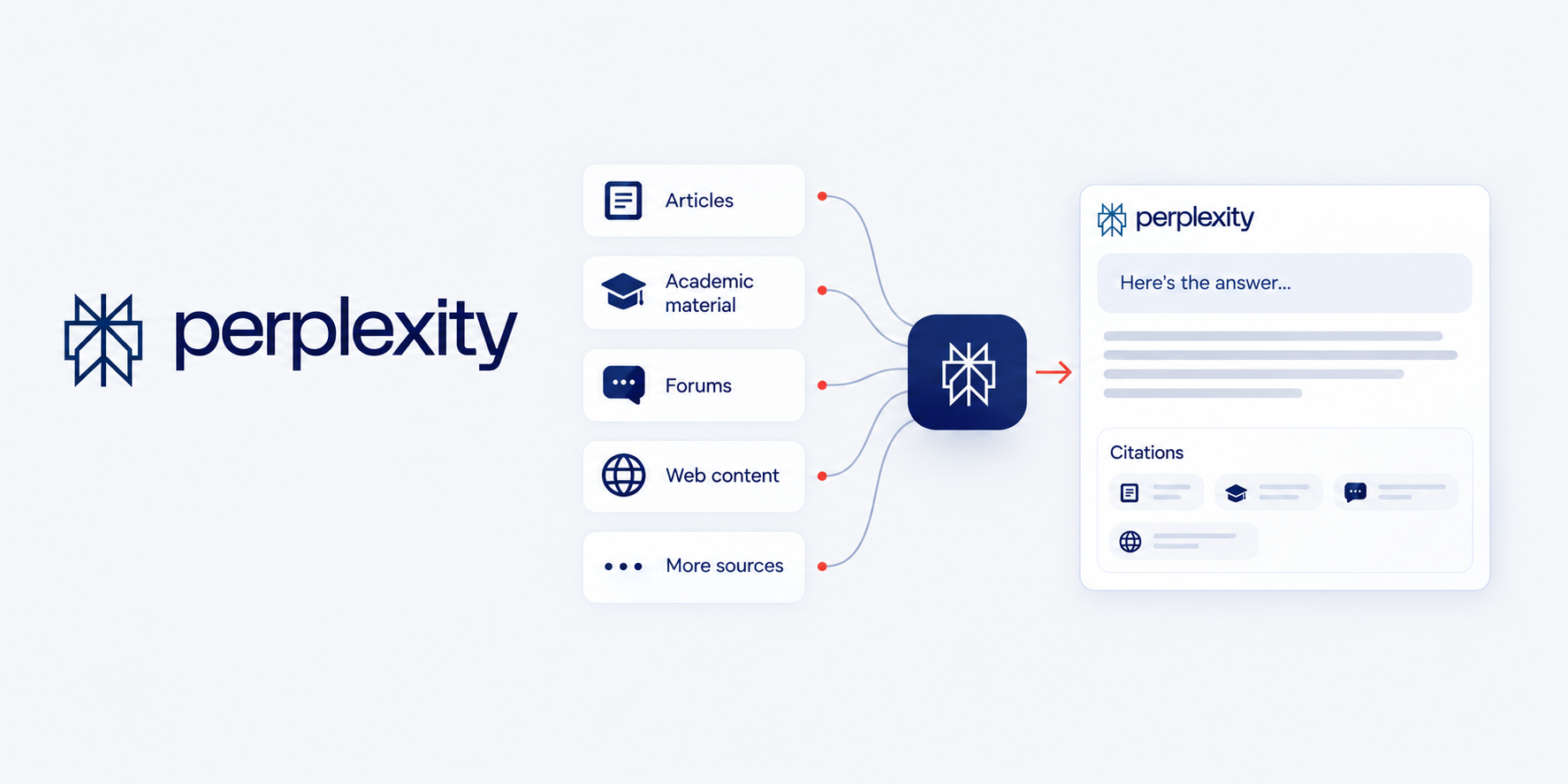
Its Pro Search conducts multiple searches, examines sources including articles, academic material, forums and other web content, and then synthesizes the findings into an answer with citations. Perplexity describes the process as relying on a diverse, high-quality source set.
For product recommendations specifically, Perplexity says listings are ranked using criteria such as authority and relevance to the user's query.
That makes source credibility particularly important.
If a brand appears only on its own site but competitors appear across respected industry sources, comparisons, discussions and reviews, the AI has a different evidence environment to work with.
This is one reason Generative Engine Optimization needs to go beyond on-page optimization. GEO increasingly involves improving the wider information environment from which generative systems construct answers.
How Google AI Mode Chooses What to Surface
Google's system is different because AI Mode sits directly on top of Google's existing search infrastructure.
Google says AI Mode can use Google Search ranking and quality systems, its web index, query fan-out, the Knowledge Graph, real-world information, and (for commercial searches) the Shopping Graph.
For shopping, the Shopping Graph contains tens of billions of listings and incorporates information including reviews, prices, availability, retailers and product attributes.
Importantly, Google has also clarified something marketers should not overlook:
You do not need a mysterious new technical trick to appear in AI Mode.
For a page to be eligible as a supporting link, it still needs to satisfy the fundamentals of Google Search: crawlability, indexation, technical accessibility, useful content and general SEO best practices. Google explicitly says there is no special AI schema or required AI-only markup for visibility in AI Overviews or AI Mode.
So, AI search optimization does not replace SEO. It expands the job SEO has to do.
AI Search Ranking Is Really a Retrieval Problem
The term AI search ranking can be misleading because it makes marketers imagine another SERP with ten permanent positions.
That is not how recommendation visibility should be treated.
A brand might be mentioned for:
“best CRM for agencies”
but not:
“best CRM for regulated financial companies.”
It may appear when cost is the deciding factor and disappear when integration capability becomes the priority.
It may be cited as a source without being recommended as a vendor.
It may appear in ChatGPT but not Perplexity because the platforms retrieved different evidence.
AI visibility is therefore query-, context-, source- and platform-dependent.
Brands should stop asking only:
“Where do we rank?”
They should also ask:
“For which customer questions are we considered a credible answer?”
That is a much more useful way to think about modern AI search visibility.
What Brands Should Optimize for Now
There is no credible “get recommended by ChatGPT in seven steps” shortcut.
The stronger approach is to build what we might call recommendation readiness.
That means making your brand easy to understand, retrieve and substantiate across the web.
Start with clear positioning. Your category, audience, services, differentiators and use cases should not require interpretation.
Then strengthen the evidence. Publish case studies with measurable outcomes, expert-led content, real comparisons, methodologies and original data where possible.
Build external authority as well. Earn coverage, reviews, citations and meaningful industry mentions instead of manufacturing low-quality links or mentions.
Keep commercial information accurate. Pricing, availability, locations, product specifications, company information and service capabilities should remain current wherever customers and AI systems may encounter them.
Finally, measure visibility by prompts as well as keywords. Track which competitors are mentioned, which sources are cited, how your brand is described and what attributes AI associates with you.
That is where Answer Engine Optimization becomes strategically useful: not as an SEO replacement, but as a framework for ensuring the brand answers the questions shaping customer decisions.
The Brands AI Can Verify Have an Advantage
AI engines do not magically know which company deserves a customer's business. They construct answers from available information. And that makes the quality of a brand's digital evidence increasingly important.
A strong website matters.
Strong SEO matters.
But so do clear positioning, useful content, third-party validation, accurate product data, reviews, category authority and consistency across the wider web.
At MMB, this is why we increasingly look at marketing AI search strategy as a combination of traditional SEO, brand authority, GEO, content intelligence and digital reputation, not as another isolated optimization exercise.
The question for brands is no longer simply:
“Can customers find us?”
It is becoming:
“When an AI system is asked who customers should consider, is there enough credible evidence for it to include us?”
That may become one of the defining visibility questions of the next phase of search.
Loading FAQs
Please wait while we fetch the questions...
Published on September 25, 2026 by Surbhi Sood