AI in Healthcare Marketing: How AI Is Transforming Patient Engagement
AI in healthcare marketing is transforming patient engagement from reactive communication to predictive, personalized experiences. Learn how healthcare organizations can leverage AI to improve acquisition, retention, and long-term patient relationships while building trust and efficiency.
Healthcare marketing is no longer just about visibility - it’s about influence, timing, and trust.
Today, AI in healthcare marketing is transforming how organizations engage patients, deliver personalized experiences, and build long-term relationships. For decades, hospitals and healthcare businesses have depended on awareness-raising efforts, stagnant communication systems, and fragmented patient experiences. However, the system is currently under strain from two sides: growing patient expectations and increased operational inefficiencies.
AI in healthcare marketing is emerging not just as a solution - but as the infrastructure redefining how healthcare organizations engage, convert, and retain patients.
At Make My Brand, we help healthcare businesses integrate AI technology with meaningful patient engagement strategies- turning every interaction into an opportunity for care and connection.
The Patient Engagement Challenge: From Awareness to Action
Patient engagement - enabled by modern patient engagement tools - is one of the most expensive yet under-optimized functions in healthcare.
Patient data is still fragmented across systems
Communication is reactive, not predictive
Administrative load reduces time for actual care
At the same time, patients are no longer passive participants.
Nearly 70% of patients now actively participate in treatment decisions, and over 60% research care options before consulting a provider
This shift has fundamentally changed the role of marketing - from awareness generation to decision enablement.
Why Is Traditional Healthcare Marketing Failing?
Traditional healthcare marketing models are breaking down because they are not built for modern, AI-driven healthcare automation and personalization.
Most campaigns still operate in silos:
CRM systems disconnected from clinical data
Generic messaging across diverse patient segments
No visibility into intent signals
Meanwhile, patients expect:
Immediate responses
Personalized communication
Seamless digital experiences
This gap between expectation and experience is where AI creates the biggest opportunity.
AI as a Revenue Engine in Healthcare Marketing
There’s a tendency to think of AI as a layer you “add” to marketing - chatbots, automation tools, maybe some analytics.
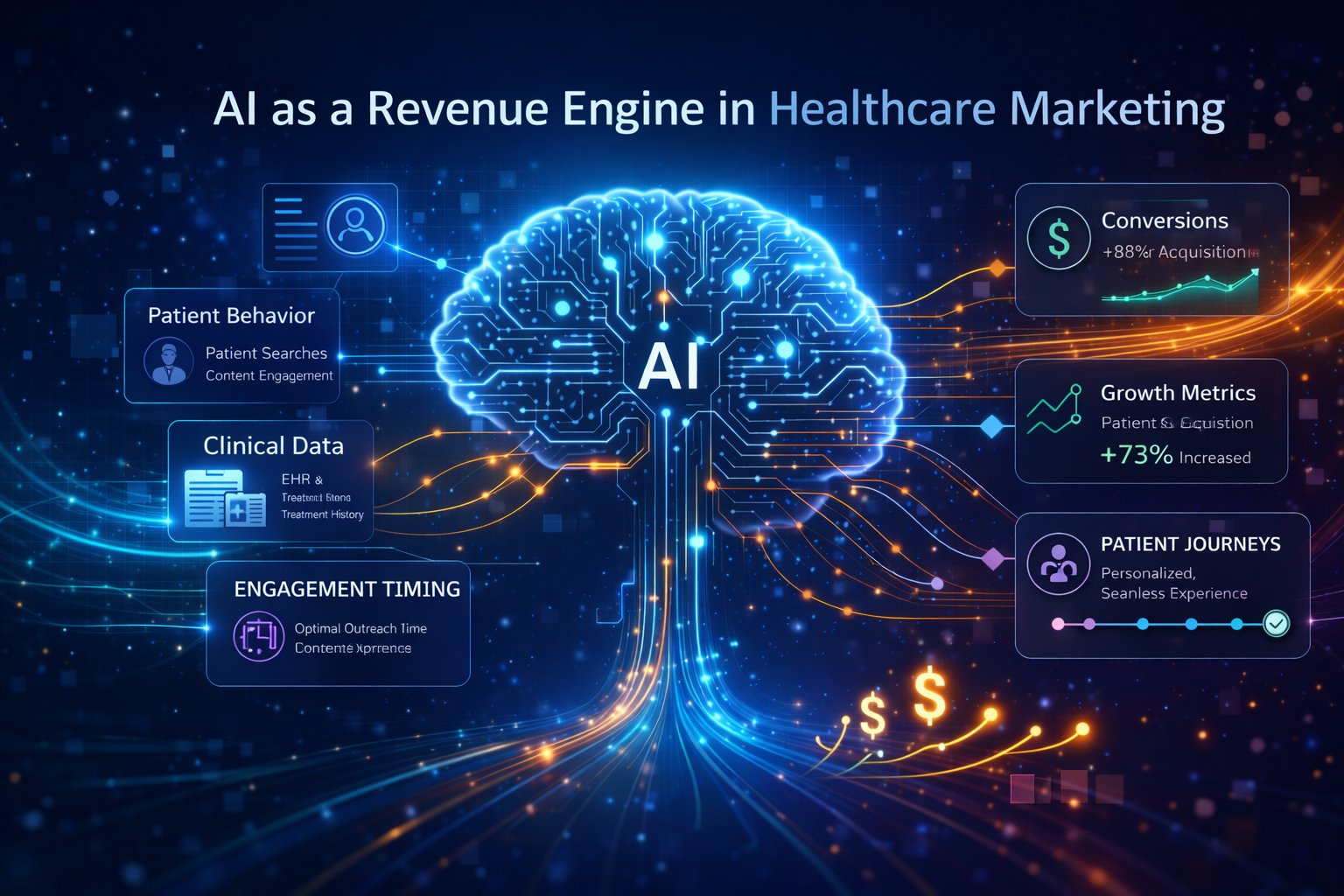
AI in healthcare marketing is no longer a support function - it is becoming a business growth solution and revenue-driving system that connects:
Patient behavior
Clinical context
Engagement timing
When those three come together, marketing stops being guesswork.
Instead of asking, “What campaign should we run?”, the question becomes, “Which patient needs what intervention, at what moment?”
That shift - from campaigns to systems - is where real growth happens.
By integrating AI across marketing and patient engagement workflows, healthcare organizations can:
Increase patient acquisition through precision targeting
Improve retention via personalized communication
Optimize conversion rates through real-time engagement
Unlock lifetime value through predictive care journeys
At Make My Brand, we position AI not as an add-on but as a core growth infrastructure for healthcare businesses.
Patient Expectations Have Quietly Reset
One of the most underestimated changes in healthcare isn’t technological - it’s behavioral. Patients are no longer passive in an era shaped by AI personalization.
They’re:
Using AI tools to understand symptoms
Comparing treatment options before consultations
Expecting faster, more contextual responses
What used to feel like “good service” now feels slow or generic. For example, a basic appointment reminder used to be enough. Today, patients expect:
Context (why the appointment matters)
Timing (when it’s most relevant)
Personalization (based on their history)
This is subtle, but important. Engagement is no longer about contacting patients - it’s about guiding them.
This shift means healthcare marketing must evolve from:
Campaign-based → Conversation-driven
Reactive → Predictive
Generic → Hyper-personalized
Where AI in Healthcare Marketing Is Driving Real Impact?
Let’s move beyond theory and look at where AI in healthcare marketing is creating a real impact.
1. Smarter Front Doors: Intelligent Chatbots and Virtual Assistants
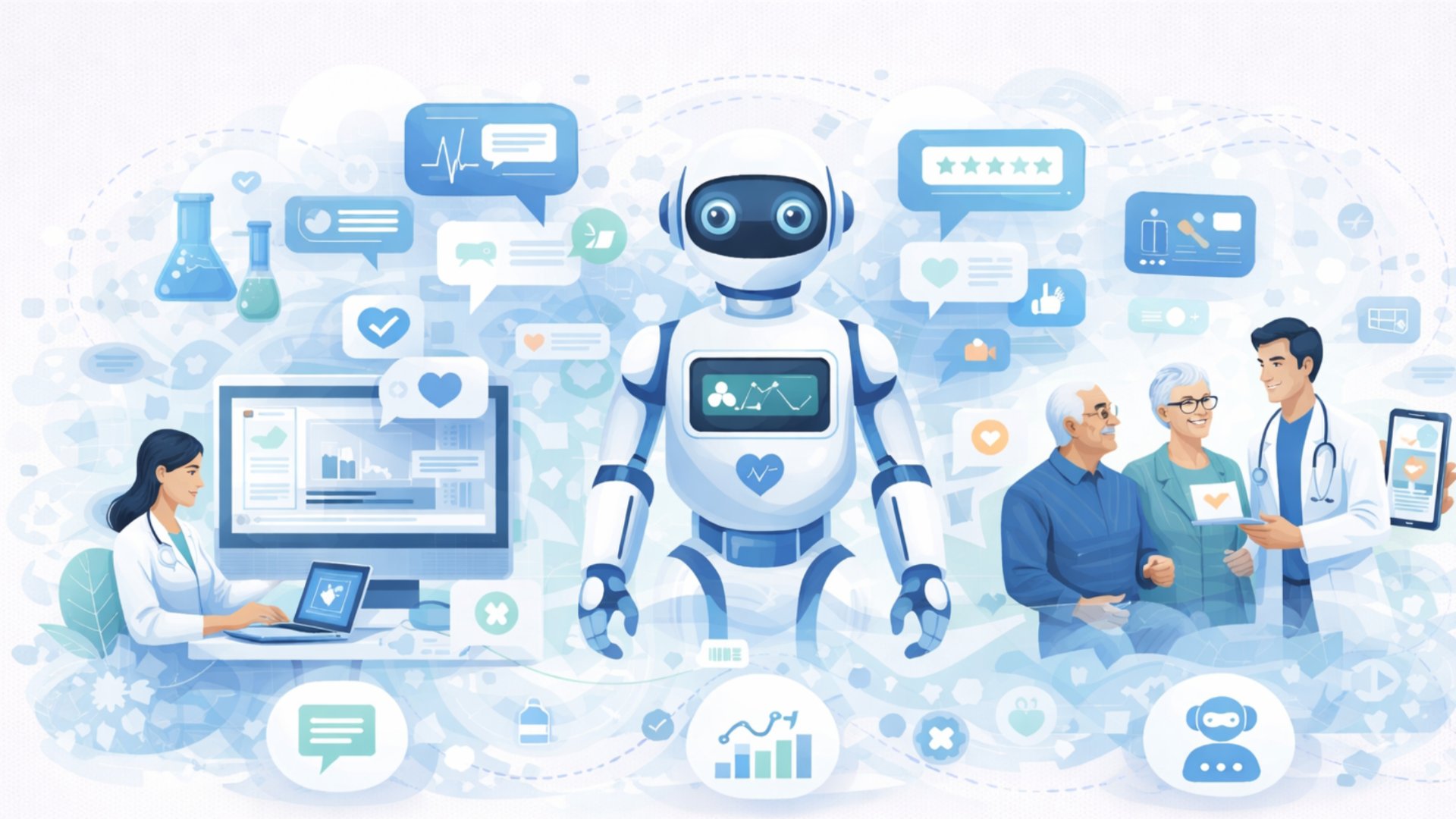
AI-powered patient engagement tools like chatbots are now handling:
Appointment bookings
Symptom-based guidance
Insurance queries
Post-treatment follow-ups
Unlike traditional bots, modern systems use natural language processing (NLP) to understand intent and context. These tools are especially valuable for AI for hospitals, improving front-desk efficiency and patient experience.
This reduces friction and significantly improves patient acquisition and retention rates.
2. Patient Portals That People Actually Use
AI-enhanced patient engagement tools transform traditional portals into interactive platforms, including:
Personalized dashboards
Automated reminders
AI-curated health insights
Smart navigation based on user behavior
This shifts portals from static repositories to active engagement platforms.
3. Predictive Analytics for Patient Behavior
Predictive analytics is a core component of healthcare automation, that analyze:
Appointment history
Treatment adherence
Demographics and behavior patterns
AI models can identify patterns like:
Patients who are likely to miss appointments
Individuals who may delay treatment
Segments that are more likely to convert for specific procedures
That allows healthcare brands to intervene earlier - not after the fact. It’s a shift from “follow-up” to “prevention,” even within marketing itself.
4. Communication That Feels Personal
AI enables hyper-personalized communication- one of the most powerful applications of AI in healthcare marketing. Most healthcare communication still feels like a broadcast. AI changes that by enabling:
Messaging based on patient history
Timing based on behavior
Content aligned with specific conditions
So instead of sending the same message to everyone, you’re speaking to individual contexts. And patients notice that difference.
5. AI-Driven Advertising and Targeting
AI in Healthcare marketing is becoming more data-driven :
Identifying high-intent patient segments
Optimizing ad spend in real time
Delivering personalized creatives
AI for hospitals and healthcare providers ensures marketing budgets target high-intent patients.
6. Automation of Medical Records + CRM Integration
AI bridges the gap between:
Electronic health records (EHRs)
Marketing automation systems
AI-driven healthcare automation is streamlining backend operations:
Automated documentation
Smart data extraction
Integration across systems
While this seems operational, it directly impacts marketing by enabling:
Better data-driven decisions
Faster patient communication
Seamless experience across touchpoints
7. Wearables and Real-Time Engagement
Wearable devices are becoming a major data source:
Heart rate, sleep patterns, activity levels
Chronic disease monitoring
AI analyzes this data to trigger:
Personalized alerts
Preventive care recommendations
Timely engagement campaigns
This is where AI in healthcare marketing evolves into continuous engagement.
Similarly, mobile health (mHealth) applications are rapidly using AI to deliver individualized patient assistance, real-time monitoring, and seamless interaction on-the-go.
8. Personalized Education and Awareness
Personalized education is a key function of advanced patient engagement tools. AI enables healthcare providers to deliver:
Condition-specific educational content
Personalized treatment plans
Interactive health journeys
This builds trust and long-term engagement, especially for chronic care patients.
The Role of AI Search in Healthcare Marketing
AI in healthcare marketing is also transforming how patients discover providers through search. The rise of AI-powered search engines and intelligent answer platforms is fundamentally changing how healthcare organizations engage patients.
1. From Keywords to Intent
Traditional SEO depended on keywords. Today, AI search interprets patient intent, context, and behavioral patterns. For example:
A patient searching for "best diabetes doctor near me" is looking for more than just a list - they want trust signals, reviews, insurance alternatives, and location.
AI search engines can offer synthesized answers immediately, therefore your website must deliver structured, authoritative, and AI-readable content
Healthcare businesses today compete not only for page rankings, but also to be recognized as a credible source by AI systems. This makes content planning and structured data more important than ever.
2. Personalization at Scale
AI search enables dynamic personalization, adapting results based on:
Patient history (if logged into a portal)
Location and local healthcare availability
Previous interactions and engagement patterns
For hospitals, clinics, or telemedicine platforms, this means your content, appointment options, and educational material can appear in contextually relevant ways, boosting engagement and conversions.
3. Integration with Patient Engagement Tools
AI search doesn’t exist in isolation - it connects with:
Chatbots and virtual assistants for immediate follow-ups
Patient portals for real-time content delivery
Telemedicine platforms for appointment scheduling and reminders
For healthcare organizations, this integration creates a seamless patient journey, turning search queries into actionable engagement points.
4. Predictive Insights for Marketing Strategy
AI search solutions generate data based on what patients really seek, not what businesses believe they want. This enables:
Anticipating patient concerns and queries.
Identifying content gaps on your website or blog.
Developing targeted advertising for high-intent search queries
Over time, AI search findings flow into predictive marketing, allowing healthcare marketing to anticipate patient demands.
5. Building Trust and Authority
AI-powered search rewards information that is organized, clear, and credible. Healthcare providers, telemedicine companies, and hospitals can establish themselves as reliable sources by:
Using structured data and schema markup to improve AI comprehension
Releasing educational resources with scientific support
Being open and honest about services, results, and patient support
In the patient journey, being identified by AI search as a reliable source strengthens brand trust in addition to increasing visibility.
At Make My Brand, we assist healthcare companies in coordinating their technology, strategy, and content to take advantage of AI search for patient acquisition, retention, and meaningful engagement.
Industry-Wide Adoption: Who’s Leading the Shift?
AI-driven patient engagement is not limited to hospitals.
Healthcare companies are using AI for lifecycle marketing
Telemedicine platforms are leveraging AI for virtual consultations and engagement
Health insurers are using predictive analytics for risk profiling and communication
Public health organizations are deploying AI for awareness campaigns and population-level engagement
This widespread adoption signals a clear shift: AI is becoming a standard, not a differentiator.
The Business Impact
When AI in healthcare marketing is implemented with a clear strategy, the outcomes are tangible:
Better conversion from inquiry to appointment
Lower drop-offs across the patient journey
Improved retention and repeat visits
Reduced operational load on teams
But the bigger impact is structural.
You move from:
Campaign-based growth → System-driven growth
One-time interactions → Long-term engagement
What Most Healthcare Organizations Are Still Missing?
Despite growing adoption, many healthcare organizations fail to fully leverage healthcare automation and AI-driven systems. Common gaps include:
Treating AI as a tool, not a system
Lack of integration across data sources
Over-reliance on generic automation platforms
No clear patient journey mapping
AI without strategy leads to fragmentation - not transformation.
This is where Make My Brand differentiates itself, by building integrated, AI-driven growth systems rather than isolated marketing tactics.
Ethical Considerations: Trust Is Non-Negotiable
Trust is especially critical when implementing AI in healthcare marketing. AI in healthcare must operate within strict ethical boundaries. Key priorities include:
Data privacy and security
Regulatory compliance
Transparency in AI-driven decisions
Bias mitigation
A considerable amount of healthcare executives expects AI to significantly impact the industry, but also emphasize the need for strong governance.
In healthcare, trust is the ultimate currency - and AI must reinforce it.
Final Thought
AI is not a future trend in healthcare marketing - it is already reshaping how patients discover, evaluate, and engage with providers. The shift is clear:
From campaigns to continuous engagement
From generic messaging to hyper-personalization
From reactive communication to predictive systems
Healthcare organizations that understand this shift - and act on it - will not just improve marketing performance. They will redefine patient relationships. And in healthcare, that is where real growth begins.
At Make My Brand, we help healthcare organizations move beyond experimentation - building AI-driven marketing systems that are scalable, measurable, and future-ready.
Ready to transform your patient engagement with AI-driven strategies? Contact us today to see how we can help your hospital, clinic, or health tech startup stay ahead in the AI-powered healthcare market.
Loading FAQs
Please wait while we fetch the questions...
Published on March 30, 2026 by Surbhi Sood