AI Personalization: How Brands Are Transforming Customer Experiences at Scale
AI personalization is transforming how brands connect with customers. By analyzing real-time data and behavior, businesses deliver hyper-relevant experiences across websites, emails, and apps boosting engagement, improving conversions, and building stronger long-term customer relationships at scale.
Growth today depends on how intelligently brands use data to shape customer experiences. Artificial intelligence has transformed personalization from a manual marketing tactic into a scalable, real-time strategy that drives engagement, loyalty, and revenue. Organizations that successfully operationalize AI across the customer journey are gaining a clear competitive edge.
In a digital economy where relevance directly influences revenue, brands that implement AI personalization are gaining a measurable competitive advantage.
In this blog, we explore how AI personalization is transforming customer experiences at scale- enabling brands to deliver hyper-relevant interactions, improve engagement, and drive measurable business brand growth.
The Rising Demand for Personalized Experiences
Today’s consumers expect every interaction with a brand to feel personal and relevant. Generic messaging no longer works.
Research highlights just how strong this expectation has become:
71% of customers expect companies to deliver personalized content and experiences.
67% feel frustrated when interactions are not tailored to their needs.
More than half of customers expect brands to know understand when, where, and how to personalize interactions.
88% of customers say the experience a company provides is just as important as its products.
According to IBM, AI personalization refers to using artificial intelligence to tailor messaging, product recommendations, and services for individual users.
These numbers reveal a clear shift in customer behavior. Personalization is no longer a competitive advantage - it’s a baseline expectation. Brands that fail to personalize risk losing engagement, trust, and long-term loyalty.
How AI Personalization Works at Scale
Meeting personalization demands for thousands - or even millions - of users would be impossible manually. This is where modern AI personalization technologies make a difference.
AI-driven platforms analyze large volumes of customer data, including:
browsing behavior
purchase history
interaction patterns
contextual signals across channels
Using machine learning and generative AI, these systems transform raw data into actionable insights that power real-time personalization.
Instead of delivering generic marketing campaigns, AI enables brands to create highly relevant experiences for every individual customer.
For example, AI can dynamically personalize:
Website content based on user behavior
Email campaigns tailored to interests and purchase history
Product recommendations aligned with past preferences
Content feeds and promotions customized for each visitor
This leads to hyper-personalization - experiences that continuously adapt as the system learns more about each customer.
Over time, the AI improves its predictions and recommendations, ensuring every interaction becomes more relevant, timely, and engaging.
The ROI of AI Personalization
AI personalization is not just about improving customer experiences - it also delivers measurable business results. When integrated across the entire customer journey, AI-powered personalization can significantly increase revenue, engagement, and operational efficiency.
Stronger Revenue Growth and Conversions
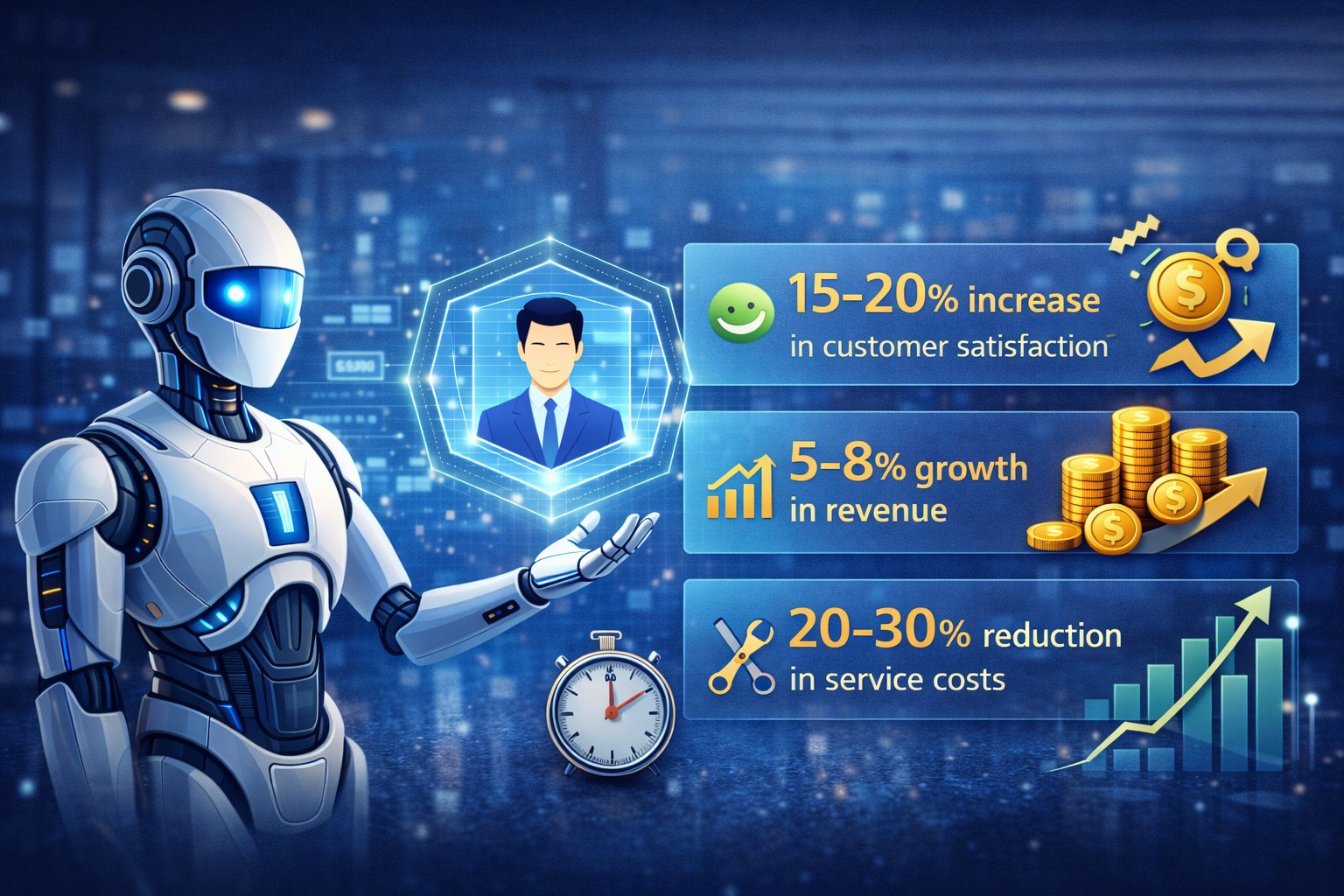
Research consistently shows that personalization has a direct impact on business performance. According to McKinsey, AI-powered “next-best experience” capability can deliver:
15–20% increase in customer satisfaction
5–8% growth in revenue
20–30% reduction in service costs
Similarly, IBM reports that companies prioritizing customer experience - including personalization - achieve nearly three times the revenue growth of their competitors.
Personalized experiences also improve purchasing decisions. When customers receive relevant recommendations and tailored content, they are far more likely to convert.
Key benchmarks show:
Personalization can increase company revenue by up to 40%.
Segmented email campaigns generate 30% more opens and 50% more clicks compared to generic campaigns.
This is where AI marketing personalization becomes especially valuable, helping brands deliver highly targeted communication that drives engagement and conversions.
Lower Marketing and Acquisition Costs
On the cost side, personalization also pays off. McKinsey notes that a successful personalization strategy can reduce customer acquisition costs by around 50%. AI automates tasks such as:
audience segmentation
content recommendations
behavioral analysis
campaign optimization
This automation allows marketing teams to operate more efficiently while focusing on strategic work.
Supporting this trend, reports indicate that the fastest-growing companies are significantly more likely to use AI and machine learning for content analysis and automatic tagging. This highlights the growing connection between AI adoption and business performance.
Increased Customer Loyalty and Lifetime Value
The benefits of personalization extend far beyond the initial purchase. When brands deliver experiences tailored to individual needs, customers are more likely to stay engaged and loyal.
Customers increasingly value brands that understand their preferences and anticipate their needs.
However, the opposite is also true. Failing to personalize can negatively impact customer relationships. This reinforces a key point: personalization is not just about marketing performance. It is about creating experiences that customers value and remember.
How AI Personalization Tailors Every Customer Interaction
AI personalization may seem complex, but the core idea is simple: use customer data and intelligent algorithms to deliver the right experience to the right person at the right time.
Modern AI systems continuously analyze data across every touchpoint to understand individual preferences and behavior.
1. Collecting Data Across the Customer Journey
AI-powered platforms begin by gathering data from multiple customer interactions, including:
Browsing behavior
Purchase history
Customer service conversations
Website and app activity
Contextual signals like time, device, or location
Advanced AI stacks combine technologies such as:
Machine Learning (ML)
Natural Language Processing (NLP)
Generative AI
These technologies merge multiple data streams into unified customer profiles, creating a complete view of each individual.
2. Identifying Patterns and Customer Segments
Once the data is collected, machine learning algorithms analyze it to detect patterns in behavior and preferences. Customers are automatically grouped into behavior-based segments, allowing businesses to understand:
What customers like
How they interact with products
What they are most likely to purchase next
This analysis enables brands to move beyond broad targeting and deliver highly relevant experiences.
3. Delivering Dynamic and Real-Time Experiences
Based on these insights, AI decides what content, recommendation, or offer a user should see next. For example:
A retail website might recommend products a shopper is likely to love.
A streaming platform can suggest content based on viewing history.
A learning platform recommends the next course aligned with a student’s progress.
Instead of static experiences, AI enables dynamic personalization, where content adapts in real time to each user.
4. Learning and Improving with Every Interaction
AI systems continuously learn from customer responses. For instance:
If a product recommendation results in a purchase, the system strengthens similar suggestions.
If an email subject line is ignored, the AI tests a new variation next time.
This feedback loop allows AI to refine its predictions and recommendations over time, improving personalization accuracy. As a result, the approach creates what many experts describe as an AI-powered customer experience - one where interactions are continuously optimized across channels.
5. Predicting Customer Needs Before They Act
One of the most powerful capabilities of AI predictive personalization. AI models can forecast customer behavior and trigger proactive engagement. For example:
Predicting which product a shopper may buy next month
Identifying customers likely to churn
Automatically sending personalized offers or reminders
This allows businesses to anticipate customer needs rather than simply reacting to them.
The Impact on Engagement and Performance
Organizations implementing AI personalization consistently see higher engagement and stronger business outcomes. Examples include:
Marketing campaigns: AI-powered segmentation and recommendations ensure consumers receive content that matches their intent.
Websites and apps: AI can rearrange layouts and product listings in real-time based on each user’s profile.
Customer service: AI chatbots and agents instantly recognize a customer’s history and preferences, reducing resolution time.
Why It Matters?
By tailoring every interaction, AI helps businesses create experiences that feel intuitive, relevant, and valuable to customers.
The result is a powerful cycle:
Better experiences lead to higher engagement, which generates more data, enabling even smarter personalization in the future.
In today’s competitive market, this ability to continuously learn and adapt customer experiences is becoming one of the most important advantages a brand can have.
Real-World Examples of AI Personalization
What was once considered a futuristic idea is now a business reality. Across industries, leading brands - from streaming platforms to e-commerce giants - are harnessing AI to deliver hyper-personalized customer experiences and strengthen engagement at scale.
Entertainment Platforms: Personalized Content Discovery
Streaming platforms rely heavily on AI to keep users engaged.
Netflix uses machine learning to recommend shows through features like “Top Picks for You.”
Spotify creates curated playlists such as “Discover Weekly,” which recommends music based on listening behavior.
These systems continuously analyze user activity to deliver content that matches individual preferences, making it easier for users to discover what they love.
E-Commerce Leaders: Smart Product Recommendations
Online retailers use AI to personalize shopping experiences in real time.
Amazon is well known for recommendation engines like “Customers who bought this also bought…”
AI analyzes browsing patterns, purchase history, and preferences to suggest relevant products and custom deals.
These personalized suggestions significantly increase average order value and purchase likelihood.
Retail: Omnichannel Personalization
Modern retailers combine data from multiple touchpoints to personalize both online and in-store experiences while strengthening their omnichannel branding strategy.. For example, retailers integrate insights from:
mobile apps
loyalty programs
online browsing behavior
purchase history
Using this data, brands can personalize:
targeted email promotions
product recommendations on websites
in-store advertisements and offers
The result is a consistent, personalized shopping experience across channels.
Travel and Hospitality: Customized Trip Planning
Travel platforms also use AI to personalize recommendations. Websites analyze traveler preferences such as:
destination interests (beach vs. city)
travel style (luxury vs. adventure)
booking history and seasonal behavior
Based on these insights, travel websites automatically recommend relevant hotel deals, flights, and vacation packages, making trip planning easier and more engaging.
B2B Example: Predictive Personalization
AI personalization isn’t limited to consumer brands. B2B organizations are also using it to improve customer engagement.
For example, a global payments company implemented a predictive AI model to analyze merchant behavior and identify accounts at risk of leaving. By using these insights to deliver personalized outreach, the company successfully reduced merchant attrition by 20%.
This demonstrates how AI can strengthen B2B relationship management and retention strategies.
AI Marketing Personalization in Action
In marketing, AI tools are increasingly used to automate and scale personalized campaigns. These platforms analyze customer segments and generate tailored marketing assets such as:
personalized ad copy
product recommendations
targeted email messaging
customized landing page experiences
For example, AI-powered email systems can dynamically change images, messaging, and offers based on factors like age, preferences, or past behavior.
Similarly, AI enables dynamic website banners and social media ads that adapt to each visitor’s interests.
Personalization Across the Entire Marketing Funnel
AI-powered personalization is now integrated across every stage of the marketing funnel:
Prospecting: identifying the right audience
Conversion: delivering relevant offers and content
Retention: maintaining engagement through tailored communication
The result is a marketing strategy that is smarter, more efficient, and far more effective at building long-term customer relationships.
A Real-World Example: AI Personalization in Action
A strong example of AI-driven personalization in action comes from Make My Brand’s work with Knowledger, an innovative EdTech platform focused on secure and personalized digital learning.
Knowledger aimed to modernize traditional learning systems by introducing AI-driven recommendations and blockchain-based credential verification. Make My Brand implemented a full-stack solution combining branding, UI UX design, AI personalization, and blockchain technology to create a seamless learner experience.
AI models analyzed learner behavior, assessment outcomes, and pacing signals to deliver adaptive course recommendations and personalized learning journeys. This intelligent system ensured that each learner received content aligned with their progress and skill level.
The results were significant:
40% faster course completion rates through personalized learning paths
85% reduction in academic fraud using verifiable blockchain credentials
10,000+ learners empowered with secure, portable achievements.
This case highlights how AI personalization can transform user experiences while delivering measurable business outcomes.
Read the full Knowledger case study
Getting Started with Personalization
For organizations seeking similar gains, the path forward is clear.
The first step is data unification. Businesses need to consolidate customer information across channels to create a single, comprehensive view of each user.
Next comes choosing or building the right AI tools (from CRM systems with AI modules to bespoke recommendation engines).
Machine learning models can then be trained on this data to predict customer needs and segment audiences.
It’s also critical to set up a continual feedback loop: A/B test personalized content, measure click-through and conversion lifts and refine the models accordingly.
Throughout, privacy and compliance should be built in, ensuring customers trust that their data is used responsibly.
How Does Make My Brand Enable Scalable Personalization?
At Make My Brand, we embed AI with clear intent across every stage of a brand’s growth journey.
Our AI-as-a-Service framework integrates advanced AI capabilities across key business functions- from UX personalization and predictive layout optimization to AI-driven CRM workflows and behavior-triggered engagement.
This means your website, emails, apps, and ads become smarter – automatically adapting to drive results. The goal is always “smarter decisions, faster execution, and scalable personalization”.
In other words, as a brand grows, the AI system grows too, continuously learning to deliver the right offer at the right time to each customer.
Conclusion
Personalized experiences are a powerful growth driver. AI personalization has become a core growth engine for modern businesses. Brands that leverage AI personalization see higher engagement, better conversions, lower marketing costs, and stronger customer loyalty. From intelligent product recommendations to dynamic content and AI-powered campaigns, personalization at scale is now essential for modern businesses.
At Make My Brand, we help businesses turn this potential into real impact by combining strategic branding, data insights, and advanced technology.
Take the next step toward smarter, scalable customer experiences. Talk to the experts at Make My Brand and discover how AI personalization can accelerate your growth.
Loading FAQs
Please wait while we fetch the questions...
Published on March 11, 2026 by Simran