From Clicks to Conversions: How AI Search Is Changing Performance Marketing
AI search is reshaping performance marketing by influencing customers before they click. Explore how AI visibility, GEO, brand authority, attribution, paid media, and landing pages are changing the path from discovery to conversion, and why marketers need to optimize for decisions, not just clicks.
Performance marketing has traditionally been built around a simple chain:
Impression → Click → Landing Page → Conversion
That model is becoming less reliable. Users are increasingly getting answers before they click. Search engines can now summarize information, compare options, surface recommendations, and answer complex commercial questions directly within the search experience. A brand may influence a purchase without receiving the first click, and a customer may encounter several AI-generated recommendations before visiting a website.
That changes the economics of acquisition.
This is where AI search marketing starts to overlap with performance marketing. The goal is no longer only to buy or earn the click. It is to make sure the brand is discoverable, credible, and persuasive across a fragmented decision journey.
For businesses focused on ROI-driven marketing and data-driven ad campaigns, that requires a broader definition of performance. Clicks still matter, but influence, visibility, assisted conversions, and recommendation presence are becoming harder to ignore.
AI Search Is Changing the Role of the Click
Traditional search marketing has always treated the click as a valuable transition point. A user searches, a result appears, the user clicks through, and the brand then controls most of the experience.
AI search disrupts that handoff.
Instead of presenting only a list of links, AI-powered search experiences can synthesize information from multiple sources and answer questions directly. A user looking for “best CRM for a 50-person SaaS company” may receive a summarized comparison before visiting a single vendor. Someone searching for “which accounting platform is best for a multi-location retailer” may be exposed to several brands, features, pros, and use cases inside an AI-generated response.
By the time they eventually click, much of the initial evaluation may already have happened.
That means performance marketers need to stop treating the website visit as the beginning of the customer journey. In many cases, it may now be the middle.
AI Search Marketing Is About Influence Before the Visit
AI search marketing is not simply another version of SEO. It is about increasing the likelihood that a brand, product, service, or point of view is surfaced when AI systems help users make decisions.
That requires a different mindset.
Traditional optimization often asks, “How do we rank for this keyword?” AI search asks additional questions: Is our brand associated with this topic? Is our expertise clear enough to be interpreted correctly? Are we referenced across credible sources? Does our content answer specific commercial questions? Can AI systems easily understand our positioning?
This is why AI search optimization is becoming relevant to performance teams, not just SEO teams. If AI-generated answers are influencing purchase decisions upstream, they are also influencing conversion outcomes downstream.
Search Visibility Is Becoming More Distributed
One of the biggest shifts in performance marketing is that visibility is no longer concentrated in one place.
A customer may encounter the same brand through a paid search ad, an organic result, an AI-generated summary, a product comparison, a Reddit discussion, a review site, a creator recommendation, or a branded search later in the journey.
This makes attribution more complicated.
The channel receiving the final click may not be the channel that created the initial preference. An AI-generated answer might introduce a brand, after which the user searches the brand by name and clicks a paid ad. Analytics may attribute the conversion to paid search, even though the decision was influenced earlier.
This is not a completely new attribution problem, but AI search makes it more visible. Performance marketing therefore needs to evolve from asking “Which channel generated the conversion?” toward “Which interactions contributed to the conversion?”
That is a much more realistic view of how modern buyers behave.
Generative Engine Optimization Enters the Performance Funnel
This is where generative engine optimization (GEO) becomes commercially important.
GEO focuses on improving how brands and content appear within AI-generated search and answer experiences. Unlike conventional SEO, where rankings and click-through rates dominate the conversation, GEO is concerned with whether AI systems understand and reference your brand when answering relevant questions.
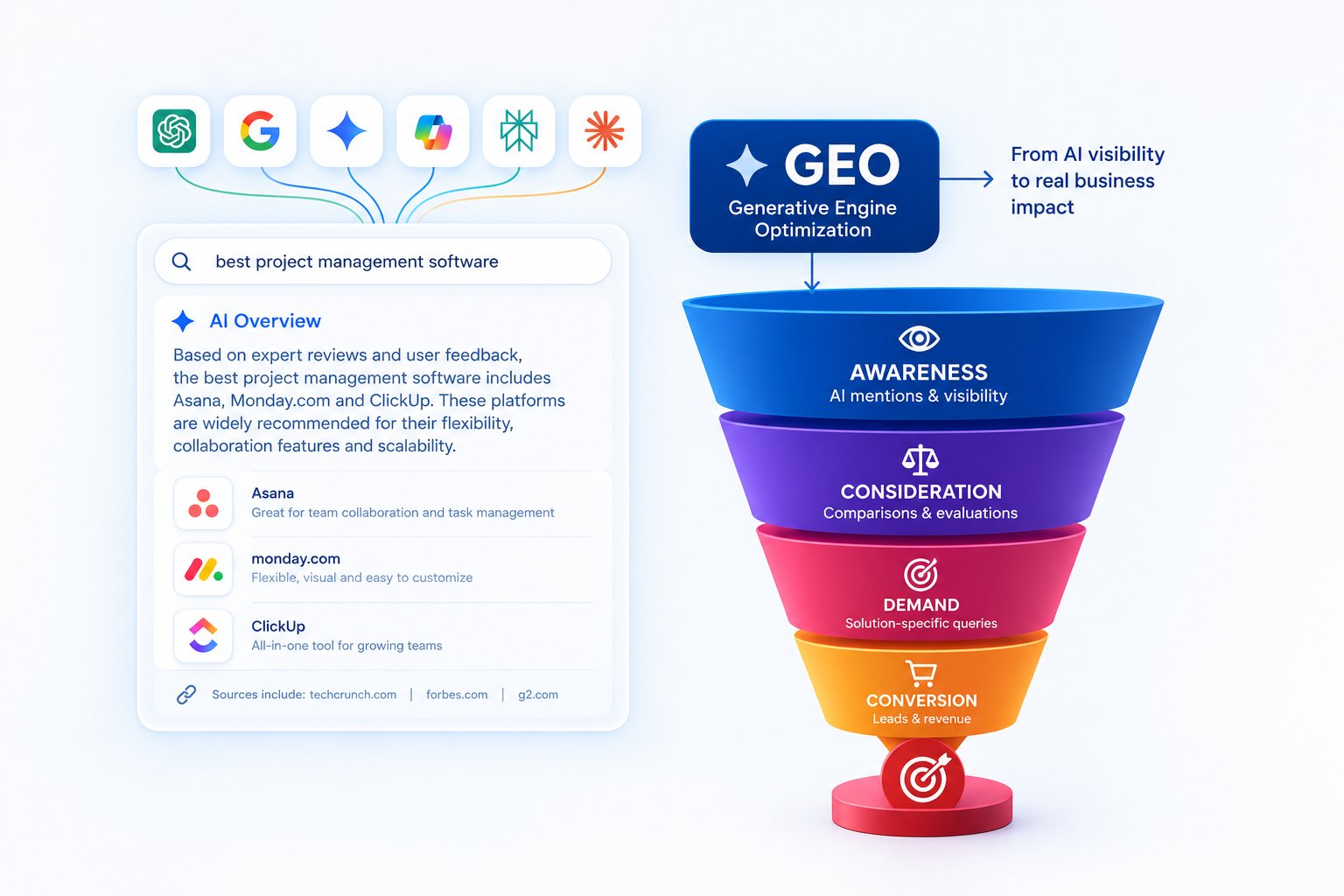
That can involve clearer positioning, authoritative content, structured information, third-party references, topic depth, expert-led insights, citations, original data, and strong brand consistency.
A practical generative engine optimization (GEO) strategy therefore needs to connect visibility with commercial relevance.
Appearing in AI results for broad informational queries may increase awareness. Appearing when users are comparing providers, evaluating solutions, or asking category-specific questions can influence demand. Not every AI mention has equal commercial value.
AI Search Optimization Changes Content Strategy
Traditional search content has often been built around keyword opportunities: find a query, create a page, optimize it, build links, and wait for rankings.
That playbook still has value, but AI search optimization places more emphasis on how well a brand answers clusters of related questions.
AI systems are not always retrieving a single page for a single keyword. They may synthesize multiple sources, connect concepts, infer relationships, and prioritize information that appears credible and contextually relevant.
That means brands need content ecosystems, not isolated SEO pages.
A strong content strategy might include category explainers, comparison content, FAQs, use-case pages, original research, case studies, expert commentary, product or service documentation, and clear commercial landing pages. Together, these assets help establish what the brand knows, who it serves, and where it fits.
This is the broader role of AI search optimization. The objective is not to “write for AI.” It is to make the brand easier for both humans and AI systems to understand.
Performance Marketing Will Need New Metrics
If users can be influenced without clicking, click-based measurement becomes incomplete.
That does not mean familiar metrics disappear. CPC, CPA, conversion rate, ROAS, CTR, and revenue remain important. But AI-driven performance marketing may need additional signals such as brand search lift, assisted conversions, AI visibility, recommendation presence, qualified traffic, and branded demand.
The important point is not to create more dashboards. It is to measure the signals that better reflect actual customer behavior.
For example, if more users begin searching directly for the brand after exposure in AI-generated answers, that indicates a form of demand creation that may not show up neatly in last-click attribution. Likewise, if visitors arriving from AI-influenced journeys convert at a higher rate, that may reveal stronger pre-qualification before the site visit.
Performance measurement needs to account for those effects.
Paid Media Will Not Disappear, but Its Role May Shift
AI search does not make paid media irrelevant. If anything, it may change where paid media is most valuable.
As users receive more information before visiting a website, paid campaigns may increasingly support brand reinforcement, retargeting, high-intent capture, competitive search, offer-led acquisition, and demand activation.
This means the relationship between paid media and organic discovery may become more interconnected. A user might first hear about a company through an AI answer, later encounter a LinkedIn campaign, search the brand directly, and eventually convert through paid search.
The channels did not compete. They reinforced one another.
That is why ROI-driven marketing should evaluate the entire acquisition system rather than forcing every interaction into a last-click framework.
Landing Pages Still Matter, Possibly More Than Before
If AI search increasingly handles discovery and early education, people who do click through may arrive with stronger expectations.
They may already know what the company does, how it compares with alternatives, what problem it solves, and which features matter. The landing page therefore needs to continue the evaluation process rather than repeat generic introductory messaging.
That means stronger emphasis on evidence, use cases, differentiation, pricing logic, proof, implementation detail, and clear next steps.
A visitor who arrives after an AI-assisted comparison may be more informed than a traditional top-of-funnel visitor. Showing them vague marketing copy creates friction.
The website needs to meet users at the stage they have already reached.
AI Search Makes Brand Authority a Performance Asset
For years, brand marketing and performance marketing were often treated as separate disciplines. Brand created awareness. Performance generated measurable leads.
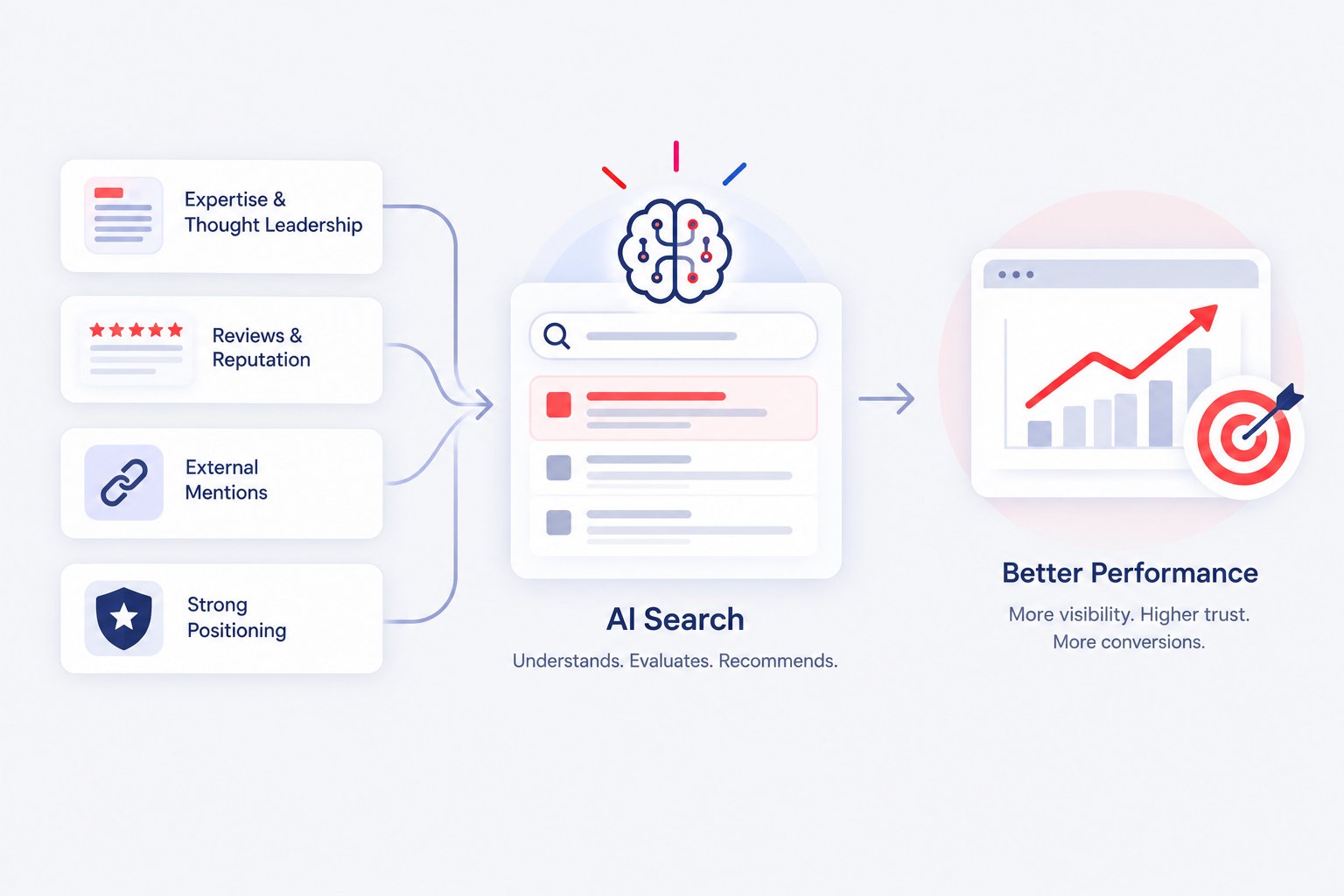
AI search weakens that separation because AI-generated recommendations often depend on signals that performance teams do not directly control through media spend alone.
Brand authority matters. External mentions matter. Expertise matters. Strong positioning matters. Consistent information, reviews, and reputation all matter.
The stronger these signals become, the easier it may be for AI systems to interpret where the brand belongs.
That means brand-building assets can indirectly support performance. A strong case study may improve conversion. An expert article may improve discoverability. Third-party recognition may strengthen trust. Consistent positioning may improve both user comprehension and AI interpretation.
The result is a more integrated acquisition model.
What Performance Teams Should Do Differently
AI search does not require performance marketers to discard their existing playbooks. It requires them to expand them.
Performance teams should map the full discovery journey, understand where AI search, organic search, paid media, social, reviews, and branded search interact, and optimize around customer questions rather than keywords alone.
They should also strengthen brand authority through credible references, expert content, strong case studies, and consistent positioning. Post-click experiences should assume that some users are arriving further down the funnel than before, while attribution models should account for multi-touch influence rather than only final-click conversion.
Finally, teams should measure commercial AI visibility, not vanity mentions. The useful question is not whether the brand appears somewhere in an AI answer. It is whether it appears in the decision-oriented conversations that matter to revenue.
From Click Optimization to Decision Optimization
The biggest shift in AI search marketing is not technological. It is strategic.
Performance marketing has spent years optimizing the click. AI search forces marketers to think about the decision that happens before, during, and after that click.
Visibility matters before the website visit. Brand authority influences consideration. Content shapes AI-generated recommendations. Paid media reinforces demand. Landing pages validate the choice. Conversion data closes the loop.
The result is a broader version of performance marketing, one that measures not just which channel delivered the final click, but how the brand influenced the customer across the entire decision journey.
This is where a partner such as Make My Brand can add value: connecting brand strategy, content, AI search visibility, and performance marketing so each touchpoint supports the next.
Clicks are still important.
They are simply no longer the whole story.
Loading FAQs
Please wait while we fetch the questions...
Published on October 7, 2026 by Simran