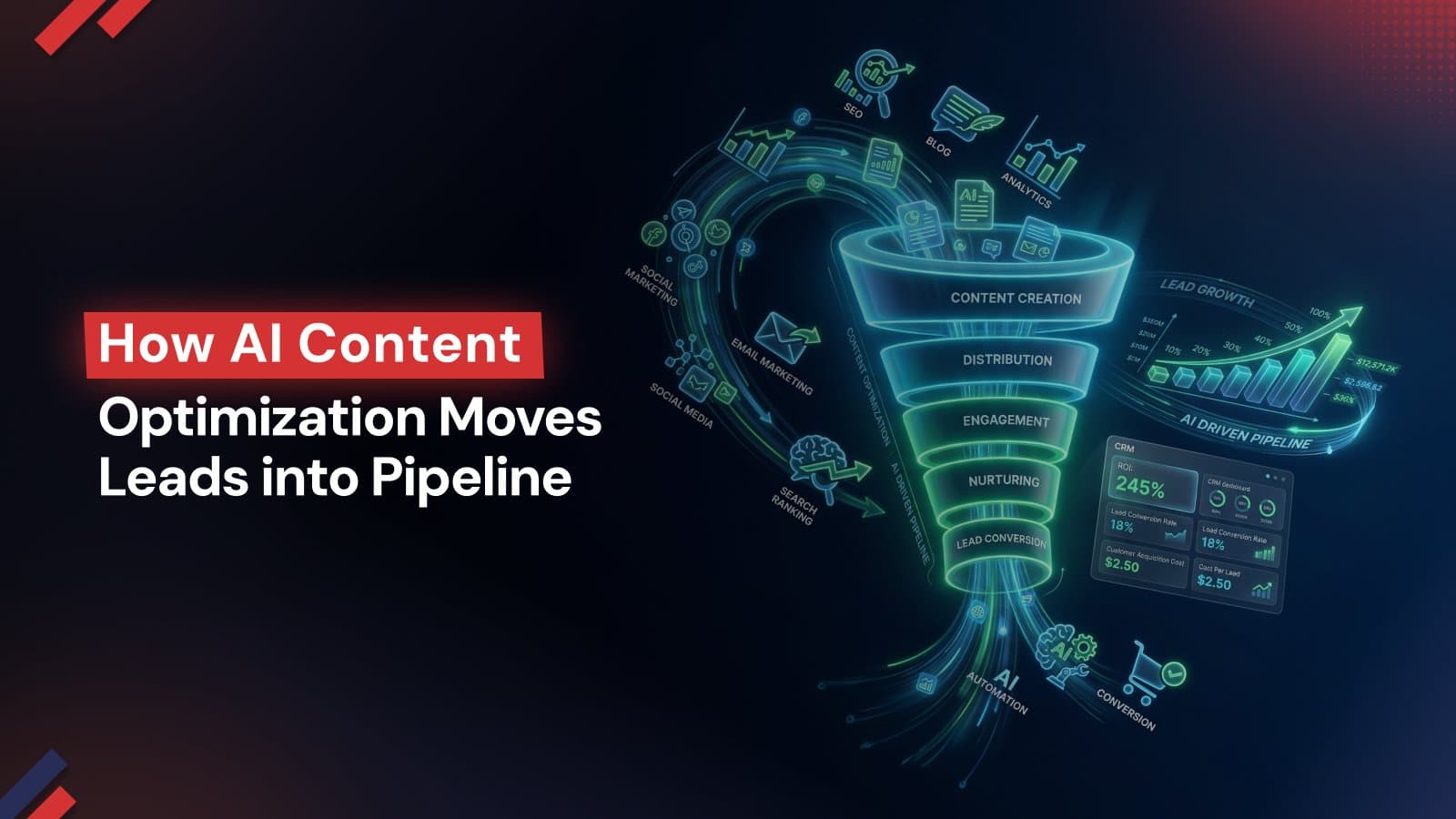
Content Marketing ROI: How AI Content Optimization Moves Leads into Pipeline
Traffic growth no longer guarantees revenue growth in the age of AI search. Discover how top B2B brands are updating their Content Marketing ROI frameworks using GEO, AISO, and predictive content systems to capture qualified pipelines.
Content production has become cheaper than ever, but pipeline generation has become harder. As AI floods search ecosystems with generic information, brands are discovering that traffic growth no longer guarantees revenue growth.
In this blog, we will examine how AI content optimization, modern search behavior, and evolving buyer expectations are redefining B2B content marketing ROI - and what businesses need to do to stay competitive.
Why Traditional Content Marketing ROI Models Are Failing in AI Search?
The old model was simple:
Publish more blogs
Target more keywords
Generate more leads
Hope some of them convert
That approach is no longer enough. Discovery is now fragmented across search engines, AI answers, social platforms, and owned channels. Buyers are also more selective. They want clarity, credibility, and relevance before they engage.
At the same time, AI adoption has changed the pace of execution. Competitors are using AI marketing services, automation workflows, and predictive optimization systems to research faster, optimize faster, and distribute faster. That means your content must do more than exist - it must perform commercially.
The second problem is measurement. Many teams still cannot clearly connect content to revenue because their analytics, CRM, and marketing systems are disconnected. When attribution is weak, content may still influence deals - but its impact stays hidden.
Low-value, mass-produced content may increase volume, but it does not build trust, authority, or a qualified pipeline. The market is rewarding originality, depth, and usefulness instead of output for output’s sake.
How to Measure Content Marketing ROI in 2026?
A modern ROI model should look beyond visits and clicks. It should track whether content contributes to:
Sourced pipeline - opportunities created directly from content
Assisted pipeline - deals influenced by content across multiple touchpoints
Lead quality - whether the content attracts real buyers, not broad traffic
Sales velocity - whether content shortens the buying cycle
Revenue attribution - whether content supports closed-won business
This is the real shift behind content-led pipeline growth.
The strongest content programs do not just educate. They move buying committees forward with precision. That means the strategy has to include stronger intent mapping, better distribution, measurable CRO improvements, and more serious attribution systems.
The New Visibility Stack: SEO, GEO, AEO, and AISO
SEO still matters. But it is no longer the full answer. Search is now shaped by AI features, answer experiences, and generative discovery. That means content has to be built for multiple visibility layers.
Search Engine Optimization (SEO)
SEO services focus on improving your website’s visibility in traditional search engine results pages (SERPs) like Google and Bing.
Generative Engine Optimization (GEO)
GEO focuses on helping your content get referenced, cited, or surfaced inside AI-generated responses from platforms like ChatGPT, Google AI Overviews, Gemini, Claude, or Perplexity.
Answer Engine Optimization (AEO)
AEO focuses on structuring content to give direct, concise answers that search engines and voice assistants can easily extract.
AI Search Optimization (AISO)
AISO is the broader strategy of optimizing content for all AI-powered discovery experiences, including AI search, conversational engines, multimodal search, and recommendation systems.
It combines SEO + GEO + AEO with additional focus on semantic relevance, entities, automation, multimodal content, and conversational intent.
Easy way to remember it:
SEO = Ranking
AEO = Answering
GEO = Being referenced by AI
AISO = Owning visibility across AI-powered discovery
The practical takeaway is simple - Content must be written for retrieval - not just for publication. That means:
Tighter semantic structure
Clearer entity signals
Stronger internal linking
Direct answers to buyer questions
Content that supports both humans and machines
How AI Content Optimization Improves Pipeline Growth?
AI content optimization emphasizes a pipeline-focused content marketing with:
1. Relevance
AI helps teams cluster keywords, map intent, and understand what buyers are actually trying to solve. Instead of generic content, brands get content built around the buyer journey:
awareness
comparison
evaluation
decision
That is where content starts to influence revenue, not just awareness.
2. Speed
AI can accelerate research, outlines, content repurposing, and performance analysis.
That matters because modern content teams are expected to move quickly without losing quality. AI reduces operational friction, so strategists can focus more on branding, positioning, messaging, and optimization.
3. Scale
A strong AI workflow can turn one strategic idea into multiple assets. For example:
Blog post
Social snippet
FAQ section
Landing page copy
Video script
Sales enablement asset
This is where content becomes a system instead of a single deliverable.
4. Measurability
When content is connected to CRM, analytics, and content attribution ROI tools, teams can see which topics create high-intent leads and which assets influence deals.
The Content Marketing Trends Reshaping ROI in 2026
The future of content marketing services will be defined by who builds the smartest content ecosystem. The following shifts are not emerging ideas anymore - they are becoming competitive requirements.
Buyer-intent content is outperforming generic content.
First-party data is becoming the core fuel for smarter content strategy.
Human-in-the-loop governance is essential for quality control and brand safety.
Interactive and multimodal assets are becoming more important for engagement.
Voice search and visual search are pushing content teams to think beyond text.
Social search is growing as buyers discover brands inside social platforms, not only search engines.
Agentic AI is emerging as a workflow layer for research, content ops, and optimization.
AI reputation management is becoming part of content strategy because AI systems often surface summary-level brand signals before a buyer visits a site.
The Content Types That Move Leads into the Pipeline
Knowing the trends is one thing. Turning them into measurable business outcomes is another. Not all content contributes to revenue in the same way. The difference between content that generates traffic and content that generates pipeline comes down to structure, intent, and optimization.
Here are the five content systems helping brands turn ROI from AI content optimization into a measurable business impact.
1. Buyer-intent content
The biggest mistake brands still make is creating content for visibility without considering purchase intent.
Buyer-intent content is designed for prospects already researching solutions, comparing vendors, or preparing to make a decision. This is where content marketing ROI becomes more measurable because the content directly supports pipeline movement.
High-converting buyer-intent assets often include:
Comparison pages
Solution-focused pages
Industry-specific landing pages
Case studies
Decision-stage blogs
Implementation guides
These formats work because they answer the exact questions prospects ask before converting.
2. First-Party Data-Led Content
The strongest content strategies are no longer built only from keyword strategy tools.
They are built from first-party data - CRM insights, lead-source patterns, sales feedback, engagement trends, and conversion behavior. That is where content becomes more commercially intelligent.
Instead of asking, “What keyword has search volume?” the better question is, “What topic actually influences qualified demand?”
That shift transforms content planning from a publishing exercise into a growth strategy.
When content decisions are backed by first-party insights, brands can produce assets that align more closely with buyer concerns, sales friction points, and actual revenue opportunities.
3. Predictive Content Systems
Predictive content systems help teams decide what to create next, what to refresh, and what to retire.
This matters because not every topic deserves equal investment. Some pages attract attention but do little for the pipeline. Others may have modest traffic but strong conversion potential.
AI can help surface those patterns faster, so brands can spend less time guessing and more time prioritizing content with business value.
4. Multimodal assets
Search is no longer text-only. Discovery is increasingly happening through:
Visual search
Voice search
AI-generated summaries
Social discovery
Interactive experiences
Buyers also expect content to be easy to consume in multiple formats. That means a strong content strategy should not rely only on blog posts. As a result, high-performing content strategies now include:
Explainer videos
Visual comparisons
Product demos
Interactive guides
Modular assets that can be reused across channels
5. Human-in-the-loop governance
Generic AI content is losing ROI for one simple reason - it often sounds acceptable without saying anything meaningful. The internet is increasingly crowded with repetitive, low-value content that lacks expertise, perspective, and differentiation.
The answer is not to stop using AI. The answer is to keep human experts in the loop to:
Validate claims
Strengthen positioning
Add real-world expertise
Preserve a distinct brand point of view
Consequently, content becomes credible enough to support AI search visibility and brand reputation at the same time. In a market flooded with average content, expertise becomes the differentiator.
How Does Make My Brand Approach Content Marketing ROI?
Make My Brand positions content as part of a larger growth system - one designed to improve visibility, strengthen trust, and move qualified buyers deeper into the pipeline.
Instead of isolating SEO services, intent-based branding, automation, or web experience into separate workflows, Make My Brand connects them into a unified digital growth strategy built around measurable business outcomes.
This matters because measurable content marketing ROI is no longer created by blogs alone. It is created when:
Messaging aligns with buyer intent
Search visibility supports discovery
Content nurtures trust
And the website experience converts attention into action
That integrated approach is exactly what Make My Brand is building across its growth framework and service ecosystem.
How does that look in practice?
The case studies show how content, strategy, and execution work together.
SkyHi Tech Academy
This project combined web design, SEO, paid ads, automation, content strategy, and social media. The work scaled organic users from 0 to 6.4K+, achieved a 16.47% average CTR on top campaigns, and introduced schema markups and a modular CMS to support future growth.
Elder Law Center of Wisconsin
This was a trust-sensitive category where credibility, clarity, and emotional reassurance mattered just as much as search visibility. This was a trust-sensitive category where credibility, clarity, and emotional reassurance mattered just as much as search visibility.
The result was a 67% increase in client inquiries, stronger local visibility, and a more trustworthy digital presence.
Conclusion
Traffic is becoming easier to generate and harder to monetize. That is why content marketing ROI in 2026 demands a different mindset - one where content is treated less like a publishing function and more like a growth system. Brands that combine AI content optimization, human expertise, stronger search visibility, and measurable business outcomes will outperform those still relying on outdated volume-first strategies. The future belongs to content that drives revenue - not just reach.
Ready to turn content into a revenue driver? Contact us to build an AI-optimized strategy that accelerates pipeline growth.
Loading FAQs
Please wait while we fetch the questions...
Published on May 15, 2026 by Simran