How Data-Driven Design Improves Customer Experience and Engagement?
Discover how data-driven design improves customer experience through behavioral analytics, AI-powered personalization, UX optimization, and predictive insights. Learn how modern brands use intelligent digital experiences to increase engagement, reduce friction, and drive long-term business growth.
Modern customers no longer compare your brand only with direct competitors. They compare every digital interaction with the best experience they have had anywhere online.
That shift is changing how businesses approach customer experience strategy. A visually appealing website is no longer enough. Brands now need digital experiences built around real customer behavior, personalization, and usability. This is where Data-Driven Design becomes critical.
At Make My Brand, data-driven design is approached as a long-term growth strategy rather than just a visual design philosophy.
In this blog, we uncover how data, AI, and behavioral insights are reshaping customer experience strategies and helping brands create more adaptive and conversion-focused digital journeys.
Why Traditional UX Models Are Losing Relevance?
For years, digital design followed a predictable cycle: Research → Design → Launch → Periodic Updates.
That model no longer matches how customers behave today. Today’s customer journeys are spread across multiple platforms, shaped by AI recommendations, and influenced by rapidly changing user intent.
Users move between devices, platforms, search environments, and AI-generated recommendations in seconds. Static digital experiences can no longer keep pace with changing customer expectations. According to McKinsey, 71% of consumers expect personalized interactions - while 76% become frustrated when personalization is missing.
Businesses are increasingly investing in:
UX optimization
Predictive customer experience systems
Real-time personalization
AI-driven customer journeys
Behavioral analytics
Design-led growth strategy models
The goal is no longer just to make interfaces visually appealing – it is to create experiences that continuously adapt to user intent.
What Is Data-Driven Design?
Data-Driven Design is the process of using customer insights, behavioral analytics, testing frameworks, and real-time feedback to improve digital experiences continuously.
Instead of relying on assumptions, businesses now use behavioral data and customer insights to guide design decisions.
1. Behavioral Analytics
Understanding how users interact with pages, buttons, forms, navigation, and content.
2. Heatmaps & Scroll Tracking
Identifying where users focus attention, where they lose interest, and where friction exists.
3. A/B Testing
Testing multiple design variations to determine which experience performs better.
4. User Feedback
Collecting qualitative insights through surveys, reviews, and usability testing.
5. Predictive Analytics
Using AI and machine learning to anticipate customer needs before they explicitly express them.
6. Journey Analytics
Understanding how users move across channels and touchpoints before conversion.
This combination helps businesses move from reactive UX improvements to proactive experience design.
The Shift from Static UX to Real-Time Adaptive Experiences
One of the biggest transformations in customer experience is the move from static interfaces to adaptive digital ecosystems.
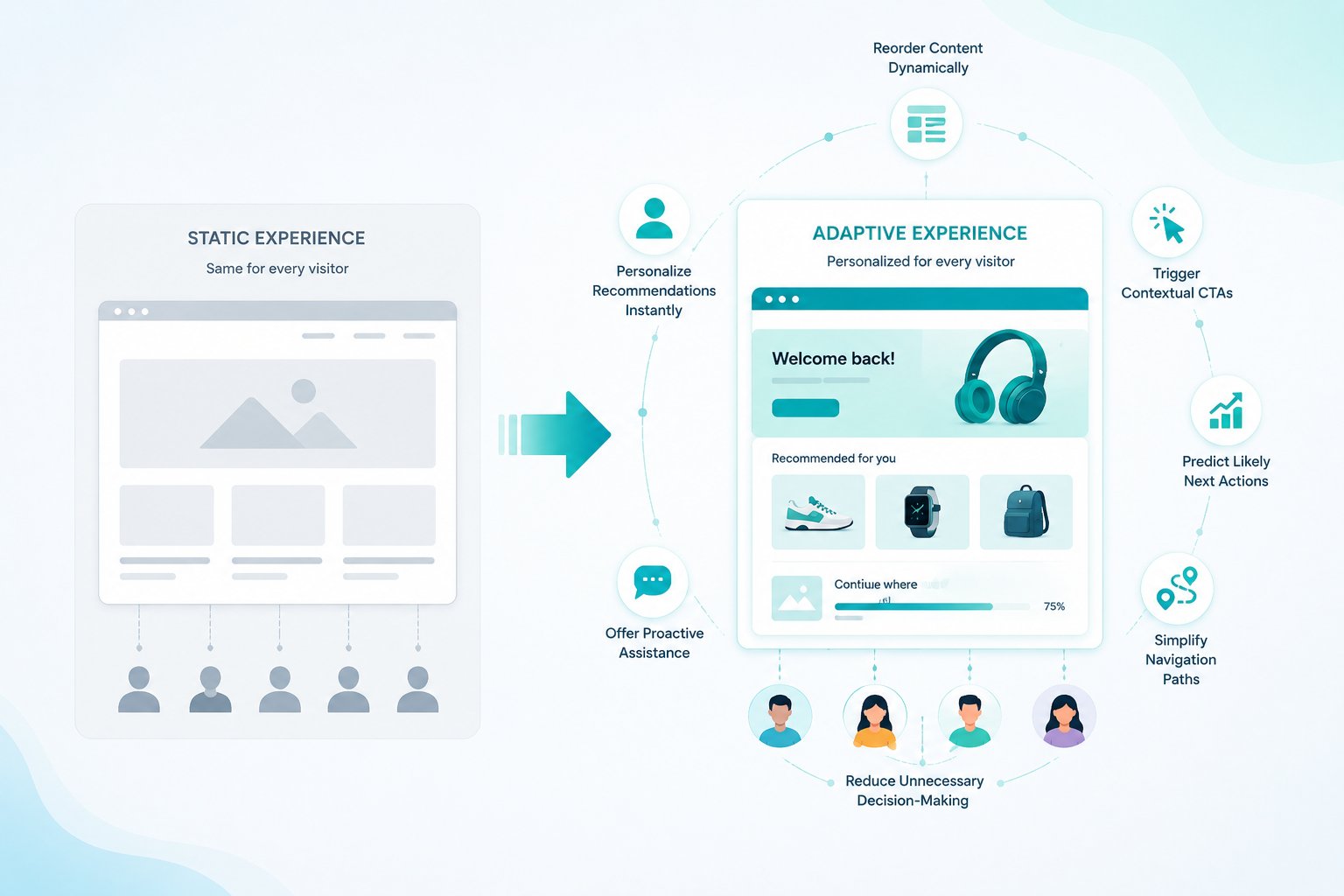
Traditional UX showed every visitor with identical experiences. Modern UX systems continuously adapt based on customer behavior, intent, and interaction patterns. Today’s intelligent systems can:
Reorder content dynamically
Personalize recommendations instantly
Trigger contextual CTAs
Predict likely next actions
Simplify navigation paths
Reduce unnecessary decision-making
Offer proactive assistance before users ask for help
Here, predictive customer experience becomes extremely powerful. Instead of reacting after users abandon a journey, businesses can now identify friction signals early and optimize experiences proactively.
McKinsey refers to this as the “next best experience” approach, where AI-powered systems determine the most relevant interaction in real time.
How Predictive Customer Experience Is Changing Engagement?
Modern customer experience is increasingly predictive rather than reactive.
Instead of waiting for customers to ask for support or guidance - businesses are now using AI and behavioral intelligence to anticipate intent. Examples include:
E-commerce platforms predicting purchase intent
SaaS products identifying churn risk early
Banking apps detecting financial behavior patterns
Streaming platforms personalizing recommendations instantly
AI chat systems anticipating support needs
The experience feels smoother because users spend less time searching, deciding, and navigating.
This directly addresses a growing digital problem - decision fatigue.
Why Decision Fatigue Is Hurting Customer Engagement?
Modern digital environments overwhelm users with excessive choices:
Too many CTAs
Overcrowded interfaces
Endless navigation paths
Complex onboarding flows
Information overload
Customers rarely leave only because something is technically broken. They often leave because the journey feels mentally exhausting. The more friction a platform creates - the faster engagement drops. Data-driven experiences reduce cognitive overload by simplifying decisions intelligently.
That is why leading brands now focus heavily on reducing cognitive friction through smarter UX optimization.
How Data-Driven Design Reduces Decision Fatigue?
Progressive Disclosure - Showing information gradually instead of overwhelming users immediately.
Personalized Journeys - Reducing irrelevant pathways and surfacing only the most relevant actions.
Smarter Information Hierarchy - Structuring interfaces around user priorities rather than internal business priorities.
AI-Guided Navigation - Helping users move forward with contextual recommendations.
The best customer experiences today are not necessarily the most feature-rich. They are the easiest to navigate confidently.
Privacy-First Personalization Is Reshaping Customer Experience
Consumers still want personalization. But they are becoming increasingly cautious about how brands use their data. This has created a major shift toward privacy-first personalization. Customers now expect:
Transparency
Consent-based personalization
Ethical AI implementation
Control over preferences
Trust-centered digital interactions
This is changing how businesses approach personalization entirely.
The future is not about collecting maximum data - it is about using meaningful first-party data responsibly and intelligently. That is why modern customer experience strategies increasingly prioritize:
Consent-driven systems
First-party behavioral ecosystems
Ethical recommendation engines
Transparent AI experiences
Trust-led personalization frameworks
The Rise of AI Assistants and Agentic Design
Another major shift happening right now is the rise of AI assistants and agentic AI systems. Unlike traditional automation tools, agentic AI systems can:
Understand intent
Execute tasks
Make contextual decisions
Adapt workflows dynamically
Coordinate across systems
This is changing how interfaces are designed. According to McKinsey’s research on agentic AI, businesses are increasingly preparing infrastructure that supports AI-driven orchestration across customer journeys.
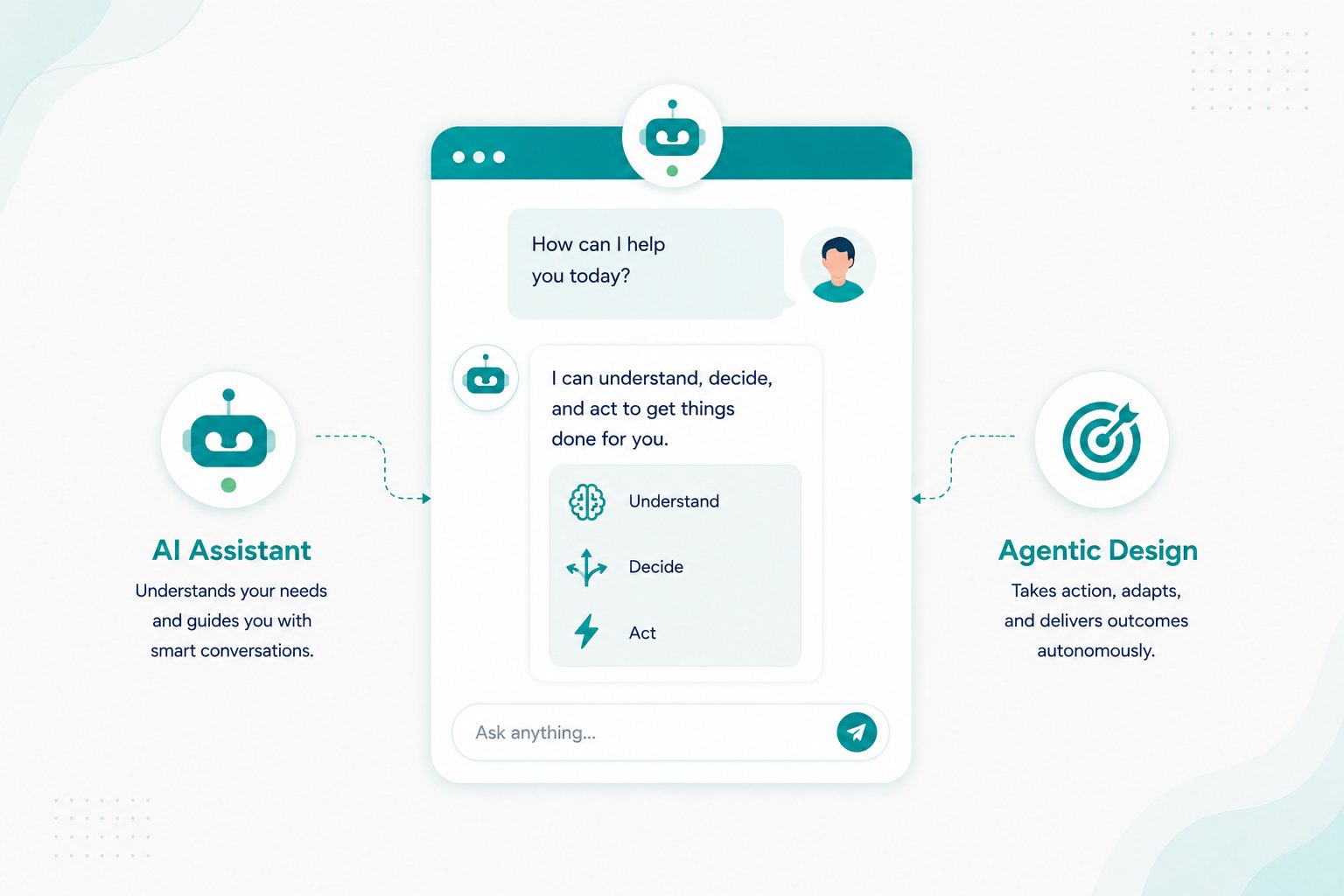
This evolution is influencing a new UX category called agentic design. Examples include:
AI-powered onboarding assistants
Smart customer support systems
Dynamic recommendation engines
Automated workflow guidance
Conversational interfaces
Intelligent search experiences
At the same time, there is growing AI skepticism among consumers. Customers are becoming more aware of:
Manipulative recommendation systems
Over-automation
Generic AI-generated interactions
Lack of transparency
Fake personalization
This is creating a new challenge for digital brands. Users want smarter experiences - but they still expect:
Human judgment
Authenticity
Clarity
Control
Trustworthy interactions
That is why successful agentic design focuses heavily on:
Transparency - Users should understand why recommendations are appearing.
Human Oversight - AI should support human experiences - not replace trust.
Ethical Automation - Automation should reduce friction without becoming intrusive.
Explainable Personalization - Customers should feel guided - not manipulated.
The future of customer experience is not “AI-first.” It is human-centered AI integration.
The Most Valuable Types of Data in Modern CX
Many companies collect enormous amounts of customer data but fail to generate meaningful insights from it. Strong data-driven design focuses on actionable intelligence instead of vanity metrics.
Here are the data categories creating the biggest impact in modern customer experience systems:
1. Behavioral Data
This data helps brands understand how customers interact with digital experiences in real time, making it essential for effective UX optimization. Key behavioral insights include:
Click behavior
Scroll depth
Exit points
Navigation flow
Session duration
Conversion pathways
By analyzing behavioral patterns, businesses can make more informed design decisions and continuously improve customer interactions.
2. Customer Feedback Data
While behavioral analytics show what users are doing, feedback data explains why they are doing it. Common sources include:
Surveys
User interviews
Review analysis
Support conversations
Session testing
Feedback loops
3. Emotional Engagement Indicators
Modern UX is becoming increasingly psychological. Brands are no longer focused only on usability - they are also analyzing how digital experiences make users feel. This includes studying:
Trust signals
Frustration indicators
Attention retention
Confidence-building interactions
Emotional engagement depth
These signals are especially important as AI-generated experiences become more common and customers grow more cautious about automated interactions.
4. Operational Data
Operational data helps businesses identify gaps that negatively impact the overall customer experience. Examples include:
Response times
Failed interactions
Drop-off stages
Repeat support requests
5. Predictive Data
Predictive Analytics helps businesses anticipate future customer behavior instead of simply reacting to past actions. Using AI and behavioral modeling, brands can forecast:
Churn probability
Conversion likelihood
Engagement scoring
Retention forecasting
When combined effectively, these datasets create far more intelligent customer experiences.
The Growing Importance of Micro-Behavior Analytics
Businesses are no longer analyzing only large conversion events. They are now studying smaller behavioral indicators that reveal intent earlier. These include:
Cursor movement
Hover behavior
Scroll hesitation
Form abandonment patterns
Navigation loops
Repeated interactions
Session inactivity
These micro-signals help businesses identify friction before customers leave. This creates opportunities to improve:
Checkout experiences
Lead generation funnels
Navigation structures
Mobile usability
Content engagement
Product discovery journeys
This approach aligns closely with how modern design and development teams are evolving toward scalable UI/UX design services and growth-focused digital systems.
The Role of A/B Testing, Heatmaps, and UX Optimization
Modern UI/UX design services increasingly depend on continuous experimentation. Some of the most valuable optimization methods include:
A/B Testing
Testing variations of layouts, messaging, CTAs, and flows to identify what performs best.
Heatmaps
Understanding where users click, pause, ignore, or abandon interactions.
Session Recordings
Observing real user behavior to identify hidden friction.
Funnel Analysis
Tracking conversion drop-offs across customer journeys.
Predictive Analytics
Using AI models to anticipate future user actions and intent.
At Make My Brand, these approaches align closely with how modern design and development services are evolving - design decisions are increasingly tied to performance, scalability, and business growth instead of visual aesthetics alone.
Why Design-Led Growth Is Becoming a Competitive Advantage?
Businesses are realizing that growth is no longer driven only by advertising budgets or traffic acquisition. Experience quality now directly influences:
Conversion rates
Customer loyalty
Retention
Brand perception
Revenue efficiency
This is why design-led growth strategies are gaining momentum across industries. The strongest digital brands today are not simply building prettier websites. They are building:
Adaptive ecosystems
Data-informed journeys
Intelligent interfaces
Trust-centered experiences
Continuous optimization systems
That requires the integration of:
UX strategy
Behavioral analytics
AI capabilities
Customer journey mapping
Performance-focused design systems
Conclusion
The future of customer experience will not be built on assumptions, static interfaces, or generic personalization. It will be built on intelligent systems that continuously learn from user behavior while balancing trust, privacy, and usability. That is the real power of data-driven design. The businesses leading the next phase of digital engagement are the ones using data responsibly to improve real customer outcomes.
Ready to turn user insights into higher engagement and conversions? Connect with Make My Brand to build smarter digital experiences.
Loading FAQs
Please wait while we fetch the questions...
Published on May 13, 2026 by Surbhi Sood