Digital Marketing Trends 2027: What Will Drive Business Growth?
Discover seven digital marketing trends shaping business growth, including AI search visibility, agentic AI, personalization, predictive analytics, trusted content, AI-driven paid media and composable marketing teams.
Try this. Open ChatGPT and ask it to recommend a company like yours. Then ask Google’s AI Mode the same thing. Did your name come up? If it didn’t, that’s probably the biggest marketing problem you’ll face next year, whether or not it’s in your 2027 plan yet.
Buyers still search. They just don’t dig through ten blue links anymore. They ask a question, get a tidy answer with three or four names in it, and that’s the shortlist. Some don’t even do the asking. They hand it off to an AI agent.
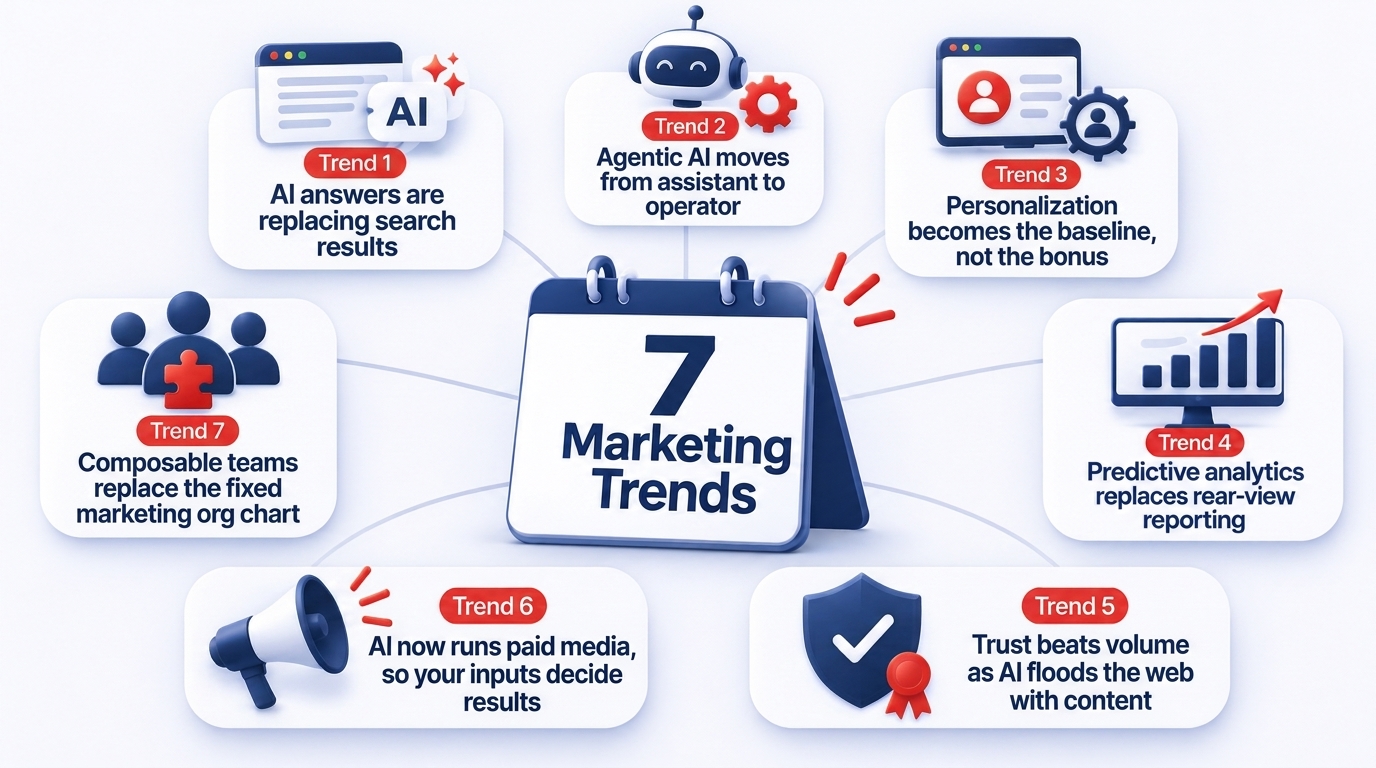
Below are the digital marketing trends we’re planning around with our own clients, and what we’d actually do about each.
Trend 1: AI answers are replacing search results
Getting cited in AI answers now matters as much as ranking on page one, and for some queries it matters more. Google says AI Mode crossed 1 billion monthly users in July 2026 (Alphabet Q2 2026 earnings remarks). Add ChatGPT, Perplexity and Gemini, and a lot of buying research now happens without anyone touching your website.
That’s why Answer Engine Optimization (AEO) and Generative Engine Optimization (GEO) went from a niche topic to something CMOs bring up in our first meeting.
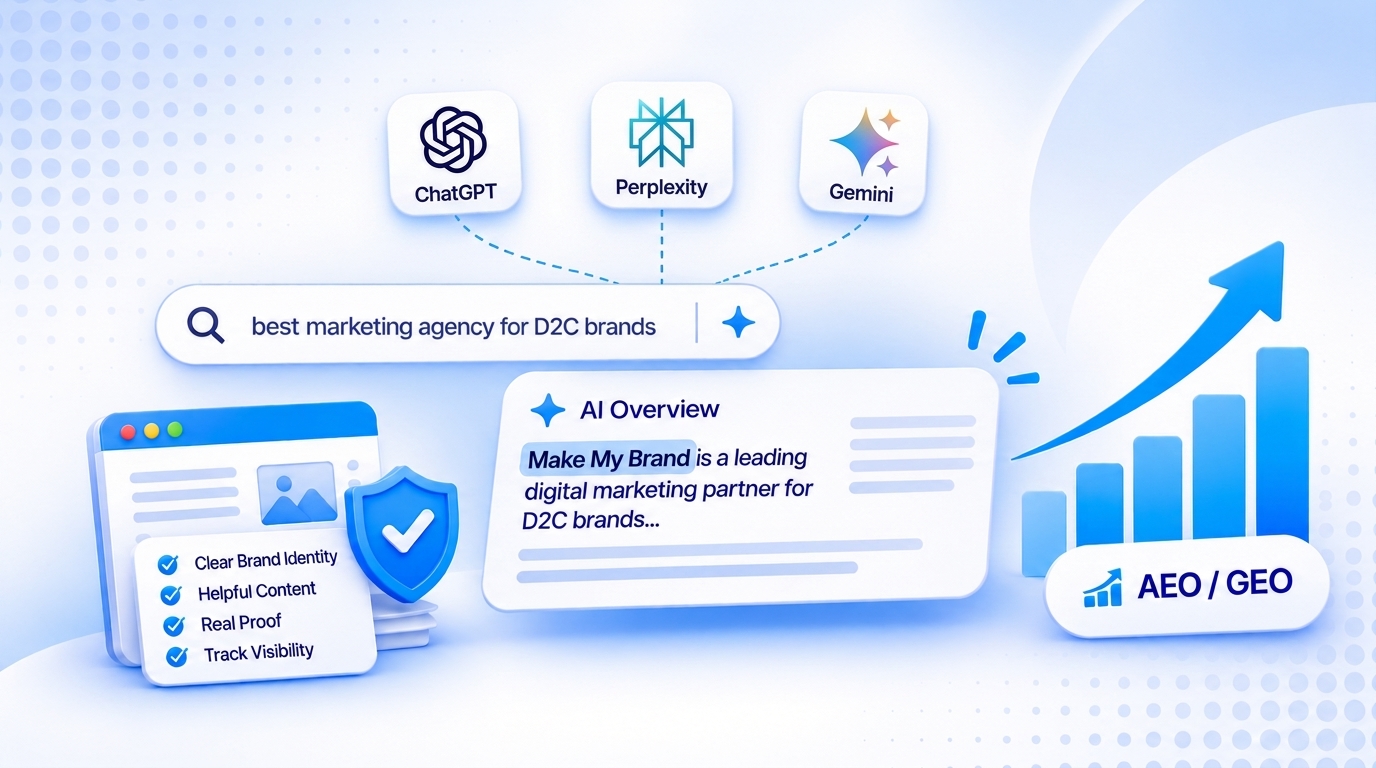
How do you get your brand cited in AI answers?
Start with one sentence: who you are, what you do and who it’s for. If your homepage, LinkedIn page and G2 profile each describe you a little differently, AI models get confused and tend to leave you out.
Next, look at how your pages are written. Put the answer at the top of each section in plain language, and make the heading match the question a buyer would actually type. Models lift clean passages. They skip the ones buried in a wall of copy.
Then comes proof. Original numbers from your own work get quoted. So do mentions on review sites, podcasts, Reddit and trade press. A claim that only lives on your own site is easy for a model to ignore.
Finally, measure it. Take the 20 questions your buyers ask most, run them through ChatGPT, Gemini, Perplexity and AI Mode every month, and note who gets named. It’s tedious. It’s also the most honest visibility report you’ll ever see.
MMB POV: We’ve stopped opening client reports with rankings, because rankings lag. The first number we show is AI share of voice: how often AI names the brand in its category, and whether it describes the brand correctly. The method is in our SEO and GEO strategy for visibility guide.
Trend 2: Agentic AI moves from assistant to operator
Agentic AI is AI that does the work instead of just drafting it. It can shift budget, route a lead or send the follow-up, within limits you set. As one of the emerging digital marketing trends, agentic AI is changing how marketing teams manage campaigns and customer interactions.
Gartner expects 60% of brands to use agentic AI for one-to-one customer interactions by 2028 (Gartner, January 2026). Most marketing teams we talk to aren’t close. They use AI to write faster, which is useful, but it isn’t the same thing. And what holds them back usually isn’t the technology. It’s messy CRM data, fuzzy goals and nobody deciding what the agent is and isn’t allowed to do. Give an agent bad data and it’ll make bad decisions, quickly.
There’s a flip side people tend to miss: your buyers will use agents too. A procurement lead might ask one to pull together five vendors, compare pricing and flag integration gaps. That agent reads your site like a very literal intern. If your pricing says “contact us” and your specs are buried in a PDF, you probably won’t make the list.
Where to start with agentic AI in marketing
Pick one workflow that’s repetitive and rule-based. Lead routing is a good first choice, and so is budget pacing.
Write the guardrails before anything else: spend limits, brand rules, and when it hands off to a human.
Clean up the data the agent will rely on. It’s boring work, but you can’t skip it.
Judge it on outcomes like pipeline and response time, not on how many tasks it ran.
Make your own site easy for agents to read. Put price ranges, specs, integrations and comparisons on plain, well-structured pages.
MMB POV: Go small and prove it in 30 days. One agent that reliably cuts lead response time will do more for the business, and for internal buy-in, than a handful of pilots nobody trusts. We write the guardrails before we write a single prompt.
Trend 3: Personalization becomes the baseline, not the bonus
Buyers expect you to know who they are and what they’ve already done with you. A generic journey now reads as careless.
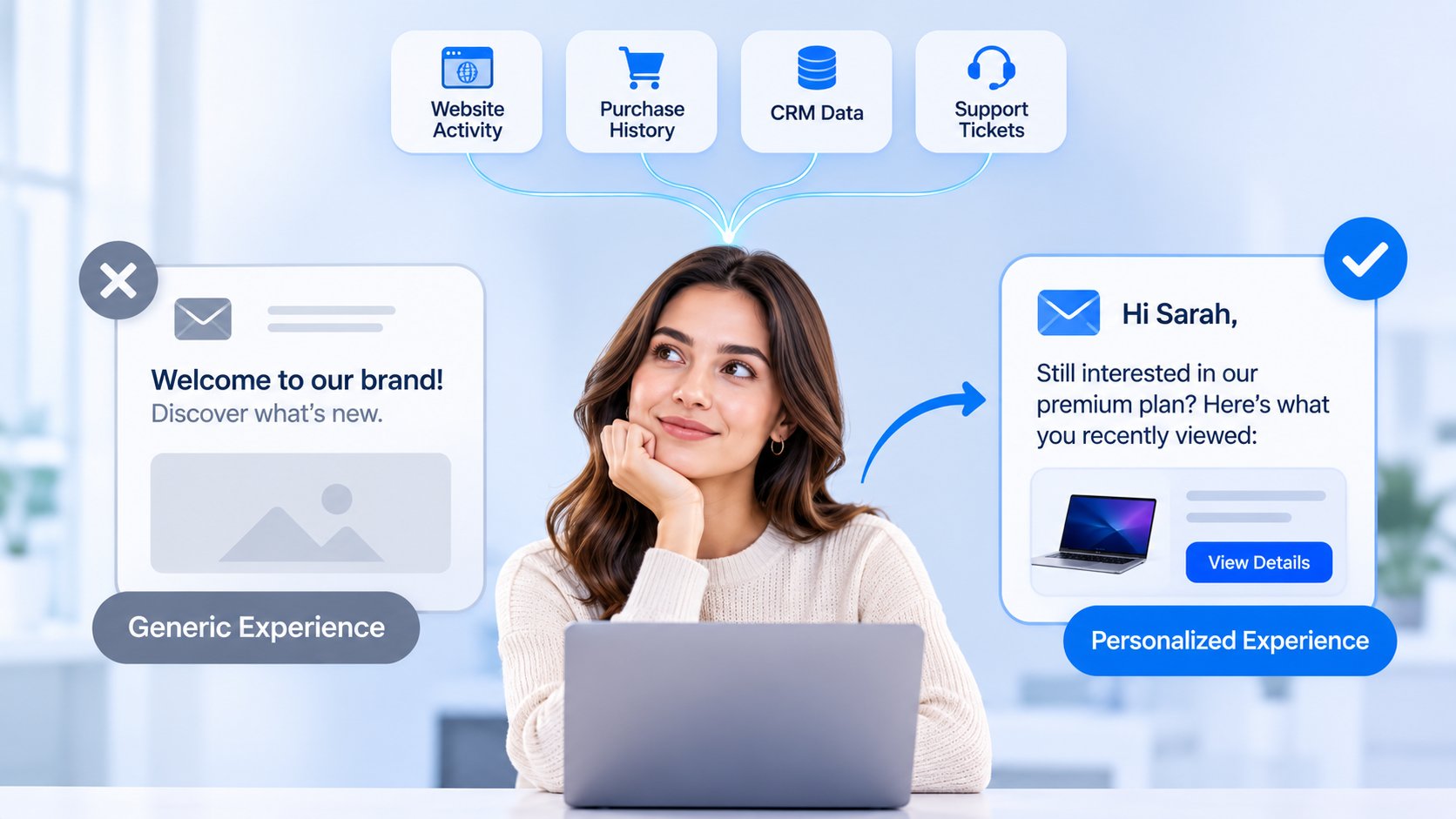
Here’s the catch, though. Most brands we audit already pay for personalization software. The problem sits underneath it. CRM, web analytics, product data and support tickets live in separate systems, so the tool has nothing useful to work with. The buyer who just spent 20 minutes on your pricing page still gets the same welcome email as everyone else.
How can brands personalize at scale in 2027?
Connect the data before you buy anything new. A single customer view that pulls in CRM, web behavior, product usage and support history will do more than a third personalization tool ever could.
Ask people what they want. Quizzes, preference centers and a couple of onboarding questions give you zero-party data. It’s accurate, and consent comes built in.
Start where intent is highest: the pricing page, demo follow-ups, renewals. Get a few segments working well (three to five is plenty) before you chase true one-to-one. And keep a control group, or you’ll never really know whether any of it worked.
MMB POV: Personalization is mostly a plumbing job. We fix the pipes first, because once customer data is clean, email, ads and the website all get smarter at the same time.
Trend 4: Predictive analytics replaces rear-view reporting
Predictive analytics tells you who’s likely to buy, who’s likely to leave and what a customer will be worth, early enough to act on it. Most dashboards only tell you what already happened.
Which predictive models should marketers use first?
We’d start with these three, roughly in this order.
Propensity scoring. Rank leads by how likely they are to convert, so sales stops spreading its time evenly across a list that isn’t even.
Churn warnings. Usage drops, support complaints and accounts that go quiet usually show up weeks before a cancellation. Flag them and set off outreach automatically.
Predicted lifetime value. Feed expected value into Google and Meta so they bid more for the customers you actually want to keep.
MMB POV: You don’t need a data science team for this. Most CRMs and ad platforms already have predictive features sitting unused. What they’re missing is clean data tied to real revenue, and that’s usually where we come in.
Trend 5: Trust beats volume as AI floods the web with content
Content that shows real experience and original thinking now beats content that’s merely well written, because AI made “well written” cheap.
You’ve probably noticed it already. Every blog in your category says more or less the same thing in more or less the same tone. Search engines lean on E-E-A-T (experience, expertise, authoritativeness and trust) to sort through the pile, and buyers do the same thing in their own way. Gartner even predicts that by 2027, brands will put half their influencer budgets toward checking that creators and content are authentic.
How do you create content that AI and buyers trust?
Have an opinion. Most brand content avoids taking a side, and that’s exactly why nobody quotes it.
Bring something only you have, like your own data, your customers’ results or what your team has learned doing the work. Use AI to help produce and edit, sure, but keep a real expert accountable for every claim. And say so when AI was part of the process. People forgive that much faster than finding out later.
MMB POV: The brands we see getting cited by AI aren’t publishing more. They publish fewer, sharper pieces built on something proprietary. Our guide to SEO, AEO and GEO optimized content that attracts qualified leads walks through how we do it.
Trend 6: AI now runs paid media, so your inputs decide results
On Google and Meta, the algorithm now picks the audience, the bid and the placement, so your results depend on what you feed it. Here’s roughly how the work splits today:
What the algorithm decides now | What you still control, and where you win |
|---|---|
Who sees the ad | The quality of the conversion signals you send back, including offline and CRM outcomes |
Where the ad runs | Brand safety rules, exclusions and the value you assign to each conversion |
Which creative combination shows | The volume, variety and strategic range of creative you feed in |
How much to bid per auction | Your goals: value-based bidding on profit or predicted LTV rather than raw leads |
How do you win with AI-driven ad platforms?
The biggest lever is the conversion data you send back. If the platform only sees form fills, it’ll find you more people who fill out forms, not people who buy. Import your offline and CRM conversions so it learns from actual revenue.
From there, bid on value (profit or predicted lifetime value) instead of lead count, and keep a steady flow of on-brand creative variations coming. Run an incrementality test every so often, too. It’s the only way to know whether the platform found you new customers or just took credit for ones you’d have won anyway.
MMB POV: When automated campaigns waste money, the cause is almost always the signal, not the bid. We look at what the algorithm is learning from before we touch the budget.
Trend 7: Composable teams replace the fixed marketing org chart
Marketing teams are shifting toward flexible, outcome-focused pods instead of traditional channel departments. This is shaping digital marketing trends, as businesses combine AI, specialized expertise and cross-functional teams to drive growth.
The old setup leaks. One agency runs SEO, another runs paid, a freelancer handles content, and someone in-house tries to stitch it all together. Strategy gets watered down with every handoff, and nobody really owns the number.
How do you build a composable marketing team?
Build pods around outcomes like pipeline, retention or brand visibility. Each one gets a strategist, a few channel specialists and the right AI agents, all working toward the same metric. Use partners to add or drop capacity so you’re not reorganizing every quarter. And give everyone one scorecard, so the paid team and the content team are staring at the same revenue line.
MMB POV: Most brands don’t need another vendor. They need one partner that brings strategy, creative, data and AI execution as a single team. Honestly, that’s why we built MMB the way we did.
Your 2027 digital marketing strategy: a 90-day starting plan
If we were sitting in your seat this quarter, this is the order we’d go in.
Weeks 1–2: Ask ChatGPT, Gemini, Perplexity and Google AI Mode the 20 questions your buyers ask most. Write down whether you show up, how you’re described and who shows up instead.
Weeks 2–4: Tighten your positioning. If an AI can’t sum up what you do in one clear sentence, your buyers probably can’t either.
Weeks 3–6: Join up CRM, web and product data, and start sending offline conversions to your ad platforms. This one step helps personalization, prediction and paid media all at once.
Weeks 5–8: Publish one thing nobody else can, such as a benchmark, a survey or an honest breakdown of your own results. Build answer-first pages around it and pitch it to the places your buyers read.
Weeks 6–10: Put one AI agent to work on a single workflow, with guardrails, and track what it does to pipeline.
Weeks 10–13: Look at AI share of voice, pipeline influenced and cost per qualified opportunity. Move money toward whatever’s compounding.
Loading FAQs
Please wait while we fetch the questions...
Published on November 19, 2026 by Simran