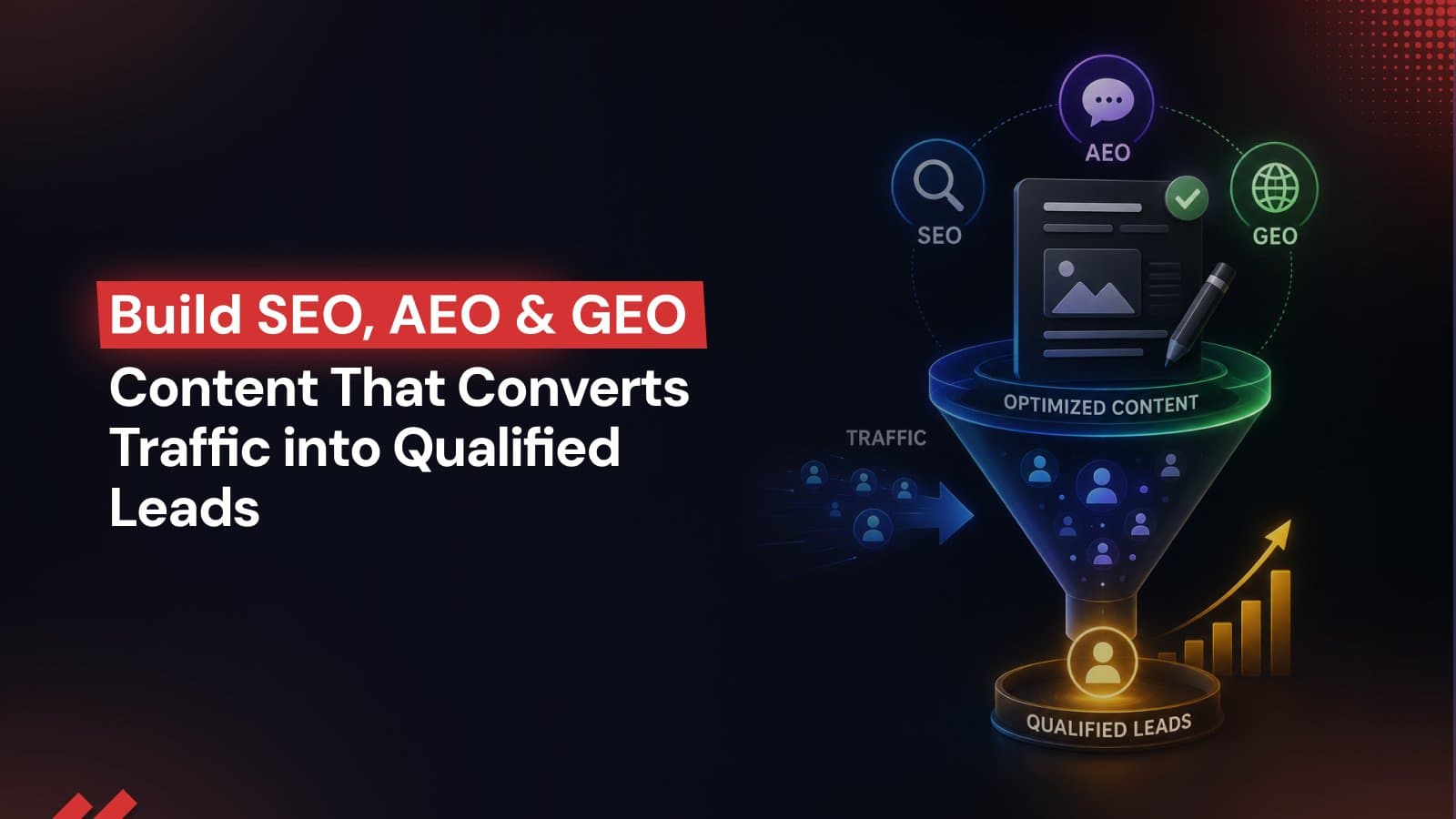
How to Build SEO, AEO & GEO Optimized Content That Converts Traffic into Qualified Leads
As search shifts toward AI generated answers, learn how to optimize content for SEO, AEO, and GEO to increase visibility, improve machine readability, and drive qualified lead generation across modern search experiences.
As the digital discovery ecosystem evolves, classic search rankings no longer guarantee pipeline velocity. Generative AI and conversational answers now dominate, turning traditional search into a highly integrated recommendation economy. Capturing high-intent customer acquisition requires a unified SEO, AEO, and GEO content strategy. By aligning technical crawlability with structured, machine-readable authority, businesses can secure critical citations across platforms, converting zero-click visibility into highly qualified lead generation.
In this blog, we examine the mechanics of the zero-click economy and outline how a unified SEO, AEO, and GEO strategy can convert passive AI interactions into a predictable, high-intent lead.
The Evolving Search Ecosystem: Deciphering the Zero-Click Economy
The mechanics of how buyers discover services are undergoing a structural shift. The decades-old model, where a user types a short query into a search engine and clicks through a list of indexed links, is being replaced by an ecosystem driven by conversational synthesis and real-time context compilation.
This evolution is fundamentally altering organic traffic patterns. According to SEMrush, 58.5% of Google searches in the United States now end without a single click to an external domain.
As generative summaries resolve user intent directly on the results page, the traditional click-through pipeline is experiencing significant friction. This shift is driven by massive enterprise investments in cognitive technologies. Gartner forecasts that worldwide spending on artificial intelligence will total $2.52 trillion, representing a 44% year-over-year increase.
For organizations focused on B2B demand generation, this transition demands a new perspective on content marketing ROI. Classic keyword matching is no longer sufficient when 94% of business buyers consult generative AI tools during their vendor evaluation process.
Rather than chasing raw search volume that evaporates into zero-click results, modern content marketing services must optimize for inclusion within the direct answers generated by AI-assisted platforms. To achieve this, companies are partnering with specialized growth partner like Make My Brand to restructure their digital assets for maximum visibility in the AI search era.
The Integrated Search Triad: SEO, AEO, and GEO
Navigating this new environment requires an integrated search ecosystem optimization approach. Winning in this competitive space is not about choosing between traditional ranking, voice-activated answers, or generative citations. Instead, it requires building a stacked content architecture where each discipline serves as a distinct layer.
.png)
1. Search Engine Optimization: The Foundation
Traditional SEO remains the bedrock of digital discoverability. AI crawlers and large language models do not generate knowledge in a vacuum - they crawl, parse, and index the web using the same technical protocols that search engines have used for decades.
A high-performance website, built with clean mobile-first architecture, rapid server response times, and an organized sitemap, determines whether an AI bot can access your content in the first place.
2. Answer Engine Optimization: The Answer Layer
AEO focuses on structuring content, so search engines can easily extract and deliver immediate answers to user questions. This discipline targets zero-click features like Google’s featured snippets and voice search assistants.
By designing highly specific, question-based content blocks, AEO positions your brand as the definitive answer directly on the results page, earning authority even when a click does not occur.
3. Generative Engine Optimization: The Recommendation Layer
GEO focuses on optimizing your brand’s total digital footprint through advanced AI search optimization practices so that generative models cite, mention, and recommend your business when synthesizing conversational answers.
Unlike traditional SEO, which focuses on ranking in a list of links, GEO is about building the deep topical authority and external trust signals required to be selected as a primary source of truth by AI models.
The practical value of this integrated approach is illustrated by real-world growth campaigns executed by the team at Make My Brand. Through their proprietary BDLC framework, Make My Brand combines technical SEO, targeted AEO structuring, and authoritative GEO distribution to help businesses scale their revenue and secure predictable leads.
Real-World Execution: Turning Search into Revenue
High-Urgency Local Capture
For United Building Solutions, the team rebuilt the brand's search architecture, separating call-only and inquiry-focused ad groups. By optimizing mobile landing pages for immediate conversion, the campaign generated 320 high-intent phone calls and 107 verified online conversions.
Search-Led Brand Footfall
For Vancouver-based Eat Bar & Patio Haraheri, the firm mapped high-intent local queries and deployed structured local schemas, driving over 20,000 users from organic search and turning local digital visibility into real-world footfall.
The Science of Machine Readability
To build a content strategy for lead generation that performs well in the AI era, you must understand how machines read, interpret, and cite digital assets.
Entity SEO and Digital Authority
Generative search engines do not merely match keywords. They evaluate the relationships between "entities", which are defined as unique, verified, and well-documented concepts, organizations, or individuals.
When a buyer asks an AI engine for a vendor recommendation, the algorithm calculates an Entity Resolution Score (ERS) based on how clearly and consistently your brand’s identity is represented across the web. If your company description, product specifications, or executive profiles are inconsistent across directories, social channels, and press releases, the AI's confidence in your brand drops, and your competitors are recommended instead.
The Mechanics of Query Fan-Out
To design content that gets cited, you must align with the technical process of "Query Fan-Out." When a user enters a complex prompt, such as:
"Which cybersecurity integration is most secure for a mid-market financial platform?"
The underlying AI model does not execute a single search. Instead, it "fans out" that prompt into multiple simultaneous sub-queries, retrieving distinct data points on compliance standards, competitor pricing, and user reviews.
To be included in the final synthesized answer, the website content strategy for lead generation must anticipate these sub-questions. By breaking down broad topics into precise, modular sections, your content becomes highly extractable for these parallel search queries.
Citation Engineering Tactics
Earning citations within AI-synthesized responses is a structured engineering process, not a creative exercise. Modern SEO copywriting services increasingly focus on creating content structures that improve both human engagement and AI citation potential. To optimize your content for machine retrieval, implement these structural principles:
The 40-to-60-Word Answer Capsule
Place a concise, direct summary immediately below your question-based H2 or H3 headers. This matches the ideal length that models lift verbatim for snippets and overview summaries.
Structured Data and Schema Markups
Implement advanced JSON-LD schemas, such as FAQPage, Product, HowTo, and Organization. This feeds Google's Knowledge Graph directly and makes your technical specifications easily parseable for bots.
Factual Density and Information Gain
Replace vague brand positioning with concrete, qualitative data, proprietary statistics, and structured HTML tables. AI engines are structured data consumers, they cite HTML comparison tables 2.5 times more frequently than standard prose.
Off-Site AI Reputation Management & Trust Signals
Optimizing your own website is only half the battle. Generative models show a strong bias toward earned media, independent third-party mentions, and public discussion. This shift is redefining content marketing in the AI era, where external validation often carries greater weight than brand-owned assets.
To manage your brand’s reputation across AI models, you must optimize for how different platforms source their information:
ChatGPT Search
Heavily correlates with Bing's organic search index and favors sites with high domain authority and clean link architectures.
Perplexity
Prioritizes deep data density, frequently citing original research, technical white papers, and industry directories.
Claude
Highly values peer-to-peer discussion and community platforms, sourcing recommendations from Reddit, Quora, and G2 at a significantly higher rate than other engines.
Google Gemini
Heavily prioritizes verified brand entities, direct Google Business Profile data, and authoritative news coverage.
Overcoming the Challenges of Modern Search Implementation
Transitioning your content strategy to succeed across SEO, AEO, and GEO introduces several distinct strategic and operational challenges.
1. Inconsistent Brand Signals Across the Web
The most common point of failure is a fragmented digital footprint. Outdated press releases, inconsistent service descriptions on social profiles, and varying contact details confuse AI models. When an AI engine encounters conflicting data about a brand, its entity confidence drops, causing the algorithm to skip the brand entirely to avoid generating inaccurate answers.
2. High Technical and Rendering Complexity
AI crawlers operate on highly compressed timelines and often struggle to render complex client-side JavaScript. If your website’s core content, schema, or pricing tables exist only after JavaScript execution, AI bots may fail to capture them. Ensuring server-side rendering (SSR) and maintaining exceptional page speeds are non-negotiable for AI visibility.
3. Content Freshness and Citation Decay
AI models prioritize novelty, making content updates an essential component of both SEO content strategy and long-term AI visibility. A highly authoritative guide published last year will lose citation share to a newly updated, well-structured resource. Preventing citation decay requires a systematic content refresh cycle, ensuring your statistics, dates, and market references are continuously kept up to date.
4. Zero-Click Attribution Gaps
Traditional marketing relies on clear, click-based metrics. In a zero-click marketing environment, measuring ROI requires transitioning to modern tracking parameters. Teams must monitor Share of Voice (SoV) across target prompt sets, track unlinked brand mentions, and measure the high-intent conversion rates of referral traffic arriving directly from AI search tools.
The Emerging Frontier: Agentic Search
While the current landscape is defined by conversational AI, we are witnessing the nascent stages of agentic search. This is an emerging technology where AI systems evolve from passive assistants into autonomous agents that can research, compare, and recommend vendors independently, performing multi-step workflows on the user's behalf.
Unlike current generative models that simply summarize information, agentic search will be capable of executing tasks such as booking a consultation, comparing pricing tiers, or verifying insurance coverage directly within the interface.
Conclusion
The evolution of digital discovery is a permanent shift in how buyers research and select partners. Relying on traditional keyword placement alone is no longer enough to support a healthy sales pipeline. Surviving and leading in this new environment requires a unified program that coordinates traditional SEO infrastructure, direct AEO answer blocks, and authoritative GEO citation networks.
Connect with the growth team at Make My Brand to align your content architecture with the realities of modern AI search ecosystem.
Loading FAQs
Please wait while we fetch the questions...
Published on June 19, 2026 by Surbhi Sood