Website Content Strategy for Lead Generation: Turning Traffic Into Qualified Leads
A strong website content strategy does more than attract traffic. It turns visitors into qualified leads by aligning content with buyer intent, AI search visibility, and conversion goals. Learn how structured content, optimization, and attribution create sustainable business growth.
The digital market has shifted from passive discovery to AI-driven synthesis. In an era of zero-click search and anonymous self-directed buying, a website can no longer function as a static brochure. To bridge the gap between initial visibility and pipeline generation, organizations require a comprehensive website content strategy for lead generation that addresses both human decision-makers and machine-learning search crawlers.
This blog breaks down the content architecture required to ensure your brand is not only discovered by generative AI but also positioned as the primary authority for your targeted audience.
The New Search Reality: Aligning with the Zero-Click and AI-Driven Landscape
To build an effective lead generation website, one must first recognize that the definition of website traffic has fundamentally changed. The traditional model of attracting visitors through generic, high-volume keywords and routing them to a landing page is yielding diminishing returns. Today, search has bifurcated into transactional query resolution and conversational synthesis, a shift driven by search engine platforms prioritizing direct answers directly on the search engine results page.
This zero-click marketing reality means that up to 60% of search queries on Google now resolve without a single click to an external domain. Rather than fighting this trend, a sophisticated content marketing strategy for lead generation embraces it by optimizing for brand imprinting and AI discoverability.
The goal is to optimize for both brand discoverability and machine indexability, ensuring that when AI platforms synthesize an answer, they cite and recommend your brand as the primary authority.
According to rigorous academic research on Generative Engine Optimization (GEO), specific structural adjustments to website content can yield a substantial increase in AI search visibility.
Alongside, GEO adapting to this environment requires utilizing Answer Engine Optimization (AEO) and AI Search Optimization (AISO). This is done by drafting and structuring content in a way that lets machine-learning models easily parse, extract, and verify information.
Designing Content for Machine Retrieval
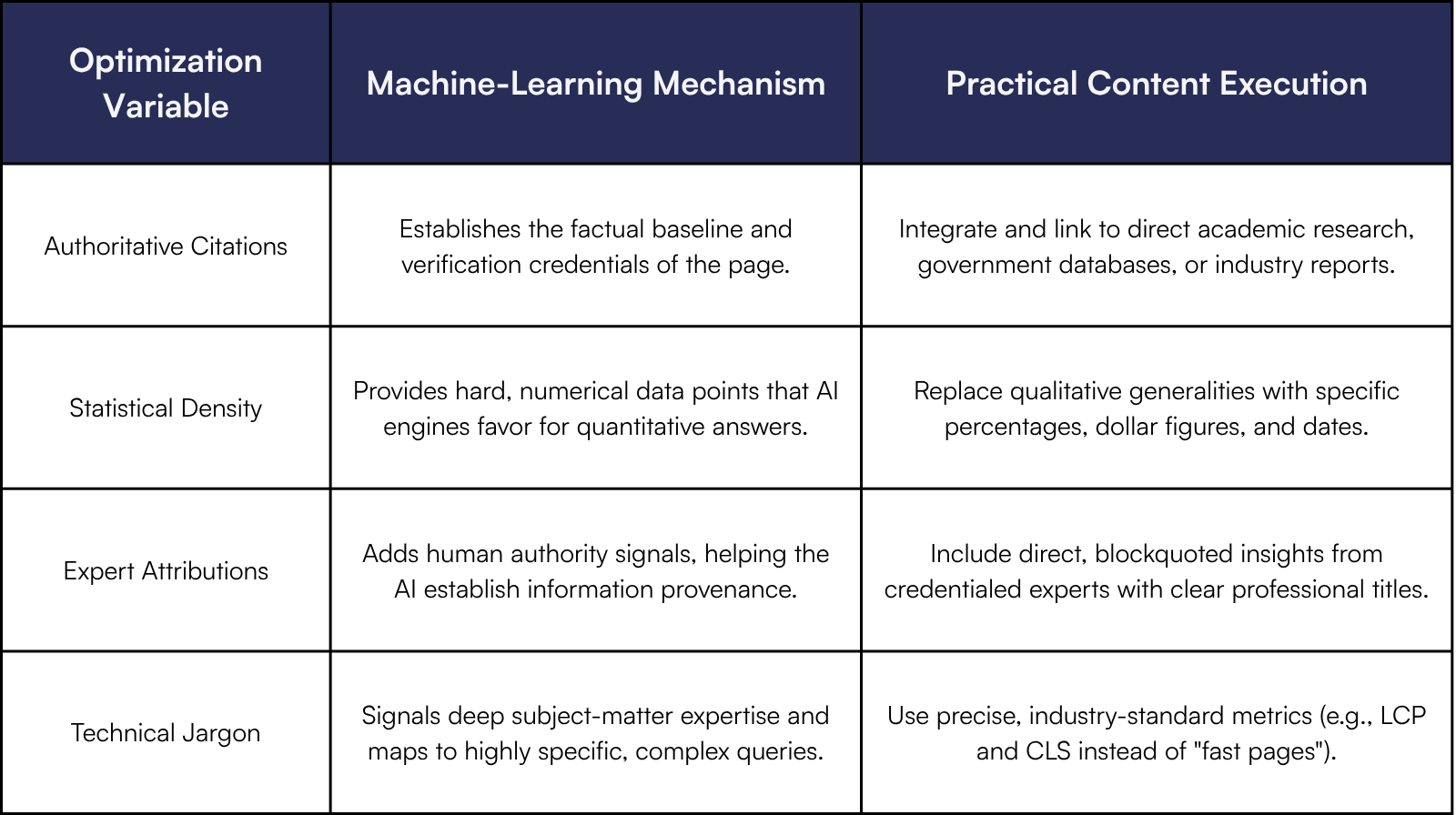
Implementing these data-dense structures does not mean sacrificing user readability. Instead, it requires structuring the content funnel strategy using the inverted pyramid format.
Placing a highly concise, 40-to-60-word direct answer immediately below a descriptive heading allows conversational search crawlers to extract the core definition instantly, while human readers can continue reading for deeper contextual analysis.
Managing these technical and operational conversion pathways is central to the growth frameworks managed by Make My Brand.
Architecting an Intent-Based B2B Content Marketing Strategy
Generating leads is no longer about high-volume traffic - it is about reaching the right audience with highly relevant information. The modern buying journey is complex and non-linear, with purchasing committees conducting extensive, anonymous research long before they ever engage with a sales representative. To capture this high-intent traffic, the B2B content strategy must offer deep, self-service utility that guides prospects through their decision-making process.
Modern website content strategy frameworks must move past keyword density and focus on "Intent" and "Entity-Based" content architecture. Search engines no longer view queries as isolated text strings - they view them as requests for relationships between semantic entities.
Furthermore, because of "Query Fan-Out", where an AI engine breaks down a single user prompts into multiple sub-questions, a website must build comprehensive topical depth around its core offerings.
To support this complex buyer behavior, leading organizations are replacing generic resources with "Revenue Content Hubs," often developed through specialized content marketing services that align content with revenue objectives. These centralized hubs are systematically organized to host high-utility buyer enablement content, mapping directly to the distinct stages of the purchasing journey.
To move prospects naturally through these stages, content marketing must be mapped directly to their specific operational priorities:
1. Problem Identification and Solution Exploration
At the top of the funnel, prospective clients are working to articulate their business challenges. The most effective lead generation content strategy at this stage is the "anti-pitch post".
Unlike standard marketing copy that aggressively pushes a product, an anti-pitch post focuses on objective education, mapping out industry challenges, and transparently outlining who the product is not for.
This clinical transparency builds immediate trust, enhances the brand’s authority signals, and filters out low-intent traffic before it consumes valuable sales resources.
2. Requirements Building and Supplier Selection
As buyers move toward evaluating solutions, they require interactive, self-service tools. Providing assets like ROI calculators, technical integration sheets, and detailed comparison guides directly supports their decision-making process.
3. Validation and Consensus Creation
At the final decision stage, the buying committee must justify their investment to internal finance and operational stakeholders. The primary assets at this juncture are detailed, objective case studies that provide clear, verifiable proof points.
This rigorous approach is demonstrated in Make My Brand’s strategic optimization of Seasia Infotech's digital presence. By mapping 50+ service pages to high-intent queries and resolving technical performance barriers, they achieved 40% faster load times. This overhaul successfully synthesized technical metadata with an automated sales workflow, creating a highly efficient, scalable engine for lead capture.
Website Conversion Optimization: Turning Traffic into Qualified Leads
Attracting high-intent traffic to a lead generation website is only the first step - the primary objective is converting website visitors into leads. To surpass standard conversion rates, organizations must implement sophisticated website conversion optimization strategies that personalize the visitor experience in real-time.
Modern conversion optimization moves beyond static lead forms to leverage dynamic, behavior-driven user experiences:
Behavioral Scoring and Intent-Based Pop-ups
Static pop-ups that appear immediately upon page entry increase friction and raise bounce rates. Instead, modern websites use behavioral scoring to track visitor actions like scroll depth, repeat visits to pricing pages, or specific content marketing consumption patterns.
When a visitor meets high-intent criteria, the system triggers targeted, intent-based pop-ups that offer highly relevant assets, such as a tailored whitepaper or a localized case study, matching their exact stage in the buying cycle.
Structured Technical Authority (E-E-A-T)
Both search crawlers and sophisticated buyers look for explicit security and authority signals. Integrating structured Schema markup, such as Product, Review, or Organization data, directly into a page’s code provides search engines with verifiable, machine-readable information. This practice establishes a solid foundation for organic visibility by clearly communicating details like pricing, specifications, and customer satisfaction metrics.
Conversational Automation
Promptly addressing prospective clients is critical to conversion success. To maintain this responsiveness at scale, leading enterprise sites deploy AI sales assistants, conversational qualification bots, and automated meeting-booking agents.
These tools operate continuously to engage visitors, qualify intent, answer complex objections, and schedule qualified sales meetings directly onto sales calendars.
Verifying Pipeline Impact: Advanced Multi-Touch Revenue Attribution
Investing in an advanced website content strategy requires a robust framework for tracking content marketing ROI and proving revenue impact. Standard metrics like page views, social shares, and session durations are useful diagnostic indicators, but they fail to show how specific content marketing assets contribute to closed-won revenue.
Leading B2B organizations are moving toward multi-touch revenue attribution to clearly understand how their content assets influence the sales pipeline.
Implementing multi-touch attribution is especially important in complex B2B sales cycles that involve multiple stakeholders and touchpoints over several months. By utilizing advanced attribution platforms, organizations can accurately map the touchpoints that led to a sale, helping marketing teams optimize their budgets and prioritize the content formats that drive the highest conversion rates.
First-Touch Attribution
Attributes all conversion value to the initial content asset that introduced the visitor to the brand. This is highly effective for measuring the ROI of top-of-funnel awareness campaigns but overlooks the mid-and-bottom-funnel assets that helped nurture the lead.
Last-Touch Attribution
Attributes all conversion value to the final asset the user engaged with before converting. While excellent for identifying the specific bottom-of-funnel assets that drive conversions, it fails to recognize the educational assets that initially captured and warmed up the prospect.
Linear Multi-Touch
Distributes revenue credit equally across every content asset the prospect touched during their journey. This provides a balanced view of the entire customer journey, though it treats minor touchpoints with the same value as high-intent downloads.
W-Shaped Attribution
Allocates the majority of the credit to three key transition points, first-touch, lead creation, and opportunity creation, while distributing the remaining credit across the touchpoints in between. This model provides an exceptionally clear view of the B2B content journey but requires robust CRM integration.
The Next Frontier: Adapting to Agent-to-Agent Communication
As organizations prepare for the future of marketing, a major technological shift is emerging - the rise of autonomous AI agents interacting directly with other AI systems. In this emerging model, buyers will deploy their own personalized AI search assistants to query, evaluate, and negotiate with seller platforms.
This means that a website's content must be optimized not just for human readers, but also for machine-to-machine exchange. Achieving this requires establishing "structured expertise signals."
Implementing precise, server-rendered schema markup and linking your brand's digital profiles to verified knowledge bases allows AI agents to instantly verify your credentials, cross-reference pricing, and assess product compliance. Ensuring your technical infrastructure is built to support these autonomous interactions will be critical to maintaining market visibility.
Conclusion: Building a Unified, Future-Proof Growth Architecture
Developing a high-performing lead generation website is not a single, isolated project - it requires the continuous alignment of website content strategy, user experience, and technical optimization. By designing authoritative, structured content that serves the self-service needs of modern buyers, while formatting pages to ensure easy indexing and citation by generative AI engines, enterprises can build a highly resilient digital presence.
Contact the growth experts at Make My Brand today to architect a high-performance content strategy.
Loading FAQs
Please wait while we fetch the questions...
Published on June 16, 2026 by Simran