10 Proven E-Commerce Growth Strategies to Boost Sales in 2026
E-commerce growth is driven by faster decision-making, not just traffic. Discover how AI personalization, predictive commerce, social ecosystems, and trust-first UX help brands reduce friction, increase conversions, and scale revenue with smarter growth systems.
Most e-commerce brands are losing conversions- not because of lack of traffic, but because of slow decision-making experiences. In 2026, winning e-commerce growth strategies are no longer about driving clicks- they are about accelerating buying decisions.
Modern e-commerce growth strategies are now driven by:
Real-time behavioral data
Social commerce ecosystems
Predictive recommendations
At Make My Brand, we analyze these evolving patterns to build full-funnel growth systems- but first, let’s break down what’s actually working in today’s e-commerce landscape.
In this blog, we break down the most current, high-impact e-commerce growth strategies shaping how modern brands drive revenue in 2026.
The Shift: From Funnel Thinking to Decision Engineering
Modern e-commerce growth strategies are shifting from linear funnels to decision-driven journeys, where users interact across multiple touchpoints before purchasing.
Discover products via short-form video and influencers
Validate decisions through reviews and social proof
Expect instant answers via AI chat or assistants
Compare options across multiple platforms
The result - growth now depends on how quickly and confidently a user can decide. That’s why the e-commerce growth strategies below focus on one thing - accelerating high-intent decisions at every touchpoint.
For example:
AI-powered shopping assistants → Help users make faster decisions
Social commerce → Turns content into buying channels
The New Growth Stack for E-Commerce in 2026
Before we get into the 10 ways, here’s what’s redefining growth right now:
AI-powered shopping assistants (like Amazon’s Rufus)
Agentic AI influencing discovery and purchase decisions
Social commerce ecosystems (Instagram, TikTok Shop, YouTube, Pinterest)
Conversational commerce (WhatsApp, chatbots, live chat)
Predictive product recommendations
Trust-first UX (reviews, UGC, transparency)
Why This Matters
These changes are redefining how e-commerce growth strategies impact conversion optimization, cart abandonment, and even Shopify SEO.
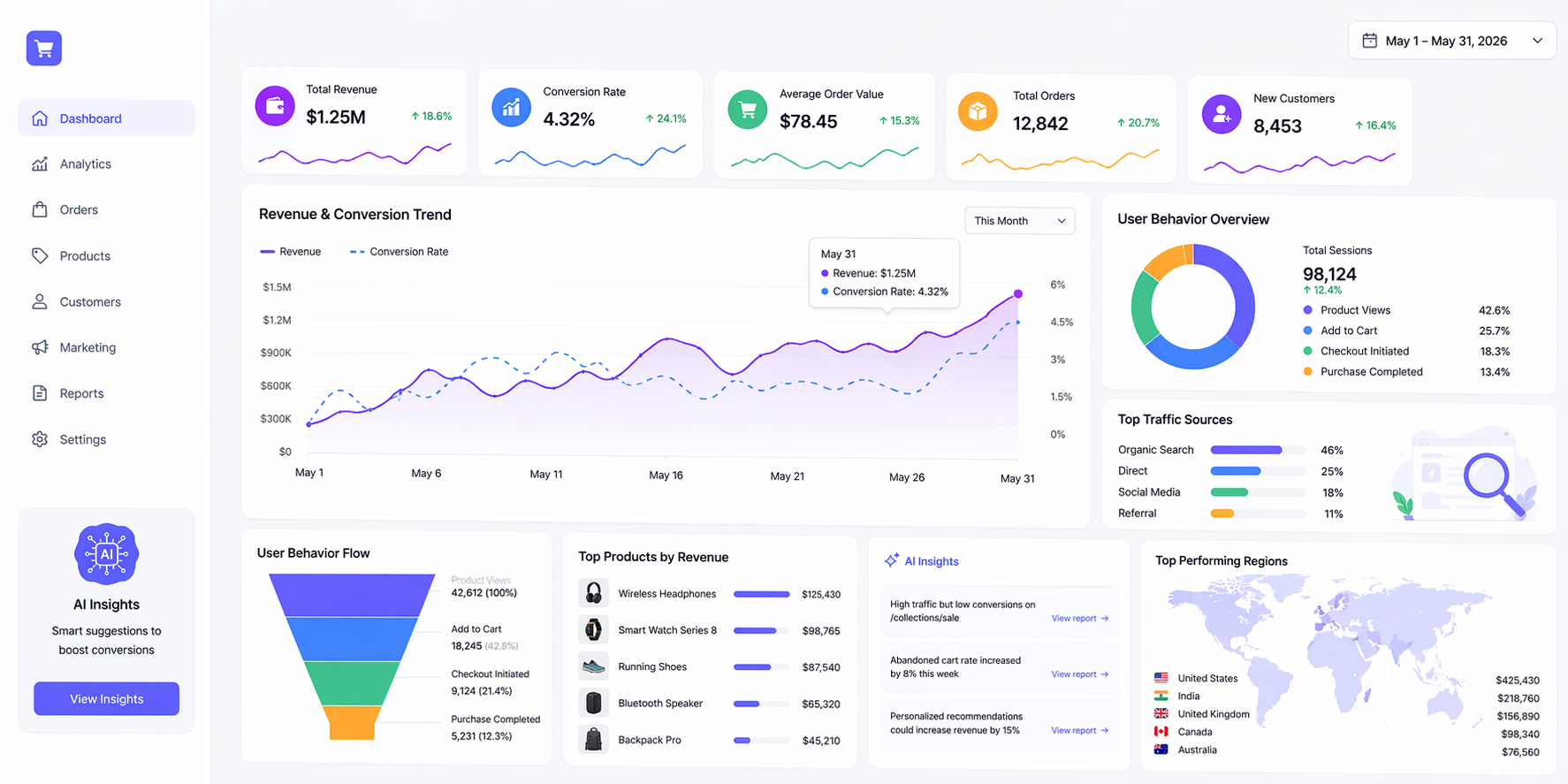
Search is no longer just about ranking product pages - it is about:
Structuring content for AI-driven discovery
Optimizing product data for recommendation engines
Building authority through reviews, engagement, and real user signals
This is not theory - it’s already how platforms like Amazon and Shopify-powered brands are scaling.
10 Proven E-Commerce Growth Strategies That Work in 2026
Here are 10 proven e-commerce growth strategies that directly improve conversions, reduce cart abandonment, and scale revenue.
1. Optimize for “Decision Speed,” Not Just Product Pages
A product page should do more than describe an item. It should help the shopper decide. When buyers slow down, they often hesitate. When they hesitate, they abandon it. So, the goal is to reduce mental effort and make the next step obvious.
Brands like Amazon have mastered this by reducing cognitive load through:
AI-powered summaries of reviews
Smart comparisons
“Frequently bought together” modules
Instant answers to common objections
Focus on:
Clear value proposition above the fold
Visible comparisons for similar products
Concise copy that answers objections quickly
Smart filtering and sorting
FAQs answered instantly
Strong imagery that removes uncertainty
The goal - Reduce thinking time → Increase buying speed
2. Interruptive Personalization That Feels Like Assistance
Personalization still matters, but it has to feel helpful, not manipulative. Most brands still get it wrong.
McKinsey reports that 71% of consumers expect personalized interactions, and 76% feel frustrated when they do not get them. That means the best personalization is context-aware, timely, and subtle. Think less “pop-up pressure” and more “helpful assistant.”
The new approach is assistive personalization:
Exit intent = “Need help choosing?” instead of “Wait! 10% off”
Context-based nudges (size, variant, category behavior)
AI-powered recommendations based on browsing patterns
Examples:
Beauty brands suggesting shades based on browsing
Apparel brands reminding users of size preferences
At Make My Brand, personalization is designed as a conversion layer, not a marketing gimmick. This is where the AI-as-a-service model plays a role - powering real-time personalization without making it feel intrusive.
3. Replace Fake Urgency with “Live Demand Signals”
Shoppers are smarter than ever. Shoppers are increasingly skeptical of fake countdowns and pressure-based tactics. What works better is visible proof that demand is real.
The strongest conversion signals are honest ones - recent purchases, stock levels, review volume, popularity trends, and delivery clarity. That keeps urgency credible instead of being forced.
Use real-time demand indicators like:
“25 people viewed this in the last hour”
“Only 3 left in stock”
“Trending in Delhi today”
“Recently purchased” notifications
This is not creating hype. It is decision psychology applied ethically.
Why it works:
Builds authentic urgency
Reinforces social validation
Reduces hesitation
Amazon and leading Shopify brands are already leveraging this through AI-driven merchandising systems.
4. Move from Personalization → Predictive Commerce
Personalization reacts to what has already happened. Predictive commerce anticipates what the shopper will need next.
This is where AI shopping assistants are changing expectations. Amazon’s Rufus can help customers compare, plan, and buy more contextually, while Walmart’s AI shopping experience is also moving in the direction of guided product discovery.
AI now enables brands to:
Recommend before intent is explicit
Predict replenishment cycles
Suggest next-best products
Example:
Amazon recommending refills before you run out
Subscription models predicting repeat purchases
What this means for you:
Invest in behavioral data systems
Build AI-led recommendation engines
Align CRM + website + ads into one intelligence loop
This is where AI-as-a-Service by Make My Brand becomes a growth multiplier.
5. Compress Checkout into a “1-Step Decision Layer”
Checkout is where intent either turns into revenue or collapses. Baymard’s research says the average large e-commerce site can improve conversion by as much as 35% through better checkout UX, and that the average checkout still has 32 unique improvements to make. Checkout friction is still one of the biggest revenue leaks.
Common friction points:
Too many fields
Hidden costs
Forced sign-ups
Payment confusion
Fix it by applying the smartest cart abandonment tips:
Enable guest checkout
Show total cost upfront
Add express payments (UPI, wallets, Apple Pay)
Reduce steps to one-page checkout
Using autofill and saved data
Think of checkout as a final reassurance moment, not a process.
6. Retarget Based on “Behavior Depth,” Not Just Visits
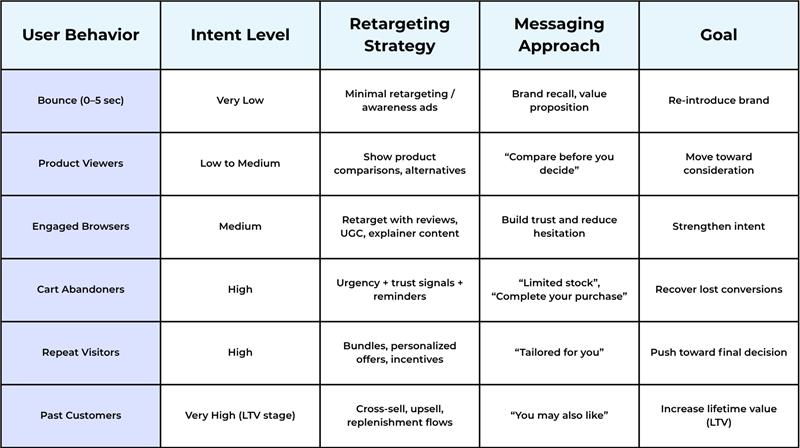
Not all visitors are equal - so treating them the same is where most brands lose revenue. A user who bounced in seconds is fundamentally different from someone who explored products, watched a demo, and added items to the cart.
This is where behavior-depth segmentation becomes critical. Instead of retargeting based on visits alone, high-performing brands align messaging with intent intensity - making every touchpoint more relevant and conversion-driven.
Behavior-Led Retargeting Framework
Channels to Activate:
Meta Ads (Instagram & Facebook): High-performing for visual retargeting and dynamic product ads
Google Display & YouTube: Ideal for reinforcing recall and showcasing product value
Programmatic Retargeting: Scales personalized messaging across platforms
At Make My Brand, retargeting is not treated as repetitive advertising - it is engineered as a multi-touch revenue system, where messaging evolves with user intent, driving higher conversions and better ROI.
7. Turn Social Proof into “Conversion Infrastructure”
Social proof is no longer optional - it is your trust architecture. Walmart’s Sparky, a GenAI assistant, synthesizes reviews inside the shopping experience. This means trust signals are moving from the footer to the center of the conversion optimization journey.
What works in 2026:
Video testimonials
Influencer reviews
Star ratings + summaries
UGC (user-generated content)
Before/after visuals
Where it matters most:
Product pages
Landing pages
Ads
Social commerce platforms
Platforms driving this shift:
Instagram
TikTok (TikTok Shop)
YouTube
Amazon Live
Pinterest
Shoppers now trust people more than brands.
8. Use “Dynamic Bundling” Instead of Static Offers
Static discounts are easy to ignore. Dynamic bundling feels more relevant. If a shopper is buying a main product, the next best step should be a helpful add-on - not a random upsell. Adjust bundles based on cart content and browsing behavior.
Examples:
“Complete the look” (fashion)
“Frequently bought together” (electronics)
“Starter kits” (beauty)
Benefits:
Higher AOV (average order value)
Feels personalized
Reduces decision fatigue
Increased perceived value
This requires integration between:
Product data
Customer behavior
AI recommendation engines
Optimize using A/B testing, product affinity data, and margin control strategies to continuously refine bundles for higher conversions and profitability.
9. Design for Thumb Behavior
Mobile optimization is not enough anymore. Brands need a mobile behavior design.
People browse differently on mobile phones. They skim faster, tap less patiently, and give less time to clutter. Baymard’s mobile UX research shows that 78% of mobile sites still perform at a mediocre or worse level in product-list UX, which is a major gap for brands that rely on mobile traffic.
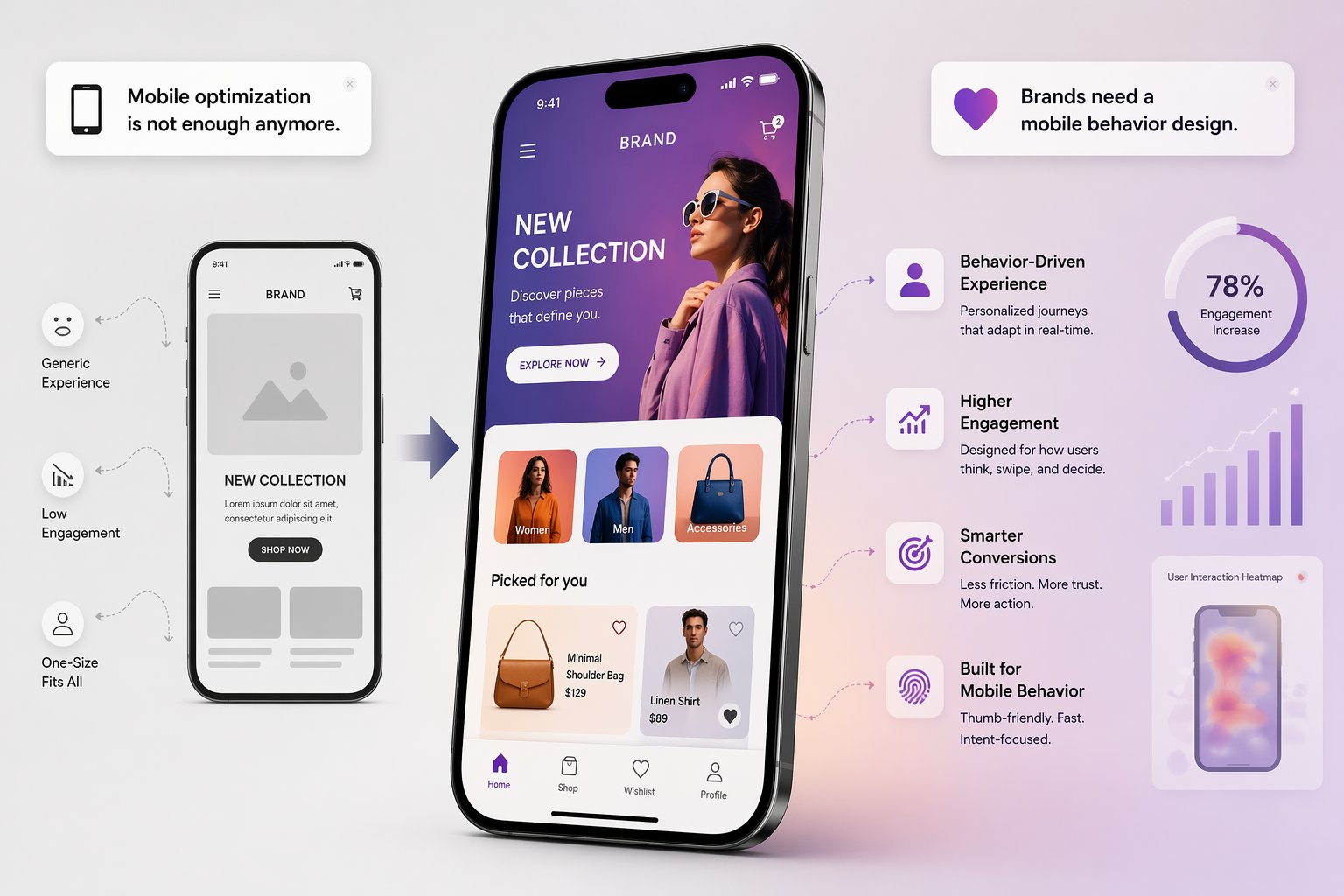
Modern shopping behavior:
Scrolling fast
Watching short videos
Clicking with one thumb
Optimize for:
Sticky CTAs
Vertical layouts
Swipeable product galleries
Keep filters, sorting, and checkout easy to reach
Reduce visual clutter on product and category pages
Make the most important action thumb-friendly
Social commerce impact:
Platforms like TikTok, Instagram Reels, and YouTube Shorts are now primary discovery engines - not just engagement tools. Make My Brand’s design and development services can directly support conversion performance, especially for mobile-first stores.
10. Build Automated Revenue Loops (Not Just Email/SMS)
Revenue growth should continue after the first purchase. The brands build automated revenue loops which include order updates, review requests, replenishment reminders, post-purchase education, referral prompts, and win-back sequences.
Build retention loops using:
WhatsApp automation
Email + SMS journeys
Chatbots
Loyalty programs
Where conversational commerce fits in:
Pre-sale questions answered in chat.
Cart recovery through messaging.
Order updates and support inside WhatsApp.
Chatbots that guide shoppers without friction.
Why this matters:
Customers prefer messaging over email
Faster responses increase trust
Personal conversations drive repeat purchases
At Make My Brand, we design automated revenue marketing ecosystems that connect acquisition, conversion, and retention seamlessly. These loops are often powered by an integrated growth-as-a-service model, where automation, data, and personalization work together continuously.
The Rise of Social & Conversational Commerce
Social Commerce is Now the Discovery Engine
Consumers are buying directly from:
Instagram Shops
TikTok Shop
Facebook Marketplace
YouTube Shopping
Pinterest
What this means:
Your funnel starts on social, not your website
Content = commerce
Influencers = distribution channels
Conversational Commerce is the New Conversion Layer
Platforms like WhatsApp, live chat, and AI chatbots are becoming core to the buying journey.
Why it works:
Real-time answers reduce drop-offs
Feels personal and trustworthy
Mirrors how people already communicate
Use cases:
Product discovery
Order tracking
Upselling
Customer support
Conclusion: Growth Will Belong to Brands That Engineer Decisions
E-commerce growth strategies in 2026 is no longer about pushing users through a funnel - it is about engineering decisions in real time. The brands that are winning are not just optimizing pages or running better ads. They are building intelligent, connected systems that:
Reduce friction at every touchpoint
Use AI to anticipate intent, not just respond to it
Turn trust into a conversion driver, not an afterthought
Align content, UX, and technology into one seamless buying experience
At Make My Brand, we build these connected growth systems - where UX, AI, automation, and performance marketing work together to turn intent into revenue.
Ready to accelerate with smarter e-commerce growth strategies? Partner with us to scale your e-commerce revenue.
Loading FAQs
Please wait while we fetch the questions...
Published on April 17, 2026 by Simran