
Enterprise SEO/GEO Strategies to Increase AI Search Visibility
Discover enterprise SEO/GEO strategies that help brands improve AI search visibility through entity architecture, structured data, topical authority, technical SEO, direct answers, expert citations, and scalable workflows designed to strengthen brand authority across AI-powered search.
While most organizations view generative engine optimization (GEO) as a content play, the real battleground is structural. Generative engines do not evaluate brand authority through surface-level keywords they extract structured, machine-readable facts from your underlying technical stack. Merging enterprise SEO with GEO principles transforms legacy web architecture into an active retrieval framework, securing brand authority and high-intent revenue where traditional search fails.
The Evolution of Search: Why Enterprise SEO and GEO Strategies Must Converge
The search ecosystem is shifting from traditional page indexing to generative answer creation. Search tools like Google AI Overviews, ChatGPT, and Perplexity no longer force users to scroll through pages of search results. Instead, these modern large language models gather information across the web to generate single, cohesive answers right on the screen.
As a result, organic visibility solutions must evolve. While the technical foundation remains essential, legacy tactics like keyword stuffing or low-quality backlink collection no longer work in a retrieval-augmented generation (RAG) environment. Instead, generative algorithms prioritize and extract factual information from authoritative, well-organized digital sources.
According to industry predictions by Gartner, traditional search engine volume will drop by 25% in 2026 as user traffic moves toward AI chatbots and conversational virtual agents.
At the same time, recent market research from McKinsey reveals that 50% of buyers intentionally use AI-powered search engines when researching products and evaluating vendors.
To stay competitive, businesses need an integrated SEO and GEO strategy. While conventional enterprise SEO strategies ensure technical health and baseline domain authority, GEO structures content so AI platforms can easily read, trust, and cite the brand as a primary source.
Operational Area | Legacy Enterprise SEO Strategy | Generative Engine Optimization Strategy |
|---|---|---|
Primary Goal | Ranking web URLs on traditional search results pages | Securing brand citations in synthesized AI answer summaries |
Content Structure | Keyword-focused articles and standard metadata | Factual data, JSON-LD schema, and structured entity nodes |
Optimization Approach | Keyword density and backlink volume building | Semantic authority, expert quotes, and statistical density |
User Journey | Multi-click website browsing | High-intent, zero-click answer evaluation with direct citations |
Core Enterprise SEO Strategies for AI Search Visibility
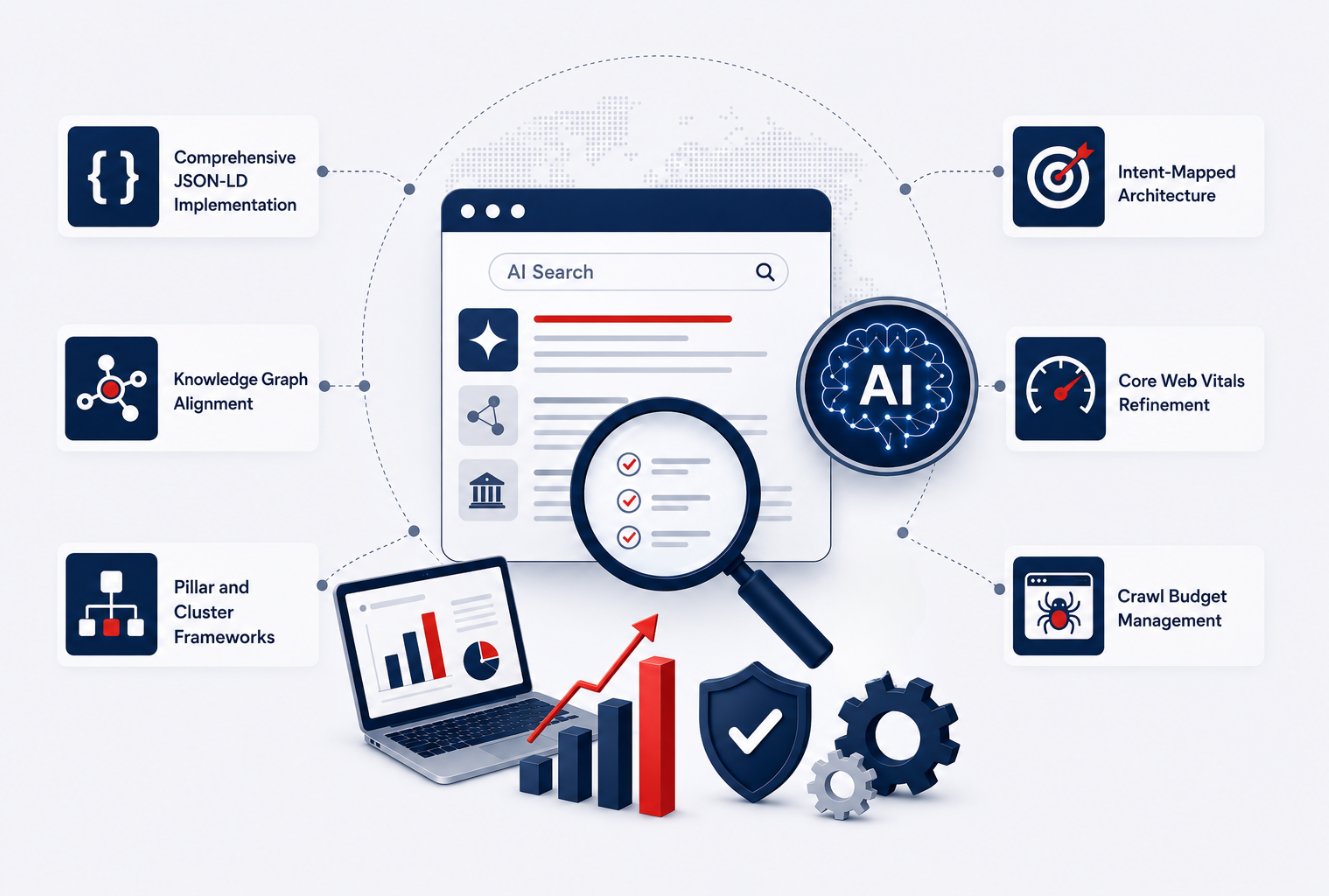
Traditional search fundamentals remain essential because generative models rely on established web crawlers to discover and verify information. Solid enterprise SEO strategies provide the baseline technical structure needed for AI search optimization.
1. Advanced Entity Architecture and Schema Engineering
Generative models do not read content like human visitors - they evaluate relationships between distinct entities such as brands, executives, products, and services.
Comprehensive JSON-LD Implementation
Deploy advanced JSON-LD schema markups across all digital assets. Define explicit relationships between the organization, industry services, and executive leadership to help AI bots understand the core business focus.
Knowledge Graph Alignment
Ensure corporate information matches across official databases, Google Business Profiles, and industry wikis. Consistent entity details help search engines confirm brand authenticity.
2. High-Yield Topical Authority and Content Clustering
To be recognized as a reliable source by LLMs, a website must demonstrate comprehensive expertise across its core business areas.
Pillar and Cluster Frameworks
Build deep content clusters around primary business offerings. Connect technical subtopics to central pillar pages using clear, logical internal linking.
Intent-Mapped Architecture
Structure content to address specific transactional and informational queries. Direct answers to complex industry questions position your site as a primary resource for answer engines.
3. Technical Infrastructure and Performance Optimization
Clean backend site performance is critical for thorough indexing by search crawlers and AI bots.
Core Web Vitals Refinement
Maintain fast page load speeds, clean mobile rendering, and zero layout shifts. High performance ensures AI scrapers process content without timeouts.
Crawl Budget Management
Streamline site architecture, fix broken links, and update XML sitemaps. Efficient crawling helps search engines discover fresh content updates quickly.
Actionable GEO Strategies
While traditional SEO focuses on getting ranked, generative engine optimization strategies focus on getting cited inside AI-generated responses. Adapting your AI search content strategy requires structuring information so machine-learning models can easily process and verify key points.
1. Statistical and Empirical Data Density
Generative platforms prioritize content that provides concrete facts, figures, and research-backed data over generic claims.
Original Data Publishing
Include proprietary research, survey findings, and specific performance metrics within key articles.
Impact on Citation Rate
A landmark study by researchers at Princeton University and Georgia Tech demonstrated that adding concrete statistics and verifiable data points increases an organization's AI citation visibility by 28% to 41% compared to unoptimized text.
2. Direct Answer Block Engineering
Generative models favor text blocks structured for simple retrieval-augmented generation extraction.
Question-to-Answer Layouts
Place clear, 40-to-60-word summary answers immediately below target question headers.
Scannable Formatting
Use concise bulleted lists, comparative tables, and clear step-by-step summaries. This scannable structure helps LLM SEO parsers extract facts accurately without misinterpreting context.
3. Expert Citation Hooks and Brand Proof
AI algorithms evaluate trust signals across external web platforms to verify author credentials and content reliability.
Direct Expert Quotations
Incorporate original insights from recognized internal executives and subject matter experts throughout technical guides.
Cross-Platform Entity Verification
Maintain consistent brand positioning across third-party industry journals, news releases, and review portals. Broad citation presence confirms your status as a trusted authority.
Operationalizing SEO and GEO Strategies: How Scaling Ventures Execute
Implementing modern AI search optimization 2026 requires speed and smooth coordination across design, content, and engineering teams.
While major organizations frequently have lengthy approval delays, agile startups are working quickly to gain early market dominance in AI search visibility.
Replacing Disconnected Vendors with Embedded Development Pods
Traditional marketing agencies often operate in silos, creating delays between content strategy and technical engineering. Modern ventures are adopting flexible execution models to streamline updates.
Growth partners like Make My Brand address these bottlenecks through their Growth-as-a-Service model. By providing dedicated cross-functional pods, Make My Brand connects UI/UX design, backend engineering, and digital marketing into a single continuous pipeline. This model allows organizations to roll out schema updates, speed enhancements, and GEO content structures rapidly.
Aligning Technical Strategy with the Brand Development Lifecycle
Long-term organic growth requires linking technical optimizations directly to overall brand positioning.
Using its proprietary Brand Development Lifecycle (BDLC) framework, Make My Brand helps growing companies build sustainable digital authority. By connecting visual design, technical web builds, and strategic SEO and GEO strategy into one structured lifecycle, Make My Brand ensures every digital touchpoint builds user trust while remaining fully optimized for AI search platforms.
Conclusion
Generative search has permanently altered how customers find and evaluate corporate solutions. Staying competitive necessitates pushing beyond traditional methods and implementing explicit enterprise SEO and GEO strategy plans. By building clean entity data, optimizing content structure for answer engines, and deploying flexible development workflows, businesses can turn search disruption into a lasting revenue engine. Investing in AI search optimization today secures brand leadership and sustained digital visibility in an AI-driven market.
Loading FAQs
Please wait while we fetch the questions...
Published on August 13, 2026 by Surbhi Sood