Google Ads AI Max: How AI Is Changing Paid Search Campaigns
Google Ads AI Max brings AI-powered automation to paid search through smarter query matching, dynamic ad copy, and automated landing page selection. It covers campaign controls, AI Max vs. traditional Search and Performance Max, conversion challenges, and ways to maintain control over ad spend.
Your cost per acquisition creeps up each quarter, yet your search campaigns show identical keyword bids. Unchecked search automation quietly eats media budgets, pairing broad user inquiries with irrelevant ad copy and draining margins on empty clicks.
Google Ads AI Max accelerates this shift by replacing static keywords with dynamic intent scoring. Commercial leaders must establish strict negative boundaries, enforce asset governance, and feed verified sales data back into algorithms to stay profitable.
What Is Google Ads AI Max?
Google Ads AI Max operates as a native optimization suite embedded within standard Google Search campaigns. Rather than functioning as an isolated campaign type, it provides an automated layer that aligns searcher queries with relevant commercial offers.
Machine learning models evaluate query semantics, historical auction results, and destination page copy to deliver dynamically generated text ads.
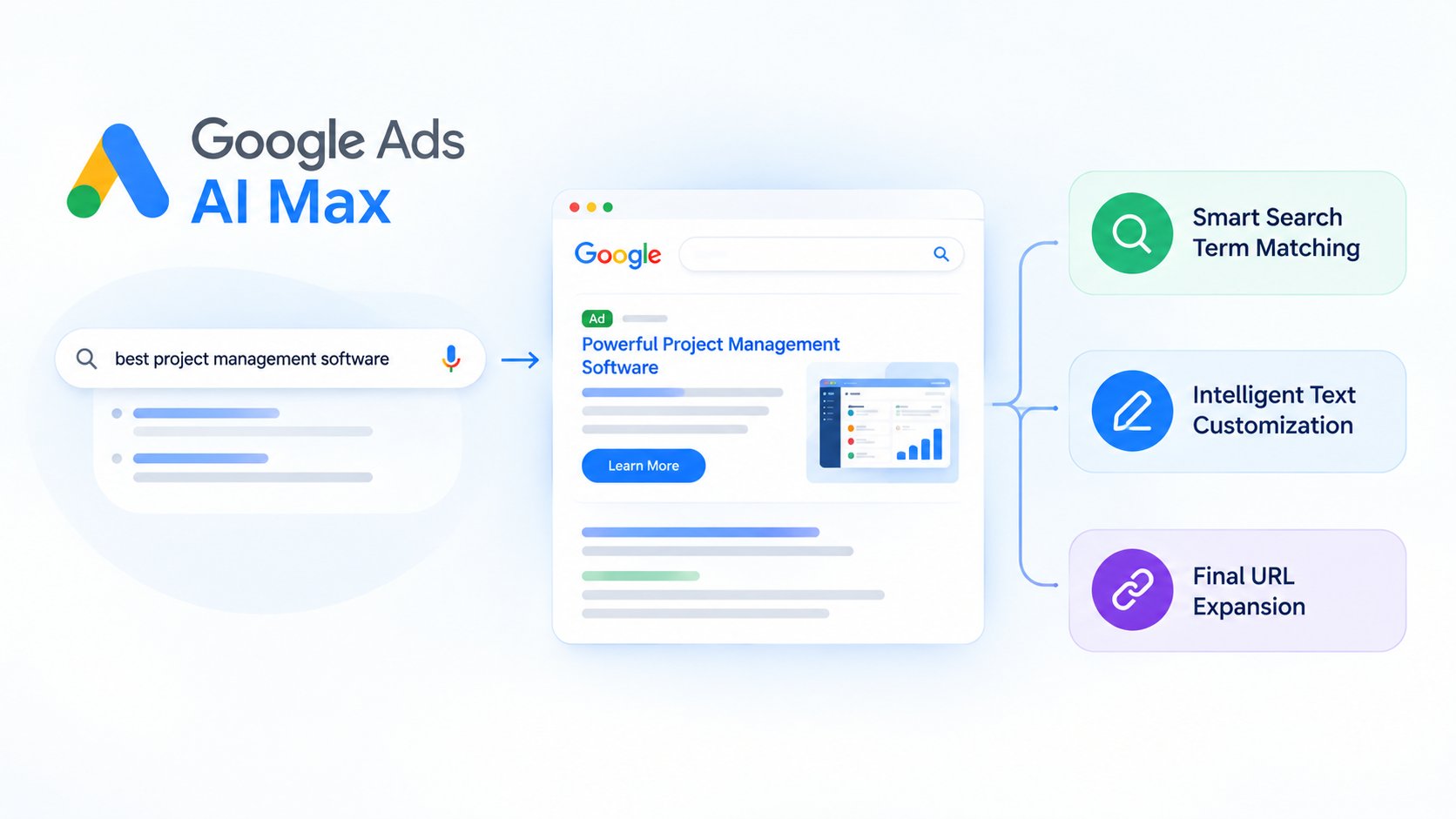
The Three Core Pillars
The system coordinates three algorithmic mechanisms:
Smart Search Term Matching: Machine models identify high-intent search queries that diverge from entered keywords yet share identical buyer intent.
Intelligent Text Customization: Generative language models craft headlines and descriptions directly from website copy and active responsive search ad assets.
Final URL Expansion: Algorithmic routing directs paid visitors to specific catalog or service pages predicted to yield the highest conversion probability.
The September 2026 Search Architecture Upgrade
In September 2026, Google initiated automated upgrades converting legacy Dynamic Search Ads (DSA) and Automatically Created Assets (ACA) directly into the AI Max framework.
Unified Search Inventory: Advertisers no longer manage separate DSA campaigns alongside standard search ad groups.
Search Terms Reporting Updates: The Search Terms Report incorporates "AI Max" as a dedicated match type. A new Source column clarifies whether matches originated from broad match semantic broadening or keywordless discovery.
Landing Page Visibility: The Landing Pages Report adds a "Selected by" column to track URLs chosen by the algorithm.
Asset Override Rules: Pinned headlines or descriptions yield priority to algorithmic generation whenever URL redirection triggers.
Managing this environment requires anchoring account structures in a verified keyword strategy that feeds clean audience data into bidding engines.
Architectural Mechanics: How Google AI Max Campaigns Operate
Predictive machine learning models evaluate millions of auction signals per millisecond. When an individual enters a search query, algorithms process contextual intent, location parameters, and device signals instead of relying solely on exact keyword strings.
Core Control Levers for Advertisers
Advertisers retain explicit governance through campaign settings:
Brand Exclusions And Inclusions: Brand exclusion lists prevent ad spend on chosen trademark terms. Brand inclusions restrict impressions to approved partner brands.
Locations Of Interest: Ad group tier settings isolate geographic buyer intent even across keywordless query matches.
URL Exclusions: Exclusion lists prevent algorithmic routing to non-commercial pages like legal policies, career listings, or internal portals.
Negative Keyword Lists: Full negative keyword management remains functional across account, campaign, and ad group levels.
Asset Level Oversight: Teams can inspect generated copy and remove low-performing assets directly inside Google Ads reporting.
Operational Feature | Administrative Tier | Functional Mechanism | Startegic Control Governance |
|---|---|---|---|
Smart Search Term Matching | Ad Group & Campaign | Semantic broad match and keywordless discovery | Negative keyword lists; toggle per ad group |
Intelligent Text Customization | Campaign Tier | Real-time generative headline and copy generation | Asset removal reports; creative asset uploads |
Final URL Expansion | Campaign Tier | Algorithmic routing to highest-intent domain pages | URL exclusion lists; URL inclusion rules |
Locations of Interest | Ad Group Tier | Intent-based geographic targeting for searches | Granular location exclusion and radius rules |
Brand Traffic Governance | Campaign & Account | Trademark-level association or suppression | Brand exclusion lists; Brand inclusion lists |
Google Ads AI Max Compared With Traditional Search And Performance Max
Commercial leaders frequently evaluate how AI Max Search campaigns differ from legacy manual campaigns and multi-channel Performance Max frameworks.
Architectural Distinctions Across Campaign Formats
Traditional Search Campaigns: Marketers construct keyword match types manually, write static responsive search ad copy, and assign fixed landing page destinations. Control remains high; scale requires continuous manual input.
Performance Max Campaigns: Ads serve across Google properties including YouTube, Display, Discover, Gmail, Maps, and Search. PMax drives broad multi-channel volume, yet it masks channel-specific placement performance and limits search query transparency.
Google Ads AI Max: Optimization remains locked strictly to Google Search inventory. Advertisers keep search query visibility, ad group structures, and negative keyword governance alongside generative copy and keywordless matching.
Auction Priority Rules
When an AI Max query and a Performance Max ad compete for identical search volume, Google awards auction priority to an exact match keyword in the Search campaign. Standard broad match queries compete through normal Ad Rank calculations.
Capability Dimension | Traditional Search | Google Ads AI Max | Performance Max |
|---|---|---|---|
Network Inventory | Search Network Only | Search Network Only | Search, YouTube, Display, Discover, Maps, Gmail |
Targeting Framework | Manual Match Types (Exact, Phrase, Broad) | Semantic Intent Matching & Broad Match | Audience Signals & Algorithmic Discovery |
Creative Delivery | Static RSA Inputs Only | Algorithmic Text Customization & RSA | Dynamic Multi-Asset Auto-Generation |
Destination Selection | Static Landing Page Assignment | Algorithmic Final URL Expansion | URL Expansion Across Entire Domain |
Placement Transparency | Complete Search Query Reporting | Complete Search Query & URL Reporting | Aggregated Search Category Insights |
Negative Keyword Control | Full Account, Campaign, and Ad Group Tier | Full Account, Campaign, and Ad Group Tier | Account-Level Negatives Only |
Economic Benchmarks And Market Trends In Google Ads Automation
Paid search performance metrics reflect shifting commercial dynamics as automation absorbs media spend.
Core Industry Performance Benchmarks
Conversion Volume Growth: Google Ads automation features in AI search campaigns deliver an average 14% lift in conversions at similar acquisition costs.
B2B Sector Conversion Baselines: Industry benchmarks record median conversion rates of 2.91% for B2B companies compared to 5.59% across consumer sectors.
Search Engagement Metrics: Average search click-through rates across industries hold at 6.66%, with conversion rates averaging 7.52%. Average search cost-per-click levels register at $5.26 across mixed enterprise sectors.
Verifiable Market Data And Institutional Findings
Conversion Tracking Accuracy: Analysis published in Forbes on conversion tracking setup confirms that without verified conversion metrics, organizations cannot measure performance or optimize campaigns effectively, risking direct capital loss.
Macro Advertising Spend: Industry benchmarks published by the U.S. Census Bureau for advertising agencies reflect substantial market investment directed into specialized media placement and automated ad buying services.
Capital Protection Guidelines: Operational advice detailed in the U.S. Small Business Administration guide on managing business finances and marketing demonstrates that structured marketing plans and expenditure controls protect cash flow from unmonitored advertising costs.
Integrating First-Party Data Signals
Deploying AI cookieless performance marketing allows marketing leaders to send verified first-party audience signals directly into automated ad auctions. Algorithmic bidding relies on incoming conversion values. Without validated server-side events, autonomous bidding algorithms optimize toward low-intent inquiries that fail to generate downstream pipeline.
Resolving Conversion Bottlenecks: Addressing Clicks Without Qualified Leads
Surging click numbers mean nothing if sales pipelines sit empty. Marketing dashboards report rising traffic volume, yet executive calendars lack sales calls with qualified prospects. Identifying where prospective buyers drop off demands a diagnostic audit across search queries, post-click messaging, and data feedback loops.
The Source of the Funnel Leak
Broadened semantic matching frequently drives heavy search traffic that fails to convert into paying customers. Accounts encounter Google ads click but no leads when autonomous matching triggers impressions for informational research queries rather than commercial purchase inquiries.
Key Factors Behind Dropping Lead Conversion
Intent Mismatch: Automated queries match broad concepts rather than buyers seeking immediate vendor selection.
Broken Message Match: Generative headlines make specific promises that the destination landing page fails to reflect above the page fold.
Friction Points On Site: Slow loading speeds and complex contact forms push high-intent visitors away before form completion.
Superficial Conversion Bidding: Algorithms bid for page views or low-value clicks instead of qualified pipeline.
Restoring Capital Efficiency
Enforce Strict Message Match: Confirm that dynamically generated headlines align with corresponding landing page value propositions.
Pass Offline CRM Milestones: Connect sales pipeline stages back into Google Ads via API webhooks so bidding models optimize for actual revenue.
Deploy Expert Oversight: Professional guidance from performance marketing services establishes rigorous tracking guardrails and weekly search term audits.
Focus On Real Commercial Returns: Adopting ROI-driven marketing confirms that automated bidding targets prospects who produce verifiable business outcomes.
Step-By-Step Guide: How To Deploy AI Max Search Campaigns
Executing Google AI Max campaigns successfully requires deliberate preparation to safeguard budget efficiency. Commercial operators must follow a structured implementation sequence:
Audit Historical Account Data and Tracking Verification: Confirm that conversion tracking captures verified commercial actions through Google Tag Manager and CRM webhooks. Campaigns require a steady historical conversion volume to inform algorithmic learning models prior to feature activation.
Enable AI Max In Campaign Settings: Navigate to the targeted Search campaign settings inside the Google Ads console. Locate the AI Max configuration module and select campaign optimization. Activate Smart Search Term Matching, Text Customization, and Final URL Expansion in unison to enable coordinated machine learning.
Establish Brand and URL Exclusions: Construct a brand exclusion list to prevent the algorithm from cannibalizing existing organic brand search volume. Define URL exclusion rules to bar non-converting web pages, including support directories, privacy notices, and internal blogs, from receiving paid traffic.
Configure Locations of Interest and Asset Groups: Set Locations of Interest at the ad group tier to isolate geographic commercial intent. Upload high-performing headline variations, descriptions, logos, and site extensions to supply the generative model with verified marketing assets.
Implement Split Testing and Match Type Isolation: Follow the recommended testing model: create a new dedicated search campaign with AI Max enabled. Add your current top-performing keywords as negative keywords in this test campaign. This setup isolates net-new query discovery without competing against existing account winners.
Execute Bi-Weekly Query Audits and Match Type Isolation: Review the Search Terms Report bi-weekly. Isolate queries labeled under the "AI Max" match type to evaluate search intent. Add non-converting or irrelevant phrases to negative keyword lists to prevent capital loss.
Strategic Directives for Enterprise Paid Search
Algorithmic paid search demands a transition from manual micromanagement to macro-level governance. Machine learning models optimize auctions faster than human operators, yet their efficiency depends entirely on the boundary conditions established by commercial managers.
Organizations seeing the highest return from Google Ads automation pair algorithmic bidding with verified first-party audience signals. Feeding verified revenue data into ad accounts guides machine learning toward valuable commercial clients rather than superficial click traffic.
Maintaining rigorous negative keyword management, continuous landing page alignment, and structured data governance safeguards capital while scaling customer acquisition. Commercial enterprises that execute these operational fundamentals will capture profitable market share across modern search ecosystems.
Loading FAQs
Please wait while we fetch the questions...
Published on October 1, 2026 by Surbhi Sood