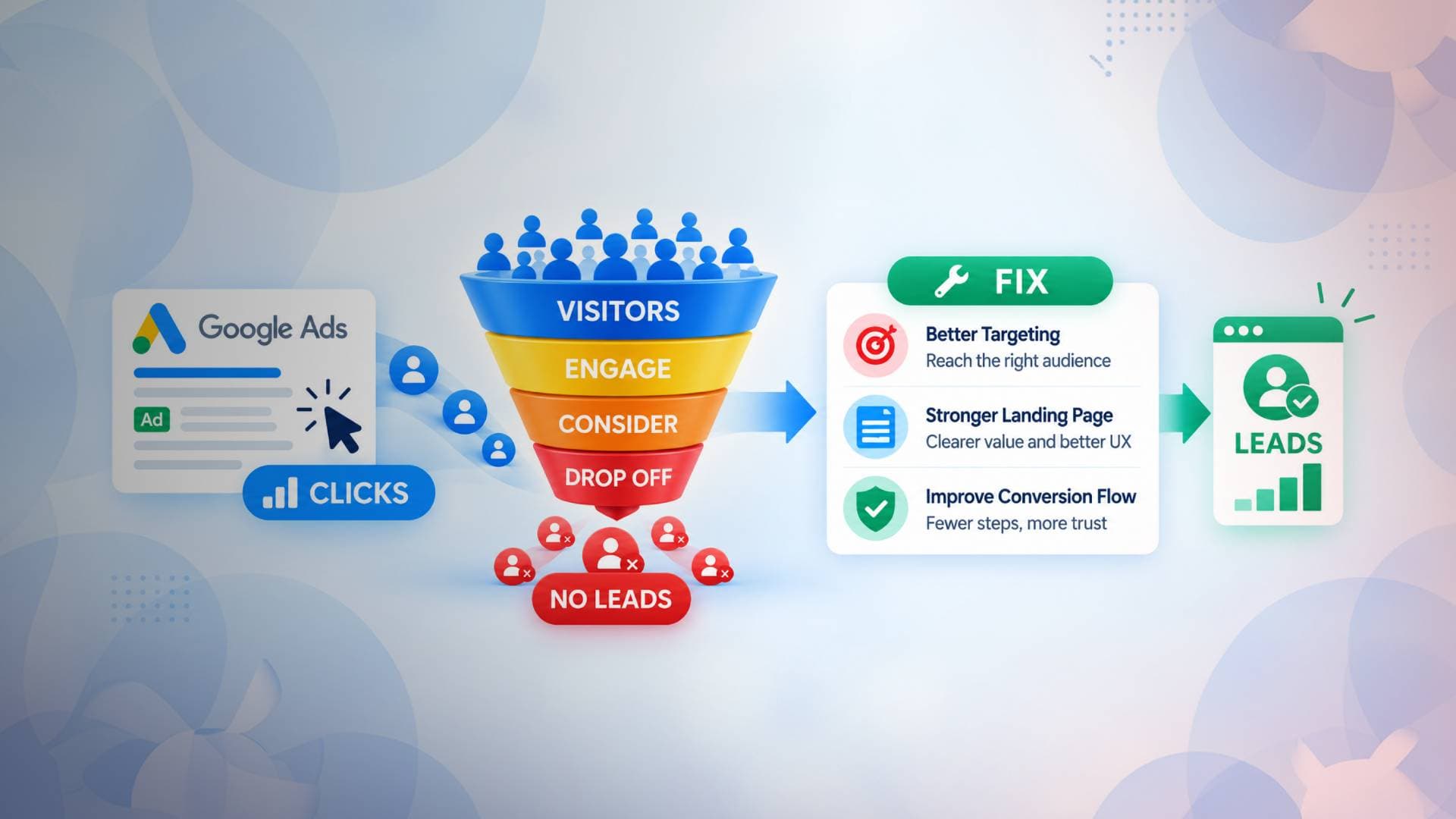
Why Your Google Ads Are Getting Clicks but No Leads (And How to Fix It)
Google Ads getting clicks but no leads can indicate gaps between search intent, ad messaging, landing pages, and conversion tracking. This blog explains how to identify paid search funnel leaks, reduce wasted ad spend, and turn clicks into qualified leads and measurable business opportunities.
Persistent click volume paired with stagnant conversion volume exposes an expensive operational defect across paid acquisition channels. Organizations celebrate rising site traffic, yet enterprise sales pipelines remain starved of verified prospective buyers.
Such friction proves attracting page visits differs fundamentally from capturing commercial intent. When search budgets deplete without generating commercial inquiries, diagnosing structural disconnects between search terms, ad copy, and destination pages restores pipeline momentum.
Defining the Click-to-Lead Breakdown in Paid Search
The problem of Google Ads getting clicks, but no leads happen when visitors view your site without taking action. A user clicks your ad. They land on your page. Then they leave without calling, submitting forms, or requesting pricing.
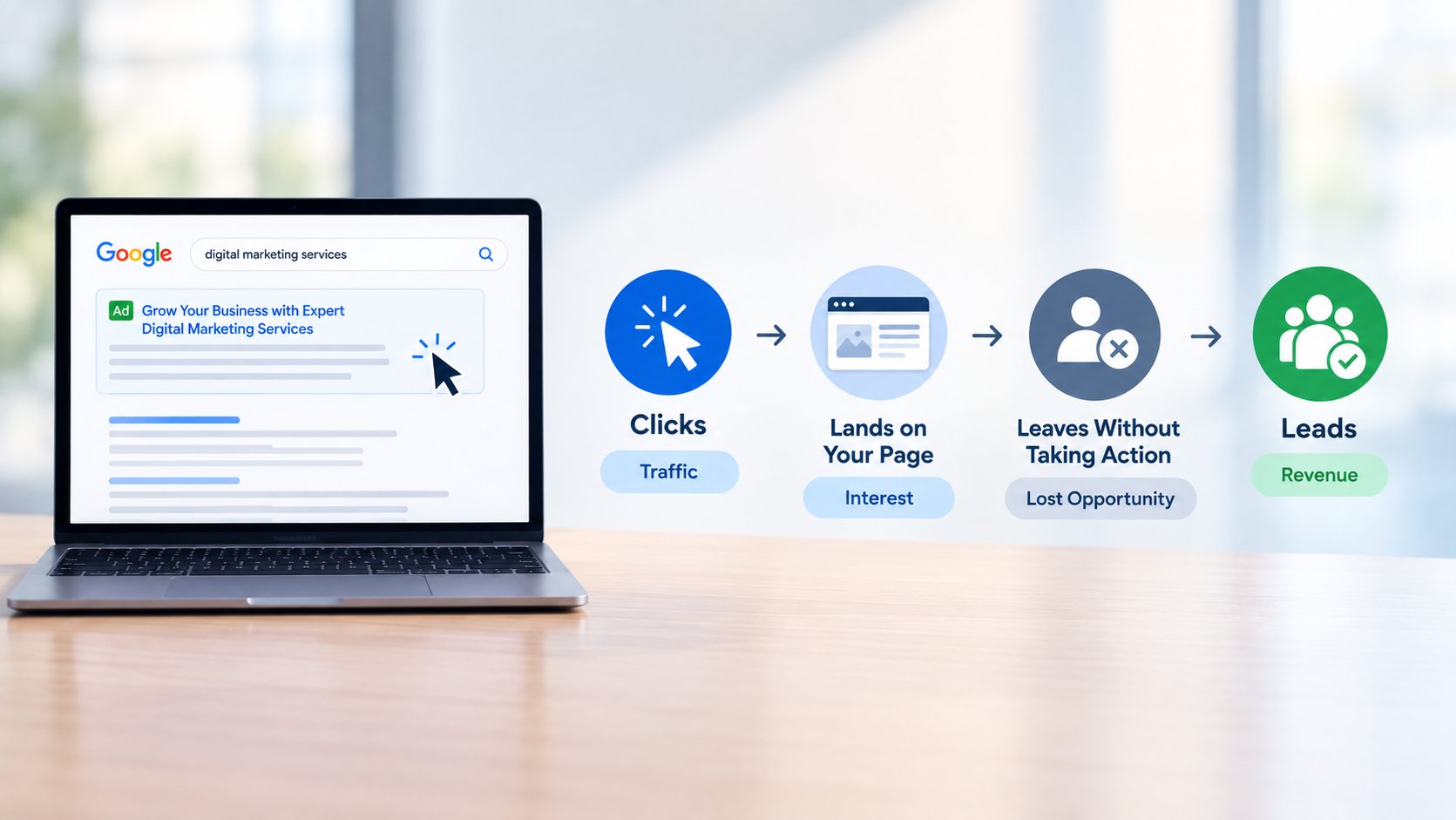
This gap highlights a clear difference between traffic and conversions:
Clicks represent curiosity: They show your ad gained attention on search results pages.
Leads represent conviction: They prove a visitor trusts your offer enough to share contact details.
Traffic is transit: It only moves visitors to your digital doorstep.
Many business owners celebrate rising click counts. Clicks cost money. Leads generate revenue.
When visitors refuse to convert, the post-click experience is broken. Prospective clients did not reject your business; they rejected the friction on your page.
Hiring a proven digital ads agency fixes this problem. They build targeted data-driven ad campaigns that capture verified buyers.
Reasons Your Google Ads Get Clicks but No Leads (And How to Fix Them)
There are can be a number of reasons for businesses to fail in getting leads even when they are getting ample clicks on their ads. Here is a list of the possible causes and ways to fix them.
How Misaligned Search Intent Wastes Paid Ad Spend
Unqualified clicks start with broad keyword choices. Undisciplined broad match settings cast an uncontrolled net. Search platforms then display ads for irrelevant inquiries.
Search campaigns often attract users looking for:
Definitions: Queries like "what is cloud computing"
Free Guides: Inquiries like "DIY plumbing repair steps"
Employment: Searches like "marketing specialist salary"
Templates: Searches seeking free document downloads
Curious searchers click your ad. They leave the second they spot a paid service. You still pay for that visit.
How to Fix It
Protecting your capital requires an intentional keyword strategy. Focus on transactional terms with commercial intent:
"Pricing" or "cost"
"Service provider" or "agency"
"Hire" or "contractor"
Shift ad spend to exact match and phrase match. Pair this setup with negative keyword management. Review your search terms report weekly. Strip away queries that display zero buying intent. High-performing ROI-driven marketing defends budgets by ensuring only real buyers trigger ad impressions.
Why Destination Pages Kill Inbound Conversions
Routing paid clicks to your generic homepage destroys conversion rates. A user clicks an ad for an emergency repair service. Your homepage forces them to search for phone numbers. Friction spikes. The visitor leaves in seconds.
Fixing this requires an optimized landing-page experience built around message match. Message match ensures that your page headline echoes the ad copy. Immediate alignment confirms visitors landed in the right place.
Four landing page elements require immediate review:
Mobile Page Speed: Slow mobile pages drive immediate visitor drop-off.
Clean Visual Layout: Strategic UI/UX design removes distracting elements.
Technical Stability: Modern website development keeps load times under two seconds.
Visible Trust Indicators: Client reviews, ratings, and security badges build instant credibility.
Dedicated landing pages turn traffic into qualified leads by removing confusion and streamlining buyer action.
Broken Tracking vs. Broken Campaigns: Identifying Real Leads
Sometimes your ads work, but your reporting dashboards remain blind. Faulty tracking setups hide successful prospect interactions.
Common tracking mistakes include:
Unlinked Google Analytics and Google Ads profiles
Broken tag triggers inside Google Tag Manager
Confirmation pages that fail to register completed form submissions
Untracked inbound phone calls from mobile search ads
An opposite issue occurs when trivial actions register as primary conversions. Labeling button clicks, scroll depth, or page views as conversions tricks bidding algorithms. Automated bidding begins chasing passive visitors instead of real buyers.
According to research published by Forbes, search advertising across Google averages a conversion rate of 8%. If your conversion rate falls far below this benchmark, inspect your tracking scripts before pausing campaigns. Accurate data signals allow automated bidding systems to locate ready buyers.
Expert Advice: The Smart Bidding Signal Distortion Trap
Modern search campaigns rely heavily on algorithmic bidding models like Target CPA and Maximize Conversions. These engines optimize strictly based on the feedback signals you feed them.
When an account records soft engagements, such as 30-second dwell times, PDF views, or chat widget opens, as primary conversions, Google’s bidding algorithms identify those passive behaviors as success criteria.
The system reallocates spend toward searchers who frequently browse sites without ever signing a contract.
Fixing this requires passing offline conversion data and qualified CRM pipeline stages back into Google Ads via API, ensuring automated bids optimize for actual revenue rather than digital window-shopping
Step-by-Step Framework to Eliminate Paid Search Funnel Leaks
Systematic diagnosis prevents the costly mistake of pausing viable ad campaigns prematurely. Marketing teams achieve improvements by executing an orderly troubleshooting protocol across account infrastructure.
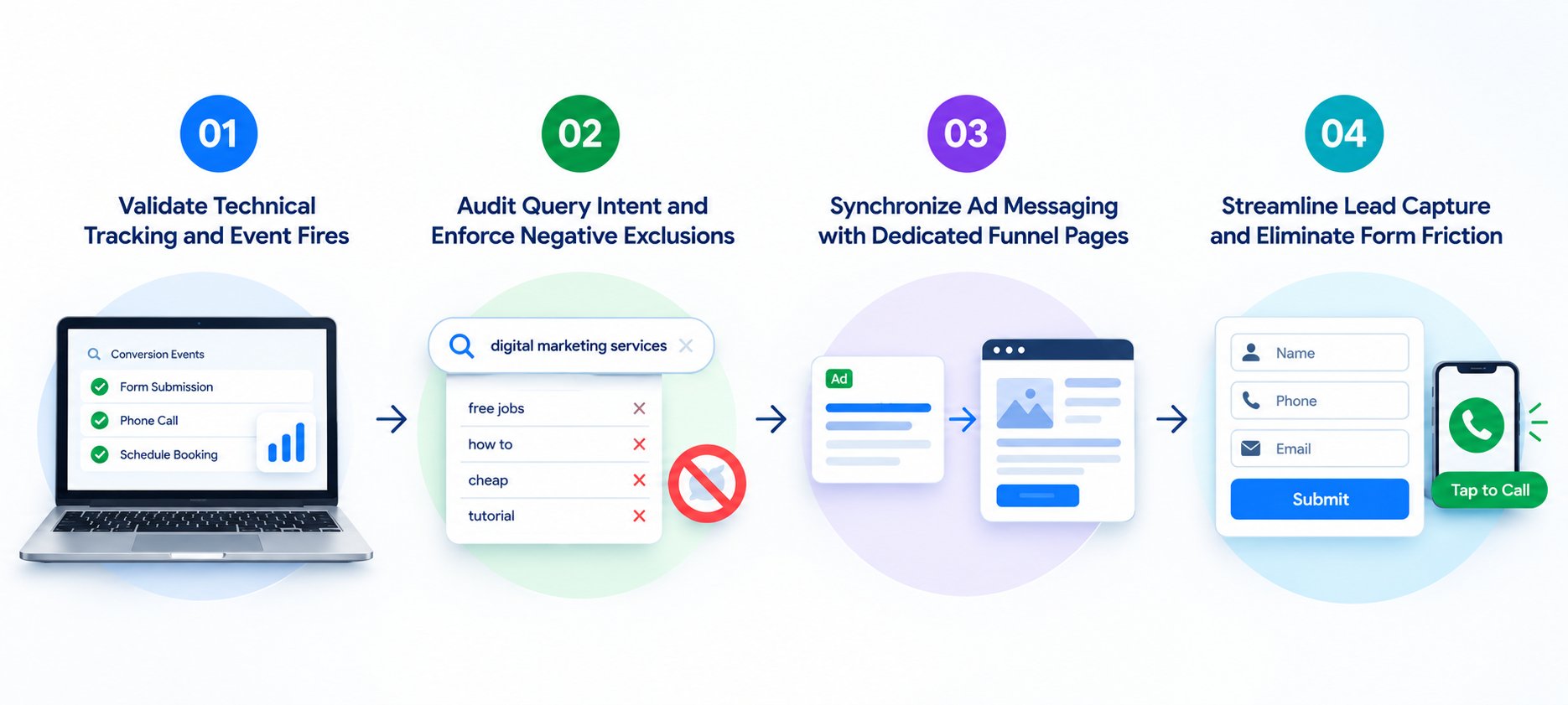
Phase 1: Validate Technical Tracking and Event Fires
The diagnostic sequence begins with verifying all conversion tracking mechanisms. Teams submit manual inquiries across all web forms, test phone tracking scripts, and verify schedule bookings to confirm events record inside analytics software. In addition, secondary engagement metrics must remain separated from primary conversion definitions to protect bidding algorithms.
Phase 2: Audit Query Intent and Enforce Negative Exclusions
The next phase inspects the actual queries triggering ad spend within the search terms report. Identifying search queries devoid of commercial intent allows managers to build negative keyword lists. Restricting keyword match types to phrase and exact match prevents search algorithms from bidding on ambiguous inquiries.
Phase 3: Synchronize Ad Messaging with Dedicated Funnel Pages
Third, ad copy must connect directly to dedicated landing page headlines. Advertisers must retire generic homepage routing in favor of dedicated service pages built directly for the advertised offer. Immediate headline consistency eliminates user confusion and validates search intent.
Phase 4: Streamline Lead Capture and Eliminate Form Friction
The concluding phase eliminates interface barriers that suppress conversions. Minimizing mandatory form fields to critical contact details lifts completion rates substantially. Embedding prominent tap-to-call buttons accommodates mobile searchers requiring immediate phone communication.
Executing these four phases allows businesses to generate high-intent leads without escalating overall marketing expenditure.
Cross-Channel Allocation and Strategic Paid Media Management
Maximizing digital marketing efficiency requires evaluating search campaigns alongside alternative paid channels. Paid search captures active intent from users actively seeking solutions, whereas social advertising builds brand awareness across passive demographics. Evaluating Meta ads vs Google ads enables decision-makers to distribute marketing spend based on specific stages of the sales funnel.
Paid advertising achieves superior longevity when integrated with an authoritative content strategy. In specialized business verticals like the Ed-Tech sector, prospects conduct comprehensive comparative evaluations before requesting formal demonstrations. Paid campaigns that direct prospects to informative, high-credibility assets establish trust before demanding commitment.
Sustaining high conversion performance demands continuous account optimization, which frequently exceeds internal organizational bandwidth. Partnering with a vetted PPC management company or an experienced performance marketing agency USA delivers specialized oversight. Through pay-per-click management services and structured Google Ads services, external specialists maintain negative keyword libraries, refine audience segments, and prevent budget waste. Selecting an experienced paid advertising agency providing holistic performance marketing services guarantees that paid advertising budgets generate measurable pipeline revenue.
Comparing Traffic-Focused and Lead-Focused Campaign Frameworks
Transitioning an underperforming account into a profitable acquisition channel requires shifting structural priorities from impression volume to conversion mechanics.
The following framework contrasts standard traffic-generating configurations against conversion-optimized campaign architectures:
Strategic Dimension | Traffic-Focused Architecture | Lead-Focused Architecture |
|---|---|---|
Bidding Strategy | Maximize Clicks or manual bids without conversion targets | Target CPA or Maximize Conversions with value parameters |
Keyword Match Types | Broad match selections capturing high search queries | Exact and phrase match variants filtered by negative keywords |
Destination Selection | General homepage or multi-topic company overviews | Dedicated landing pages with aligned copy and singular offers |
Core Success Metric | Click-through percentage and cost per site visit | Cost per acquisition and verified pipeline inquiries |
Lead Form Structure | Extended question fields requiring exhaustive prospect information | Minimal input forms paired with direct mobile calling buttons |
Tracking Setup | Baseline site analytics tracking general page visitors | Multi-point tracking linked to CRM opportunity creation |
The architectural distinction proves that clicks alone provide no guarantee of commercial viability. Prioritizing conversion mechanics over traffic metrics guarantees that every ad dollar contributes directly to pipeline growth.
Strategic Directives for Paid Search Capital Preservation
Persistent click accumulation without verified leads reveals systemic misalignment between search intent, ad promises, and destination architecture. Sustainable acquisition requires treating clicks as preliminary transit rather than commercial victory.
By auditing conversion tracking setups, pruning negative keyword exclusions, and removing form friction, enterprises protect operating margins. Methodical account calibration transforms volatile paid traffic into predictable commercial revenue, securing measurable returns on search ad investments.
Loading FAQs
Please wait while we fetch the questions...
Published on September 21, 2026 by Simran