.jpg&w=3840&q=75)
Meta Ads vs Google Ads: A Practical Comparison for Modern Businesses
Meta Ads vs Google Ads is no longer a simple comparison. Learn how AI, automation, first-party data, and intent-based targeting shape modern lead generation. Discover when to use Google for high-intent conversions, Meta for demand creation, and how combining both maximizes business growth.
Paid acquisition models are undergoing a critical restructuring. Driven by privacy protocols, conversational queries, and automated AI engines, businesses must navigate a shifting digital market to acquire high-value clients. As Google embeds Gemini AI across its advertising suite and Meta evolves into an autonomous, AI-powered customer acquisition engine, the fundamental mechanics of demand generation have fundamentally shifted.
For high-growth organizations, selecting a primary channel is no longer a simple choice between social browsing and search intent. Deciding how to balance your budget between Meta Ads vs Google Ads requires a comprehensive understanding of how these twin technical ecosystems generate enterprise-level leads.
The AI Transformation: How Both Ecosystems Have Evolved
The days of granular manual campaign control, tedious keyword parsing, and hyper-specific demographic layering are rapidly giving way to marketing automation. Paid media strategy is shifting from manual execution to strategic oversight.
Both advertising giants have completely rebuilt their systems around proprietary machine learning models, taking control away from the buyer and handing it over to algorithmic optimization.
This robust technical foundation is essential for maximizing the efficiency of data-driven ad campaigns. When marketing automation tools receive real-time, accurate conversion data directly from a CRM, ad platform algorithms exit the learning phase faster and identify high-value target audiences more reliably.
Google’s AI-Driven Search and Demand Infrastructure
Google is aggressively integrating Gemini AI to handle everything from ad creation to bidding strategies. The standard Google ecosystem relies heavily on:
Performance Max and AI Max Search Campaigns
These formats combine search, display, maps, and YouTube into a unified ecosystem, relying on smart bidding algorithms to locate conversions without manual platform separation.
Demand Gen Campaigns
Specifically built to capture early-funnel visual interest across YouTube Shorts, Discover, and Gmail, using AI creative optimization to construct personalized ad variations on the fly.
Conversational Querying & AI Overviews
As conversational search behavior shifts search queries from fragments to complex dialogues, Google AI Overviews are changing commercial search clicks, forcing brands to rely on entity-based authority rather than simple keywords.
Meta’s Autonomous Customer Acquisition Engine
Meta has pivoted from a social network to an ecosystem optimized around algorithmic predictive models. Rather than guessing who your target audience is, enterprise teams provide broad parameters and let the network optimize:
Meta Advantage+ Suites
These end-to-end automated systems handle placement, bidding, and creative selection with minimal human input.
AI Audience Expansion
Using deep behavioral patterns, Meta expands past traditional lookalikes, testing thousands of mini-cohorts to find hidden pockets of conversion.
Generative Image and Text Optimization
The system produces real-time AI text variations and optimizes image aspect ratios dynamically, fighting creative saturation by serving fresh variations to tired audiences.
Comparative Matrix: Meta Ads vs Google Ads
Choosing the correct ecosystem requires analyzing how they treat user data, process intent, and deliver conversions. Here is how the two networks stack up across core architectural pillars:
Strategic Vector | Google Ads Infrastructure | Meta Ads Infrastructure |
|---|---|---|
Primary Intent Mechanism | Intent-based marketing: Captures high-intent users actively searching for explicit solutions. | Demand generation: Uses predictive modeling to match users with solutions they haven't actively sought yet. |
Automation Maturity | Gemini-infused Smart Bidding, Performance Max, AI Max Search Campaigns. | Advantage+ Shopping/Lead Campaigns, AI audience expansion, generative creative tools. |
Tracking Framework | Heavy reliance on first-party data strategies and Google Tag Manager server-side tracking. | Advanced Conversions API (CAPI), CRM integrations, and server-side signal matching. |
Creative Demands | Dynamic search assets, copy-heavy structures, and structured video assets for Demand Gen. | Video-first campaigns, rapid creative iteration, and creator-led advertising assets. |
AI Search Positioning | Optimization for personalized AI recommendations and zero-click answer boxes. | Build entity-based authority to influence off-platform branded search queries. |
Google Ads: The Anchor of High-Intent B2B and Enterprise Lead Gen
Google Ads for lead generation remains the standard for capturing buyers who are actively looking to make a purchase. When a decision-maker types a complex query into a search engine, they are displaying an active business need. This is the foundation of intent-based marketing.
Enterprise teams are increasingly utilizing first-party data strategies combined with server-side tracking to feed clean data into Google's smart bidding systems. Because Google AI Overviews often answer basic informational questions directly on the search page, commercial clicks are becoming harder to win. To combat this, enterprise advertisers focus their budgets on deep, commercial-intent search phrases where buyers need custom, enterprise-level vendor interactions.
Global financial institutions and enterprise software providers use this method to capture accounts exactly when they are looking to switch vendors. For instance, our growth team at Make My Brand leveraged high-intent search structures for United Building Solutions, aligning structured ad extensions with granular, compliance-driven enterprise searches to scale inbound contract leads.
Furthermore, Google's continuous expansion of Gemini-powered advertising capabilities allows organizations to deploy automated creative assets that adapt to conversational queries. If your business relies on catching buyers at the exact second, they realize they have a problem, Google provides the short-path conversion channel.
Meta Ads: The Scale Engine for Disruptive Demand and Visual Discovery
If Google captures existing market demand, Meta creates it. Meta Ads for lead generation excels at identifying prospective buyers based on behavioral patterns, lifestyle changes, and corporate organizational signals.
By utilizing the Meta Conversions API (CAPI) alongside direct CRM integrations, enterprises pass offline conversion data back to the platform, teaching the algorithm exactly what a qualified lead looks like.
This approach bypasses the limitations of browser tracking restrictions, giving Meta the signal strength it needs to power its Advantage+ systems. Because video-first campaigns dominate both major ad ecosystems, brands are shifting resources toward creator-led advertising on Meta. Working with industry creators allows brands to build native-looking video case studies that naturally capture attention within social feeds.
Additionally, strong performance on Meta often impacts other channels. When an executive views an engaging video ad on Instagram, they frequently jump over to search engines later to look up the company. Meta Ads are heavily influencing branded Google searches, making the platform a massive driver of downstream search volume.
Executing this balanced model is illustrated by the enrollment strategy designed for Sky Hi Tech Academy, a digital edtech platform offering coding classes for kids. Instead of waiting for prospective applicants to search for advanced certifications, the growth engine developed by Make My Brand utilized Meta's AI audience expansion alongside highly tailored video assets. This allowed the client to capture attention early in the consideration cycle, generating qualified enrollments before competitors could bid on their search keywords.
The Enterprise Choice: Strategic Factors for Allocation
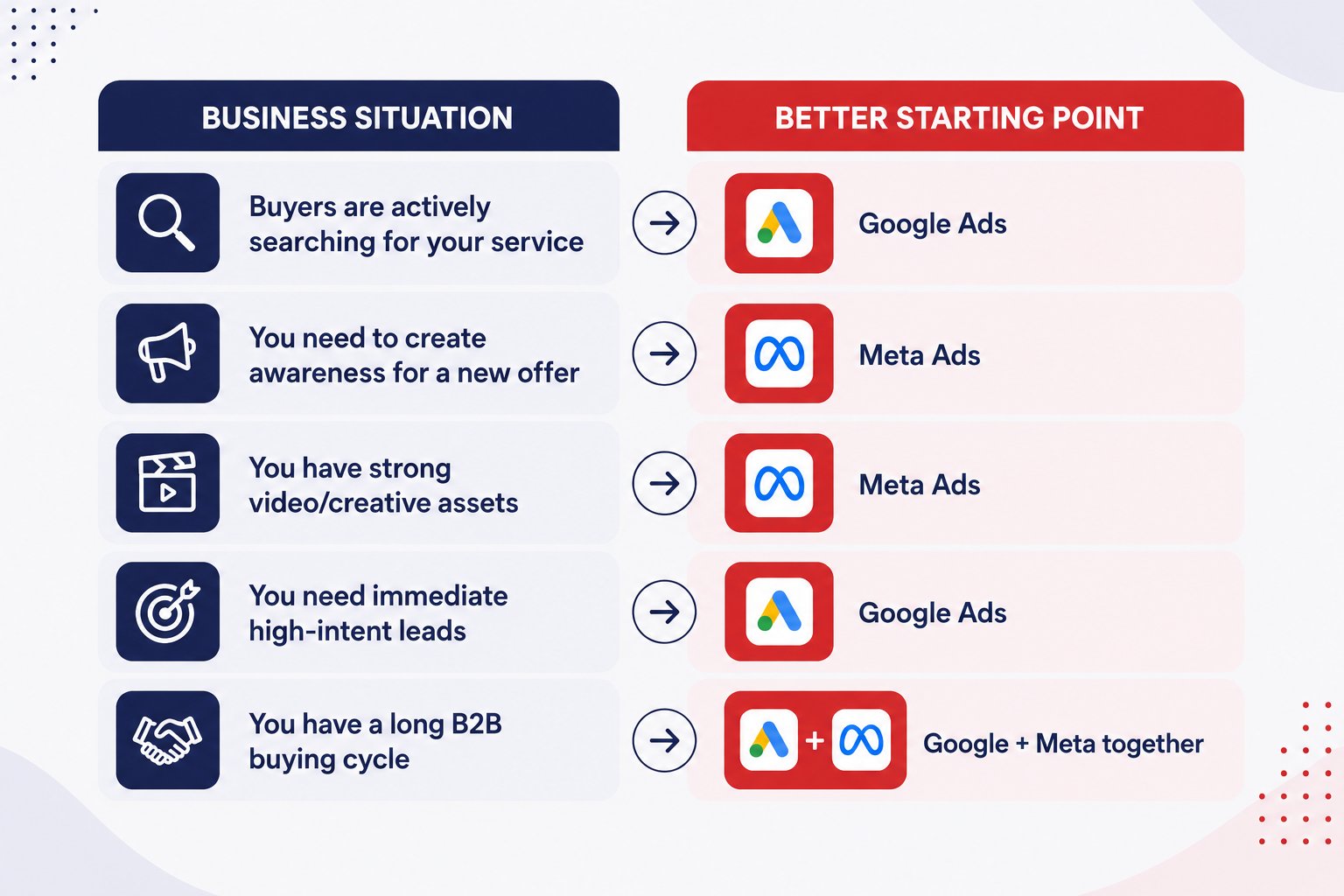
Because no single platform is a universal winner, enterprise teams must assess their unique profile before splitting their budgets.
Growth Stage and Immediate Objectives
Early-stage corporate entities looking to secure immediate, high-value contracts typically prioritize Google Search to capture immediate market demand.
Conversely, established market leaders looking to expand their total addressable market use Meta to introduce new methodologies to audiences who are unaware that a better solution exists.
Vertical Complexity and Buying Cycles
For highly specialized B2B fields with long, multi-stakeholder buying cycles such as the legal structures optimized for Elder Law by Make My Brand, a balanced mix is essential.
Google captures the urgent inbound queries, while Meta's custom audiences handle retargeting, nurturing decision-makers across a multi-month evaluation process with educational content.
Internal Resources and Creative Capacities
Meta requires a continuous stream of creative content. If your organization lacks the capacity to produce constant video-first variations and creator-led assets, you risk running into creative saturation quickly.
Google can be more forgiving with leaner creative assets, provided your server-side tracking infrastructure and first-party data pipelines are pristine.
Maximizing Performance Marketing Through Holistic Integration
Instead of viewing paid media through an isolated lens, modern performance marketing strategies treat Meta and Google as two interconnected parts of a larger customer acquisition system. When run in tandem, they create a highly efficient growth system.
Cross-Ecosystem Nurturing
Use Meta’s visual storytelling formats to introduce a complex problem to a broader audience, then use Google Search campaigns to capture the resulting branded search traffic.
Shared Intelligence Pipelines
Export high-value customer lists generated via Google Search and upload them into Meta as a seed audience for Advantage+ lookalike expansion.
Unified Attribution Models
Implement robust server-side data collection to accurately map the path to purchase, ensuring Meta receives credit for early discovery and Google for final conversion.
By breaking down internal silos and allowing data to flow freely between platforms, enterprises protect themselves from fluctuating acquisition costs on any single network.
When comparing Meta Ads vs Google Ads, enterprise leaders must evaluate their specific market dynamics rather than searching for a single superior platform. This visual hierarchy demonstrates that the debate of Meta Ads vs Google Ads is not a matter of selecting one channel, but of aligning the platform with the consumer's research and decision cycle. Rather than choosing between the both as a singular tactic, high-growth organizations use both channels to balance demand generation with immediate intent capture.
The ideal platform for lead generation and overall Google Ads vs Meta Ads ROI depends on an enterprise’s growth stage, category complexity, and internal design and development resources. When partnering with Make My Brand, organizations secure the technical infrastructure, creative assets, and automated pipelines required to turn cross-channel traffic into measurable revenue growth.
Conclusion
Ultimately, scaling enterprise client acquisition requires moving beyond platform silos to build a unified, multi-channel growth marketing architecture. Combining intent capture with algorithmic demand generation allows organizations to maximize capital efficiency across the entire customer journey. By implementing advanced first-party data strategies and automation, brands can insulate themselves from search volatility and secure sustainable pipeline growth. Partnering with Make My Brand provides the specialized expertise and technical infrastructure required to lead this digital transformation.
Loading FAQs
Please wait while we fetch the questions...
Published on July 17, 2026 by Simran