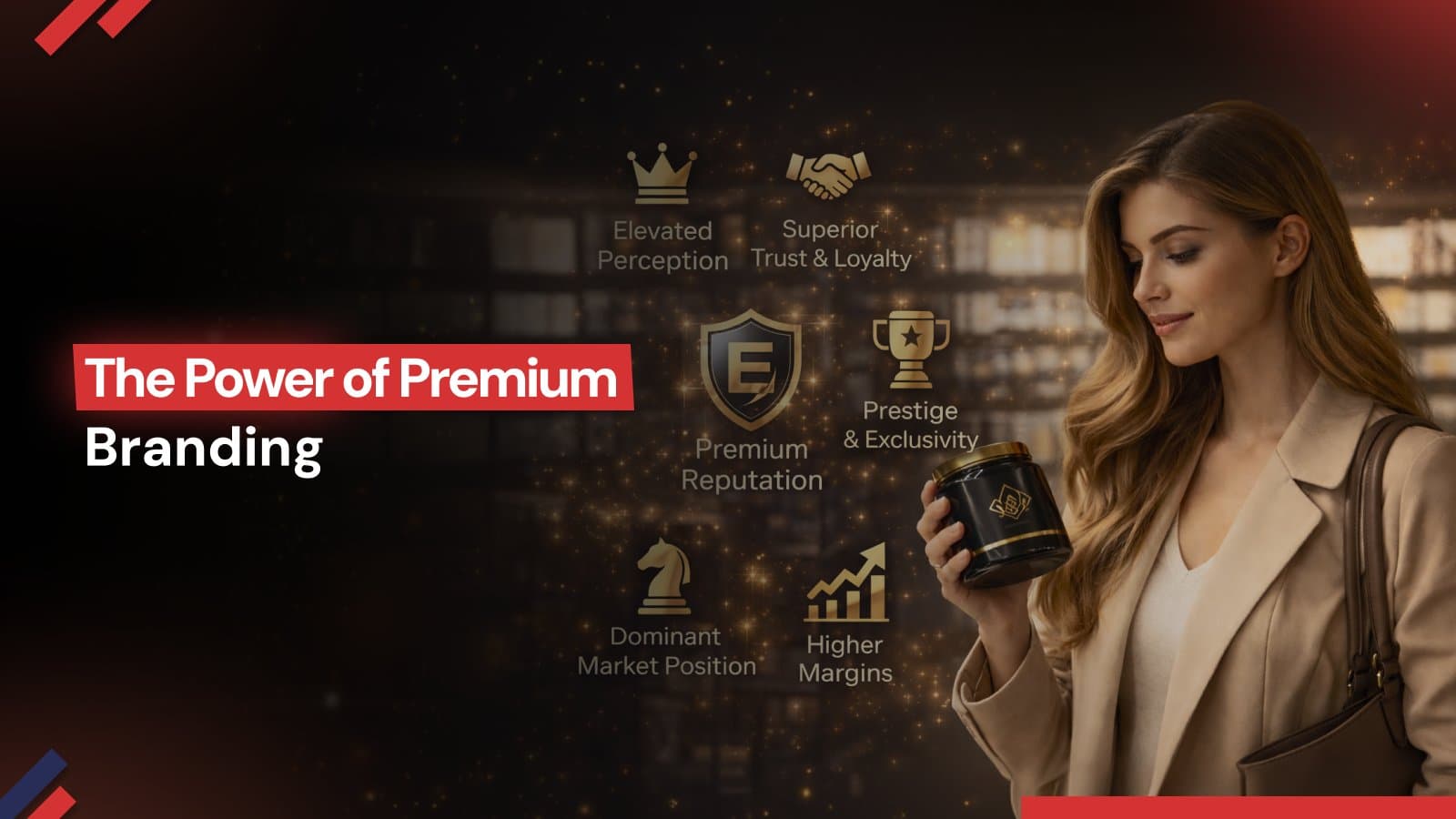
Premium Branding Strategy: How Brands Charge 2–5x Higher Prices
Premium branding isn’t about looking expensive, it’s about being perceived as worth it. Discover how strategy, psychology, and experience come together to justify higher pricing, build loyalty, and create long-term brand equity in today’s competitive market.
A strong premium branding strategy is not a coincidence - it’s engineered to influence perception, justify higher pricing, and build long-term brand equity.
In today’s market, where consumers are more informed and more selective than ever, the premium branding strategy has evolved. It is no longer about looking expensive - it’s about being perceived as worth it at every touchpoint.
At Make My Brand, we approach premium brand development as a structured growth system, not a surface-level exercise. Through our BDLC framework, we help brands create positioning, experiences, & perception that justify higher pricing and long-term loyalty.
Let’s explore how premium branding actually works - and why it enables companies to command significantly higher prices.
Why Premium Branding Strategy Enables Higher Pricing?
Premium pricing works when brands align perception, value, and experience to justify higher costs. Customers pay more when a brand successfully communicates:
Exclusivity → “Not everyone can have this”
Status → “This says something about me”
Quality assurance → “This reduces my risk”
Emotional value → “This makes me feel something”
Identity alignment → “This is who I am (or want to be)”
What’s Changed in Premium Branding?
Premium branding has evolved from visual differentiation to full-stack perception management across every customer touchpoint.
Key shifts shaping premium brands today:
From visibility → Selectivity
Premium brands are pulling back from overexposure and mass discounting
From product → Experience ecosystems
Experiences now drive stronger loyalty than features alone
From consistency → Adaptive consistency
Brands must stay recognizable while evolving with culture
From storytelling → Story-doing
Customers expect brands to deliver, not just communicate
From intuition → AI-enhanced personalization
Data and AI now shape tailored premium experiences at scale
This is where most brands fail - they upgrade visuals but ignore systems.
The Psychology Behind Premium Pricing
Premium pricing works because human decision-making is emotional first and rational second. Several psychological factors influence why consumers accept higher prices from certain brands.
1. Premium Brands Act as Quality Indicators
Price itself becomes a signal of quality. When customers see a significantly higher price, they often interpret it as proof of superior craftsmanship, materials, or expertise.
If a brand positions itself correctly, the higher price reinforces trust rather than discouraging purchase.
2. Emotional Branding Drives Loyalty
Premium brands create emotional relationships with customers. Instead of focusing only on features, they focus on feelings:

aspiration
confidence
belonging
status
identity
Example:
Tesla positioned itself not as a car company, but as a technology and innovation brand
Dior positions itself at the intersection of heritage and modern luxury
This clarity and connection reduce comparison and increase perceived value.
That is why brands focus heavily on storytelling, community, and purpose rather than product specifications alone. Emotional branding transforms a purchase into a personal statement.
3. Status and Exclusivity Increase Perceived Value
Luxury and premium brands carefully manage exclusivity. When a product appears rare or selective, its perceived value increases dramatically. Premium brands achieve this through:
controlled distribution
limited product releases
invitation-only experiences
membership programs
The result is not just higher prices - it is stronger brand desire.
4. Premium Brands Sell Identity, Not Products
Premium brands succeed because they align psychology, perception, and positioning to create value beyond the product.
Consumers don’t choose premium brands for functionality alone - they choose them for identity, status, and emotional connection.
Apple doesn’t sell phones - it sells simplicity, innovation, and status
Rolex doesn’t sell watches - it sells legacy, success, and prestige
Hermès doesn’t sell bags - it sells rarity and cultural capital
The product becomes a symbol. This is why premium brands don’t sell products - they sell perception, identity, and experience.
In each case, the product is only one part of the value equation. This is why emotional branding plays a central role in premium pricing strategies.
The Core Levers That Justify 2–5x Pricing
1. Sharp Brand Positioning Strategy
A strong brand positioning strategy is the foundation of any premium branding strategy. Premium brands don’t compete - they differentiate. They define:
Who are they for?
What do they stand for?
Why are they different?
For example:
Hermès → craftsmanship + scarcity
Louis Vuitton → heritage + status
They are not alternatives - they are categories of their own.
2. Visual Identity as a Strategic Weapon
Premium design is not decoration - it’s a signal of standards. Every element communicates precision, attention to detail, consistency, and control.
Think of:
Minimal packaging from Apple
Signature orange boxes of Hermès
Clean, editorial aesthetics of Aesop
These are not design choices - they are brand codes that reinforce premium perception.
At Make My Brand, we emphasize that visual identity is often the first signal of value. A weak design immediately lowers perceived worth - no matter how good the product is.
3. Customer Experience That Feels Effortless
Customer experience is a critical pillar of any premium branding strategy. Brands that deliver superior customer experience across digital, retail, and service channels can differentiate themselves dramatically. Premium customer experience includes:
personalization
concierge-style service
frictionless digital journeys
post-purchase engagement
Luxury example:
Ritz-Carlton empowers employees to spend up to a certain amount to solve customer issues instantly - no approvals needed.
That level of responsiveness builds trust - and trust justifies price.
4. Emotional Branding & Neuromarketing
Premium brands win in the subconscious. They use:

Storytelling
Sensory cues
Emotional triggers
Memory associations
Why? Because decisions are emotional first, rational second.
Example:
Nike sells aspiration and personal achievement
Gucci sells bold self-expression and cultural relevance
Emotion creates attachment. Attachment reduces price sensitivity.
5. Controlled Distribution & Scarcity
Premium brands grow by limiting access, not expanding it. They:
Restrict where products are sold
Avoid excessive discounting
Maintain tight inventory control
Example:
Hermès Birkin bags have waiting lists, luxury brands avoid mass marketplaces to protect perception.
Scarcity increases desirability - and perceived value. This is often called the “Sell Less, Earn More” strategy. This creates clarity, focus, and exclusivity.
It’s not about volume - it’s about value per unit.
6. The Hero Product Strategy
Many successful premium brands do not rely on large product catalogs. Instead, they build their reputation around one or two iconic “hero products.” These flagship offerings serve multiple strategic purposes:
establish credibility
define the brand’s standards
create aspirational demand
elevate the perception of the entire portfolio
For example:
The Birkin bag for Hermès
The Submariner for Rolex
The Air Jordan line for Nike
Once the hero product establishes authority, additional offerings inherit the same premium perception. This strategy allows brands to scale revenue without diluting brand prestige.
8. Brand Rituals Increase Perceived Value
Premium brands create moments, not just transactions. These rituals include:
Unboxing experiences
Personalized notes or onboarding flows
Store interactions
Signature packaging
Purchase ceremonies
Product usage behaviors
Example:
Receiving a luxury handbag from Louis Vuitton feels deliberate and satisfying - this is engineered psychology.
These rituals slow the experience down and make it feel special.
How AI is Transforming Premium Branding Strategy?
AI is not replacing premium branding - it is enhancing it.
Key Applications:
Hyper-personalized customer journeys
AI-driven content adaptation
Predictive customer behavior insights
Faster design iterations
According to McKinsey, AI-driven personalization is becoming a key driver of customer experience and revenue growth. However, premium brands must balance:
Technology with authenticity
Efficiency with craftsmanship
The goal is not automation - it’s elevated personalization.
The Future of Premium Branding
The future of premium branding strategy will be shaped by several emerging trends:
AI-powered personalization
experiential commerce
community-driven brand narratives
sustainability and purpose-led branding
direct-to-consumer premium ecosystems
Brands that successfully integrate these elements will build stronger emotional connections, deeper loyalty, and higher pricing power.
Premium branding will increasingly depend on strategic thinking, design excellence, and intelligent technology integration.
Final Thoughts
Premium branding is not about charging more - it’s about becoming worth more in the customer’s mind.
The brands that successfully charge 2–5x higher prices:
Own a distinct position
Deliver exceptional experiences
Build emotional connections
Control perception at every level
At Make My Brand, we believe premium branding is one of the most powerful growth strategies available today. When executed through a structured system like BDLC, it transforms branding from a creative exercise into a measurable business advantage.
Because in the end - People don’t pay more for products - they pay more for brands they believe in.
Build a brand that commands its price! Partner with Make My Brand to craft a premium brand development system that drives higher margins and long-term value.
Loading FAQs
Please wait while we fetch the questions...
Published on April 7, 2026 by Surbhi Sood