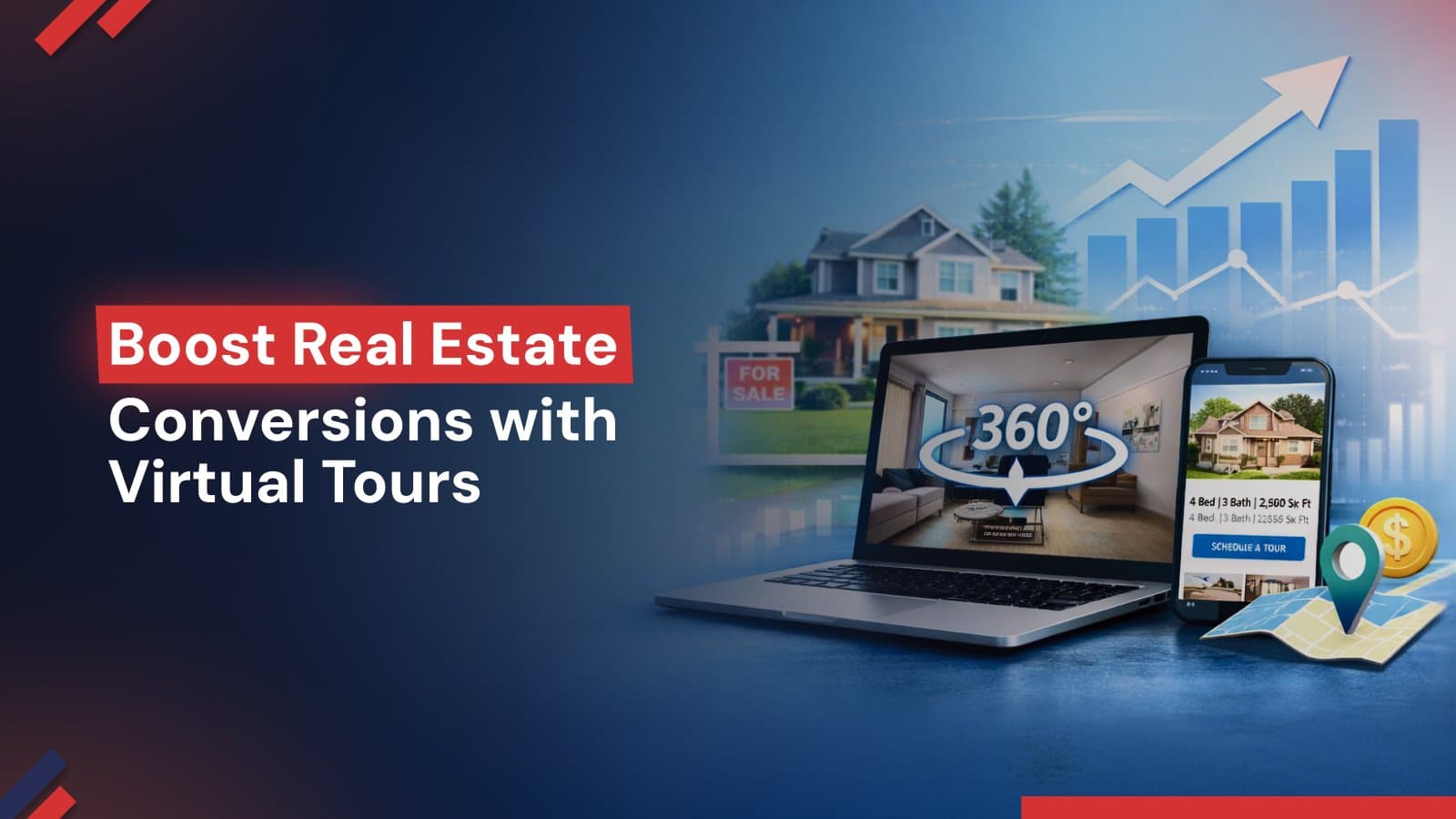
How Virtual Tours & Website Design Boost Real Estate Conversions?
Boost real estate conversions with virtual tours and high-performance website design. Learn how immersive experiences, mobile-first UX, and AI-powered property discovery reduce drop-offs, improve engagement, and turn property browsers into high-intent leads.
The first property visit doesn’t happen at the site anymore - it happens on a screen. And in today’s market, that first digital interaction determines whether a prospect becomes a lead or disappears.
Real estate brands are no longer competing on listings alone. They’re competing on experience, clarity, and emotional connection. The difference between a high-performing website and an average one is simple: one guides users toward action, the other leaves them browsing.
At Make My Brand, we’ve seen this shift firsthand. The most successful real estate platforms are no longer static listing hubs - they are conversion ecosystems built around immersive experiences, intuitive UX, and intelligent lead capture.
This blog breaks down what’s driving conversions today - and how virtual tours and website design are at the center of it.
The New Buyer Journey: From Browsing to Decision-Making
The modern property buyer is more informed - and more impatient - than ever before.
They expect instant clarity on property value.
They prefer visual-first exploration over long descriptions.
They rely on digital tools before human interaction.
Buyers want to experience a property before they commit to it. They are not just looking for information. They are looking for confidence.
Can I understand this property quickly?
Can I visualize living here?
Can I trust this brand?
Nowadays, the majority of buyers begin their home search online, making your website the most critical touchpoint in the journey. At the same time, visual content - photos, videos, and virtual tours - remains the most influential factor in decision-making.
Beyond Tours: The Rise of Immersive Visualization
Virtual tours are just one piece of the puzzle. High-performing real estate brands are integrating a broader set of immersive tools:
1. Virtual Tours & 3D Walkthroughs
These allow buyers to explore properties remotely with a realistic sense of space.
Impact:
Reduces unnecessary site visits
Improves lead quality
Increases time spent on the website
2. Virtual Staging
Empty properties often feel cold and difficult to visualize. Virtual staging solves that problem.
Adds furniture and decor digitally
Helps buyers imagine real-life usage
Makes listings more appealing instantly
Industry data shows that 83% of buyers’ agents say staging helps buyers visualize properties better, directly influencing decisions.
3. Architectural Visualization & AR
For under-construction or pre-launch properties, visualization is critical.
3D renders show future outcomes
AR enables real-time spatial interaction
Buyers gain confidence in incomplete projects
4. AI-Driven Property Discovery
AI is redefining how users search and discover properties.
Personalized recommendations based on behavior
Smarter filtering beyond price and location
Predictive suggestions for similar properties
This reduces search fatigue and helps users find the right property faster.
Why Virtual Tours Are Now Conversion Drivers for Real Estate Marketing?
Virtual tours have evolved from a “premium feature” to a conversion necessity. Today’s buyers are not just browsing - they are evaluating. They want to understand:
Spatial flow
Room proportions
Lighting and layout
Overall livability
And static images alone cannot deliver that.
What Makes Virtual Tours So Effective?
They reduce uncertainty - buyers get a realistic sense of the property.
They qualify leads faster - only serious prospects reach out.
They expand geographic reach - outstation and international buyers can engage remotely.
They drive emotional connection - users can “experience” the space.
This emotional clarity directly impacts conversions.
Why Traditional Listing Pages Fail to Convert?
Most real estate websites still follow an outdated format - a grid of images, scattered information, and generic CTAs. This creates friction instead of clarity.
Common Problems:
Random image order with no narrative
Lack of spatial understanding
Poor mobile experience
Too many clicks to access key information
Weak or delayed calls-to-action
Slow loading speed
Complicated navigation
No clear next step
Lack of trust signals
The result? Interested visitors drop off before becoming leads.
A high-performing website removes these barriers and replaces them with a guided experience.
Conversion-Focused Real Estate Website Design
To drive leads consistently, your property website UX design must be built around conversion psychology. Core elements of a high-converting real estate landing page:
1. Strong First Impression
Clear headline with property value proposition
High-quality hero visuals or video
2. Guided Property Experience
Structured content flow (spatial storytelling)
Easy access to virtual tours and floor plans
3. Clear Information Hierarchy
Price, location, and highlights upfront
Supporting details progressively revealed
4. Integrated Lead Capture
Short forms, WhatsApp integration, and click-to-call features increase conversion rates.
5. Trust & Credibility
Testimonials
Developer/agent credibility
FAQs and compliance details
6. Strategic CTAs
“Book a Site Visit”
“Schedule a Virtual Tour”
“Download Brochure”
All CTAs should be visible and easy to act on.
The “Spatial Storytelling” Model: How High-Converting Real-Estate Websites Work
Traditional listing pages are no longer fulfilling the user’s intent. They present properties as random image galleries, forcing users to piece together the story themselves.
High-performing real estate website design follows a different approach - they use spatial storytelling.
A Proven Content Flow
Instead of randomness, content is structured as a guided journey:
Exterior overview
Entrance experience
Living spaces
Kitchen and functional areas
Private spaces
Outdoor areas
Neighborhood context
This structure mirrors how people physically experience a home.
Why It Converts
Reduces cognitive effort
Builds emotional engagement step-by-step
Creates a sense of “being there”
Aligns with how buyers make decisions
Virtual tours amplify this model by allowing users to move through the story, not just view it. At Make My Brand, this storytelling approach is central to how we design property pages and landing experiences.
Mobile Experience: The Silent Conversion Driver
Most property searches today happen on mobile devices. Yet many real estate website designs are still not optimized for mobile-first behavior.
What High-Converting Mobile UX Looks Like:
Fast-loading pages (under 2–3 seconds)
Sticky CTAs (Call, WhatsApp, Book Visit)
Easy swipe navigation for images and tours
Minimal form fields
Click-to-view key details (price, location, amenities)
At Make My Brand, mobile UX is not an afterthought - it is the foundation of every real estate website we design.
AI-Driven Property Discovery: The New Competitive Edge
Search behavior is evolving rapidly. Buyers are no longer relying on filters - they expect personalized recommendations.
A recent Realtor.com survey found that 82% of Americans use AI for real estate insights, while still relying on real estate agents as the most trusted source of information.
That tells us something important: buyers are using technology to prepare, but they still want confidence before they convert. Your website has to support both of those needs.
How AI Is Transforming Real Estate Websites?
Personalized property recommendations
Predictive search results
Comparing properties and evaluating pricing trends
Behavior-based content display
AI-powered chat assistants
Smart lead scoring
Why It Matters for Conversions
Reduces search fatigue
Speeds up decision-making
Improves relevance
Increases engagement time
How Make My Brand Bridges the Gap?
At Make My Brand, we approach real estate marketing differently. We don’t just build websites - we build conversion ecosystems.
Our approach combines:
UX/UI strategy
High-performance web development
SEO and AI-search readiness
Paid media integration
Automation and CRM alignment
Real-World Impact: Turning Experience into Leads
A strong digital experience directly translates into measurable business outcomes. In one of our real estate projects, Make My Brand Labs developed a high-performance digital platform that delivered:
11K+ active users
600+ qualified leads
Sub-₹100 cost per lead
High engagement across property pages
The success came from aligning UX design, immersive content, lead capture systems, and performance optimization. This is the difference between a website that “exists” and a website that converts.
What’s Driving Conversions in Real Estate Today
To summarize, real estate conversions are being driven by a combination of:
Immersive Experiences
Virtual tours, AR, and 3D walkthroughs increase engagement and clarity.
Emotional Visualization
Staging and storytelling help buyers imagine ownership.
Frictionless UX
Simple, intuitive design reduces drop-offs.
Mobile Optimization
Fast, responsive websites capture on-the-go users.
AI-Powered Discovery
Personalized recommendations improve relevance.
Strong Lead Systems
Integrated CRM ensures no opportunity is lost.
Final Thoughts
Real estate websites are evolving into decision-making platforms. Buyers no longer want to “explore options” - they want to arrive at decisions faster. That means your website must:
Guide, not overwhelm
Engage, not just inform
Convert, not just attract
Real estate is no longer just about property - it’s about perception, experience, and timing. Immersive technologies, intelligent design, and AI-powered discovery are reshaping that moment, making it faster, more informed, and more emotional.
The question is no longer whether to adopt these changes, but how effectively you implement them.
At Make My Brand, we help real estate brands stay ahead of this shift - by creating digital experiences that align with how modern buyers think, explore, and decide. Because in a market driven by experience, the best-designed journey always wins.
Stop missing opportunities - start converting them. Talk to our experts today.
Loading FAQs
Please wait while we fetch the questions...
Published on March 31, 2026 by Abhishek Vasudev