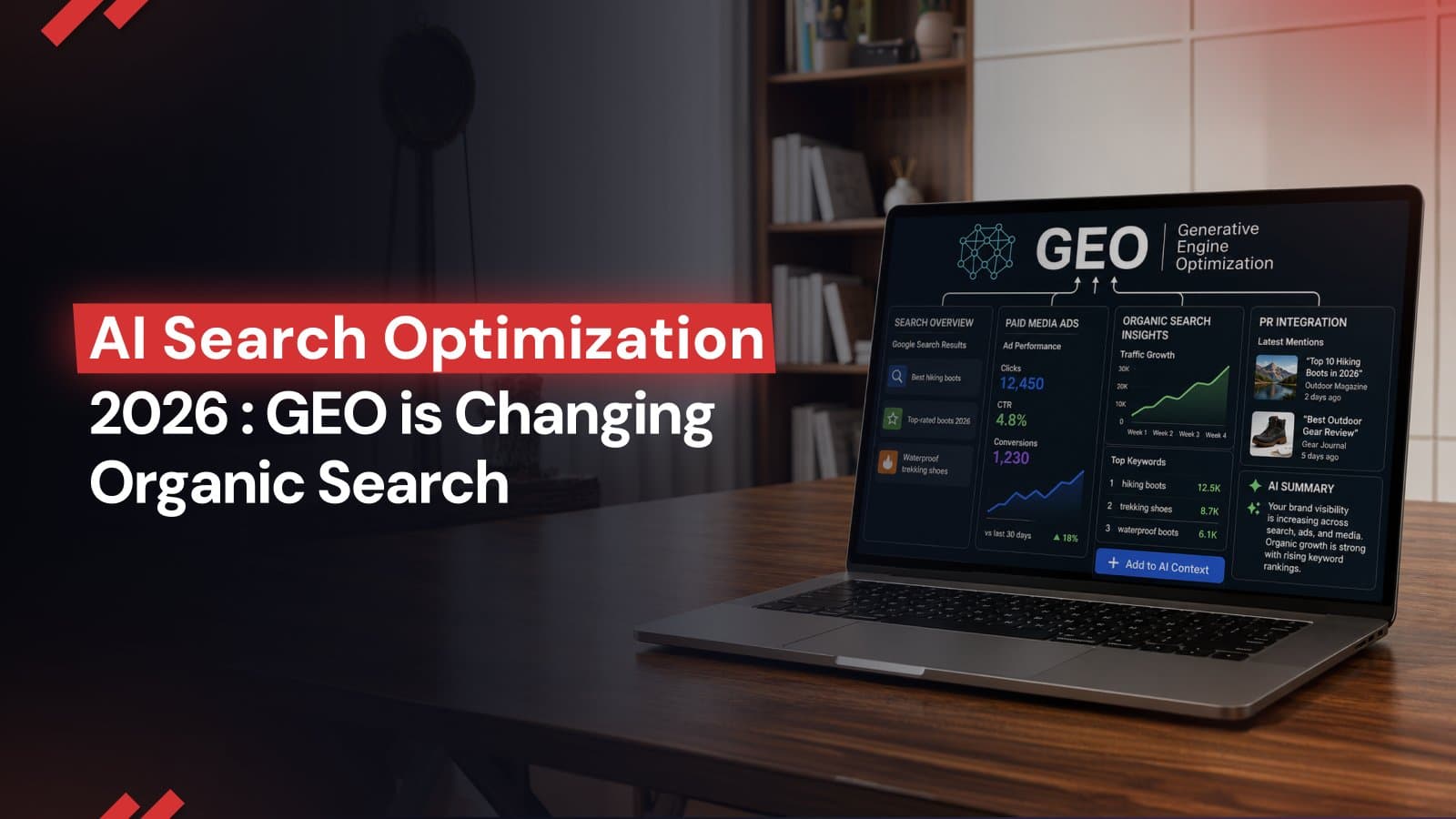
AI Search Optimization 2026: How Generative Engine Optimization (GEO) is Changing Organic Search
AI Search Optimization 2026 is redefining organic search in an AI-first ecosystem. Learn how GEO, AEO, semantic SEO, and entity-based strategies help your content get cited, build authority, and drive high-intent conversions across zero-click and multi-platform search journeys.
In 2026, AI Search Optimization (AI SEO Strategy) is redefining how content ranks, appears, and converts across search ecosystems. AI-powered search experiences like Google’s AI Overviews and conversational AI modes are fundamentally changing how users discover, evaluate, and engage with content. Instead of navigating multiple websites, users are increasingly getting synthesized answers directly within search interfaces.
This shift is redefining visibility, authority, and ultimately growth.
At Make My Brand, this shift aligns with how modern growth should work - where organic visibility is not just about traffic, but about influence, authority, and conversion across fragmented discovery channels.
This blog breaks down what’s actually changing and how to build an AI SEO strategy that keeps you discoverable in 2026.
The New Reality: AI Search Optimization 2026 & the Shift to Answer Engines
Search has evolved into what many now call an answer-first ecosystem - where visibility depends on whether your content can be understood, trusted, and surfaced by AI.
Recent industry findings highlight this shift:
AI-generated summaries are reducing traditional click-through behavior significantly.
A growing percentage of queries now trigger AI-powered responses.
Users are shifting toward conversational and long-tail queries.
This is where AI search optimization 2026 becomes critical. It’s no longer about ranking pages - it’s about becoming the source AI chooses to reference.
What is AI Search Optimization 2026?
AI Search Optimization 2026 refers to optimizing content for AI-driven discovery systems where visibility depends on being cited, summarized, and recommended by generative engines.
It Includes:
Generative Engine Optimization (GEO)
Optimizing content to be cited and summarized by AI systems.
Answer Engine Optimization (AEO)
Structuring content to directly answer queries clearly.
Semantic SEO
Building topical depth instead of keyword pages.
Entity-based optimization
Helping AI understand who you are, what you do, and why you matter.
Understanding the Shift: Key Trends Reshaping Search
1. The Emergence of AI Overviews, AI Mode & Zero-Click Dominance
AI Overviews and AI Mode are compressing the organic search journey. Users are getting answers without clicking.
AI Overviews reduce the need to visit multiple websites
AI Mode enables deep, conversational exploration
Complex queries now trigger AI-generated responses first
Impact on content visibility
Organic CTRs are declining for informational queries
Visibility is shifting from ranking → being referenced
Long-form, intent-rich queries are now more valuable than short keywords
2. Intent-Based & Conversational Search
Search queries are becoming more human. Instead of typing - “best CRM tools”. Users now ask - “Which CRM is best for small SaaS teams with limited budget?”
AI thrives on this complexity.
To stay visible, the content must:
Address specific use-cases
Cover layered intent (informational + commercial)
Provide contextual depth - not just surface-level answers
3. Search is Fragmenting Beyond Google
This fragmentation defines the future of organic search where visibility extends beyond traditional search engines. Discovery is spreading across platforms:
AI tools (Chat-based search)
Social platforms (Instagram, YouTube, LinkedIn)
Marketplaces and communities
What users are doing differently?
Searching on social before Google
Asking AI tools for recommendations
Comparing options across multiple platforms
The content strategy must now be multi-platform, format-diverse, and context-aware.
This is why Make My Brand integrates SEO, content, and performance marketing into a unified growth system.
4. AI Content Scaling = More Competition
AI has made content creation faster but also more competitive. The barrier to publishing is gone. The barrier to standing out is higher than ever.
The real challenge
Content saturation is increasing rapidly
Generic AI-generated content is everywhere
Differentiation is becoming harder
Instead of volume, focus on:
Original insights
Real-world experience
Strong POV (point of view)
Clear positioning
AI can scale content - but it cannot replace strategic thinking.
The competitive edge lies in original thinking, real-world insights, and a strong brand perspective. This directly impacts AI content visibility, making differentiation critical.
AI SEO Strategy for 2026: How to Dominate AI Search Results
Despite all the noise, Google has been consistent about one thing - fundamentals still matter - but execution must evolve.
In 2026, AI systems are no longer just scanning for keywords. They are interpreting meaning, mapping relationships between topics, and prioritizing content that delivers depth, structure, and usefulness across multiple related intents.
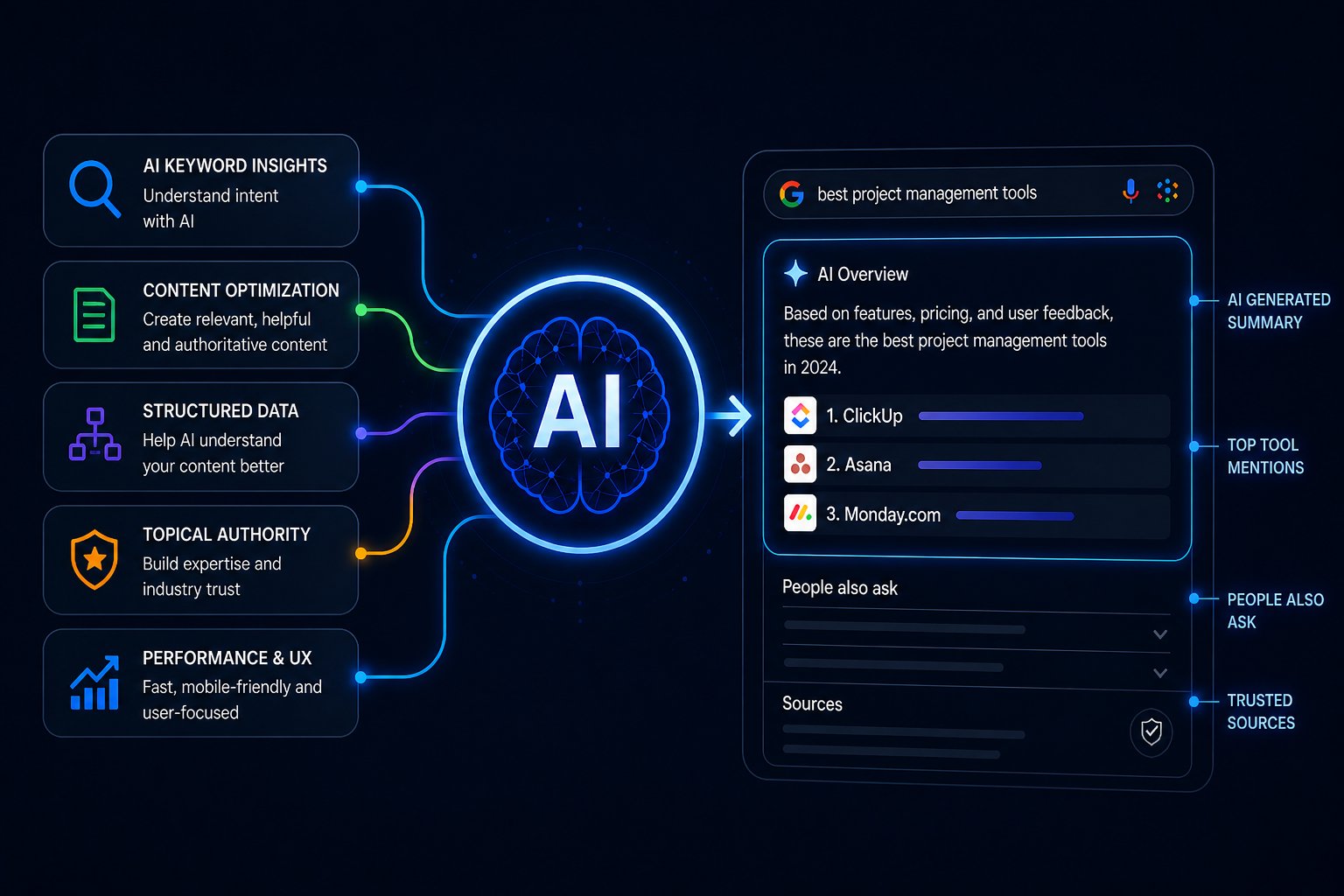
Instead of chasing isolated keywords, focus on:
Intent completeness
Cover the main query and related sub-questions in one ecosystem
Semantic relevance over keyword stuffing
Keywords still matter - but context, entities, and natural language matter more
Structured clarity
Headings, summaries, and logical flow to help AI extract meaning
Topical authority
Single blogs don’t rank - content ecosystems do
Content freshness
Especially for fast-evolving topics like AI search ranking factors 2026
How to Actually Execute This in 2026?
To align with modern AI search behavior, the content should be:
Well-structured → clean sections, scannable formatting
Contextually complete → answers primary + secondary intent
Semantically rich → built around topics - not just keywords
Entity-driven → connects concepts - not just phrases
These practices align with modern AI search ranking factors 2026, where structure, semantics, and intent define visibility.
Don’t Ignore the Multimodal Layer
Multimodal optimization is becoming a key factor in AI search optimization 2026. With AI-powered experiences like Google Lens, voice search, and AI Mode, users now interact with search through images, videos, audio, and mixed inputs. They can click a photo, ask a follow-up question verbally, and refine it with text - all within the same journey.
This shift toward multimodal search is not just a UX upgrade - it’s a fundamental change in how content is discovered, interpreted, and ranked.
What this means for content:
Visual-first indexing: Images and videos are analyzed for meaning - not just metadata
Context layering: Text, visuals, and intent are combined to understand queries deeply
Higher engagement signals: Rich media improves dwell time and discoverability
How to optimize:
Pair every key idea with supporting visuals (diagrams, screenshots, short videos)
Use descriptive alt text and context-rich captions
Align visual assets with search intent - not just design
To improve both AI content visibility and user engagement, integrate visual explainers, short-form videos, infographics, and diagrams.
Personalization in AI Search
AI-driven search has moved beyond static rankings to dynamic, user-specific experiences. Every result is now shaped by context. Personalization is a core driver in the future of organic search, where visibility varies per user.
What’s Driving Personalization?
User behavior signals (past searches, clicks, dwell time)
Contextual intent (location, device, time of query)
Preference patterns (content formats, brand affinity)
What This Means for Content Visibility
There is no universal “#1 ranking” anymore. Instead:
Different users see different results for the same query
Content must address multiple intent layers
Relevance is evaluated at an individual level
To stay competitive, brands must build adaptive, intent-layered content ecosystems that align with diverse user journeys and evolving expectations.
Agentic AI & Predictive Search: The Next Frontier
We are next entering the era of agentic AI - where AI doesn’t just answer questions but takes action. This shift will redefine AI SEO strategy, where content must not only inform but enable decisions. Examples include:
Recommending tools
Booking services
Automating decision-making
Alongside this, predictive analytics is enabling:
Anticipation of user needs
Proactive content delivery
Smarter content marketing planning
This is where future-ready brands will differentiate. At Make My Brand, leveraging AI for predictive growth and intelligent content strategy is already a core part of how we build scalable digital ecosystems.
Risks You Can’t Ignore
With opportunity comes complexity.
Key challenges in AI-driven search:
Content manipulation risks: Low-quality AI content flooding search
Misinformation: AI-generated inaccuracies
Loss of direct traffic: Due to zero-click behavior
How to stay ahead:
Focus on credibility and accuracy
Build strong brand signals
Maintain content freshness and updates
Trust is becoming the ultimate ranking factor.
The New Content Visibility Framework
To win in 2026, your strategy must evolve into a multi-layered visibility system:
Foundation Layer: SEO Basics
Crawlability
Site structure
Technical optimization
Intelligence Layer: AI Optimization
Structured, answer-ready content
Semantic depth
Entity clarity
Experience Layer: User & Content Experience
Engaging formats
Visual storytelling
Clear navigation
Distribution Layer: Multi-Channel Presence
Organic Search
Social
AI platforms
This is the shift from SEO → AI SEO strategy → Growth Intelligence.
How Make My Brand Turns AI Search into a Growth Advantage?
At Make My Brand, we don’t treat AI as a trend - we treat it as infrastructure. Our approach combines:
Organic Visibility & AI SEO Strategy
Content Marketing with GEO & AEO frameworks
Performance Marketing for scalable growth
AI-as-a-Service for predictive insights
We help brands:
Build authority in AI-driven search
Increase discoverability across fragmented platforms
Turn content into a measurable growth engine
Because in 2026, visibility without strategy is just noise.
Conclusion: Visibility in 2026 Is Earned
Organic search hasn’t disappeared - it has evolved into an intelligence-driven ecosystem where the most relevant, structured, and trustworthy content survives.
AI is filtering noise, compressing journeys, and rewarding brands that:
Understand intent deeply
Create meaningful, structured content
Build trust across platforms
Adapt faster with the market changes
This is what AI search optimization 2026 truly demands. Brands that adapt will not just survive declining clicks - they will dominate high-intent discovery moments.
At Make My Brand, we help brands transition from traditional SEO to AI-led growth systems - where content drives visibility, trust, and measurable business impact across fragmented search environments.
Ready to dominate AI-driven search? Get in touch with us today!
Loading FAQs
Please wait while we fetch the questions...
Published on May 6, 2026 by Khushpreet Kaur