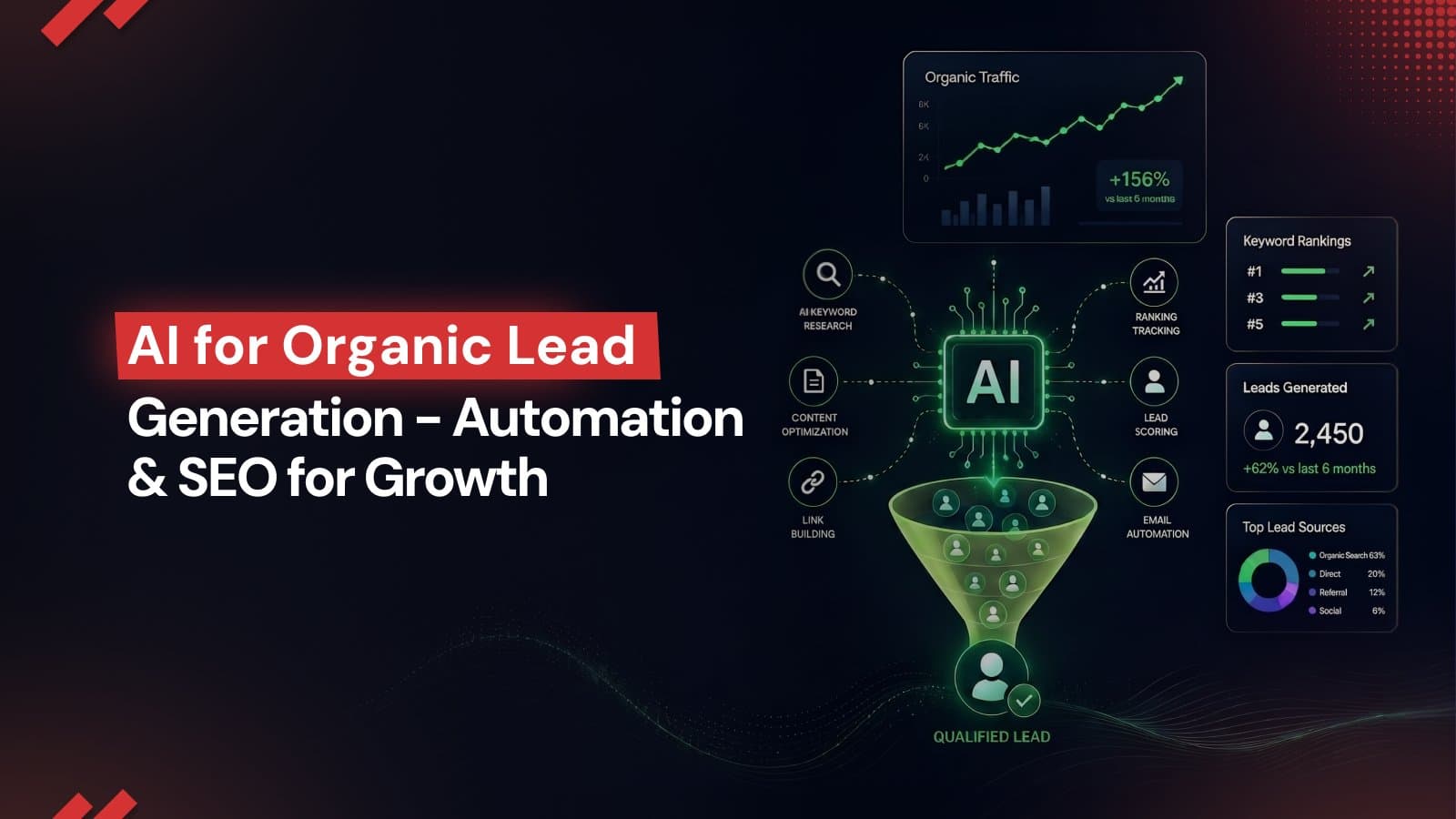
AI for Organic Lead Generation: How Automation and SEO Work Together for Predictable Growth
As search evolves beyond traditional rankings, AI for Organic Lead Generation is emerging as a cornerstone of sustainable growth. By combining SEO, automation, and intelligent workflows, businesses can strengthen visibility, improve lead quality, and drive more predictable growth outcomes.
Organic lead generation is changing fast. Google now explicitly says its generative AI features still rely on core search ranking and quality systems, which means SEO has not disappeared. It has become the foundation that helps content surface in both traditional search and AI-led discovery.`
Therefore, the strongest organic growth strategy today is built on a connected system where AI improves research, content production, qualification, and reporting. Meanwhile, SEO ensures the content remains crawlable, structured, and visible in the places where buyers are now searching.
In this blog, we will explore how SEO blends with automation and AI for organic lead generation to create a more predictable, scalable, and intent-driven growth system.
Why Organic Lead Generation Now Demands a Different Approach?
Search behavior is becoming more conversational, more intent-driven, and less linear. Google claims that their AI Overviews are available in 40 languages and more than 200 countries and territories, demonstrating how rapidly AI-assisted discovery is expanding across markets.
In practice, that means a page does not only need to rank - it needs to be useful enough to be selected, summarized, and trusted within AI-influenced experiences. This evolution has also reshaped SEO lead generation, where ranking alone is no longer sufficient without contextual authority and semantic depth. That shift has made three things especially important:
Semantic content generation that covers topics, entities, and buyer questions instead of only repeating keywords.
Technical optimization and schema so search systems can interpret the page correctly and surface it in richer formats. Google's structured data guidance states explicitly that structured data helps pages qualify for rich results.
LLM visibility and citation readiness need information that is clear, truthful, and well-structured enough to be referenced when AI technologies synthesize responses.
Where AI Actually Adds Leverage?
Many organizations view AI as a content-generation tool. The reality is much bigger. AI for organic lead generation is becoming an operational layer that supports the entire growth lifecycle.
Instead of solving one marketing problem at a time, AI can continuously improve performance across multiple functions simultaneously.
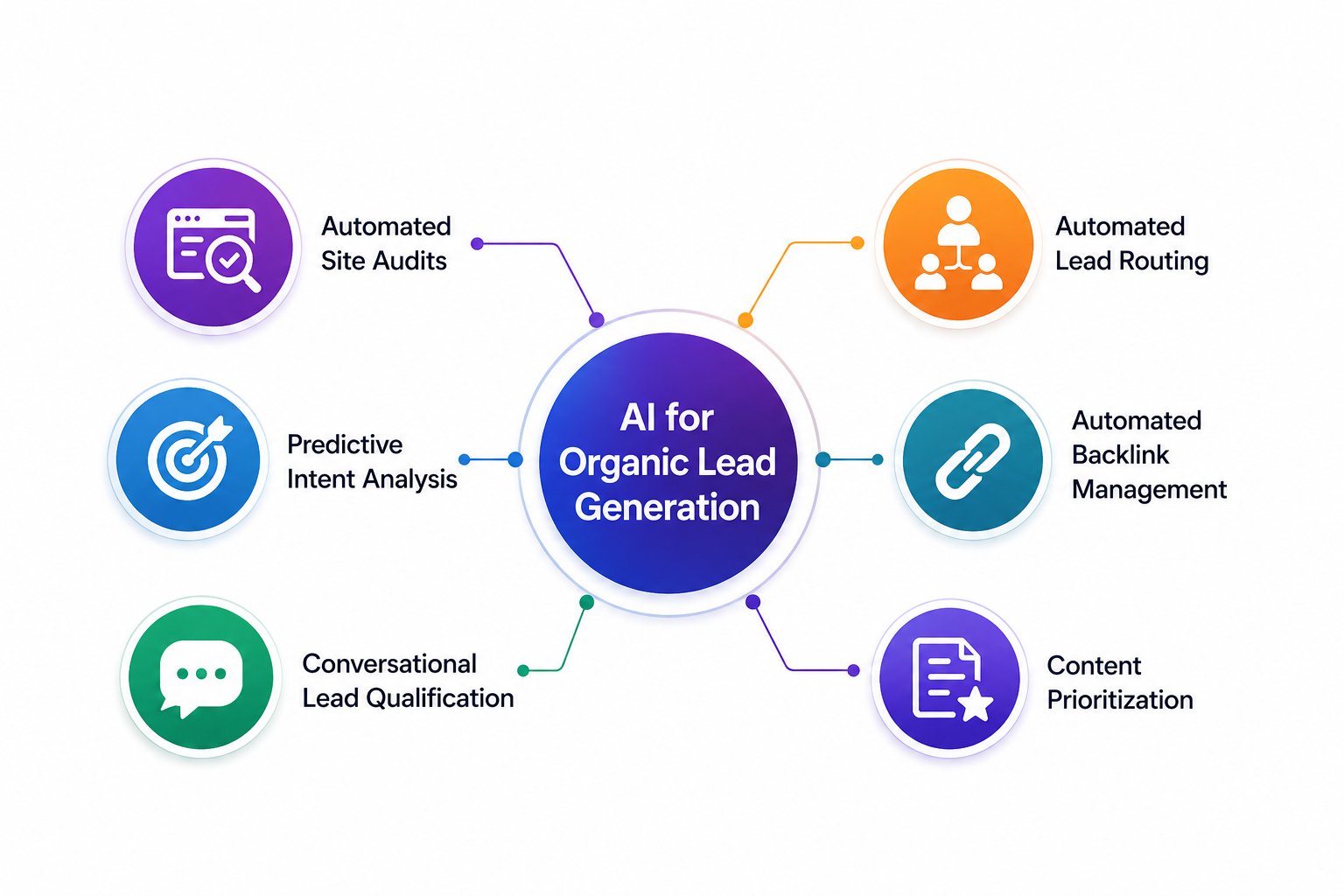
In a modern organic growth system, AI helps with:
Automated site audits to find crawl issues, broken experiences, thin pages, and content gaps faster.
Predictive intent analysis to identify which topics and questions are most likely to convert.
Automated lead routing so qualified demand reaches the right sales or specialist team without delay.
Conversational lead qualification through chat, forms, or guided flows that reduce friction and route visitors faster.
Automated backlink management and content prioritization, so SEO work stays focused on pages with the strongest commercial intent.
Collectively, these capabilities are often delivered through modern AI automation services, creating a growth framework that becomes more efficient over time.
The Growth Framework That Works Now
In an environment where discovery happens across Google, AI Overviews, ChatGPT, Perplexity, Gemini, and industry-specific AI assistants, growth requires a framework designed for both search engines and AI-driven recommendation systems.
1. Search Intelligence Before Content Production
Traditional keyword research is rapidly being replaced by search intelligence. Instead of focusing only on search volume, leading organizations analyze:
Emerging buyer questions
Topic momentum and trend acceleration
Competitive content gaps
AI-generated query patterns
Commercial intent signals
The objective is to identify opportunities before they become crowded. AI-powered search intelligence platforms can now surface rising demand patterns well before they become mainstream search trends. This strengthens long-term AI search optimization efforts and helps brands build visibility ahead of competitors.
2. Entity-Led Content and Generative Engine Optimization (GEO)
Search engines and large language models increasingly evaluate content through entities, relationships, and contextual relevance rather than exact-match keywords.
This shift has given rise to GEO, where success depends on:
Building topical authority around core business themes
Strengthening brand entity recognition
Creating semantically connected content clusters
Earning citations from authoritative industry sources
The goal is not simply to rank pages but to increase a brand's likelihood of being referenced, cited, and recommended within AI-generated responses. This is where modern organic visibility solutions become critical for sustained discovery across platforms.
3. Predictive Intent Analysis Instead of Reactive SEO
Most SEO programs respond to demand after it already exists. Modern systems use AI for organic lead generation, identifying behavioral and search signals that indicate future buying intent.
By analyzing:
Search journeys
Engagement patterns
Content consumption behavior
First-party data signals
Organizations can predict which prospects are moving toward a purchasing decision and prioritize content, offers, and outreach accordingly.
This transforms SEO from a traffic-generation channel into an intent-generation channel.
4. Autonomous Optimization Across the Digital Ecosystem
One of the most significant developments is the emergence of agentic SEO and autonomous growth systems. AI agents can now continuously:
Audit websites for technical issues
Detect content decay
Identify internal linking opportunities
Monitor competitor movements
Recommend schema enhancements
Surface backlink opportunities
Instead of waiting for quarterly audits, optimization becomes continuous, allowing brands to maintain search visibility at scale with significantly greater efficiency.
5. Signal-Based Selling and Automated Lead Orchestration
Traffic alone has become an increasingly poor indicator of growth. The strongest organizations focus on intent signals rather than visitor counts.
AI-powered systems can combine signals to determine readiness to engage from:
Organic search behavior
Content engagement
Website interactions
CRM activity
Conversational AI interactions
These signals can automatically trigger lead qualification, personalized nurturing sequences, and intelligent routing to the appropriate sales or customer success teams.
The result is a connected growth ecosystem where SEO, AI marketing automation, and revenue operations work as a unified system rather than isolated functions.
Ultimately, the organizations generating the most predictable organic growth today are not those producing the most content. They are the ones building intelligent, self-improving growth systems that transform search visibility into measurable business outcomes.
Measuring Brand Presence in AI Search: LLM Visibility
Historically, brands measured:
Rankings
Traffic
Leads
Today, another question is becoming important: "How often is our brand referenced, cited, or surfaced within AI-generated responses?"
This has led to growing interest in:
LLM Visibility Audits
Evaluating how AI systems perceive and reference a brand.
Citation Share
Understanding how often a company appears compared to competitors within AI-generated answers.
Trusted Entity Optimization
Strengthening digital signals that establish credibility across search and AI ecosystems.
These disciplines are still evolving, but they represent the next frontier of organic visibility.
Proof Signals from Make My Brand
The strongest way to demonstrate expertise is through execution. Make My Brand shows how integrated growth work can produce measurable outcomes.
MoogleLabs is one example. The project combined branding, UX improvements, web development, SEO, analytics, and performance marketing. The result included a jump in sessions from 15.7K to 36.8K, which is a strong signal that content, technical structure, and digital experience were working together rather than separately. Read full case study here.
Kensington adds another layer of relevance. The work centered on intent-aligned content, UX optimization, analytics, and B2B distribution, which reflects the exact kind of connected system organic lead generation now requires. That is the type of execution that helps Make My Brand stand out as a growth partner rather than an agency. Read full case study here.
What Does it Means for the Next Phase of Organic Growth?
The discovery layer is changing, but the fundamentals have not gone away. Search still rewards quality, structure, and trust. AI is simply raising the bar on how those fundamentals need to be delivered.
Brands that combine semantic content, structured data, conversational qualification, predictive analytics, and automation will have a better chance of generating demand that is both visible and measurable.
That is why AI for organic lead generation is not about replacing SEO. It is about making SEO smarter, faster, and more commercially useful.
SEO remains the foundation. AI becomes the acceleration layer.
Final Thoughts
Organic growth is becoming increasingly complex, but the underlying challenge remains the same earning visibility before competitors and converting demand more efficiently. What has changed is the technology available to achieve it. Brands that embrace AI for organic lead generation now will be better positioned to gain market share, reinforce digital authority, and build a more predictable pipeline in an increasingly AI-driven discovery market.
Ready to build an organic growth engine designed for the AI era? Talk to the experts at Make My Brand.
Loading FAQs
Please wait while we fetch the questions...
Published on June 4, 2026 by Surbhi Sood