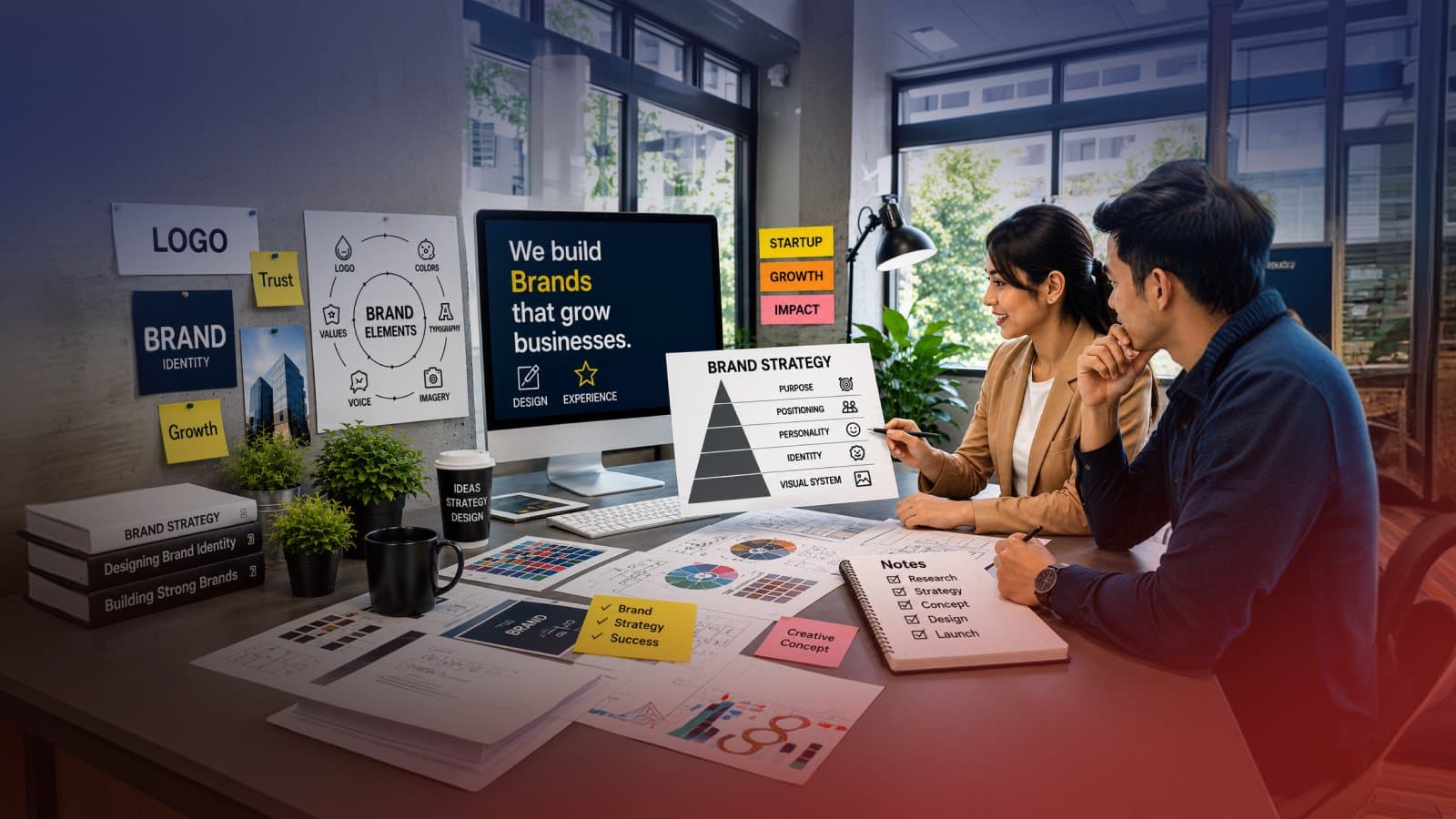
How to Choose the Right Branding Agency for Startups and Growing Businesses?
Choosing the right branding agency requires more than reviewing a portfolio. Discover how startups and growing businesses can evaluate strategic depth, relevant experience, digital execution, scalability, AI capabilities, and growth expertise to find a partner built for long-term success.
Selecting a professional branding agency represents a critical inflection point for emerging ventures and expanding enterprises seeking market leadership. In crowded commercial environments, sustainable branding requires transforming visual identity into an engineered system that drives customer acquisition, market trust, and long-term valuation.
Choosing the right brand agency ensures that positioning, digital touchpoints, and technical infrastructure align directly with commercial objectives, turning brand equity into a predictable growth driver.
Why Does the Right Branding Agency Matter More Now?
While startups often prioritize speed over structure when building their initial identity, growing businesses encounter a fundamentally different challenge their brand outgrows the systems meant to support it.
As a company expands, messaging frequently loses consistency. Different internal teams begin using conflicting visual assets, creating a divide where the website communicates one value proposition while sales decks present another. Furthermore, as new products are introduced without a clear brand architecture, the business risks gaining market recognition without establishing a strong, unified position.
To solve this disconnect, a strategic branding agency does more than just update visuals it aligns the company’s entire operational footprint. A strong growth partner bridges these gaps by seamlessly integrating:
Positioning & Messaging
Tailoring core value propositions to the target market.
Visual Identity
Establishing scalable, repeatable design systems across all channels.
User Experience & Conversion
Synchronizing customer expectations with digital conversion goals.
Web Development
Integrating technical touchpoints into the broader brand experience.
Data & Analytics
Leveraging performance insights to refine both brand and growth strategies.
This integrated approach is becoming more important as brand decisions increasingly sit alongside digital experience and technology decisions.
What Is Changing in Branding Operations?
The traditional agency model operated on a rigid, linear sequence - strategy, identity, guidelines, and handoff. However, modern digital environments demand a far more dynamic, interconnected framework.
Today, brand systems must be completely consistent across a growing number of touchpoints, including corporate websites, product interfaces, social media campaigns, sales collateral, performance marketing, and AI-assisted processes.
As the number of digital encounters increases, brand inconsistency incurs rising financial and reputational costs. Modern agencies must consequently change from providing static recommendations to developing dynamic, integrated brand systems that scale effortlessly across all client interactions.
The next generation of branding operations is therefore built around three ideas.
1. Brand systems instead of isolated assets
A scalable brand is not a collection of files - it is a system of decisions.
That includes positioning, messaging hierarchy, typography, color logic, visual rules, content principles, tone, component libraries, and usage guidelines. This gives internal teams and external partners a reliable structure to work from.
For a startup, this prevents the brand from becoming unstable as the company grows. For an established business, it makes expansion easier without forcing every new initiative through a full redesign.
2. Brand experience instead of brand appearance
A strong identity can attract attention but the customer experience decides whether that impression lasts.
Website structure, page speed, navigation, mobile responsiveness, forms, product interfaces and conversion paths all influence how the brand is perceived.
This is why a branding agency for growing businesses increasingly needs design and development capability - not simply creative production.
Make My Brand follows this integrated approach through its Design & Development-as-a-Service model, combining branding, UI/UX, website development services and engineering rather than treating them as disconnected services.
3. Data-informed branding instead of opinion-led branding
Creative judgment remains essential. But important brand decisions should not depend on taste alone.
Audience research, conversion data, user behavior, search intent, campaign performance and customer feedback can reveal where a brand is strong, unclear, or losing momentum.
This is the foundation of data driven branding using evidence to refine positioning, messaging, UX and customer journeys over time.
How AI Is Changing the Role of a Branding Agency
AI is not replacing brand strategy. It is changing the speed, scale and operating model behind it.
McKinsey’s 2025 State of AI research found that 62% of respondents said their organizations were at least experimenting with AI agents, while nearly two-thirds had not yet started scaling AI across the enterprise. The important point is not simply adoption - it is the widening gap between experimentation and disciplined implementation.
For branding teams, this creates several practical changes.
Faster creative exploration
Generative AI is changing how quickly branding teams can move from an initial idea to multiple creative directions. It can support concept development, visual exploration, copy creation, research synthesis, and early-stage prototyping, allowing teams to evaluate more possibilities before committing to a final direction.
However, greater production speed also increases the need for stronger brand governance. When content, visuals, and creative variations are produced at scale, inconsistencies in messaging or visual identity can spread just as quickly. A clear branding strategy, supported by defined creative standards and review processes, keeps AI-generated output aligned with the brand.
More personalized customer experiences
AI enables companies to adapt messaging, recommendations and experiences according to customer signals.
Adobe’s 2025 AI and Digital Trends research found that 55% of surveyed executives saw balancing AI with human creativity as an area where more work was needed, while governance, compliance and privacy were major barriers to scaling AI.
That distinction matters. Effective AI branding is not about putting AI into every creative workflow. It is about using it where it improves relevance, speed or decision-making without weakening the identity.
New expectations around brand consistency
AI systems can generate content at a scale that manual teams cannot match. A brand therefore needs stronger rules for tone, terminology, visual language, and approval.
The agency should understand how those rules can be translated into practical systems rather than leaving them inside a static brand guideline PDF.
How to Hire a Branding Agency - 8 Things to Evaluate
Choosing the right brand agency is easier when the evaluation goes beyond portfolios.
1. Look at strategic depth
Ask what happens before design begins.
A credible partner should be able to discuss positioning, audience, competitive space, value proposition, messaging and business objectives before presenting visual concepts.
2. Examine relevant experience
An appealing portfolio is not enough.
Look for work that resembles the complexity of your growth stage, business model, market, and customer journey. A B2B technology company, consumer startup and enterprise platform may require very different branding decisions.
3. Check whether branding connects to digital execution
The strongest branding solutions should survive beyond the presentation deck.
Ask whether the agency can carry the identity into UX, website development, landing pages, content systems, campaign assets, and digital products.
Make My Brand’s case work, for example, combines branding with website design, development, SEO, analytics and automation, reflecting a broader growth-oriented operating model rather than a branding-only handoff.
4. Ask how performance is measured
Branding does not always produce an immediate revenue number, but the agency should still define useful indicators.
These include:
Brand awareness and consideration
Qualified traffic
Engagement and conversion quality
Customer acquisition efficiency
Website behavior
Lead quality
Retention or repeat purchase indicators
The goal is not to force every creative decision into a short-term performance metric. It is to create enough visibility to understand whether the brand is supporting business growth.
5. Assess scalability
A brand should work when the company has ten products, multiple regions, and larger teams - not just at launch.
Look for agencies that build modular design systems, clear brand architecture, and practical governance.
This is where scalable branding solutions become more valuable than one-time creative packages.
6. Understand the agency's AI approach
Ask where AI is actually used.
A capable agency should have a clear position on research, personalization, content workflows, creative production, experimentation, and governance.
AI should increase strategic capacity - not become a marketing label attached to routine work.
7. Evaluate the working model
The right agency should fit the way the business operates.
Some companies need a defined project. Others need ongoing support, rapid execution, and strategic guidance across branding, UX, marketing, and development.
Make My Brand’s Growth-as-a-Service model is designed around that second requirement, positioning the agency as an integrated growth partner with strategy, execution, analytics and ongoing optimization rather than isolated deliverables.
8. Review the thinking - not just the final work
Ask an agency to explain why a decision was made.
Can it explain the business problem behind the identity?
Can it defend the positioning?
Can it show how the design translates into a website, product, or campaign?
The quality of the reasoning often tells you more than the polished portfolio.
What Startups and Growing Businesses Need from an Agency?
A branding agency for startups should solve immediate positioning problems while preparing the company for its next stage.
Early-stage companies generally need sharper answers to questions such as:
What category are we creating or competing in?
Why should customers choose us?
What should the brand be known for?
How should the identity work when the company adds products or markets?
Can the website explain the value proposition quickly?
A startup branding agency should bring strategic clarity to an evolving business, translating its vision, market opportunity, and growth objectives into a distinctive brand foundation that can scale with the company.
Growing businesses have a different brief. They already have awareness, customers, and established visual assets. The challenge is often fragmentation, repositioning, or outdated digital experience.
That is where rebrand vs brand refresh becomes an important decision.
Rebrand or brand refresh?
A full rebrand is appropriate when the existing positioning, architecture, or identity no longer supports the business direction.
A brand refresh may be enough when the underlying strategy remains relevant, but the identity, messaging or digital experience feels dated.
The right agency should be able to explain the difference and, importantly, recommend not rebranding when a smaller intervention will solve the problem.
That restraint is a useful indicator of strategic maturity.
What Should the Best Branding Agency for Startups Look Like in 2026?
The best branding agency for startups is not necessarily the largest agency or the one with the most dramatic portfolio.
It is the partner that can move from strategy to execution without losing the commercial objective. In practice, that means combining:
Brand strategy + identity + UX + technology + data + AI + growth
This integrated model reflects how modern companies actually operate.
The lesson is straightforward - technology increases the number of ways a brand can interact with customers, but differentiation still determines whether those interactions create preference.
Why An Integrated Branding and Growth Partner Can Be More Effective?
As a company grows, branding, marketing, UX, and technology become increasingly interconnected rather than functioning as separate disciplines.
A positioning decision affects website structure. Website structure affects conversion. Conversion data informs messaging. Customer behavior influences product experience. AI changes how content and personalization are delivered.
Working with separate vendors can make those connections harder to manage.
An integrated model can reduce that friction by creating one strategic thread across the customer journey.
That philosophy is central to Make My Brand’s Brand Development Lifecycle, which connects brand strategy and identity with visibility, performance and thought leadership across the growth journey. The company also describes its approach around real-time performance visibility, benchmarking, and cross-functional execution.
For a startup, this can mean building the right foundations before fragmentation begins. For a growing business, it can mean connecting an existing brand to the next phase of expansion.
Conclusion
Choosing a branding agency should not come down to which portfolio looks most impressive. The stronger choice is a partner that understands where the business is today, where it needs to go next, and how brand, experience, technology and data must work together to get there. The right agency builds more than an identity. It creates a brand system that can remain relevant, recognizable, and commercially useful as the business evolves.
Loading FAQs
Please wait while we fetch the questions...
Published on August 25, 2026 by Surbhi Sood