.jpg&w=3840&q=75)
Content Marketing Agency vs Freelancers: What to Choose?
Choosing between a content marketing agency and a freelancer is no longer just about cost. In the AI era, businesses need scalable content systems, strategic governance, SEO, and distribution that drive measurable growth. The right choice depends on your goals, resources, and growth stage.
The question is no longer simply who writes the content. It is who builds the system that keeps content useful, consistent, and tied to revenue.
That is the real backdrop for the content marketing agency vs freelancer discussion. The market is not only producing more content - it is also demanding stronger content operations, better governance, and clearer point of view. HubSpot’s 2026 marketing report frames AI as a baseline, not a differentiator, and says growth now depends more on brand POV, trust, and human-led marketing than on volume alone. HBR has also pointed to AI’s trust problem as a major business issue, not just a technical one.
The Debate Has Changed - From Content Creation to Content Ownership
A few years ago, the comparison was simple. A freelancer meant flexibility and lower overhead. A content marketing agency meant structure and broader capability.
Today, enterprises are asking a different question who owns the content operating system?
The primary challenge of content marketing for businesses has transitioned from basic asset creation to the strategic ownership of an integrated ContentOps infrastructure.
That system usually includes research, SME interviews, AI tools, approvals, legal review, SEO, distribution, analytics, and iteration. In other words, content is no longer a single deliverable. It is an operating layer for brand building, demand generation, and search visibility.
This is also why answer engine optimization and generative search matter. As AI search surfaces grow, content needs to be structured for clarity, citation, and reuse. Pages that are vague, thin, or generic are easier to ignore.
Pages that carry original insight, clean structure, and strong topical authority are easier for both users and AI-assisted systems to trust.
Content Marketing Agency vs Freelancer
Choosing the right content structure depends entirely on your current growth phase, budget, and internal management capacity. While traditional agencies provide multi-channel security, independent specialists offer targeted agility that is hard to match.
The core operational differences between the two models break down as follows:
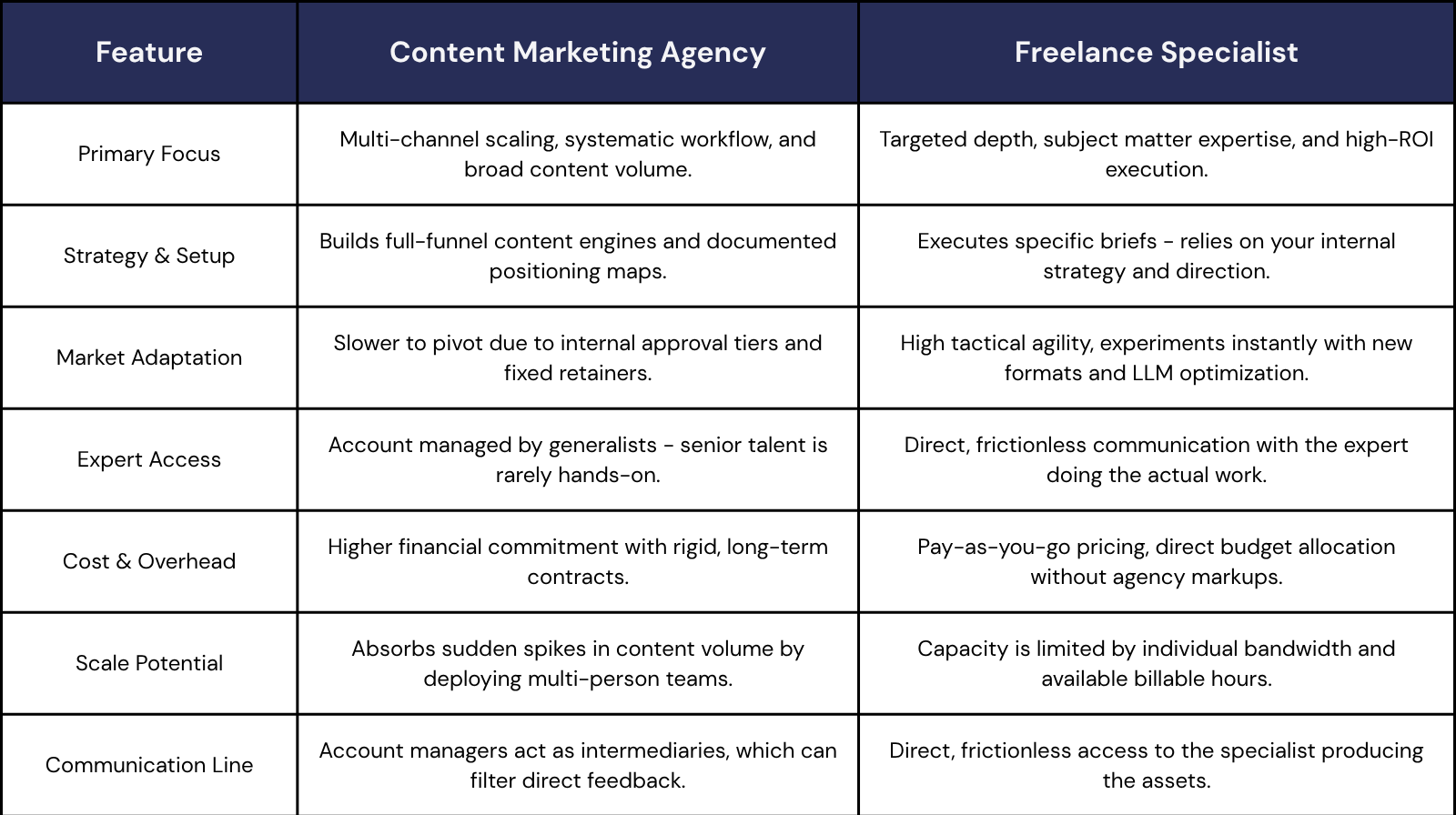
The 2026 Reality
Brands increasingly favor a hybrid approach. They retain an internal lead for high-level strategy while deploying specialized freelancers to handle deep industry execution and multimedia formats.
When Can a Freelancer Be the Better Fit?
A freelancer can be a strong choice when the need is narrow and well-defined.
That usually applies when:
The brand already has a clear strategy and needs execution support
The scope is limited to blogs, email copy, social captions, or a specific content format
The internal team can handle planning, review, and distribution
Speed matters more than cross-functional coordination
In these situations, a skilled freelancer can be highly effective. The upside is flexibility. The risk is dependency. If the project needs multiple disciplines working together, one person can quickly become a bottleneck.
When Does a Content Marketing Agency Becomes the Stronger Option?
A content marketing agency tends to fit better when the content program has to do more than publish.
That is often the case when a company needs:
A content marketing strategy connected to pipeline or revenue
Content marketing outsourcing with clear governance and review stages
Multiple formats across blogs, whitepapers, landing pages, email, and thought leadership
SEO, conversion, and distribution working together
Consistent output across several departments or markets
Brand thinking over AI content, especially where trust matters
This is where agencies bring value that is hard to replicate with one person. The best ones do not just produce content. They orchestrate inputs from subject matter experts, analyze performance, and keep the brand voice consistent across channels.
Rather than relying on a single individual, a professional content marketing firm deploys a dedicated pod team containing a lead SEO strategist, a content manager, specialized writers, a UI/UX designer, and a technical analytics engineer.
For instance, in SkyHi Tech Academy’s growth program, the Make My Brand’s team worked across web design, SEO, paid ads, automation, content strategy, and social media, scaling organic users from 0 to 6.4K+ and lifting campaign CTR to 16.47%. That is the kind of multi-layer execution that is difficult to sustain through disconnected freelancers alone.
Why are Hybrid Models Becoming Common?
The strongest enterprise model is often not agency or freelancer only. It is a hybrid.
Many organizations now keep strategy, approvals, and brand governance close to the business, while bringing in outside specialists for execution, SEO, design, and distribution. That model helps teams move faster without losing control.
This is especially relevant in content marketing in AI era.
Continuous Multi-Channel Orchestration
High-performing content is never static. It must be systematically broken down, adapted, and distributed across multiple channels including executive thought leadership on LinkedIn, branded newsletters, short-form video, and structured help centers.
For instance, the proprietary BDLC framework deployed by Make My Brand maps content strategy directly to audience psychographics and go-to-market (GTM) execution, mitigating the inconsistencies typical of fragmented production lines. By connecting brand foundation and technical setup with performance optimization, this systematic approach has helped B2B brands achieve faster market penetration and generate higher engagement.
Make My Brand addresses these challenges through its Growth-as-a-Service and Staff-as-a-Service models, which provide customized real-time performance dashboards and benchmark reporting. This structured approach helps brands maintain strict messaging alignment and operational transparency.
What Drives Business Growth Now?
In the AI era, growth comes from content that does a few things well.
Proprietary insight
Generic AI content is everywhere. What stands out is original thinking, first-party data, customer patterns, and executive points of view.
Editorial governance
Enterprises are increasingly wary of hallucinations, brand inconsistency, and compliance risk.
Distribution
Great content that never reaches the right audience does not create growth.
This is also where content optimization strategies matter.
Pages should be created with a clear structure, direct responses, strong entity signals, and helpful summaries for both human readers and AI search engines. It is about developing content that is simple to trust, cite, and use.
The underlying pattern is clear AI increases content production while also boosting the value of clarity, authority, and point of view. That is why the firms that succeed typically regard content as an owned system rather than a one-time offering.
So, Which One Drives Better Business Growth?
There is no universal winner.
A freelancer can deliver a remarkable development when the assignment is specific, the plan is established, and the organization requires targeted execution. When a business requires cross-functional collaboration, scalability, procedure, and a more robust content engine, a content marketing agency can propel greater growth.
For many established brands, the smartest answer is not choosing one side permanently. It is matching the model to the maturity of the business, the complexity of the funnel, and the level of governance required.
Conclusion
The choice between an agency and a freelancer is no longer about outsourcing simple writing tasks. It is about deciding who builds, owns, and maintains the underlying content infrastructure. Because basic AI generation has flattened the playing field for standard text, the ultimate differentiator for an enterprise is operational discipline the ability to verify information, maintain strict editorial standards, and keep distribution channels aligned.
For organizations with an established internal strategy and a need for deep, targeted expertise, independent specialists offer incredible agility without agency overhead. But when a brand needs to connect technical SEO, user experience design, and multi-channel distribution into a single revenue engine, a cross-functional agency team becomes necessary.
Ultimately, content is an operational asset rather than a series of one-off deliverables. True growth belongs to businesses that treat their distribution and authority as a structured system, matching their execution model to the exact level of governance the market requires.
Looking to scale with smarter content? Get in touch with Make My Brand.
Loading FAQs
Please wait while we fetch the questions...
Published on July 6, 2026 by Surbhi Sood