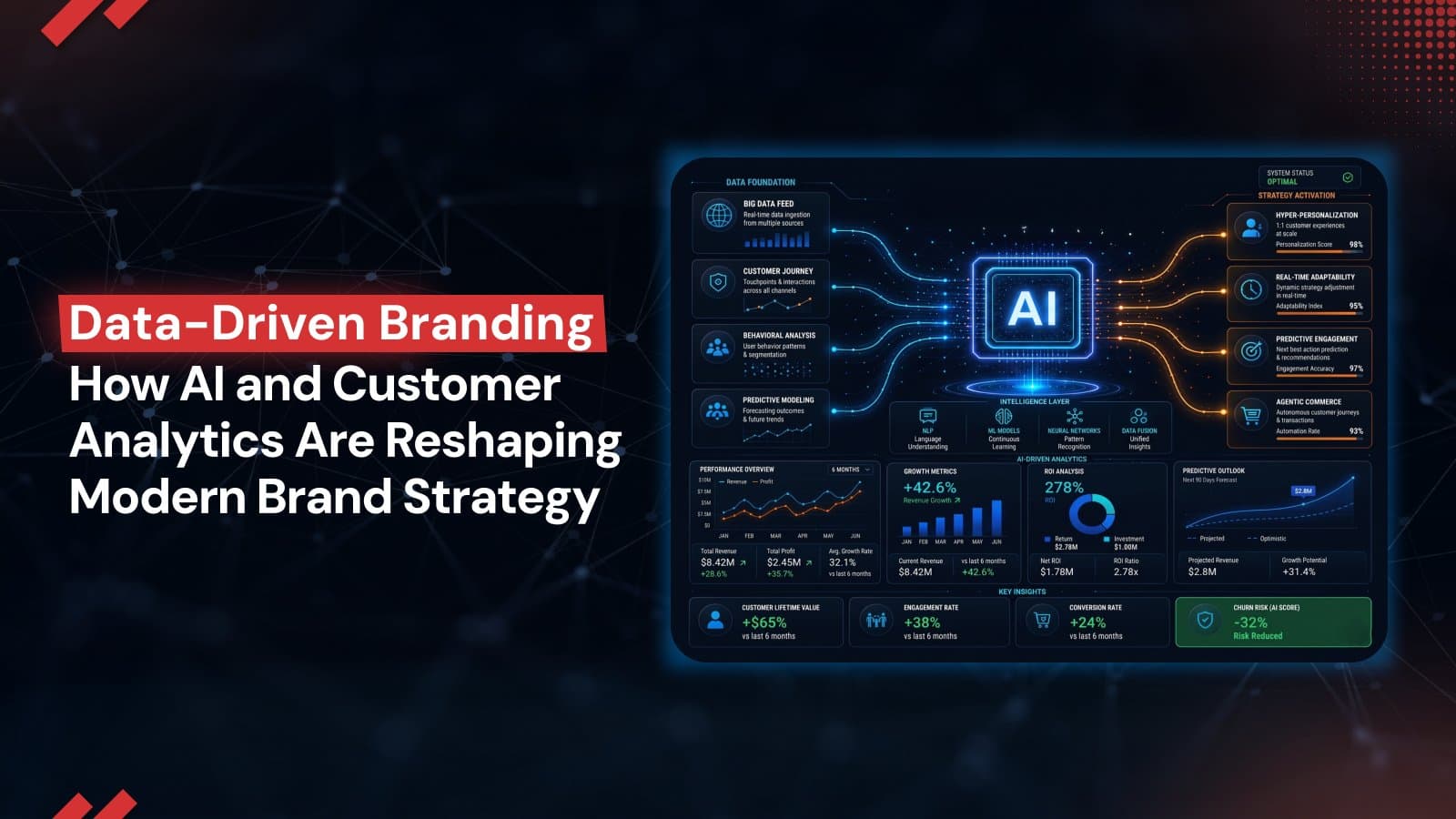
Data-Driven Branding: How AI and Customer Analytics Are Reshaping Modern Brand Strategy
Data-Driven Branding explores how AI, customer analytics, predictive intelligence, and real-time personalization are transforming modern brand strategy. Learn how brands use behavioral data, AI search , and adaptive customer experiences to improve engagement and long-term business growth.
Data and AI now underpin every element of brand strategy. Today’s consumers increasingly expect personalized, data-driven brand experiences across every touchpoint. In fact, 71% of consumers expect companies to deliver personalized experiences. Brands that embrace customer analytics can predict needs, tailor messaging, and build loyalty. Key trends in this space include:
Agentic AI & Automation - AI-powered agents that can analyze customer behavior, generate insights, automate workflows, and take contextual actions in real time.
Predictive Analytics & Personalization - Hyper-personalized customer experiences powered by first-party data and behavioral intelligence.
AI Search & Conversational Interfaces - Voice and AI-driven search (zero-click) transforming discovery.
Real-Time Customer Intelligence - Real-time analytics dashboards and “dark funnel” intelligence systems that monitor brand momentum and audience behavior.
Privacy & Ethics - Transparent data use and compliance (GDPR, CCPA) are now mandatory.
Each trend has profound implications for brand strategy and identity. At Make My Brand, analytics, AI, and customer intelligence are integrated throughout the Brand Development Lifecycle to help brands become more adaptive, predictive, and insight-driven.
In this blog, we’ll explore how brands are using customer analytics, AI automation, and real-time intelligence to build stronger customer relationships and competitive advantage.
Agentic AI and the Rise of Real-Time Brand Intelligence
AI is no longer just supporting marketing teams - it is actively shaping decisions, workflows, and customer experiences.
The rise of agentic AI means businesses are increasingly working with systems capable of analyzing customer behavior, identifying patterns, generating insights, and recommending actions in real time.
Major platforms including Microsoft and Google are rapidly expanding agentic search and AI assistant ecosystems that can act on behalf of users, changing how people discover and interact with brands.
This shift is forcing businesses to rethink their entire data ecosystem.
What This Means for Brands?
To stay competitive, businesses must become AI-ready at the infrastructure level. That includes:
Audit first-party and third-party data infrastructure
Structure content for AI interpretation and entity recognition
Train AI systems on approved brand messaging
Monitor how AI platforms describe and recommend their brand
Build internal brand-intelligence capabilities
This matters because AI models are already influencing customer perception.
The Rise of Brand-Intelligence Teams
Leading companies are creating dedicated brand-intelligence teams focused on:
AI visibility monitoring
Real-time sentiment analysis
Conversational search optimization
Brand consistency across AI-generated responses
Behavioral insight tracking
This represents a shift from static campaign management toward continuous, real-time brand intelligence operations.
At Make My Brand, this is already becoming part of a modern growth brand strategy. AI-powered workflows are being integrated into SEO, content, analytics, automation, and customer experience systems to ensure brand messaging remains consistent across both human and AI-led interactions.
The focus is not just automation. It is controlled, data-driven brand governance.
From Static Campaigns to Real-Time Brand Intelligence
Traditional branding relied on planned campaigns and delayed reporting cycles. Modern AI-powered branding works differently. Brands now operate through:
Continuous customer feedback loops
Real-time behavioral intelligence
Predictive customer analytics
Adaptive messaging systems
AI-powered customer experience platforms
Instead of broadcasting static campaigns, businesses are expected to respond dynamically to changing customer intent, sentiment, and context.
The result is a major shift - Branding is becoming conversational, predictive, adaptive, and continuously optimized.
How Predictive Customer Analytics Is Transforming Brand Strategy?
Modern consumers increasingly expect brands to understand their intent, preferences, and behavior in real time. That expectation is driving the rise of predictive analytics and enterprise-level hyper-personalization.
AI-driven analytics platforms can now predict purchase intent, identify churn risk, and personalize experiences across multiple touchpoints in real time.
The Shift From Demographics to Behavioral Intelligence
Traditional audience segmentation focused on age, location, and demographics. Today’s leading brands focus on:
Behavioral data
Intent signals
Purchase patterns
Content consumption habits
Engagement velocity
Cross-platform interactions
Platforms like Netflix and Amazon have normalized predictive personalization by continuously adapting recommendations based on user behavior. This same intelligence model is now being adopted across industries - from SaaS and retail to healthcare and finance.
Why First-Party Data Matters More Than Ever?
As third-party cookies disappear, first-party data is becoming the foundation of sustainable data-driven branding. Brands are investing heavily in:
Loyalty ecosystems
Owned communities
CRM enrichment
Customer feedback loops
AI-native customer data platforms (CDPs)
This allows businesses to create unified customer profiles while maintaining greater control over privacy, compliance, and long-term customer intelligence. For brands, this goes far beyond performance marketing. It directly impacts:
Customer trust
Brand reputation
Messaging accuracy
Long-term retention
Adaptive Brand Messaging at Scale
Hyper-personalization is also changing how brands manage:
Brand voice
Brand tone
Creative branding
Brand positioning
AI-driven personalization engines can now dynamically adapt:
Messaging
CTAs
Visual assets
Product recommendations
Email copy
Website experiences
based on customer behavior in real time.
How AI Search Is Transforming Modern Branding?
Search behavior is changing faster than most brands realize. AI-generated search experiences are reducing traditional website clicks and shifting visibility away from standard rankings toward AI-generated recommendations and summaries.
Platforms like Google are aggressively expanding AI Overviews and conversational search experiences that answer queries directly inside search results. This creates a major branding challenge.
Visibility Is No Longer Just About Rankings
Brands now need to optimize for:
AI citations
Conversational discovery
Entity recognition
Structured content
Zero-click search experiences
AI recommendation systems
In practical terms, AI visibility is becoming a new branding metric. If AI assistants cannot confidently understand, summarize, or recommend your brand, visibility drops - even if traditional SEO rankings remain stable.
Google’s Crackdown on Manipulative AI Content
At the same time, search engines are becoming stricter about low-quality AI-generated content. Google has intensified efforts against:
Thin, low-value AI-generated content
Manipulative AI-search optimization
Low-value affiliate content
Scaled content spam
This means businesses can no longer rely on volume-based content production alone. Brands now need:
Original insights
Expert-led content
Structured authority signals
Credible brand positioning
Clear topical expertise
The brands winning in AI search are the ones building trust - not just traffic.
Conversational Interfaces Are Reshaping Brand Discovery
Customers are increasingly discovering products through:
AI assistants
Voice search
Chat interfaces
AI shopping tools
Recommendation engines
This changes how brand messaging is consumed.
Content must now be optimized for conversational clarity, structured retrieval, semantic relevance, and contextual understanding rather than keyword stuffing alone.
For example, AI-powered commerce systems already recommend products and compare options on behalf of users. That means product feeds, pricing data, inventory details, and brand messaging must all be machine-readable and consistently structured.
At Make My Brand, this shift is influencing how SEO, content strategy, and performance marketing are executed together. The focus is significantly increasing on Answer Engine Optimization (AEO), entity-driven SEO, and AI discoverability rather than traditional ranking metrics alone.
The goal is simple - ensure AI systems understand your brand as clearly as human audiences do.
The Rise of AI-Native Brand Experiences
This is creating demand for:
AI-native CX platforms
Conversational commerce systems
Real-time customer intelligence dashboards
Cross-platform brand orchestration
Multimodal interfaces
AI shopping ecosystems
Predictive engagement systems
At Make My Brand, SEO, AI branding, performance marketing, and customer analytics are integrated into unified growth systems designed for AI-first discovery environments.
How Leading Brands Use Customer Analytics to Measure Growth and Market Relevance?
Modern branding is no longer measured through quarterly surveys and static reports. Brands now rely on real-time intelligence systems that continuously track customer behavior, engagement, sentiment, and conversion patterns across channels.
Today’s brand performance analytics focus on metrics like:
Engagement trends in real time
Repeat purchase behavior
Share of voice across platforms
Customer sentiment shifts
AI search visibility
Community and influencer impact
One of the biggest shifts in modern brand measurement is the rise of dark funnel analytics. Customer decisions increasingly happen in spaces traditional attribution tools cannot fully track, including:
Private communities
Slack groups
Reddit discussions
WhatsApp sharing
Creator ecosystems
AI conversations
As a result, brands can no longer rely only on last-click attribution models. Modern customer insights strategies now combine:
Social listening
AI-assisted attribution
Behavioral intelligence
Multi-channel customer data
Predictive Brand Intelligence Is Becoming Essential
Brand analytics is also shifting from historical reporting to predictive intelligence. AI-powered customer analytics platforms can now identify:
Emerging audience interests
Changes in customer sentiment
Churn probability
Brand reputation risks
Market demand patterns
This shift is also changing how businesses measure brand growth. Today, brands are increasingly measuring indicators like:
Brand momentum
Perceived growth trajectory
Market relevance
Cultural visibility
Sentiment velocity
Together, these signals contribute to what many marketers now describe as a brand velocity score - a measurement of how quickly a brand is gaining relevance, attention, engagement, and cultural traction over time.
A brand velocity score reflects whether audiences perceive the brand as actively evolving, innovating, and leading conversations within its category. High-growth brands often outperform competitors because consumers naturally gravitate toward brands that appear future-focused.
Metrics That Matter in Data-Driven Branding
The most valuable brand measurement tools now prioritize long-term customer intelligence over vanity metrics.
Key KPIs include:
Customer Lifetime Value (CLV)
Customer retention and loyalty
Predictive churn analysis
Engagement quality
Share of search
AI visibility and citation frequency
Sentiment analysis
Brand recall across AI platforms
AI visibility is becoming especially important as conversational AI platforms increasingly influence product discovery and purchase decisions. Brands now need to measure how often AI systems reference, summarize, or recommend their content.
At Make My Brand, automated brand-intelligence systems are used to monitor sentiment, search trends, and behavioral shifts in real time. This enables faster campaign optimization, stronger brand positioning, and more adaptive messaging strategies.
Best Practices for Brand Analytics
To build an effective customer insights strategy, brands should:
Centralize CRM, sales, support, and behavioral data.
Use attribution modeling and incrementality testing.
Combine analytics with AI-driven insights.
Build dedicated brand-intelligence workflows.
Turn customer insights into immediate campaign action.
The most successful brands are no longer separating analytics from creative brand strategy. They are using real-time customer intelligence to continuously refine messaging, positioning, and customer experience.
How Ethical Data Practices Influence Brand Reputation?
As brands collect more behavioral data, ethical data governance is becoming a competitive advantage.
Customers increasingly expect personalized experiences, but they also expect transparency, consent, and responsible AI usage. Trust can disappear quickly if consumers feel their data is being used without clear permission or accountability.
Ethical Branding Now Impacts Brand Reputation
Modern brands must prioritize:
Transparent data collection
Clear consent frameworks
Privacy-first personalization
Ethical AI implementation
Human oversight for AI-generated messaging
Regulations like the General Data Protection Regulation and the California Consumer Privacy Act are also pushing businesses toward stricter governance standards around customer data and AI systems.
At the same time, AI bias has become a serious branding risk. AI systems are only as reliable as the data they are trained on. Poor-quality or biased datasets can produce inaccurate, misleading, or offensive outputs that damage brand reputation and customer trust. That is why leading companies are now conducting AI ethics brand audits to evaluate:
Dataset quality
Representation bias
AI decision transparency
Content governance
Human review systems
Ethical AI usage is quickly becoming part of modern brand positioning. At Make My Brand, privacy-first data practices are integrated into branding, analytics, and AI workflows to help businesses scale personalization without compromising customer trust.
Conclusion
Data-driven branding is the foundation of modern brand growth. As AI search, predictive analytics, conversational interfaces, and real-time customer intelligence reshape digital experiences, brands must move beyond static campaigns and demographic-based marketing. The future belongs to businesses that can combine:
First-party data
Behavioral intelligence
AI-powered personalization
Adaptive messaging
Ethical AI governance
Real-time brand analytics
into one connected growth strategy.
Modern branding is now measured by relevance, trust, AI visibility, and customer experience - not just impressions or clicks.
Ready to turn customer insights into measurable brand growth? Connect with Make My Brand today!
Loading FAQs
Please wait while we fetch the questions...
Published on May 22, 2026 by Simran