
How to Increase Website Traffic: 20 Strategies That Actually Work
Learn 20 strategies to increase website traffic and attract qualified buyers. From SEO and content marketing to social media, paid search, and competitor analysis, discover practical ways to improve online visibility, generate leads, and drive measurable business growth.
Founders spend months finishing an immaculate web build, yet incoming sales inquiries stall out completely. Real buyers search online daily. Still, unqualified clicks replace real pipeline revenue. Visibility means little when it doesn't bring in business.
Here are 20 tested mechanisms to command organic search positions, outperform aggressive competitors, and generate high-intent buyers who convert directly into paid pipeline.
The Commercial Reality of Website Traffic Growth Strategies
Here’s where the truth comes out. Traffic without commercial intent drains company capital. Marketing teams push out generic articles week after week, hoping search engines reward raw output. Clicks tick up. Revenue stays flat.
Real growth comes down to distinct operational choices:
Strategic Dimension | Vanity Impression Method | Intent-Driven Organic Method |
|---|---|---|
Primary Objective | Unfocused visitor volume | Qualified decision-maker acquisition |
Query Focus | High-volume single head terms | High-intent operational phrases |
Site Speed Standard | Unoptimized server response | Sub-two-second paint thresholds |
Search Engine Alignment | Keyword repetition | Structured entities and answer modules |
Visitor Destination | Generic homepages | Dedicated conversion paths with social proof |
20 Strategies to Increase Website Traffic (and Which Ones Pay Off)
Most traffic advice reads like a grocery list. Do all of it, in any order, and hope something sticks. That’s how teams burn six months and end up with a graph that climbs while the sales inbox stays quiet.
The twenty ideas below are grouped by channel, so you can see where your effort goes. Start with SEO, since that’s where returns compound. Pick two or three ideas a quarter instead of attempting everything at once.
One filter applies to every item: could this bring in someone who might buy? If not, skip it.
A. SEO: Get Found by People Ready to Buy
1. Build Your Keyword List Around Buying Intent
The mistake to avoid is chasing the biggest number in the tool. “Project management software” pulls huge volume and almost no signed contracts. “Project management software for construction subcontractors” pulls a trickle of people holding a budget.
Where to find those phrases:
Sales call recordings (what do prospects ask first?)
Search Console queries that already earn impressions
Competitor pages that rank for problems, not product names
Sort them by stage: problem, comparison, purchase. A sound keyword strategy covers all three.
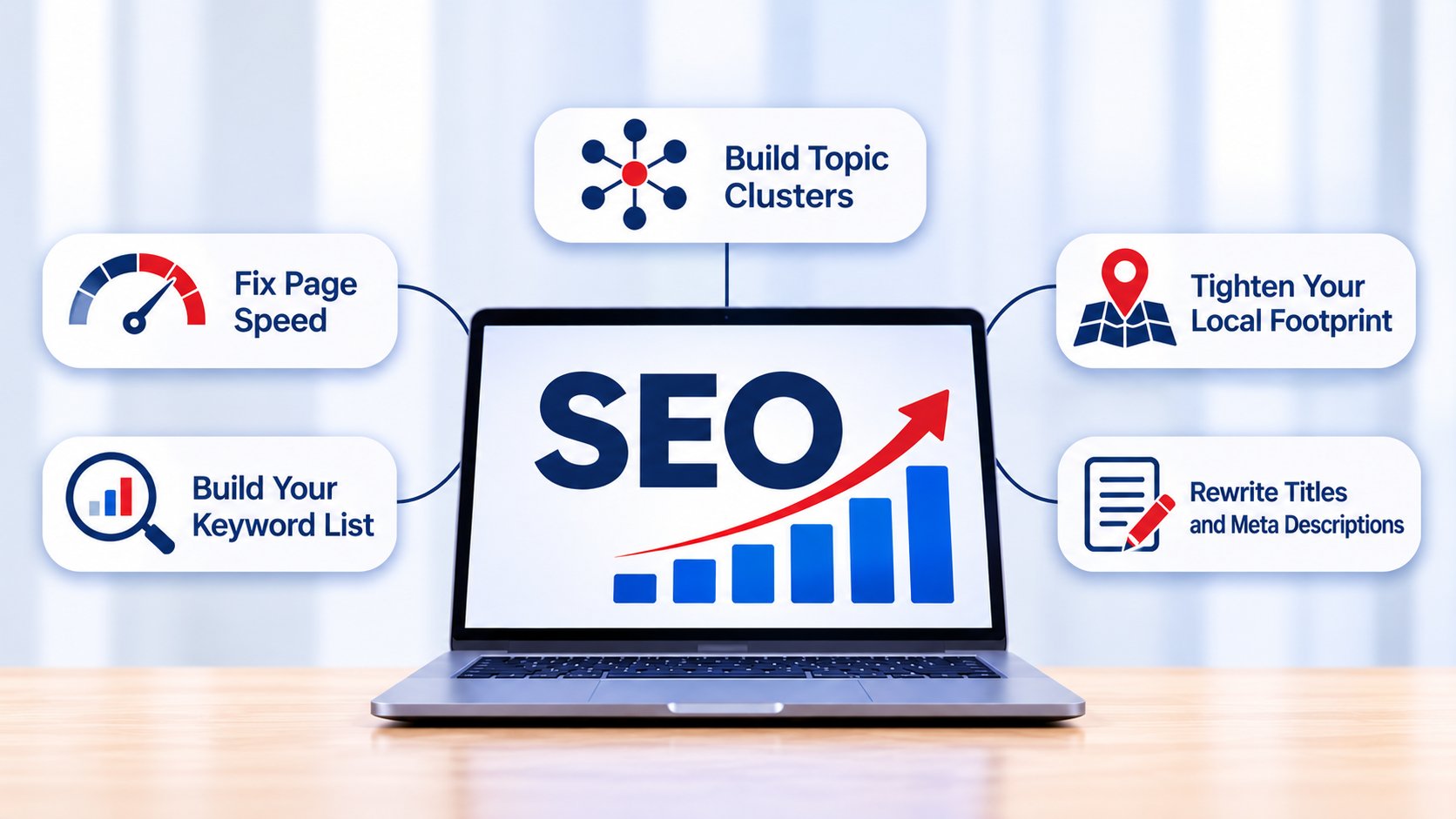
2. Fix Page Speed Before You Publish Another Word
Slow pages lose people before the headline loads. Google’s Core Web Vitals give you targets: largest content paint within about 2.5 seconds, interaction delay under 200 milliseconds, layout shift under 0.1.
The usual culprits are oversized images, bloated plugins, cheap hosting and missing caching. Run a crawl every month or two, because plugin updates break things quietly. Our guide to SEO website optimization covers the technical checklist.
3. Build Topic Clusters and Link Them on Purpose
One post on a topic rarely holds a ranking. Search engines reward sites that cover a subject from several angles.
Say you sell payroll software to restaurants. Your main guide covers restaurant payroll. Supporting pages cover tipped-wage compliance, multi-location payroll and switching from a legacy system. Every supporting page links up to the guide and across to its neighbors.
Simple. Most sites never do it.
4. Tighten Your Local Footprint
Local searchers want an answer today, and the businesses that show up get the call. If you serve a region, this is where local SEO services or a few focused afternoons of your own work pay off fast.
Do: Complete every field in your Google Business Profile, keep name, address and phone identical everywhere, and reply to reviews like a person.
Don’t: Clone forty city pages with the town name swapped out. Each location page needs something real: staff, projects, local details.
5. Rewrite Titles and Meta Descriptions That Underperform
Some of your pages already rank and still get ignored. The listing just doesn’t give anyone a reason to click.
Open Search Console and filter for pages with high impressions and low clicks.
Rewrite the title to match what the searcher wants, with the benefit up front.
Rewrite the description as a plain promise of what they’ll get.
Wait a few weeks, then compare.
It costs nothing and often beats writing a new post.
B. Content Marketing: Publish Less, Keep It Alive Longer
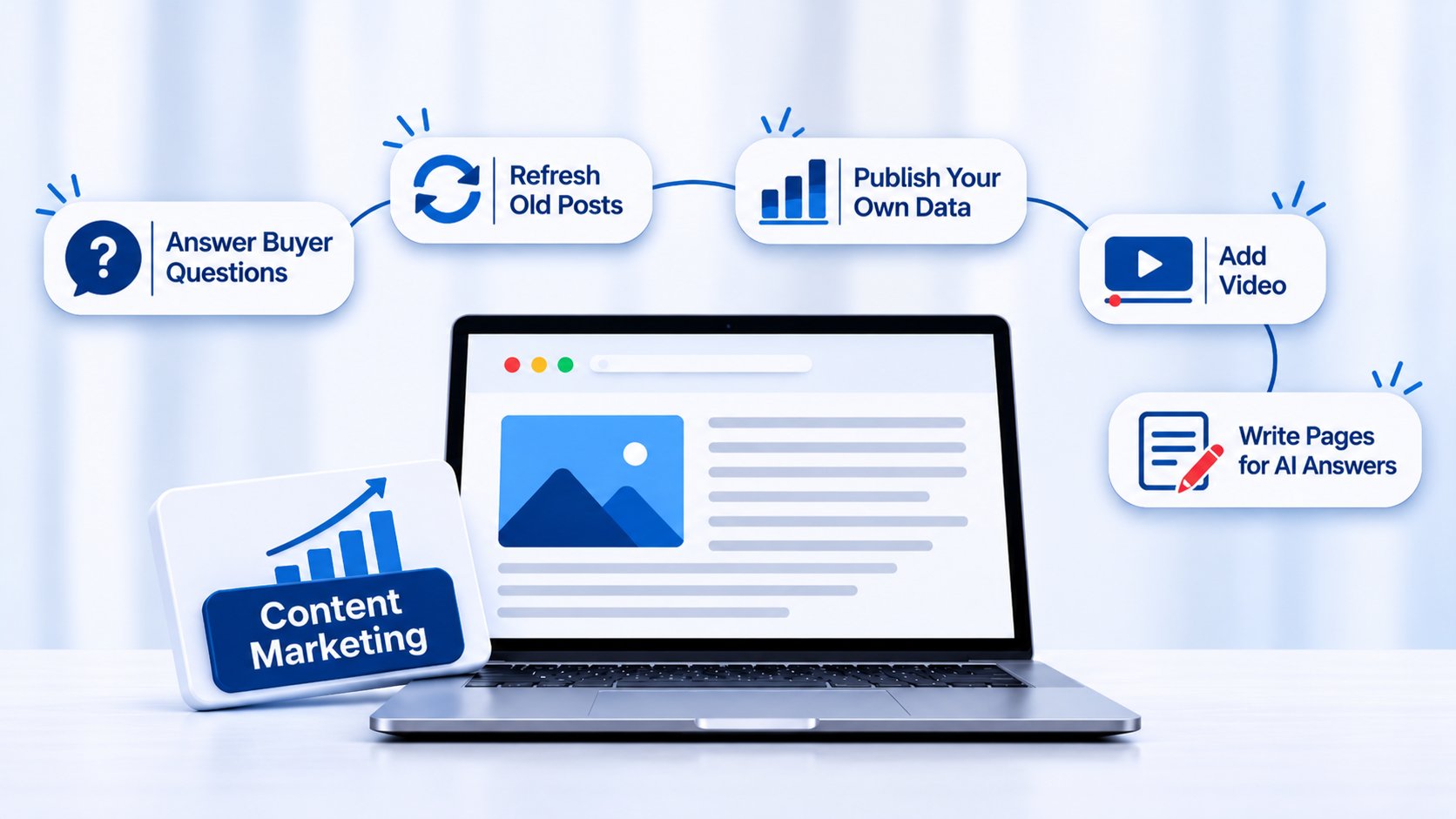
6. Answer the Questions Buyers Ask Before They Call
Here’s a quick test: could a sales rep send this link instead of typing out the answer? If yes, it’s the right post.
Buyers ask about price ranges, timelines, what goes wrong and how you compare to the alternative. Most vendors dodge all four. Good SEO content writing sounds like your best salesperson being honest on a Tuesday afternoon, and that honesty is what lets you increase organic website traffic from people who are close to buying.
7. Refresh Old Posts Before Writing New Ones
Your older articles are leaking traffic right now. Data goes stale, screenshots age, competitors publish something better.
Pull your top fifteen posts from the last two years and check each for:
Old figures or dead links
Screenshots from a past interface
Missing comparison tables or a clearer opening answer
Changing the date without changing the substance fools nobody. A real refresh usually costs far less than a new post, and the page already has links and history behind it. That’s why updating tends to be the quickest way to improve your content marketing ROI without raising the budget.
8. Publish Your Own Data
Journalists and bloggers link to numbers. Nobody links to opinions.
You don’t need a research department. Survey fifty customers. Pull anonymized patterns from your own product usage. Audit what twenty competitors charge. Then publish the findings with the sample size stated openly. A small honest study beats a big vague one, and it earns links that no outreach email can.
9. Add Video Where Search Already Wants It
Type your target phrase into Google. If video results appear, a clear walkthrough from you can compete there.
Keep it practical: a screen recording, a five-minute explainer, a customer question answered on camera. Put it on the matching page, host it on YouTube, and write a proper description. Polish matters less than usefulness.
10. Write Pages AI Answers Can Quote
Answer engines pick the page that states the answer plainly. Vague introductions get skipped.
Under each heading, give the direct answer first, in roughly 40 to 60 words (a rule of thumb, not an official limit). Then add context. Most teams already explain things well. What they skip is the plain answer up top, and that habit is what separates SEO and AEO optimized content from a page that only reads well.
Name your company, services and location the same way on every page, so the brand facts stay consistent. Schema markup (Article, FAQPage, HowTo) helps machines read your structure. Don’t count on rich results from it, though, since Google has scaled those back for many sites. Check its current guidance.
C. Social Media and Community Engagement: Show Up Where Buyers Talk
11. Post the Insight, Not the Link
A bare link with a flat headline gets scrolled past. Break your research into three takeaways, write them directly into the post, and let the full report be the follow-up.
Do: Lead with the surprising finding. Use a carousel for step-by-step material.
Don’t: Paste a URL with “New blog post!”
Many marketers report that outside links cut reach on LinkedIn. The platform hasn’t confirmed a rule, so test it on your own account before taking anyone’s word for it.

12. Be Useful in Communities First
Your buyers vent in Slack groups, Reddit threads and industry forums. They spot a sales pitch in seconds.
Answer questions properly for weeks. Share a link only when someone asks for a template or guide you happen to have. A rule of thumb I like is ten useful replies for every one mention of your own resource. It’s a habit, not a law, but it keeps you honest.
13. Write for Publications Your Buyers Already Read
Guest articles work when the editor’s readers learn something new.
Pitch one specific idea in a single paragraph. Bring your own data. Keep the product out of the body and let the author bio do the quiet work. Skip anything that smells like a backlink swap, since editors can tell and so can readers.
14. Say Yes to Podcasts and Webinars
A host with your ideal buyers in the audience hands you an hour of attention. Pitch topics, not your company. “Why mid-size manufacturers overpay for freight” gets a yes. “Our services” doesn’t.
Send listeners to a single page built for them, with a useful resource on it.
15. Co-Market with Non-Competing Partners
Find a company that sells to your buyer but not your product. An accounting platform and a payroll provider. A cybersecurity firm and an IT consultancy.
Co-host a webinar, publish a joint report or swap newsletter features. Each of you shows up in front of a warm audience at no ad cost. Match audience sizes, or one side does the work and the other collects the leads.
D. Owned Audience, Paid Support, and Proof
16. Build an Email List That Brings People Back
Most first-time visitors leave and never return. Email gives you a way to ask them back.
“Subscribe for updates” rarely works. A benchmark sheet, a checklist or a pricing calculator does. Send something useful every week or two, and link each email to a page on your site. This traffic doesn’t depend on any algorithm, which makes it the steadiest source you’ll have.
17. Use Paid Search as a Bridge, Not a Crutch
Organic rankings take months. Paid search fills the gap and shows you, within weeks, which phrases lead to real inquiries.
Bid on bottom-of-funnel terms only. Then feed the winners into your organic visibility plan, so you stop paying for what you can earn.
18. Mine Competitor Keyword Gaps
Your competitors leave openings. Pages that rank on page two with thin content are the easiest ones to take.
List five direct competitors.
Pull the terms they rank for that you don’t.
Flag the ones with weak or outdated pages.
Publish something clearly better.
An organic SEO company can run this in a day. A rough first pass with a free tool is enough to see what’s there.
19. Track Which Traffic Pays
A rise in visits proves little. Set up conversion tracking in GA4 for form fills, demo requests and calls, then look at leads by channel instead of sessions.
Be a little skeptical of any report that only shows traffic growth. Ask to see leads and revenue next to it. You may find that a small channel is carrying most of your pipeline.
20. Turn Customers into Traffic Sources
Your happiest customers are an underused channel.
Case studies with real numbers, which give sales something to send and search something to rank
Reviews on Google and industry sites, which feed local rankings and trust
A direct ask: “Would you mention us on your partner page?” Most say yes if you ask politely.
Technical Schema Implementation: Improving Retrieval for AI and Search
That’s where execution breaks down for most teams. Writing great prose is half the battle; search engines still require structured code to interpret page relationships. Schema markup translates human text into structured data objects that machine parsers process instantly.
Deploying structured markup requires three specific implementations:
Article Schema: Attaches author credentials, publisher details, and modification timestamps directly to editorial pages. This structure validates expertise and supports appearance in discovery feeds.
FAQPage Schema: Formats question-and-answer pairs into linked entity nodes. Search algorithms pull these blocks into expandable accordion snippets on search result pages.
HowTo Schema: Outlines sequential instructions, required tools, and milestone steps. Search bots read this data to generate instructional rich cards and voice search answers.
Step-by-step deployment follows a direct path:
Identify the primary entity type of the URL before drafting markup.
Build the JSON-LD script block containing all required schema properties.
Validate the code snippet through Google's Rich Results Test tool to eliminate syntax errors.
Inject the validated JSON-LD block into the page header template.
Monitor Google Search Console to track rich snippet indexation and fix crawl warnings.
Schema Protocol | Recommended Web Asset | Measurable Search Engine Impact |
|---|---|---|
Article | Research reports, technical guides | Verifies author credentials and publication freshness in search carousels |
FAQPage | Product specifications, service pages | Generates expandable question boxes directly within SERP listings |
HowTo | Operational workflows, setup guides | Populates instructional voice search responses and visual card previews |
Pick Three and Start This Month
Nobody runs all twenty at once. Choose one fix (speed or titles), one content move (a refresh or a buyer-question post) and one outside channel (a community or a partner). Track leads, not visits, and review in ninety days.
If you’d rather hand part of this to specialists, Make My Brand works with business owners on organic growth that connects to sales.
Loading FAQs
Please wait while we fetch the questions...
Published on November 13, 2026 by Surbhi Sood