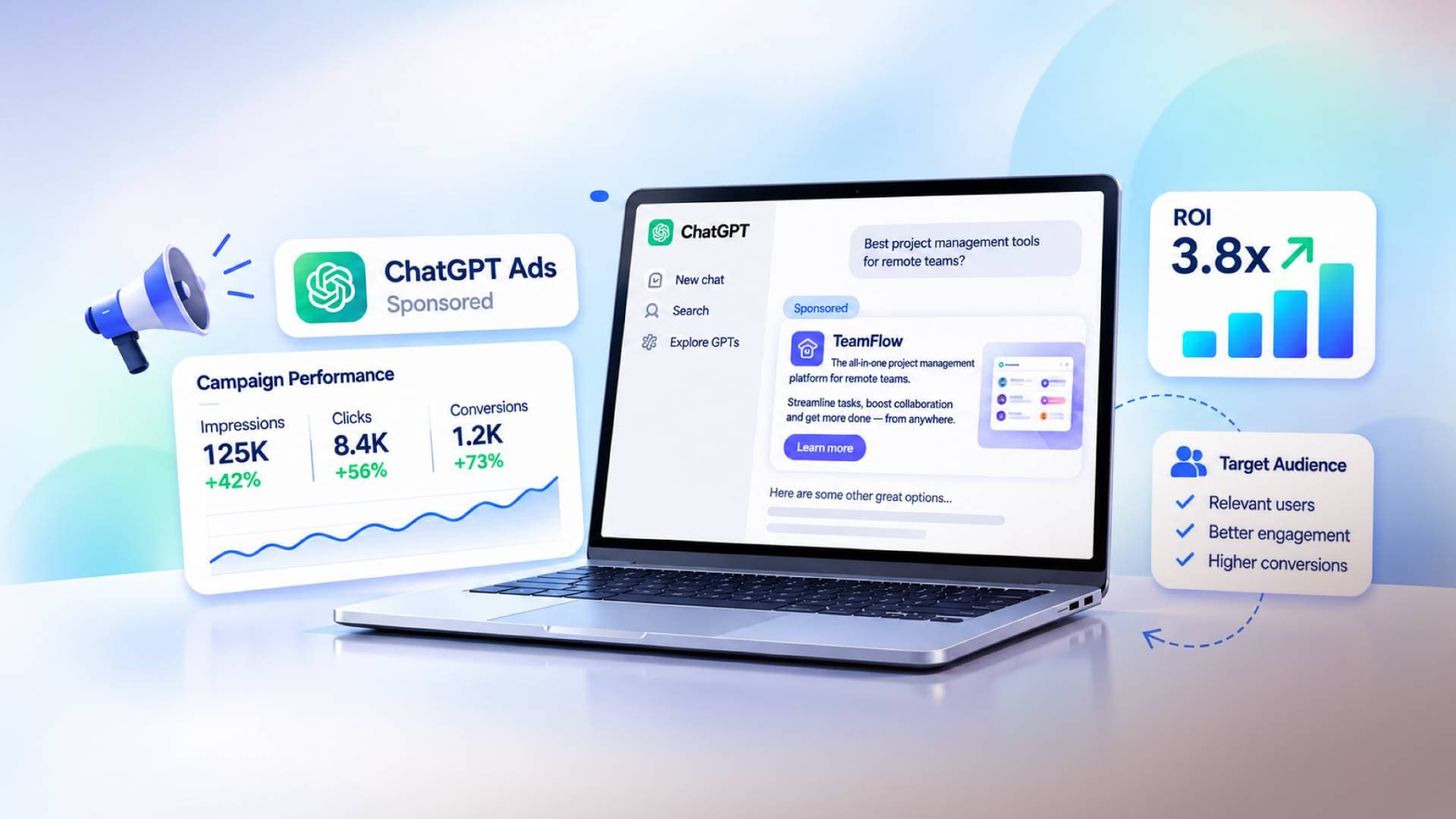
How to Run ChatGPT Ads: The Future of Online Advertising
ChatGPT Ads are transforming online advertising. Learn how to set up campaigns, target audiences, create relevant ads, manage budgets, and measure results. Explore how AI advertising, SEO, and GEO can improve brand visibility and reach potential customers.
For years, digital advertising has been organized around relatively predictable signals.
Search ads respond to keywords. Social ads respond to audiences, interests, and behaviors. Display ads follow users across websites and apps.
ChatGPT Ads introduce a different advertising environment.
A user might spend several minutes explaining what they need, comparing options, narrowing requirements, and asking follow-up questions before an ad appears. By that point, the system may have considerably more context about the problem the person is trying to solve than a conventional search query would provide.
That changes the advertising opportunity.
Instead of simply bidding against “CRM software” or targeting an audience segment called “small business owners,” an advertiser may be able to reach someone who is actively discussing how to choose a CRM for a 30-person professional services business with a specific budget, integration requirement, and implementation timeline.
As of October 2026, this is no longer theoretical. OpenAI operates a self-serve Ads Manager Beta, and ChatGPT advertising has expanded across dozens of markets. OpenAI says ChatGPT now reaches around 1.2 billion people weekly, while more than 100,000 advertisers have already used the platform.
So the question for marketers has shifted from “Will ChatGPT have ads?” to a much more useful one:
How should brands actually run them?
What Are ChatGPT Ads?
ChatGPT Ads are paid placements shown separately from ChatGPT's generated answers.
OpenAI currently says ads can appear to eligible users on its Free and Go plans, while Plus, Pro, Business, Enterprise, and Edu experiences remain ad-free. Ads are clearly labeled, and OpenAI states that advertisers cannot pay to influence, alter, or rank inside ChatGPT's answers.
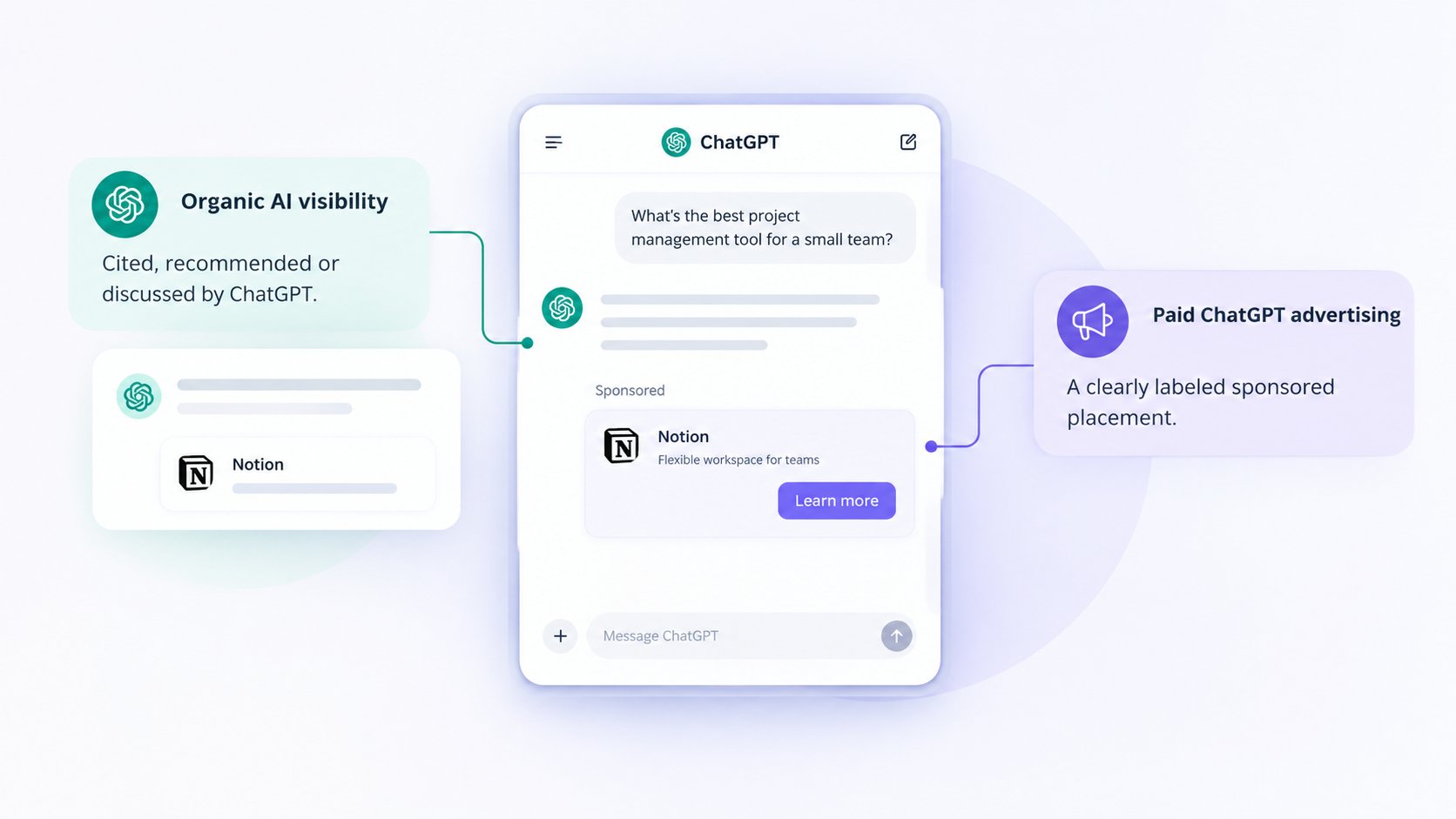
That distinction is important.
There are now two separate ways a company can gain visibility inside an AI-led customer journey:
Organic AI visibility: ChatGPT independently cites, discusses, or recommends a brand because the information it retrieves makes that brand relevant to the answer.
Paid ChatGPT advertising: A clearly labeled sponsored placement is delivered through OpenAI's advertising system.
These should not be confused.
A company cannot buy its way into an organic ChatGPT recommendation. Paid visibility and AI brand recommendation operate through separate systems.
For marketers, however, they can complement each other. Organic AI visibility can help establish authority while paid advertising creates another route to reach users during relevant decision moments.
How ChatGPT Ads Work
Traditional ad platforms often begin with a keyword, demographic, interest group, or content placement.
ChatGPT starts with conversation.
OpenAI's ads system evaluates multiple signals, including the intent and context of the current conversation, the advertiser's landing page, headline and copy, advertiser-provided context hints, targeting choices, and (when ad personalization is enabled) certain signals from the user's broader ChatGPT experience.
Under the hood, the difference is even more significant.
The company's advertising stack uses a dedicated model to interpret conversational context and perform functions including ad retrieval, relevance evaluation, ranking, and auction selection. Importantly, this system operates separately from the model generating ChatGPT's answer.
That means ChatGPT targeting is not simply keyword targeting with an AI interface added on top.
The platform is trying to understand what the person is accomplishing.
For advertisers, that makes relevance considerably more contextual.
How to Run Ads on ChatGPT
The current ChatGPT Ads campaign setup happens through OpenAI Ads Manager Beta.
The structure will feel familiar to performance marketers:
Campaign → Ad Group → Ad
But how those layers are used is somewhat different from traditional paid search.
Step 1: Create Your OpenAI Ads Manager Account
Advertisers can sign in to OpenAI Ads Manager using an existing OpenAI account or create a new one.
Initial setup includes:
advertiser and brand information,
billing details,
account verification,
brand logo,
payment method,
and user permissions for additional team members.
OpenAI also allows advertisers to start the setup process using their website URL, which the platform can use to help create an initial ad and campaign.
This is the operational starting point for how to run ads on ChatGPT.
But the more important decisions come next.
Step 2: Choose the Right Campaign Objective
At present, ChatGPT Ads Manager supports three core campaign objectives.
Views
Views campaigns are designed for reach and visibility and use impression-based buying.
This makes them most relevant for awareness, product introductions, category-building, or campaigns where exposure matters more than immediate traffic.
Clicks
Clicks campaigns optimize toward traffic and operate on a cost-per-click basis.
These are a more natural fit for advertisers trying to move users from ChatGPT to a product page, service page, offer, signup flow, or other destination.
Conversions
Conversion campaigns optimize delivery toward a supported conversion event.
Depending on eligibility and configuration, advertisers can use click-based or impression-based conversion optimization. OpenAI notes that advertisers are not billed directly per conversion.
The principle is familiar: campaign structure should begin with the business outcome, not the available ad format.
Step 3: Build Ad Groups Around Customer Needs
This is where ChatGPT advertising begins to differ more noticeably from keyword-based platforms.
Ad groups can be organized around a product, service, theme, or customer need.
OpenAI recommends separating meaningfully different use cases when they require different messages or landing pages.
Imagine a cybersecurity company.
On Google Ads, it might organize campaigns around keywords such as:
“penetration testing company”
“cloud security services”
“cybersecurity audit”
On ChatGPT, the more useful distinction may be based on the situations creating those searches:
companies preparing for a compliance audit,
businesses concerned about cloud vulnerabilities,
teams evaluating penetration testing providers,
organizations responding to a recent security incident.
The offering may be similar.
The customer context is not.
And in conversational advertising, context can influence whether the advertisement is relevant in the first place.
Step 4: Write Strong Context Hints
One of the more distinctive features of the ChatGPT advertising platform is something OpenAI calls context hints.
These are details advertisers add at the ad-group level to help the system understand what the product or service does, who it helps, and in which situations it may be useful.
OpenAI gives the example of describing running shoes as:
“Cushioned everyday running shoes for beginners training for their first 5K.”
That provides significantly more information than simply saying:
“Running shoes.”
Context hints are not exact-match keywords and do not guarantee that an ad will appear in a particular conversation. They provide additional relevance information for the delivery system.
This has major implications for ChatGPT Ads targeting.
Advertisers should think less about building enormous keyword lists and more about describing legitimate customer situations with precision.
For example:
Weak context hint:
“Project management software”
Stronger context hint:
“Project management software for creative agencies that need client approvals, workload planning, and time tracking in one workspace.”
The stronger version gives the advertising system much more context to work with.
Step 5: Create Ads for the Conversation, Not the Billboard
An ad that performs well on social media will not necessarily work well inside ChatGPT.
Users are already engaged in a conversation. The advertisement needs to feel useful in relation to that conversation rather than interrupting it with generic promotional language.
OpenAI specifically advises advertisers to use clear, specific, benefit-led messaging that explains what the offering does, who it helps, and when it is useful.
Compare:
Generic:
“Transform Your Business Today. Get Started!”
With:
Specific:
“Manage payroll for U.S. employees and international contractors from one platform.”
The second version tells the user why the product might belong in the decision they are currently making.
That is likely to become one of the defining creative principles of AI advertising:
relevance beats interruption.
OpenAI currently supports single-image ads and, as of October 26, 2026, has introduced multi-image ads in open beta.
Step 6: Set Budget, Bids, Geography, and Audience Controls
Campaigns can currently include start and end dates, budgets, countries, supported platform selections, and custom audiences in eligible situations.
Advertisers can use daily or campaign-total budgets.
ChatGPT Ads also supports CPC and CPM buying. OpenAI says its auction uses relevance alongside bidding rather than selecting ads purely on the highest bid. For click campaigns, its current guidance suggests starting maximum CPC bids around $3–$5, although actual economics will obviously vary by advertiser, market, competition, and campaign.
Custom audiences add another familiar performance-marketing layer.
Advertisers can create audiences using customer or prospect lists and then use them for campaign-level inclusions or exclusions. For example, a company might target known prospects while excluding recent purchasers from an acquisition campaign.
But context remains an important part of delivery.
That makes ChatGPT Ads targeting an interesting combination of conventional campaign controls and AI interpretation.
Step 7: Make the Landing Page Match the Conversation
In most advertising channels, landing-page relevance improves conversion.
In ChatGPT, it may matter even earlier.
OpenAI says the landing page itself is among the signals its system can consider when determining ad relevance.
That makes vague landing pages particularly problematic.
If the ad promises:
“Accounting software for independent retail businesses managing online and physical stores”
and the landing page simply says:
“Better financial management for everyone,”
the connection becomes weaker.
Landing pages should clearly explain:
what the product or service is,
who it is designed for,
the problem it solves,
important capabilities,
pricing or offer details where appropriate,
and the next logical action.
In other words, advertising optimization and content clarity are becoming increasingly connected.
Step 8: Measure More Than Click-Through Rate
The current Ads Manager reporting environment includes metrics such as impressions, clicks, spend, CTR, average CPC, average CPM, and conversions.
Those metrics will feel familiar.
The interpretation may need to change.
A user seeing an ad within ChatGPT may already have spent several conversational turns identifying needs, exploring trade-offs, or comparing alternatives. That means the intent behind the click could differ considerably from a conventional display impression.
Brands should therefore look beyond CTR and ask:
Does ChatGPT traffic convert?
How does its cost per qualified lead compare with paid search?
Which customer contexts produce the strongest conversion rates?
Do particular ad-group themes create better downstream pipeline?
Does ChatGPT assist conversions that eventually happen through another channel?
The platform is also expanding its measurement ecosystem. OpenAI has announced integrations and support involving attribution and data partners such as AppsFlyer, Adjust, Branch, Hightouch, Tealium, LiveRamp, and others.
The advertisers that learn fastest will likely be those treating ChatGPT as its own customer-acquisition environment rather than simply adding it as another line in the paid-media spreadsheet.
ChatGPT Ads vs. Google Ads: The Important Difference
Google Search Ads often begin with an explicit query.
Someone searches:
“best CRM for small business.”
The advertiser targets the query and competes in the auction.
ChatGPT conversations can contain far more information.
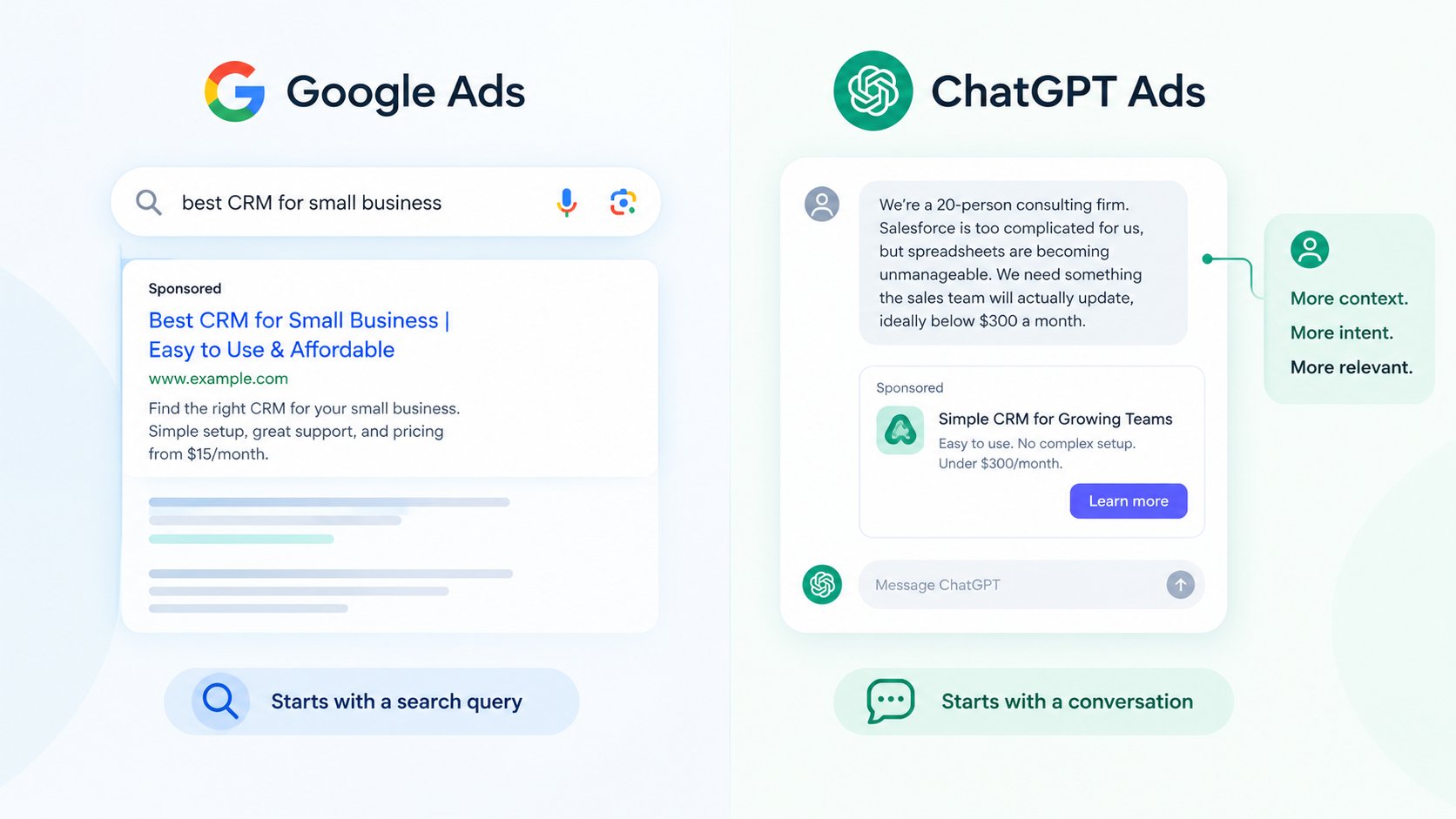
A user might say:
“We're a 20-person consulting firm. Salesforce is too complicated for us, but spreadsheets are becoming unmanageable. We need something the sales team will actually update, ideally below $300 a month.”
That is no longer just a keyword.
It contains company size, current solution, pain point, adoption concern, product category, and budget.
This is what makes conversational advertising strategically interesting.
The advertising system has the potential to operate closer to the user's decision context rather than merely the wording of a search.
That does not automatically make ChatGPT Ads better than Google Ads or paid social.
It makes the channel structurally different.
Paid Visibility Will Not Replace AI Brand Visibility
There is another mistake brands should avoid.
The arrival of OpenAI advertising does not make organic AI visibility irrelevant.
Quite the opposite.
A customer might first see a sponsored placement, then ask ChatGPT about the company, compare it with competitors, search for independent reviews, or request recommendations.
At that point, the brand's broader AI footprint matters again.
If advertising says the company is a market leader but the AI system struggles to find credible information supporting the brand's positioning, the paid and organic experiences become disconnected.
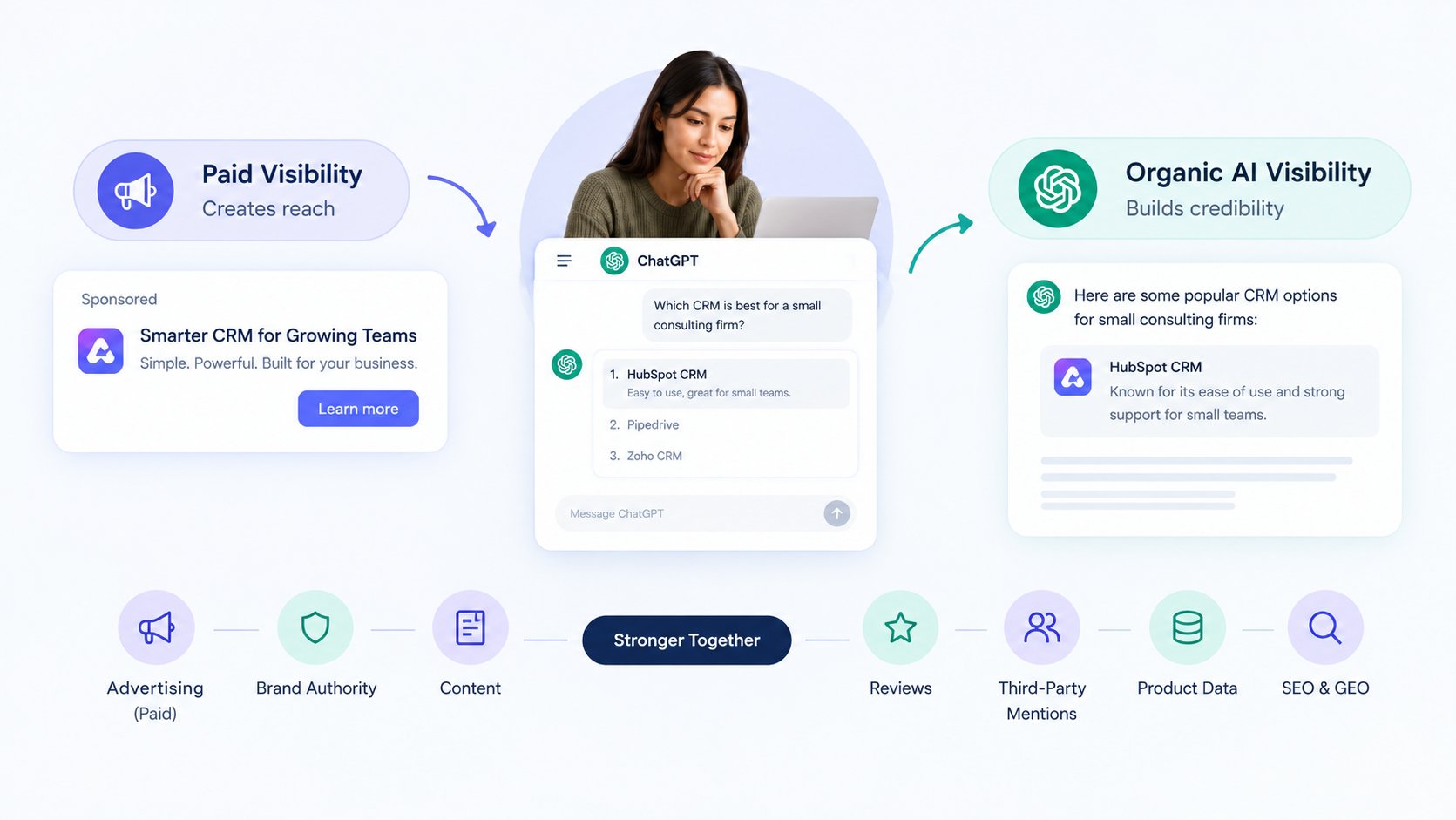
Brands therefore need to think across both sides of AI discovery:
Paid presence helps create reach.
Organic AI visibility helps create credibility.
The strongest strategy will connect advertising, brand authority, content, reviews, third-party mentions, product data, SEO and GEO rather than treating ChatGPT Ads as an isolated acquisition channel.
Where ChatGPT Advertising Is Heading
The current ad format is unlikely to be the final form of advertising inside conversational interfaces.
OpenAI is already experimenting with Sponsored Agents, which allow users to enter a conversation with a business-sponsored agent after engaging with an ad. It has also introduced AI-assisted ad creation, creative enhancement tools, and integrations with platforms such as HubSpot and Shopify.
Creative enhancements can even adapt elements such as headlines, descriptions, destination URLs, image sizing, and language using the existing advertisement, landing page, and conversation context.
The direction is significant.
Online advertising has historically optimized the path from:
Impression → Click → Landing Page → Conversion
AI-native advertising could increasingly become:
Conversation → Need Recognition → Relevant Brand → Interaction → Decision → Action
That creates opportunities well beyond another sponsored link.
The advertisement itself may increasingly become interactive.
The Future of Advertising Is Moving Closer to Intent
The biggest opportunity behind ChatGPT Ads is not simply access to another large audience.
It is access to a different type of signal.
Keywords tell marketers what someone typed. Demographics tell marketers something about who they are. Browsing behavior tells marketers what they previously viewed. Conversation can reveal what someone is actively trying to accomplish.
That is a powerful advertising context, but only when brands use it responsibly and relevantly.
For marketers, this means the early advantage may not go to whoever transfers the biggest paid-search budget into ChatGPT.
It may go to the brands that understand customer situations most clearly.
They will build campaigns around real problems. Write context hints around genuine use cases. Develop ads that add value to the conversation. Create landing pages that answer the next question. And measure whether those conversations eventually turn into business outcomes.
ChatGPT advertising is not replacing paid search or paid social. It is adding another layer to digital discovery, one built around conversational intent.
And that could make it one of the more consequential changes in online advertising since keyword search itself.
Loading FAQs
Please wait while we fetch the questions...
Published on November 2, 2026 by Surbhi Sood