
What Is LLM Optimization? How It Compares to GEO, AEO, and AIO
Discover how LLM optimization helps brands improve visibility across AI search. Learn the differences between LLMO, GEO, AEO, and AIO, plus practical strategies for earning citations, improving brand accuracy, and increasing AI recommendations.
One question every CMO is now asking - when a machine answers for your market, does it name you?
Your next buyer may never see your homepage. They will ask an AI assistant for the best options in your category, read a structures answer, and build a shortlist before your team knows they exist. Whether your brand appears in that answer, and whether the answer gets your story right, is now a growth problem, not a technical footnote.
At Make My Brand Labs, we see growth leaders stuck on the vocabulary before they ever reach the strategy. LLM optimization, GEO, AEO, LLM SEO, and AI search optimization get used interchangeably in proposals, yet each describes a different job. This guide untangles them, shows how they fit together, and lays out the AI search optimization strategies we would put in any 2027 plan.
Key takeaways
LLM optimization (LLMO) makes a brand discoverable, accurately understood, and credibly recommended by large language models.
AI search optimization is the umbrella practice; GEO optimizes for citation and AEO for extraction.
None of them replaces SEO. They are layers built on top of it.
The KPI shifts from rankings to AI search visibility: how often, how accurately, and how favorably AI describes you.
What Is LLM Optimization?
LLM optimization is the discipline of shaping how large language models find, interpret, and represent your brand in their answers. It spans ChatGPT, Gemini, Claude, Perplexity, Copilot, and Google's AI Overviews and AI Mode.
Traditional SEO asks, "Where do we rank?" LLM optimization asks three harder questions:
Does the model know we exist for the problems we solve?
Does it describe us correctly, from category to differentiators?
Does it recommend us when a buyer asks for a shortlist?
The two doors into an AI answer
Retrieval (live search). The model searches the web in real time, pulls relevant pages, and grounds its answer in them. Google documents that its AI features work this way, running several related searches for a single answer (Google Search Central).
Model memory (training data). What the model absorbed about your category and brand during training, shaped slowly by how consistently the wider web describes you.
Retrieval rewards content that is findable, current, and easy to quote. Memory rewards a brand narrative that stays consistent everywhere it appears. LLM optimization takes responsibility for both.
LLM Optimization vs. AI Search Optimization
AI search optimization is the umbrella practice; LLM optimization is the model-centric lens inside it. AI search optimization covers every tactic that improves how you show up in AI-powered search experiences, from Google's AI Overviews to answer boxes.
LLM optimization focuses on the models themselves, what they know about you, how they reason about your category, and whether they choose you. You will also see the umbrella called AIO ("AI optimization"), though some teams use AIO to mean Google AI Overviews only, so always ask which.
Generative Engine Optimization (GEO)
Generative Engine Optimization (GEO) earns citations inside answers that an AI engine composes from many sources. Think ChatGPT Search, Perplexity, and Google AI Mode, where the answer is written fresh and a handful of sources are credited.
GEO is the most research-backed of these disciplines. The term was formalized in a 2024 peer-reviewed study from Princeton, IIT Delhi, and others, which found that adding credible citations, statistics, and expert quotations raised a source's visibility in generative answers by up to 40%, while keyword stuffing did not help (Aggarwal et al., KDD 2024). Those gains came from the researchers' own benchmark and mostly apply once a page is already retrieved. Evidence helps you win the answer; authority gets you into it.
Answer Engine Optimization (AEO)
Answer Engine Optimization (AEO) makes your content easy to lift as the answer. Its home turf is featured snippets, People Also Ask, voice assistants, and the direct-answer layer of AI Overviews.
AEO is structural work: answer-first paragraphs, question-led headings, concise definitions, and tables that do real comparison work. It overlaps heavily with GEO, but the goal differs. AEO wants to be extracted; GEO wants to be credited. One caution: "AEO" is also starting to mean agent experience optimization, so define the term when you brief a vendor.
What Is LLM SEO?
LLM SEO is the SEO community's name for LLM optimization, and the name carries a useful reminder: SEO is still the foundation. Most AI systems retrieve from search indexes before they write, so a page that cannot be crawled, indexed, and trusted will rarely be cited. LLM SEO extends the familiar playbook with entity consistency, answer accuracy, and brand sentiment across every major assistant.
SEO | AEO | GEO | LLM Optimization | |
|---|---|---|---|---|
Core question | Do we rank? | Are we the answer? | Are we cited? | Do models know and recommend us correctly? |
Surfaces | Google, Bing results | Snippets, PAA, voice, AI Overviews | ChatGPT Search, Perplexity, AI Mode | All AI surfaces, with or without live search |
Main levers | Technical health, relevance, links | Answer-first structure | Evidence, authority, corroboration | All of these, plus entity consistency |
KPI | Rankings, clicks | Answer ownership | Citation frequency | AI search visibility and recommendation rate |
How GEO, AEO, and LLM Optimization Fit Together
Think of these disciplines as a stack. Each layer depends on the one beneath it.
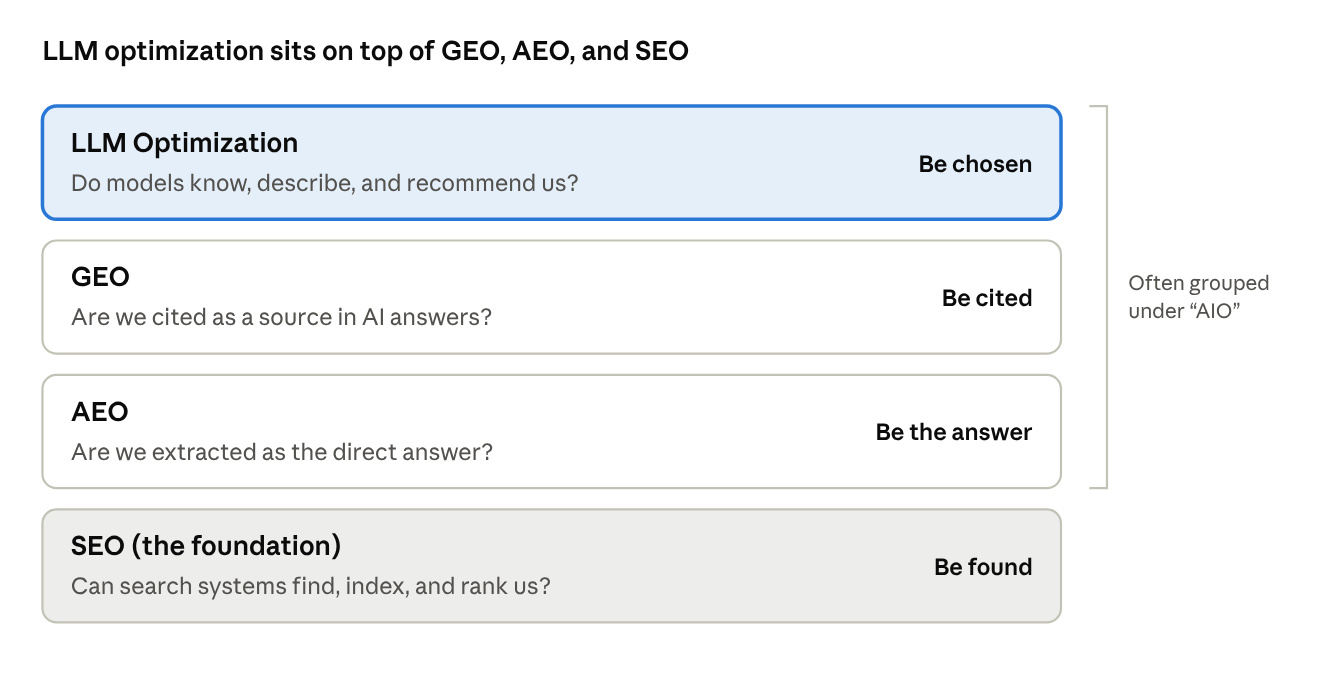
If search systems cannot find you, nothing above works. If your content cannot be extracted, it will not be cited. And if the web tells an inconsistent story about your brand, even a citation may not become a recommendation.
How to Measure AI Search Visibility
AI search visibility is the scoreboard for LLM optimization: how often, how accurately, and how favorably AI answers describe your brand. Blend first-party data with structured prompt testing:
Google's own data. Search Console's Generative AI performance report covers AI Overviews and AI Mode.
A fixed prompt panel. Run the same 30 to 100 buyer-intent prompts monthly across ChatGPT, Gemini, Perplexity, Claude, and Copilot. Log whether you appear, where, and beside which competitors.
Answer accuracy. Score whether each model gets your category, offer, and differentiators right. A mention that misstates what you do can cost more than no mention.
Sentiment and recommendation rate. Track how often you are recommended, not merely listed.
Downstream signals. Watch branded search demand, AI referral sessions, and "how did you hear about us" answers.
Third-party AI visibility tools help at scale, but no outside tool sees inside the models. Treat their scores as directional and anchor decisions in trends across your own prompt panel.
7 AI Search Optimization Strategies That Hold Up
These AI search optimization strategies work across Google and non-Google AI surfaces, and none depend on a loophole that can close next quarter.
Define your entity before you optimize it. Models can only repeat what the web says consistently. Lock one statement of who you are, whom you serve, and what makes you different, then align it across your site, LinkedIn, Crunchbase, G2, Clutch, and press boilerplates. Inconsistent positioning is the most common reason AI describes a brand vaguely or wrongly.
Publish non-commodity content with evidence built in. Google rewards unique points of view over recycled summaries, and the GEO research rewards citations, statistics, and credible quotes. Original data, named frameworks, and case results are what models most want to cite.
Write answer-first. Lead each section with the direct answer, then support it with descriptive headings, short paragraphs, and useful tables. This is AEO at its most practical, and it helps human readers too.
Map prompts, not just keywords. AI queries are longer and more conversational than keyword searches. Build a prompt set around buyer jobs, such as "best growth agency for a Series B SaaS company," and make sure you have a credible page for each underlying need.
Earn third-party corroboration. Analyst coverage, earned media, genuine reviews, podcasts, and partner listings all shape what AI says about you. Earn these mentions; never manufacture them.
Keep the technical doors open. Pages must be crawlable, indexable, fast, and renderable without fragile JavaScript. Check that robots.txt and CDN rules are not blocking the AI crawlers you want.
Refresh what matters. Answers grounded in live retrieval favor current, maintained content. Put cornerstone and comparison pages on a regular review cycle.
For more, see how ChatGPT, Perplexity, and Google AI Mode choose which brands to recommend and our Google-focused guide to AI search optimization in 2026.
The Facts: Why LLM Optimization Matters Now
AI answers now sit between your brand and most of your buyers, and the data is no longer speculative.
Single | What the data shows | Source |
|---|---|---|
Google AI Overviews | 2.5B+ monthly users | |
Google AI Mode | 1B+ monthly users, a year after launch | |
ChatGPT | 900M+ weekly users (Feb 2026) | OpenAI, via ALM Corp |
Revenue at stake | $750B could flow through AI search by 2028 | |
Traffic at risk | 20% to 50% for unprepared brands | |
B2B buyers | 94% use AI in the buying process | |
Click erosion | Position-one CTR falls ~58% under an AI Overview |
The click is disappearing. When Pew Research Center tracked 900 U.S. adults, users clicked a traditional result on 8% of visits when an AI summary appeared, versus 15% without one.
Buyers trust AI first. Forrester found that twice as many business buyers name generative AI as their most meaningful information source compared with any other channel, ahead of vendor websites and sales reps.
Being named pays. Seer Interactive found brands cited inside AI Overviews earned 35% higher organic CTR than uncited brands on the same queries, though it cannot prove causation.
Google calls it SEO. Google's official guide says optimizing for its AI features is still SEO, and that llms.txt files, content "chunking," and manufactured mentions do nothing for Google Search. That guidance covers Google only; ChatGPT, Claude, and Perplexity run their own retrieval and training data, which is why LLM optimization is broader than any one engine's rulebook.
Where LLM Optimization Fits in Your Growth Plan
LLM optimization is the visibility layer of your brand strategy. We map it onto our Brand Development Lifecycle (BDLC): Brand Foundation sets the entity definition, Digital Presence Setup makes it crawlable, Brand Visibility earns corroboration, and Leadership Positioning produces the research models cite.
The MMB view: The brands that win AI search will not chase every new acronym. They will have positioning so clear, and evidence so strong, that any model summarizing the category has to include them.
Loading FAQs
Please wait while we fetch the questions...
Published on September 30, 2026 by Simran