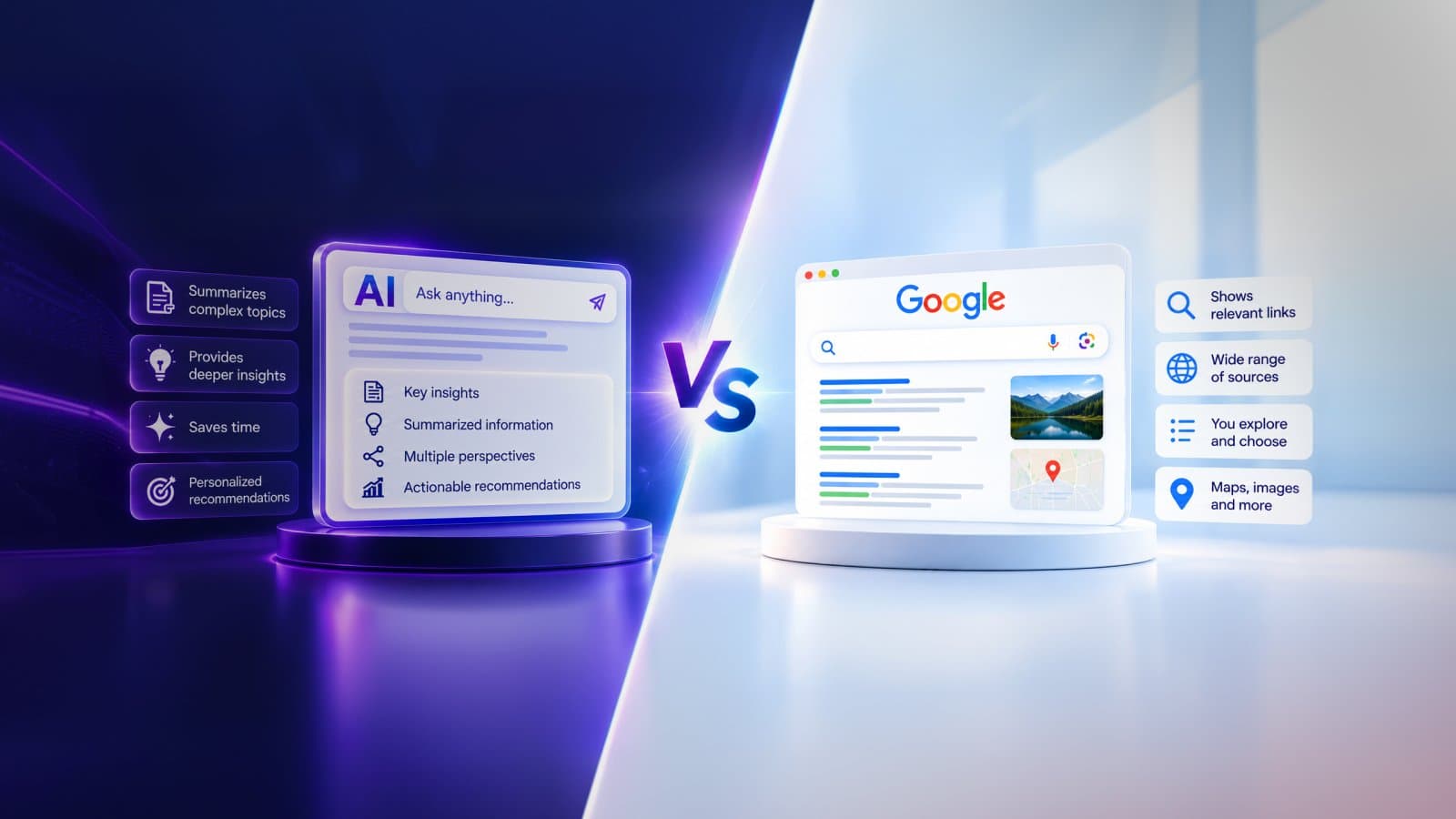
AI Search vs Google Search: How Customer Discovery Is Changing
AI Search vs Google Search is changing how customers discover, compare, and evaluate brands. Explore how AI Overviews, AI search, GEO, AEO, and modern SEO are reshaping customer discovery, brand visibility, citations, and digital growth.
For more than two decades, digital discovery followed a familiar pattern: search a phrase on Google, scan the results, open a few websites, compare information, and decide what to do next.
That pattern is being rewritten.
Customers can now ask ChatGPT, Gemini, Perplexity, Claude, or another AI-powered search engine a detailed question and receive a synthesized response, often with comparisons, recommendations, and cited sources built into the answer. At the same time, Google is integrating the same answer-first behavior through AI Overviews and AI Mode.
So, the real AI Search vs Google Search conversation is no longer about one platform replacing another. It is about a more fundamental change in discovery: from finding information to receiving interpreted answers.
The scale of traditional search remains enormous. Google says it processes more than 5 trillion searches annually, while AI Overviews have increased Google usage for the query types on which they appear in major markets such as the U.S. and India. Yet customer behavior is clearly expanding beyond the conventional search-results page. Adobe’s 2026 research found that one in four customers already considers AI-powered platforms a primary source when researching information, purchase decisions, or recommendations.
For brands, that creates a new visibility challenge: being easy to find is no longer enough. Increasingly, the brand also needs to be easy for an AI system to understand, verify, cite, compare, and recommend.
Google Search vs AI Search: What Has Actually Changed?
The common comparison is simple: Google gives users links, while AI gives users answers.
That distinction is directionally correct, but the modern search environment is more nuanced.
Traditional search engines primarily retrieve and rank pages. AI search engines increasingly combine retrieval with generation: they find relevant information, interpret it in context, and construct an answer around the user’s request.
Google, meanwhile, now does both.
Its AI Mode allows users to ask detailed questions, continue with follow-ups, use multimodal inputs, and receive AI-generated responses alongside links to supporting sources. This means the distinction is increasingly between link-first discovery and answer-first discovery, rather than simply Google versus AI.
Area | Traditional Search | AI-Led Search |
Primary output | Ranked pages, snippets and results | Synthesized answers, comparisons and recommendations |
User behavior | Search, click, review, compare | Ask, refine, follow up, validate |
Query format | Often shorter search phrases | Frequently detailed, conversational questions |
Brand visibility | Ranking position and SERP presence | Citations, mentions, recommendations and source inclusion |
Consideration | Primarily occurs after users visit websites | Can begin inside the search or AI interface |
Measurement | Rankings, impressions, CTR and organic traffic | AI visibility, citation share, brand mentions, referral quality and conversions |
From Keywords to Conversational Queries
One of the most visible changes is how people formulate searches.
A traditional query might be:
“best CRM software small business”
An AI search customer might instead ask:
“Which CRM would you recommend for a 20-person B2B company that needs HubSpot integration, simple reporting and a budget below $500 per month?”
There is far more commercial intent embedded in the second query.
It is important, however, not to assume that Google only understands isolated keywords. Modern Google Search has long moved beyond literal keyword matching. What AI interfaces change is the interaction model: they encourage users to provide more context and then preserve that context through follow-up questions.
Pew Research found that longer Google searches and full-sentence questions were substantially more likely to trigger AI summaries. In its analysis, only 8% of one- or two-word searches produced an AI summary, compared with 53% of searches containing 10 words or more.
For content teams, this means keyword research remains useful, but it must increasingly be supported by intent modeling, topic depth, use cases, comparison questions and real customer language.
That is also why modern content optimization strategies must address complete customer questions rather than merely placing search terms on a page.
From Rankings to AI Recommendations
In traditional SEO, visibility was closely associated with ranking position.
If your company ranked first for a high-value query, the customer could see your page, evaluate the snippet, click through and enter your conversion journey.
AI changes that sequence.
Consider a user asking:
“Which cybersecurity testing companies are best suited to a mid-market fintech business?”
An AI system may evaluate multiple sources and return three or four companies directly. The customer can begin forming a shortlist without opening a search results page at all.
This creates a significant distinction between ranking and recommendation eligibility.
A page can perform reasonably well in conventional organic search while the brand remains absent from AI-generated recommendations. Conversely, a brand may appear within an AI answer because its expertise, product information or market position is consistently corroborated across multiple sources.
This is one reason Generative Engine Optimization (GEO) is becoming an important extension of SEO. The objective is not simply to secure a position on a results page, but to make brand information sufficiently clear, credible and retrievable for generative systems.
AI Overviews, AI Mode and the New Google Search Experience
Perhaps the strongest evidence that this is not an “AI versus Google” battle comes from Google itself.
AI Overviews already summarize information directly within the results page. AI Mode goes further by allowing conversational exploration, deeper reasoning, follow-up questions and multimodal search. Google describes AI Mode as a way to ask complex questions in one interaction while still providing links for users who want to investigate sources further.
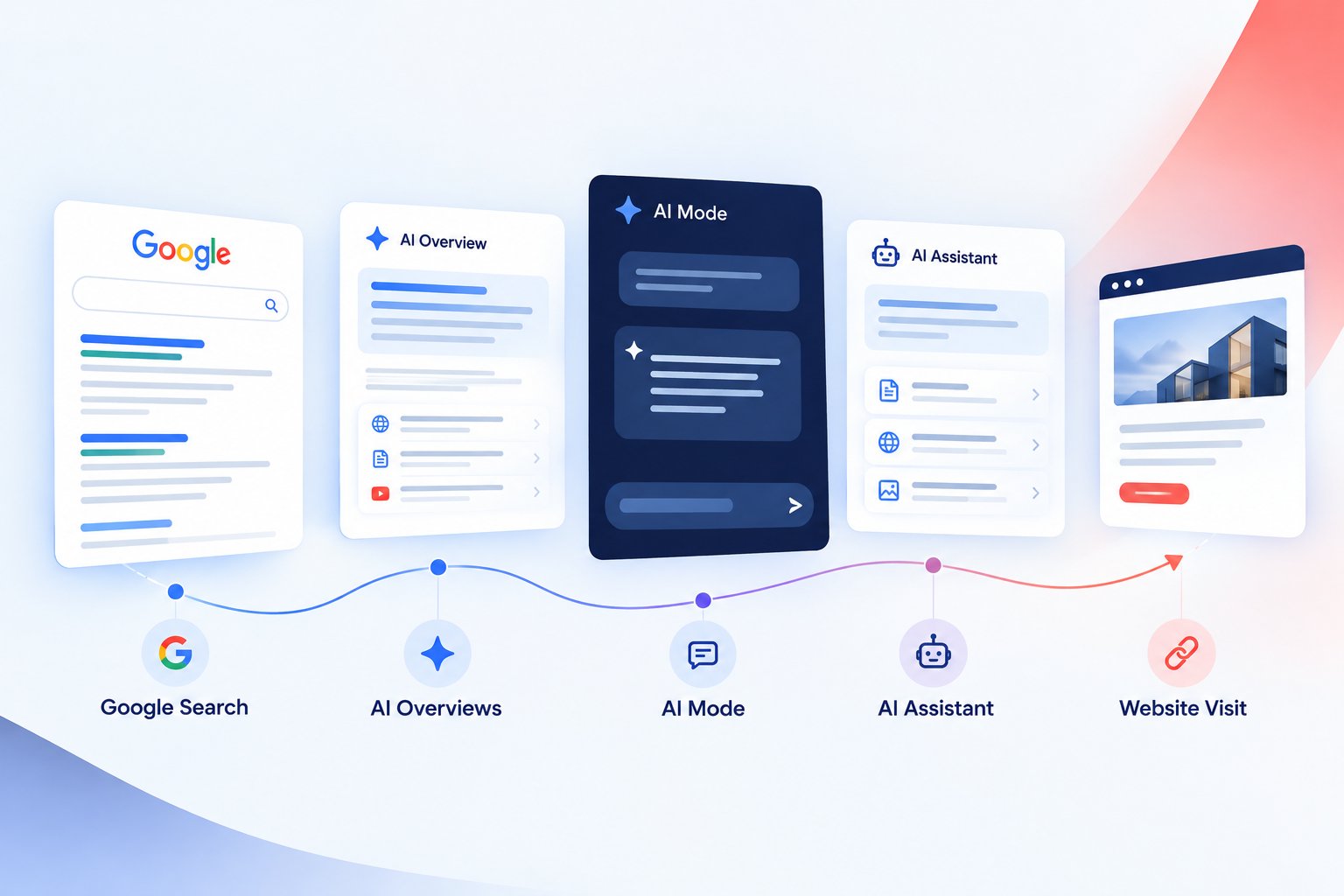
The customer journey therefore no longer begins neatly at position one.
It may begin inside an AI Overview.
It may continue through an AI Mode follow-up.
It may involve an independent AI assistant.
And only after several rounds of synthesis and comparison might the customer visit a company website.
This affects how marketers should think about AI search visibility. Search visibility is becoming less synonymous with website traffic and more connected to how much influence a brand has throughout the discovery process.
Why Citations, Mentions and Brand Authority Matter More
A traditional search result gives a brand space to make its own argument.
An AI answer can make that argument on the brand’s behalf or leave the brand out completely.
That puts more pressure on the broader information ecosystem surrounding the business.
A strong website remains essential, but AI visibility increasingly benefits from consistent entity information, well-structured content, credible expertise, independent mentions, case studies, reviews, authoritative citations, original research and clearly evidenced business outcomes.
MMB’s approach to enterprise SEO and GEO strategies reflects this structural shift: technical search foundations and machine-readable authority increasingly need to work together.
The strategic question changes from:
“Can Google rank this page?”
to:
“Can search and AI systems confidently understand what this company does, who it serves, and why it should be included in the answer?”
That is a considerably higher bar.
Zero-Click Discovery Is Changing What Visibility Means
AI search customer discovery does not always produce a website visit.
Pew’s analysis found that users clicked a conventional Google result on 15% of pages without an AI summary, compared with 8% when an AI summary appeared. Links cited inside the AI summary itself were clicked in only 1% of visits studied.
Bain has similarly estimated that AI-generated and zero-click experiences could reduce organic web traffic by 15% to 25%.
Those numbers could make AI search appear purely negative for publishers and brands. The commercial picture is more complicated.
Customers who do eventually leave an AI interface may arrive with significantly more context and stronger intent. Adobe found that AI-referred traffic to U.S. retail sites converted 42% better than traffic from non-AI sources in March 2026, while also showing stronger engagement.
In other words, fewer clicks do not necessarily mean less influence or lower-quality traffic.
The marketing measurement model therefore needs to evolve from pure traffic acquisition toward visibility, influence, qualified discovery and revenue contribution.
How AI Search Changes the Consideration Stage
This may be the most consequential change for brands.
Traditionally, the consideration stage took place largely across brand websites, review platforms, comparison pages and search results.
AI can now perform part of that consideration process for the customer.
A user can ask an AI assistant to:
“Compare these three platforms.”
“Which one is best for an enterprise?”
“Which has better integrations?”
“What are the disadvantages of each?”
“Which would you choose for my use case?”
By the time that person visits a company website, the shortlist may already exist.
This changes the AI search customer journey from a predominantly traffic-led funnel into a distributed decision journey. Brands must influence customers before the conventional website session begins.
That makes a coordinated AI search content strategy increasingly important. The content being created must support not only discoverability, but comparison, validation and decision-making.
It also connects AI search with the broader shift toward AI-driven customer experiences, where discovery becomes increasingly contextual and personalized.
The Rise of AI Agents: From Discovery to Action
The next shift goes beyond answers.
Agentic AI has the potential to move search systems from assisting decisions to executing parts of them.
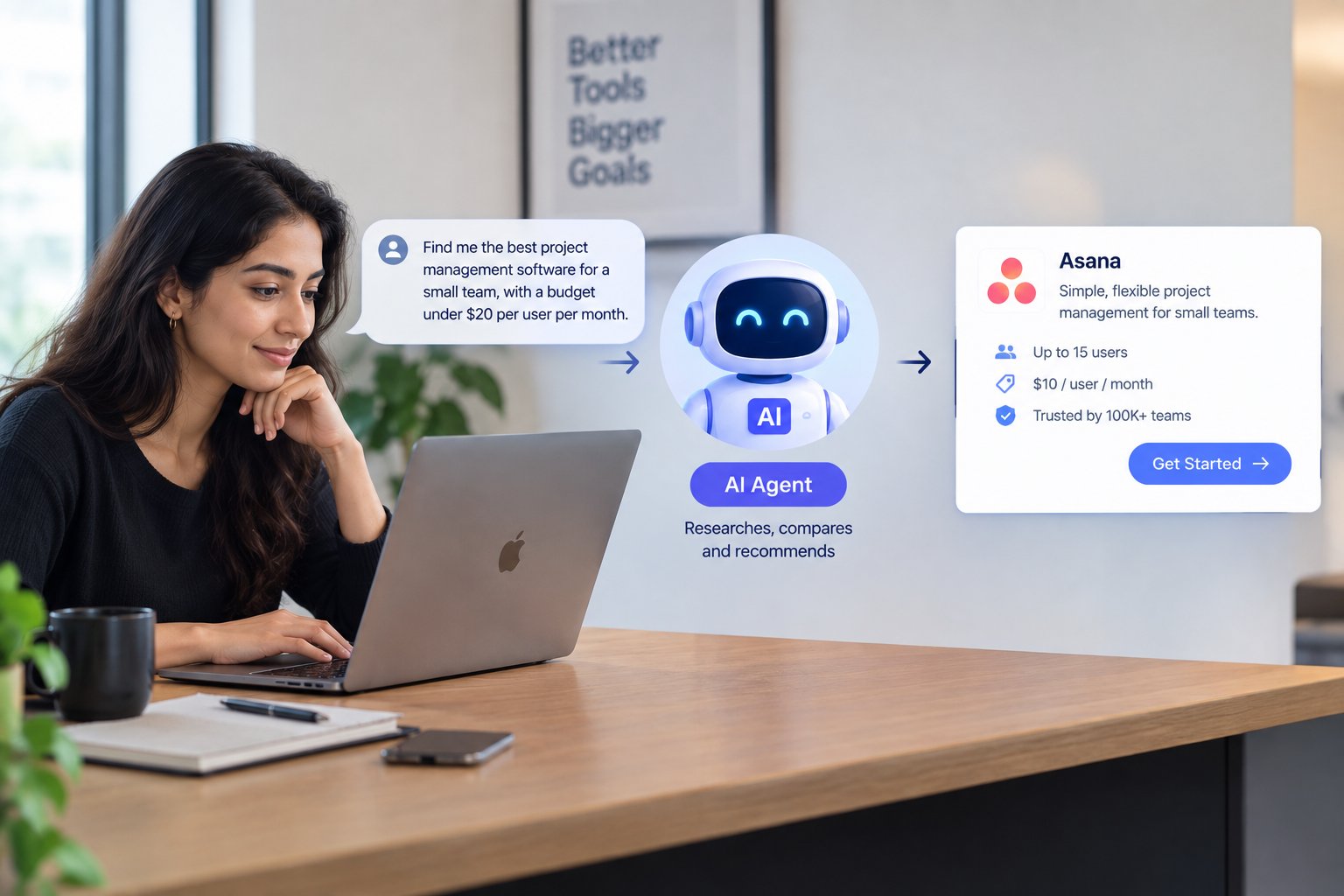
Instead of asking an AI tool to identify suitable hotels, software platforms or professional services and then manually visiting each provider, users may increasingly delegate parts of the research, comparison and transaction process to an AI agent.
We are still early in this transition, and the level of autonomous action varies considerably between platforms. But the direction matters.
When agents become an intermediary between brands and customers, websites will need to communicate information not only to people, but also to software acting on their behalf.
Product information, pricing, availability, credentials, service coverage and structured business data must therefore become easier for machines to retrieve and interpret.
That is why MMB views AI-powered marketing less as a collection of isolated AI tools and more as a shift in the infrastructure behind modern customer acquisition.
How Businesses Should Adapt Their SEO Strategy for AI Search
The answer is not to abandon SEO.
Google remains a major discovery channel, and many AI search systems depend on information retrieved from the open web. Weak technical SEO, poor crawlability or thin content therefore creates problems for both conventional and AI discovery.
The stronger model is an integrated search strategy.
Protect the SEO foundation
Technical health, indexability, site architecture, internal linking, page experience and topical authority still matter. AI search optimization should extend this foundation rather than replace it.
Build content around decisions, not just keywords
Pages should answer the questions customers ask during evaluation: suitability, differences, implementation, pricing factors, risks, alternatives, outcomes and real-world use cases.
This is where Answer Engine Optimization becomes useful. Clear, self-contained answers make content easier for both people and machine systems to interpret.
Make expertise verifiable
Generic marketing claims are easy to publish and difficult to trust. Case studies, named experts, methodology, first-party data, customer outcomes and original industry analysis create stronger evidence.
Strengthen entity consistency
Company descriptions, service categories, leadership information, locations, product terminology and other important facts should remain consistent across owned and third-party sources.
Structured data can reinforce those relationships for search systems.
Track more than rankings
SEO dashboards should begin incorporating AI citations, branded mentions, recommendation presence, AI referral traffic and assisted conversions alongside conventional impressions, CTR, traffic and rankings.
The goal of a modern AI search strategy is broader than SERP performance. It is to understand where and how a brand enters the customer’s decision environment.
How AI Search Is Changing SEO Without Making SEO Obsolete
SEO is not disappearing. Its role is expanding.
Traditional SEO optimized websites to be retrieved.
Modern search optimization must also make information interpretable and reusable.
That requires a combination of SEO, GEO, AEO, strong brand positioning, structured information and real market authority.
The brands most likely to lose ground are not necessarily those that rank poorly today. They are the ones still measuring digital visibility as if every discovery journey starts with a keyword and ends with a website click.
That journey no longer exists in isolation.
At Make My Brand, our approach to AI search optimization connects organic search fundamentals with AI visibility, content authority and customer intent. Because the objective is not merely to generate more impressions. It is to make the brand visible and credible wherever the next buying decision is being formed.
The Search Battle Is Becoming a Discovery Battle
AI is not simply creating another search channel.
It is moving the point at which customers learn about brands, compare alternatives and form preferences.
Google is adapting to that behavior. AI search engines are accelerating it. AI agents may eventually extend it into action.
The practical takeaway for businesses is therefore straightforward: do not choose between Google visibility and AI visibility. Build for both.
The next generation of organic growth will belong to brands that can rank when customers search, appear when AI systems answer, earn credibility when customers compare, and convert when those customers finally arrive.
That is the real shift behind AI Search vs Google Search.
Loading FAQs
Please wait while we fetch the questions...
Published on September 15, 2026 by Simran