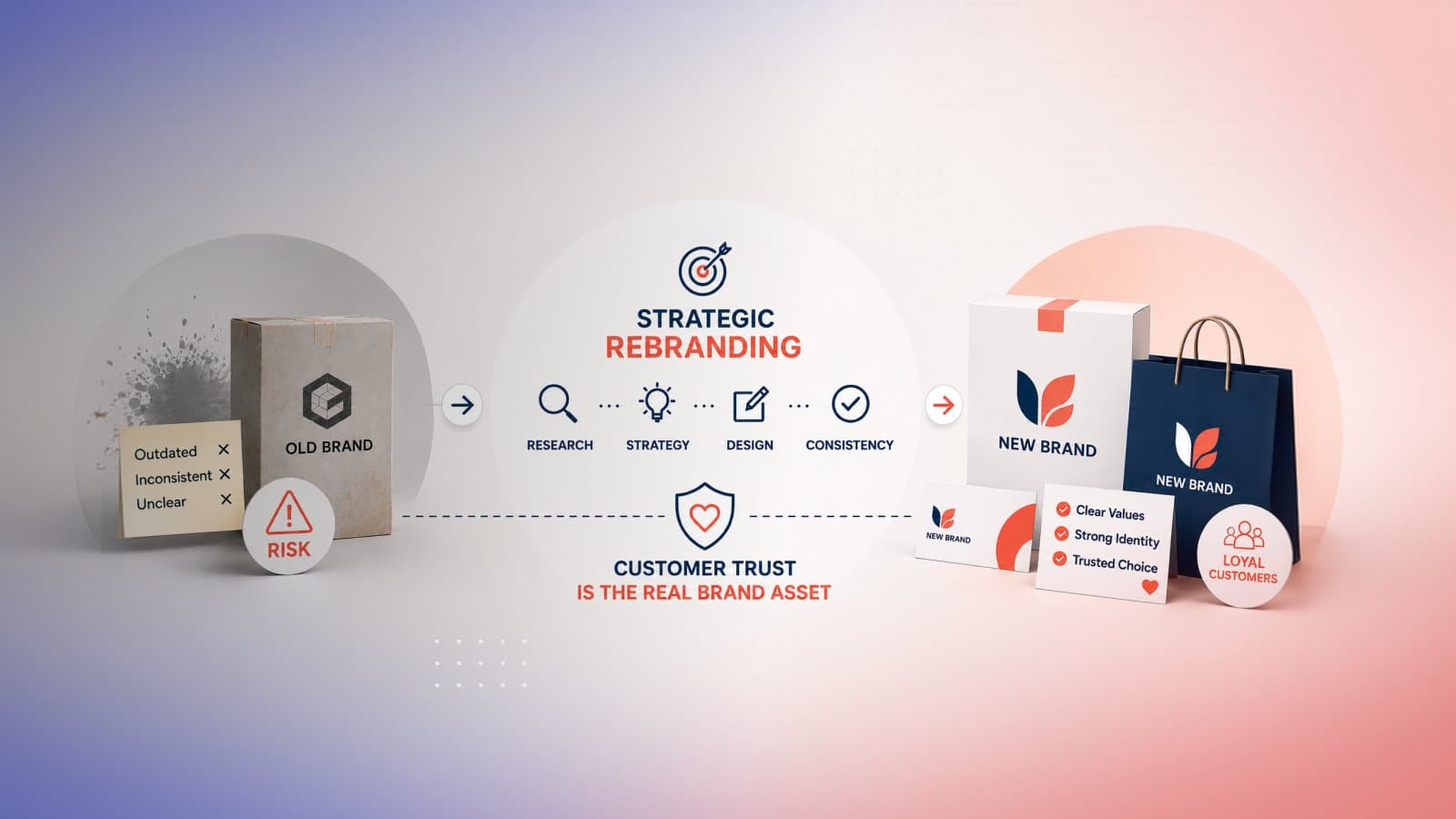
Rebranding Your Business Without the Risk: Keeping Customers Loyal
Rebranding can strengthen your business without sacrificing customer loyalty. Learn how to protect brand equity, decide between a rebrand and refresh, build a smooth transition strategy, align internal teams, and evolve your identity while keeping customers connected to what they already trust.
When Tropicana stripped the straw-punctured orange off its cartons in 2009, the executive team expected praise for a cleaner, modern look. Instead, they got a mutiny. Within weeks, revenue cratered by 20%, a swift $30 million loss that forced them to scrap the new packaging almost immediately.
The juice was identical. The connection, however, had vanished.
That is the high-stakes paradox of business rebranding. Evolve too slowly, and the market passes you by; push an abrupt overhaul, and your best buyers walk away confused and unanchored. Navigating a successful transition doesn’t mean discarding what earned that loyalty in the first place. It demands translating your core value into a sharper form without jarring the people who built your brand.
Why Businesses Rebrand in the First Place?
A rebrand should solve a business problem - not simply create a new visual style.
Companies reach this decision when the existing brand no longer reflects the business they have become. The shift may be driven by a new market, product expansion, mergers and acquisitions, outdated positioning, a major technology change, or the need to compete at a different level.
The strongest rebrands connect the brand identity change to a wider business objective.
Common signals include:
The company has outgrown its original positioning.
Products or services have expanded beyond what the current identity communicates.
Different business units are using inconsistent messaging and visual systems.
The website, customer experience and sales materials no longer reflect the actual value proposition.
The brand attracts attention but not the right customers.
A merger or acquisition has created fragmented brand architecture.
New technologies have changed how the business operates and what it promises.
This is where a brand audit becomes valuable. Instead of starting with a logo, the process examines positioning, customer perception, messaging, digital experience, visual identity, competitive space, and commercial performance.
For enterprises, that distinction matters. A rebrand affects more than marketing. It can influence product communication, sales enablement, employer branding, customer support, recruitment, technology platforms, and every customer-facing touchpoint.
Rebrand vs. Brand Refresh: The Decision Comes First
Not every brand problem requires a complete business rebrand.
A brand refresh improves the existing identity while preserving its core equity. It may involve updated typography, color systems, photography, messaging or website design.
A rebrand goes deeper. It can change positioning, brand architecture, naming, audience focus, promise, voice, and visual identity.
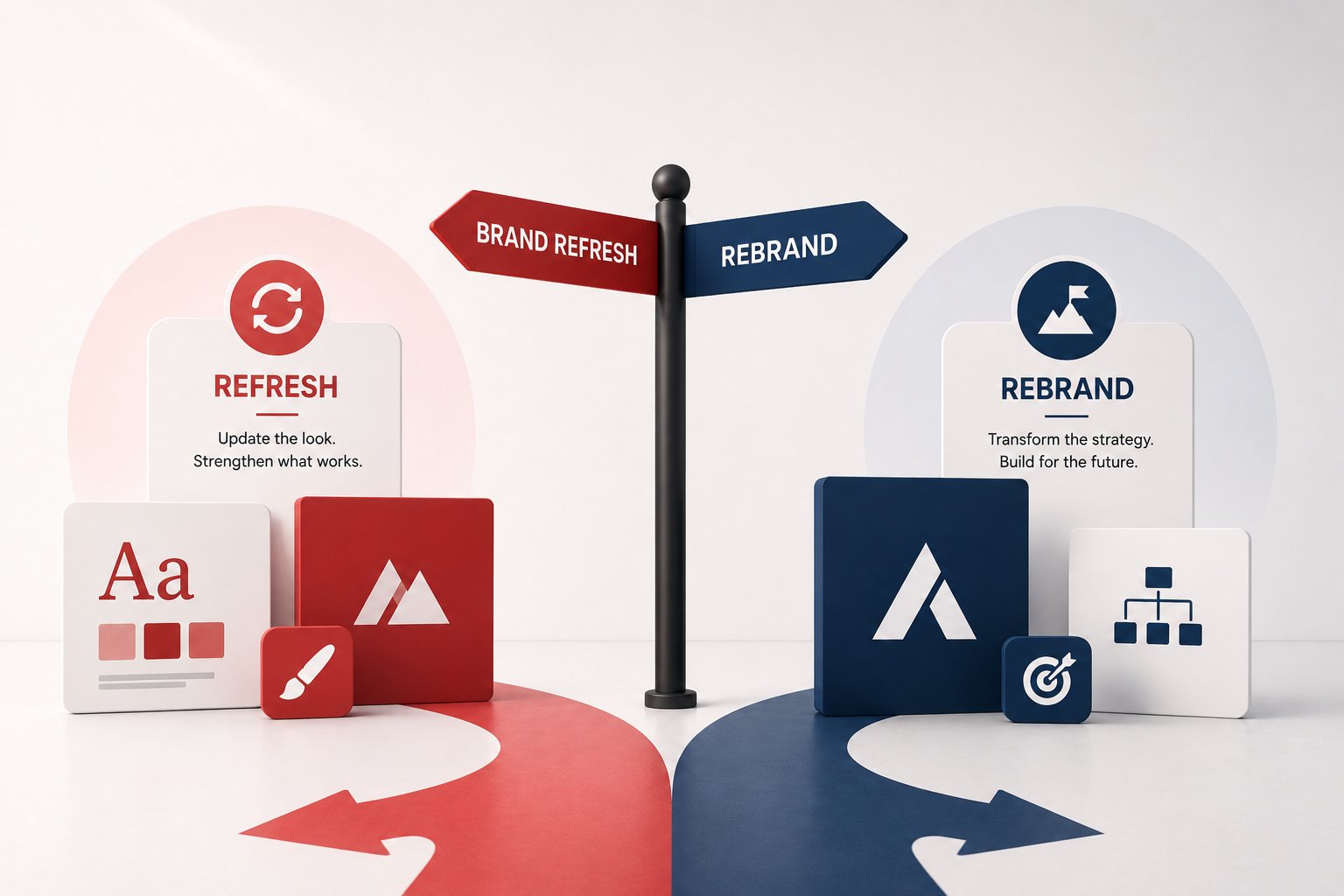
A useful decision framework is:
Refresh when:
The market position is still right, but the expression feels dated or inconsistent.
Rebrand when:
The business strategy, audience, category position or underlying brand promise has materially changed.
This distinction reduces unnecessary risk. Throwing away familiar equity when only an update was needed can create confusion without producing meaningful business value.
Why Is Rebranding Risky?
The risk of rebranding comes from changing too many signals at once.
Customers recognize businesses through accumulated cues - name, logo, language, packaging, website, product experience, service quality, and reputation.
When those cues suddenly disappear, customers may struggle to connect the new identity with the company they already know.
Recent market events make the point clearly. The backlash surrounding Cracker Barrel’s 2025 logo change showed how quickly a visual decision can become a broader reputation issue when customers feel that a familiar brand symbol has been removed without enough consideration for its heritage.
A successful business rebrand therefore answers a simple question throughout the process:
What must change, and what must remain recognizable?
That is the foundation of customer retention during rebrands.
How to Rebrand Without Losing Customers?
A safer business rebranding process follows a sequence instead of treating launch day as the main event.
1. Start With a Brand Audit
Map the current state before deciding the future state. Review:
Customer awareness and perception
Brand positioning and differentiation
Existing brand equity
Website and digital touchpoints
Conversion and retention performance
Customer feedback and support patterns
Sales and partner materials
Internal understanding of the brand
Competitor positioning
This gives decision-makers a clear basis for the rebrand, helping them distinguish between changes the market requires, and adjustments driven by internal preference.
At Make My Brand, brand strategy is developed around this broader commercial view - aligning positioning and identity with digital experience, conversion and long-term brand growth.
2. Protect the Core Before Changing the Expression
A rebrand should preserve the parts of the relationship customers already value. That could be:
A trusted brand promise
A recognizable name
A distinctive product experience
Established customer relationships
Category authority
Service standards
Familiar brand assets with strong recognition
The objective is brand evolution strategy, not identity erasure.
3. Build the New Positioning Before the New Design
Design is easier to manage when strategy is already settled. Define the new:
Positioning
Audience priorities
Brand promise
Value proposition
Messaging architecture
Tone of voice
Brand personality
Visual direction
Only then should the identity system be translated into logos, typography, colors, digital interfaces, campaigns, and collateral.
This is also why a premium brand strategy should not be confused with expensive-looking design. Premium positioning depends on consistency between promise, proof, experience, and perceived value.
4. Create a Clear Brand Transition Strategy
Customers should not have to discover the reason for a rebrand on their own. A transition plan can include:
Before launch:
Prepare customers, partners and employees with context where the change is meaningful.
During launch:
Explain what is changing, what is staying and why the change matters.
After launch:
Keep old-to-new connections visible across websites, email, customer portals, support systems and other important touchpoints.
A temporary line such as “formerly known as…” can be useful for continuity when the name changes materially. Redirects, updated metadata, consistent messaging, and clear customer communications also help reduce avoidable friction.
The principle is simple customers should experience continuity even while the brand is evolving.
Internal Branding Is Part of Customer Loyalty
One of the most overlooked rebranding risks sits inside the company.
Employees need to understand the new positioning well enough to express it consistently. An appealing designed identity can still fail when sales teams use old messaging, support teams explain the brand differently, or product teams launch experiences that do not match the new promise.
This makes internal branding a business requirement, not an HR side project.
A practical rollout should give internal teams:
A concise brand narrative
Messaging guidelines
Updated sales and service language
Brand usage standards
Product and website references
Clear examples of what has changed
The more complex the organization, the more important this alignment becomes.
What Enterprises Are Changing in the AI Era
AI is altering the conditions under which brands compete.
Gartner reported in June 2026 that 84% of companies are caught in what it calls a “brand doom loop,” where weak brand measurement leads to lower confidence, underinvestment and further difficulty proving business impact.
Gartner also predicts that more than 80% of companies will make significant changes to identity, mission or culture by 2028 as AI changes markets.
That does not mean every company needs an AI-led rebrand. It means brand decisions are increasingly connected to technology, customer experience, and market differentiation.
AI is changing rebranding in several practical ways:
Faster Brand Research
AI can accelerate audience analysis, competitor mapping, content reviews, sentiment analysis, and large-scale customer feedback analysis.
More Adaptive Brand Systems
Brands increasingly need flexible identity systems that can work across websites, product interfaces, social platforms, automated customer interactions, and emerging digital environments.
Greater Need for Human Oversight
AI can generate massive amounts of creative output, but brand consistency still depends on strategy, governance, and judgment. Gartner recommends human review and governance as organizations move toward more autonomous AI use in marketing.
There is another warning worth noting. Gartner reported in March 2026 that 50% of U.S. consumers said they would prefer to buy from brands that do not use GenAI in consumer-facing content. The message is not that brands should avoid AI. It is that technology should strengthen relevance and experience rather than make the brand feel synthetic or impersonal.
That is particularly important for AI branding automation should support the brand promise, not become the promise.
Rebranding and Business Growth: Where Revenue Fits
A rebrand rarely creates revenue by itself. Revenue impact comes when the new brand improves commercial performance. A stronger position can help a business:
Enter a higher-value category
Support premium pricing
Improve conversion across digital touchpoints
Attract a better-fit audience
Reduce confusion between products or business units
Improve retention through a clearer customer experience
Support expansion into new markets
PwC’s 2025 CEO research found a correlation between broader business-model reinvention and higher reported profit margins, reinforcing the idea that reinvention is a growth discipline rather than simply a recovery tactic.
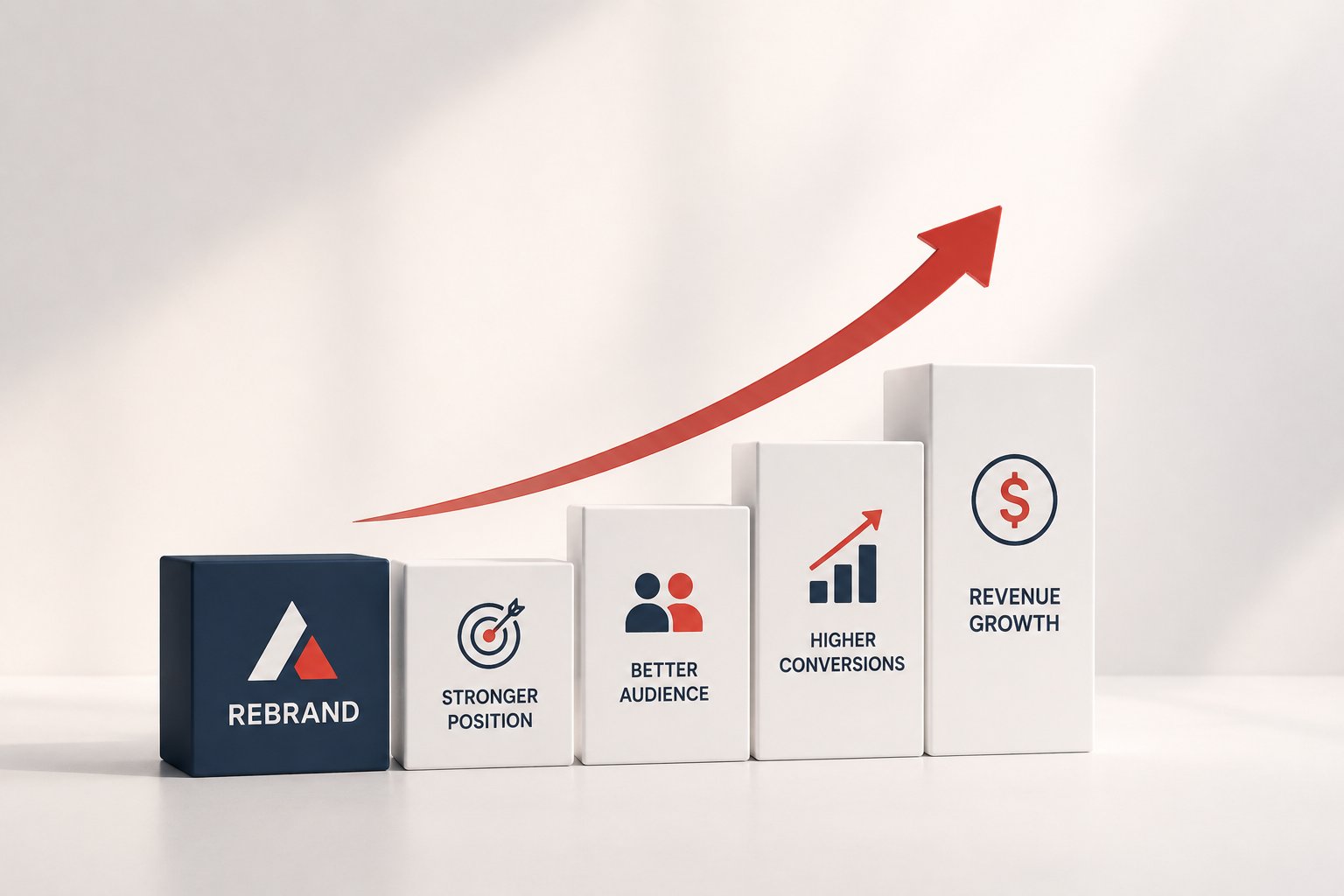
For that reason, the commercial side of rebranding should be measured alongside brand metrics. Awareness alone is not enough. Track qualified demand, conversion, retention, customer feedback, pricing response and revenue contribution where the data allows it.
Make My Brand’s Growth-as-a-Service approach reflects this same principle by connecting brand strategy with digital experience, performance marketing, analytics and ongoing optimization rather than stopping at creative delivery.
Rebranding Do’s and Don’ts
Do
Begin with a clear business reason.
Conduct a brand audit before changing assets.
Identify the equity worth protecting.
Test major positioning changes before full rollout.
Align internal teams before external launch.
Build a phased transition plan.
Measure commercial and customer outcomes.
Don’t
Treat a new logo as the entire rebrand.
Change identity without changing the underlying positioning.
Ignore existing customer associations.
Launch everything at once without transition support.
Let AI-generated content define brand personality without governance.
Choose a branding agency based only on visual style.
Measure success only through traffic, impressions, or social attention.
Choosing the Right Branding Agency for a Safer Rebrand
A rebranding partner should be evaluated on its ability to translate business strategy into a market-ready brand - not simply its ability to produce a new visual identity.
The right partner should be able to:
Diagnose the gap between the current perception of the brand and the position the business wants to own.
Define positioning, messaging and brand architecture before visual development begins.
Apply the new identity across websites, product interfaces, campaigns, sales materials, and customer touchpoints consistently.
Lead the internal teams transition so that the new positioning is reflected consistently in marketing, sales, product and customer experience.
Don’t treat the rebrand as a one-off project. Use performance data to see what needs to be improved after launch.
This is particularly important when the rebrand is expected to support a broader commercial shift. A new identity may look more contemporary, but that alone does not improve market positioning, customer acquisition or conversion.
Make My Brand brings these disciplines together through its brand development and Growth-as-a-Service model. Its Brand Development Lifecycle approach is designed to connect brand decisions with the digital and commercial systems through which customers discover, evaluate, and engage with a business.
Conclusion
True brand evolution is a balancing act. It deepens existing buyer trust while engaging the future market. When executed with precision, a strategic overhaul unifies every touchpoint, insulates your hard-won equity, and unlocks revenue gains.
Pulling this off requires more than cosmetic tweaks. It takes planning, total internal buy-in, and the right branding agency to modernize an identity without bleeding customer loyalty.
Loading FAQs
Please wait while we fetch the questions...
Published on August 27, 2026 by Simran