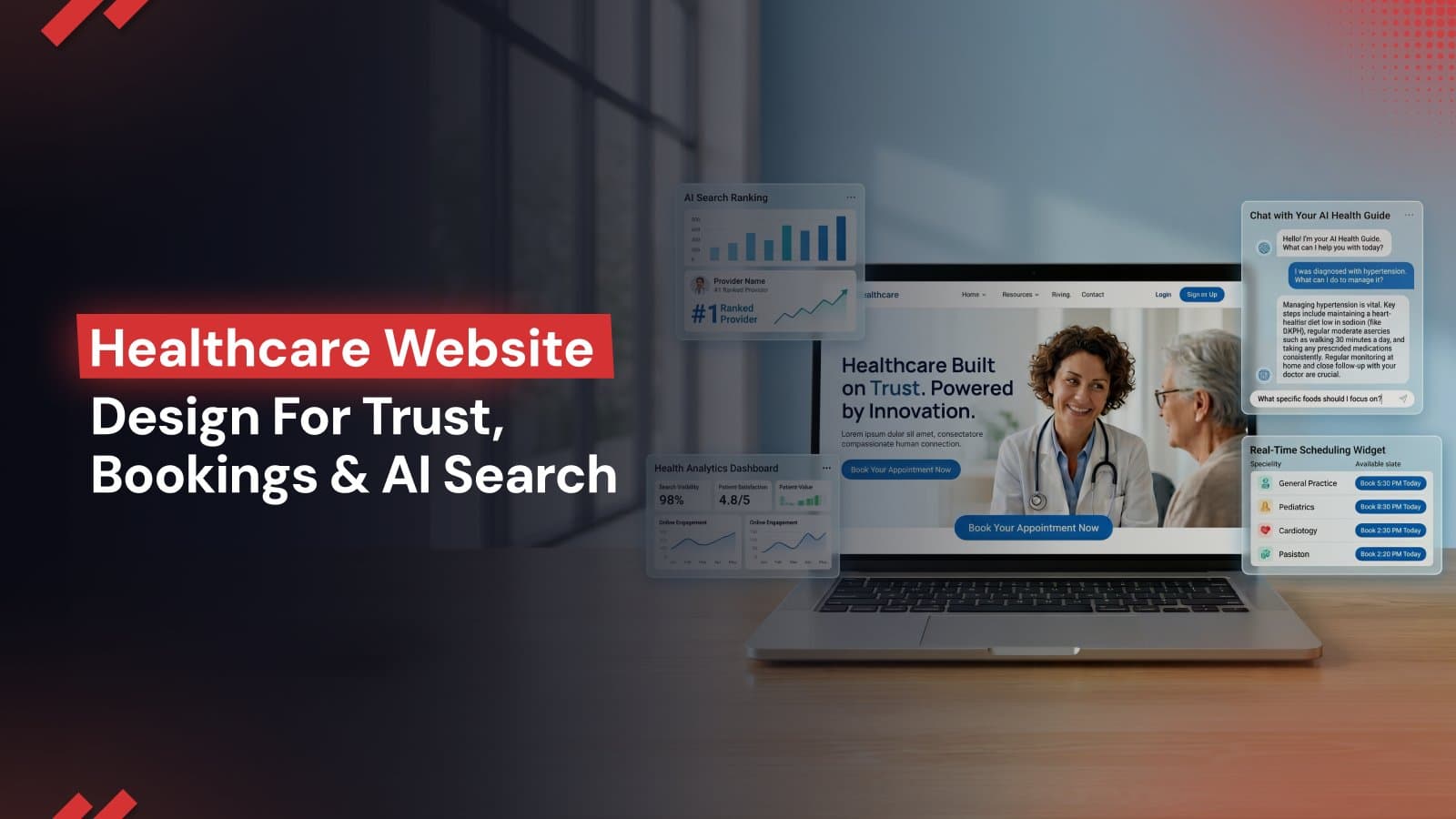
Healthcare Website Design That Builds Patient Trust, Increases Bookings, and Wins in AI Search
Discover how healthcare website design builds patient trust, increases appointment bookings, enhances user experience, and improves visibility across Google Search, AI Overviews, and AI search platforms through AI-optimized digital experiences.
Healthcare websites are no longer just marketing assets - they have evolved into critical digital infrastructure that directly influences patient trust, acquisition, retention, and long-term brand visibility.
As AI-driven search experiences reshape how patients discover healthcare providers online, many traditional healthcare websites are struggling to maintain visibility and engagement.
This shift is fundamentally redefining the role of healthcare website design and digital patient experience strategy.
In this blog, we explore why outdated healthcare websites are struggling, how AI search and conversational discovery are changing patient behavior, and what modern healthcare brands must do to build trust-first websites.
Why Traditional Healthcare Websites Are Losing Relevance?
Many healthcare websites still struggle because they were designed around organizational structures instead of patient intent. Patients do not search the way healthcare organizations traditionally structure information. Instead, patients search conversationally and contextually:
“Best orthopedic doctor for knee pain”
“Does this clinic accept my insurance?”
“Same-day dermatologist appointment near me”
“Cost of root canal treatment”
“Symptoms that need urgent care”
For local-intent SEO relevance:
“Pediatrician available this weekend”
“Best cardiologist near me with insurance”
Most outdated healthcare websites fail to answer these intent-driven questions clearly and quickly.
Common Problems in Older Healthcare Websites
1. Poor Mobile Experience
Most healthcare discovery journeys now begin on mobile devices, yet many healthcare websites still deliver desktop-first experiences.
2. Complex Navigation
Too many menus, disconnected pathways, and cluttered layouts create friction during high-intent moments.
3. Generic Content
Many service pages are written for search engines rather than real patients, making them difficult to trust.
4. Weak Conversion Flows
Patients are often pushed through lengthy forms, fragmented booking systems, or unclear appointment journeys.
5. Lack of AI Search Readiness
Most websites are not optimized for AI-generated answers, entity recognition, or conversational search visibility.
Leading healthcare website design services are increasingly focused on combining accessibility, trust signals, and AI search readiness together.
Search Behavior Has Changed - And So Has Search Itself
The rise of AI-driven search experiences is fundamentally changing how patients discover healthcare brands online.
Today:
Google AI Overviews increasingly answer healthcare-related queries directly within search results.
ChatGPT Search delivers conversational responses with linked sources
Search platforms increasingly prioritize quick, trustworthy answers over traditional rankings
For healthcare businesses, visibility is no longer only about appearing on page one. It is about being:
Referenced by generative search platforms
Summarized accurately
Trusted instantly
Recommended within answer-first experiences
This shift changes the role of the healthcare website SEO entirely. This creates a major challenge for healthcare brands:
If AI platforms answer the question directly, why would users visit your website?
The answer lies in authority, trust, and structured information. Healthcare websites that succeed in AI search environments are the ones that:
Provide clear expertise signals
Structure content properly
Maintain factual accuracy
Use entity-driven content architecture
Answer intent-based queries clearly
Demonstrate credibility consistently
Maintain semantic consistency
Use schema-supported entities
Demonstrate topical authority
Google Search documentation continues to emphasize structured data, semantic clarity, and helpful content for improved search understanding.
Consequently, AI Search Optimization (AISO), Answer Engine Optimization (AEO), and Generative Engine Optimization (GEO) - the practice of optimizing content for AI-generated search responses - are becoming critical parts of healthcare website redesign projects.
Why This Matters for Healthcare Brands?
A patient searching for:
Symptoms
Treatment options
Specialists
Insurance information
Procedure guidance
may now receive most of the information they need before ever visiting a website. That means healthcare websites must perform two critical jobs simultaneously:
Be Understandable to AI Search Systems
The website structure, content clarity, technical SEO, and authority signals must help AI platforms interpret and surface the brand correctly.
Reassure Human Visitors Immediately
Once a visitor lands on the site, the experience must reduce anxiety, build trust, and guide action quickly.
The Rise of Trust-First Healthcare Website Design
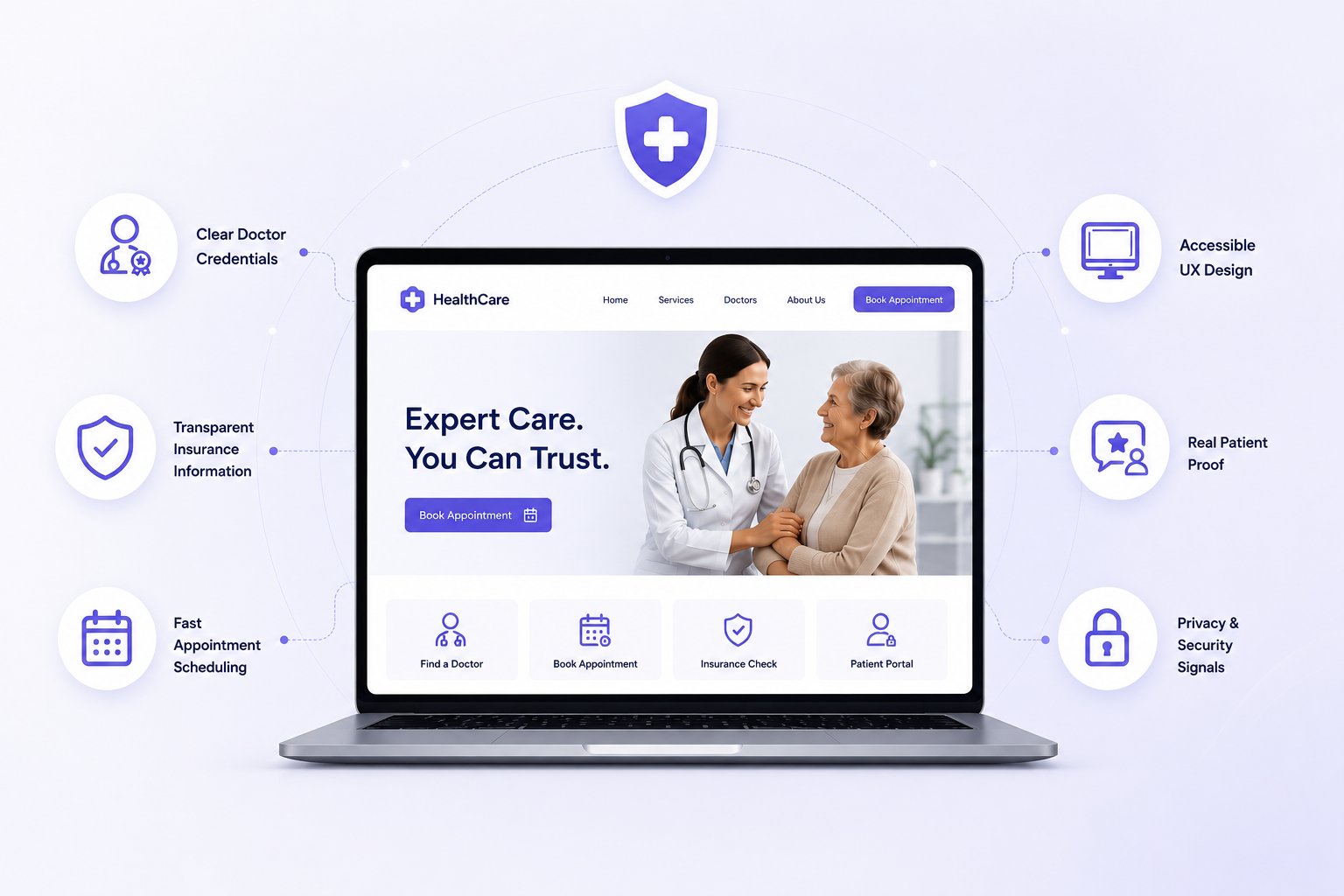
Modern healthcare website design is increasingly moving toward trust-first frameworks. This approach focuses on reducing uncertainty at every stage of the patient's journey.
What Trust-First Design Looks Like?
Clear Doctor Credentials
Patients want immediate visibility into expertise, certifications, specialties, patient outcomes, and years of experience.
Transparent Insurance Information
Real-time or clearly accessible insurance verification significantly reduces friction.
Fast Appointment Scheduling
Patients increasingly expect instant booking workflows instead of callback-based processes.
Accessible UX Design
Readable typography, intuitive navigation, accessibility compliance, and responsive mobile experiences help reduce friction and improve patient confidence.
Real Patient Proof
Verified testimonials, ratings, treatment stories, and outcomes create emotional reassurance.
Privacy & Security Signals
HIPAA-compliant communication flows, encrypted portals, and secure patient authentication improve trust perception.
At Make My Brand, healthcare website design services are approached from both a patient psychology and business performance perspective - balancing trust-building with conversion optimization and long-term search visibility.
Conversational Search Is Changing Content Strategy
Healthcare content strategies are rapidly shifting from keyword-heavy pages to conversational intent models. Instead of writing only for search rankings, healthcare brands now need content that answers how patients naturally ask questions.
1. Shorter, More Direct Answers
AI-driven search platforms increasingly prioritize concise, trustworthy, and contextually relevant answers.
2. Intent-Led Content Clusters
Healthcare topics now perform better when organized around conditions, symptoms, treatments, and outcomes.
3. Structured Entity Data
Search engines increasingly rely on structured information to understand doctors, hospitals, treatments, locations, specialties, and the relationships between them. This makes elements like schema markup, medical entities, and provider relationships critical for improving discoverability, credibility, and contextual relevance in search.
4. Zero-Click Search Optimization
Even when users do not immediately click through - visibility inside AI-generated answers strengthens brand authority and recall.
This evolution is also accelerating the role of AI in healthcare marketing - where visibility depends on clarity, trust, and machine-readable content structures.
Real-Time Healthcare Experiences Are Becoming Standard
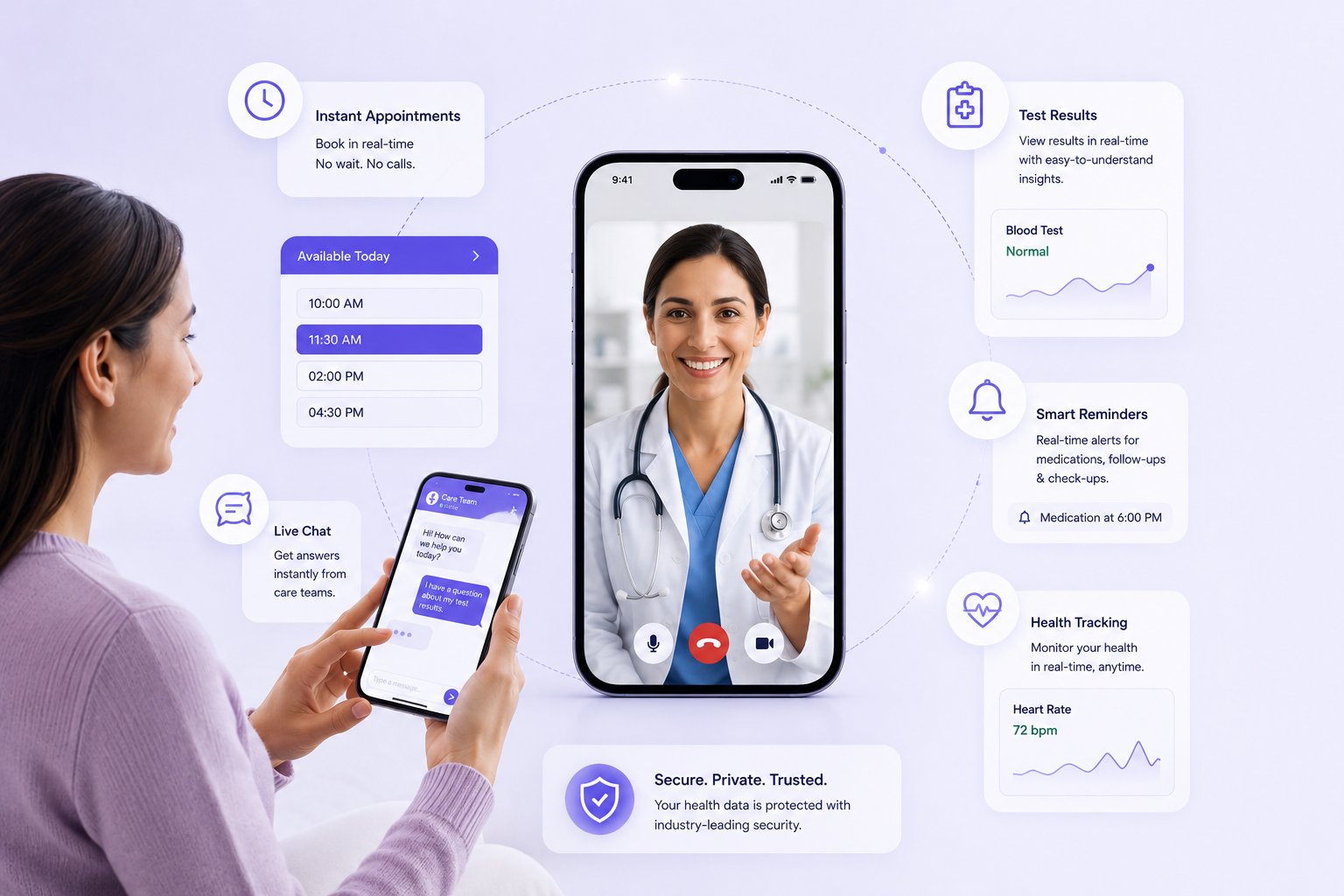
Another major evolution in healthcare website development services is the integration of real-time systems. Modern healthcare websites are no longer isolated digital brochures. They are becoming connected to operational ecosystems.
Emerging Features Defining Next-Generation Healthcare Websites
API-Driven Insurance Verification
Patients increasingly expect immediate eligibility validation instead of manual confirmation.
Integrated Patient Portals
Connected systems improve continuity between discovery, booking, and care delivery.
Health Wallet Integration
Integration with digital health records and connected patient ecosystems is becoming increasingly important.
AI-Assisted Scheduling
Smart booking systems help reduce operational inefficiencies while improving patient convenience.
Intelligent Chat Interfaces
AI-powered support systems now assist patients with multilingual support, symptom guidance, patient triage, FAQs, appointment guidance, and service discovery.
According to ONC Health IT data, healthcare interoperability and API-enabled data exchange continue to expand rapidly across healthcare systems, reinforcing the importance of connected digital infrastructure.
This is why healthcare website redesign today often involves much more than aesthetics. It increasingly requires alignment between UI/UX design services, backend integration, SEO strategy, and patient workflow optimization.
Conversion Tactics That Influence Patient Decisions
High-performing healthcare websites are designed to reduce hesitation. Small experience improvements can significantly impact appointment conversions and patient trust.
Dedicated Service Landing Pages
Generic service pages often fail to address specific patient concerns. Condition-specific and treatment-focused landing pages perform better because they align closely with search intent, patient questions, and AI-driven search behavior.
Click-to-Call & Mobile Booking
Patients expect immediate access to care. Streamlined mobile booking systems and click-to-call functionality reduce unnecessary steps and improve conversion rates - especially during high-intent moments.
Doctor-Led Educational Content
Trust increases when expertise is visible. Educational content authored around doctor insights, treatment guidance, and patient concerns builds authority far more effectively than promotional messaging alone.
Fast Page Speed & Mobile Performance
Slow-loading healthcare websites often lead to immediate abandonment and reduced patient trust. Speed, responsiveness, and seamless mobile usability directly impact patient retention and conversion.
Personalized Patient Journeys
Different healthcare visitors require different experiences. Emergency care seekers, elective treatment patients, and wellness audiences all engage differently and require tailored navigation paths.
At Make My Brand, healthcare website development strategies increasingly combine performance optimization, AI search readiness, UI/UX enhancements, and conversion-focused architecture.
The focus is on building scalable digital growth systems that strengthen patient trust, improve conversions, and deliver far more value than static websites.
The Future of Healthcare Website Design
Healthcare websites are moving beyond static digital brochures and evolving into intelligent patient experience platforms. The shift is no longer only about visual design or traditional SEO rankings - it is about creating trusted, AI-ready digital ecosystems that guide patients seamlessly from discovery to decision-making.
The Industry Shift
Modern healthcare websites are transitioning from:
Informational pages → personalized patient journeys
Traditional SEO → SEO integrated with AEO, GEO, and AI search optimization
Generic navigation → conversational, intent-driven experiences
Static content → dynamic, continuously updated ecosystems
Visual-first interfaces → trust-first digital architecture
Basic booking forms → integrated healthcare workflows
What Is Driving This Change?
The rise of Google AI Overviews, ChatGPT, voice search, and conversational discovery platforms is changing how patients search for healthcare information. Patients now expect:
Faster answers
Mobile-first experiences
Transparent information
Frictionless booking
Connected digital interactions
AI assistants
Multimodal search
Voice-based healthcare discovery
Why It Matters
This transition is not temporary. It reflects broader changes in how patients discover, evaluate, and engage with healthcare providers online.
Healthcare organizations that adapt early will be in a significantly stronger position to improve patient acquisition, trust, retention, and digital visibility over the next few years.
Final Thoughts
As patient expectations continue to evolve, websites must do far more than present information. They need to deliver seamless experiences, reduce uncertainty, support faster decision-making, and create confidence at every interaction point. From conversational search optimization and trust-first UI/UX design to integrated booking systems and AI-ready content structures, modern healthcare websites are becoming intelligent digital ecosystems rather than static online platforms.
Visibility now depends not only on rankings - but on how effectively a website communicates expertise, authority, accuracy, and relevance across AI-powered discovery channels.
Ready to transform your healthcare website into a patient-first, AI-ready growth platform? Connect with Make My Brand to build a smarter digital healthcare experience.
Loading FAQs
Please wait while we fetch the questions...
Published on May 18, 2026 by Abhishek Vasudev