Real Estate Website Design That Converts Casual Browsers Into Qualified Leads (And Ranks in AI Search)
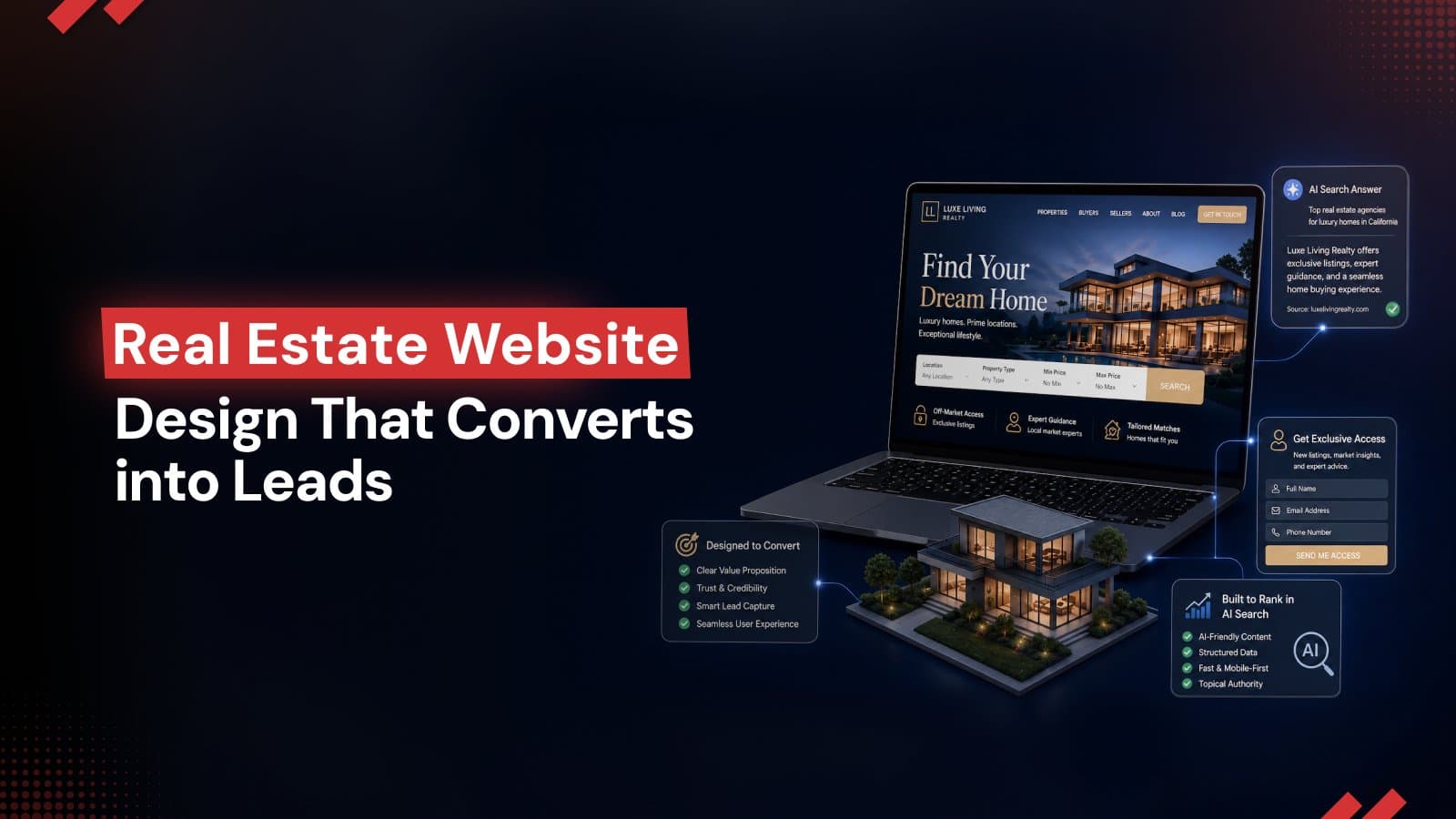
As AI search transforms how buyers and sellers discover properties, real estate websites must evolve into conversion-focused growth platforms. Learn how AI visibility, hyper-local content, trust signals, and intelligent UX work together to generate qualified leads.
A few years ago, a visually appealing website and a basic lead form were enough to generate inquiries. Today, buyers and sellers expect far more. They want instant answers, hyper-local insights, personalized recommendations, seamless mobile experiences, and complete confidence before they even speak to an agent.
Simultaneously, search behavior is evolving significantly. Prospects are no longer just depending on standard search results. AI-powered search experiences, such as Google AI Overviews and conversational search interfaces, are changing how people find homes, brokers, and real estate firms.
This means real estate websites now serve two critical functions:
Convert visitors into qualified leads.
Establish authority and visibility across AI-driven search.
At Make My Brand, we've seen firsthand that businesses achieving sustainable growth are building real estate conversion infrastructure, trust architecture, and AI visibility into every stage of the digital experience.
How AI Search Is Reshaping Real Estate Website Design?
Google's AI-powered search experiences prioritize content that demonstrates expertise, authority, relevance, and genuine user value.
For real estate brands, this creates a major opportunity.
Most property websites continue to use generic neighborhood descriptions, duplicate listing text, and sparse location pages. AI-powered searches are progressively excluding this sort of content in favor of sources that offer unique perspectives, local expertise, and structured information.
The websites gaining visibility are built around:
Natural language content
Hyper-local expertise
Structured data and schema markup
Proprietary market insights
Strong trust signals
User-first information architecture
In practical terms, real estate companies must think beyond traditional SEO and embrace what experts now refer to as AI Search Optimization (AISO) and real estate GEO (Generative Engine Optimization).
While the fundamentals of SEO remain essential, websites must also be structured in a way that AI-assisted searches can easily understand, cite, summarize, and recommend their content.
Designing for AI Visibility - What Real Estate Websites Must Include
As AI-powered search evolves, website structure becomes increasingly important. Real estate businesses should focus on creating content that AI-assisted discovery platforms can easily understand and reference.
1. FAQ Schema
Well-structured FAQs help search engines interpret content and understand user intent. Questions should address:
Buying processes
Selling timelines
Financing concerns
Local market conditions
Neighborhood-specific inquiries
2. Natural Language Content
AI search favors content that mirrors how people naturally ask questions. Instead of keyword stuffing, focus on answering real-world queries such as:
Is this neighborhood good for families?
What is the average home price in this area?
How competitive is the local market?
3. Hyper-Local Content Strategy
AI search rewards specificity. Instead of generic city pages, successful real estate websites are creating:
Neighborhood guides
School district pages
Community-specific market reports
Local investment insights
Area lifestyle content
This hyper-local focus helps establish topical authority while improving visibility across AI search experiences.
4. Citation Metrics and Entity Authority
AI systems increasingly evaluate trust through citations and entity recognition. Brands that consistently publish:
Market reports
Proprietary insights
Research-driven content
Expert commentary
are more likely to become trusted sources within AI-generated responses.
The New Formula for Real Estate Lead Generation
Instead of asking users to fill out lengthy forms immediately, leading real estate websites focus on progressive engagement through:
Property alerts
Saved searches
Interactive tools
AI-powered assistance
Personalized recommendations
Each interaction provides valuable intent signals while reducing friction. The result is high-quality leads and improved conversion efficiency.
This is where real estate website design becomes a conversion system rather than a static presentation layer. In our Mainstreet case study, that mindset helped produce 584% more conversions, 45% faster page load times, and 99% accuracy in lead tracking through an end-to-end attribution system.
Lead-Capturing UX - Turning Property Browsers into Qualified Leads
Many real estate businesses still focus heavily on aesthetics while overlooking user experience. However, it is often the UX of a property website that determines whether a visitor becomes a lead or exits within seconds.
High-performing real estate websites prioritize:
1. Frictionless Registration
Every additional form field creates drop-off risk. Instead of demanding excessive information upfront, modern websites collect data gradually through:
Social login options
Ask only for essential details
Saved listing functionality
Progressive profiling
Enable guest browsing before registration
This creates a smoother experience while increasing conversion rates. For instance, in Realesta’s launch experience, Make My Brand paired conversion-focused UX with automated form routing so engagement could move into the CRM without manual delay.
2. Interactive Property Valuation Tools
Home valuation calculators and property estimate tools continue to perform exceptionally well because they provide immediate value.
These tools help:
Capture seller leads
Increase engagement
Encourage repeat visits
Improve lead qualification
3. Visual and Map-Based Search Experiences
Modern users prefer exploring locations visually. Interactive maps allow buyers to:
Compare neighborhoods
Evaluate commute routes
Explore nearby amenities
Discover properties organically
This creates a more engaging property discovery process than traditional search filters alone. Google’s AI search guidance also highlights the importance of local, image, and video content in helping pages perform well in generative experiences.
Building Trust Architecture into Every Page
Trust is one of the most powerful conversion drivers in real estate. Before submitting an inquiry, users want confidence that they are engaging with a credible expert.
In modern real estate UI/UX design, trust architecture refers to the deliberate placement of trust-building elements throughout the website experience. This includes:
1. Local Expertise Signals
Demonstrate market authority through:
Neighborhood guides
Market reports
Area trend analysis
Community insights
School and infrastructure information
2. Social Proof
Strategically showcase verified testimonials, client success stories, transaction volume, case studies, and industry recognition.
3. Proprietary Market Intelligence
One of the strongest differentiators in AI search is unique information. Instead of repeating publicly available content, provide:
Local market forecasts
Investment insights
Pricing trends
Inventory analysis
Buyer demand indicators
AI-enabled search experiences are significantly more likely to surface content containing original expertise than generic summaries.
AI-Enhanced Features That Improve Lead Qualification
Artificial intelligence is becoming a core component of modern real estate website design development. The most effective implementations focus on improving lead quality rather than simply adding automation.
1. AI Chatbots and Conversational Assistants
Today's AI assistants can:
Answer listing questions instantly
Schedule viewings
Qualify prospects
Route inquiries to agents
Provide property recommendations
This reduces response times and increases engagement outside business hours.
2. Smart Property Recommendations
Much like ecommerce recommendation engines, modern property websites increasingly use AI to suggest listings based on:
Browsing patterns
Saved listings
Search behavior
Location interests
The result is a more personalized experience that keeps users engaged longer.
3. Predictive Alerts and Notifications
Instead of waiting for visitors to return, AI-driven systems proactively notify users about:
Price changes
New listings
Market shifts
Availability updates
These features help keep prospects engaged throughout longer buying cycles.
4. Automated CRM Workflows
Real estate lead generation does not end when a form is submitted. Modern websites should integrate directly with CRM platforms to automate:
Lead assignment
Follow-up sequences
Qualification workflows
Appointment scheduling
Nurture campaigns
This ensures that every inquiry receives timely attention.
Performance Still Matters: Core Web Vitals and Technical Excellence
Even the best content cannot compensate for poor technical performance. Google continues to emphasize user experience signals through Core Web Vitals. Real estate websites should prioritize:
Fast loading speeds
Responsive layouts
Stable visual elements
Optimized media assets
Efficient code architecture
Every second of delay increases abandonment risk.
And because most property research now happens on mobile devices, every feature should be designed mobile-first, including property galleries, search filters, contact forms, virtual tours, and interactive maps.
Final Thoughts
Real estate websites are no longer just digital storefronts, they are revenue-driving growth assets. As AI reshapes discovery and user expectations continue to rise, success depends on more than attractive design or property listings. From hyper-local content and structured data to intelligent lead qualification, automation, and seamless user experiences, every element should be engineered to move prospects closer to a decision.
At Make My Brand, we help real estate companies achieve exactly that through strategic website design, intelligent automation, and growth-focused digital experiences that drive qualified leads and long-term business growth.
Ready to turn your real estate website into a consistent source of qualified leads? Contact Make My Brand for a strategic consultation.
Loading FAQs
Please wait while we fetch the questions...
Published on June 2, 2026 by Abhishek Vasudev