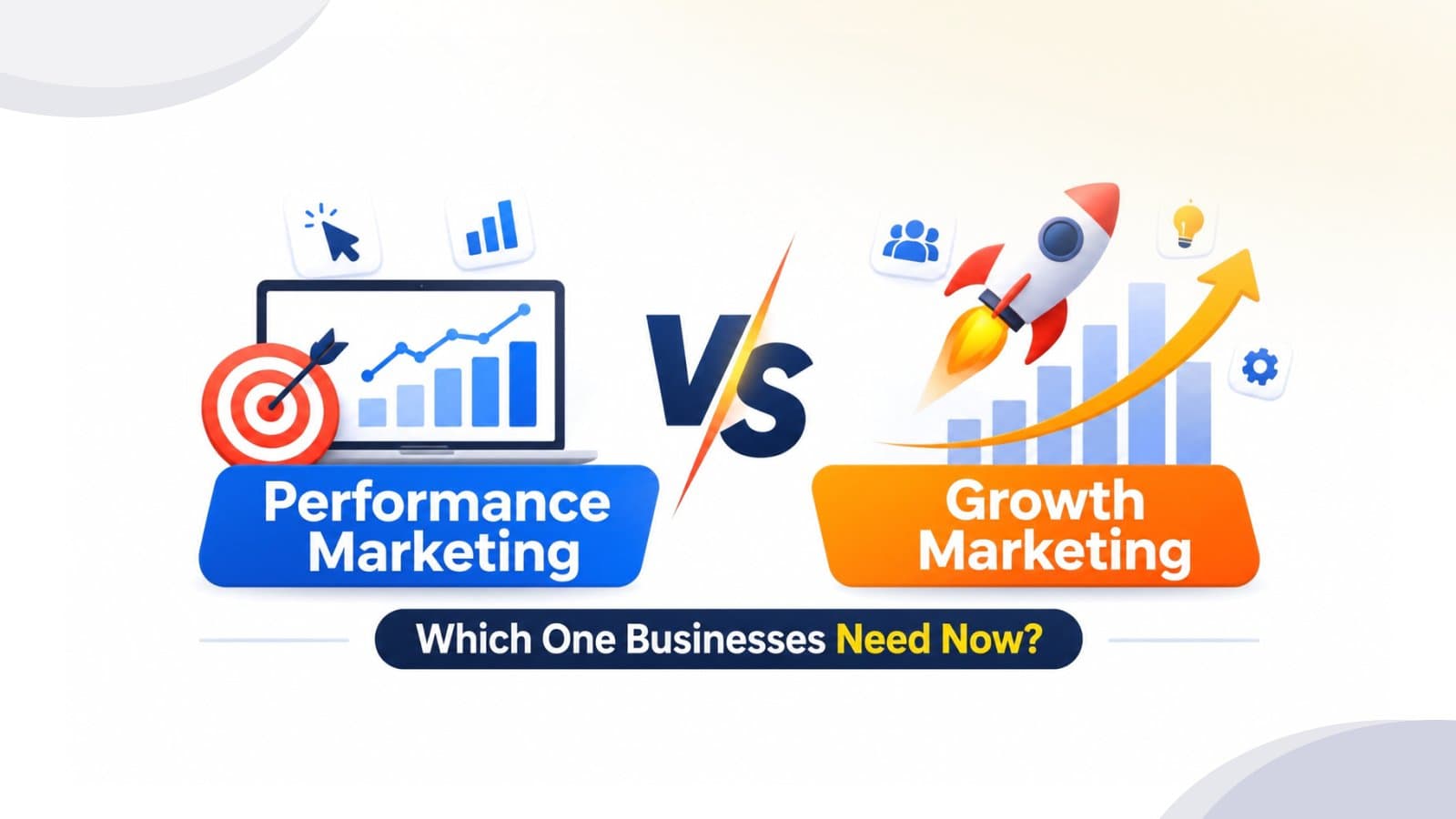
Performance Marketing vs. Growth Marketing - Which One Businesses Need Now?
Performance marketing drives measurable results through paid campaigns, while growth marketing builds long-term, compounding growth across the customer journey. Discover the key differences, when businesses should prioritize each, and why combining both creates a stronger growth engine.
Performance marketing buys measurable results today. Growth marketing builds the system that keeps those results compounding. That's the short answer to the performance marketing vs. growth marketing debate. For most US companies, the real question is which one to lead with, and when to bring in the other.
We have some version of this conversation with founders and CMOs almost every week. A company has run Google Ads for six months. CPAs are creeping up, the sales team says lead quality is slipping, and leadership wants to know whether "growth marketing" is the fix or just a new name for the same spend. Here's how we break it down.
Building a Performance Marketing Strategy That Converts
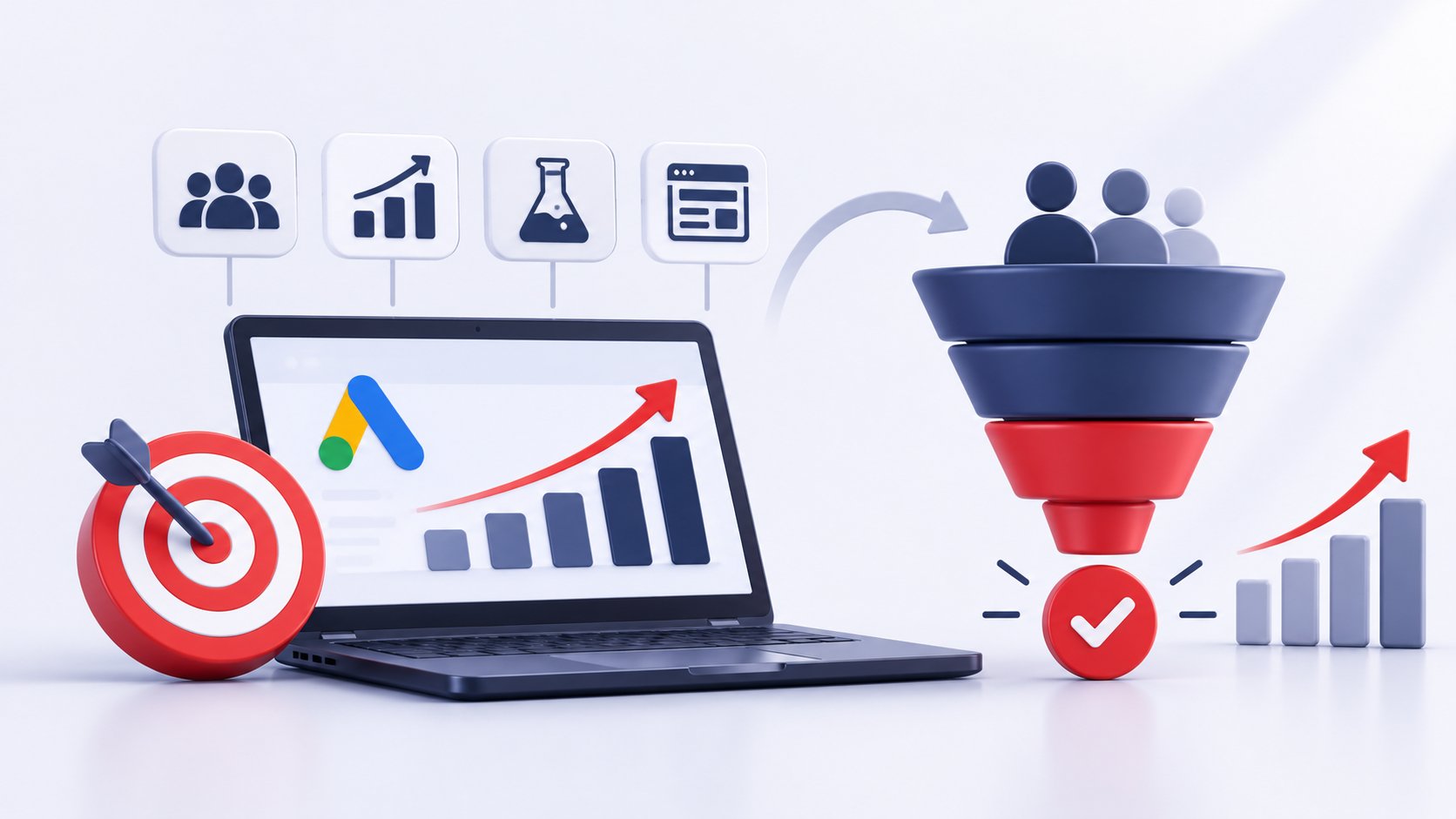
A solid performance marketing strategy usually rests on four things:
Tight audience and keyword targeting, now partly automated by tools like Google Ads AI Max
Conversion tracking that holds up after cookie loss and privacy changes
Creative testing at volume, not one ad per quarter
Landing pages built for one clear action
If your ads bring traffic but your CRM stays quiet, the problem is usually the funnel, not the bid strategy. We unpack the usual suspects in Google Ads clicks but no leads.
Performance marketing vs. digital marketing: digital marketing is the umbrella that covers SEO, content, social, email and paid media. Performance marketing is the paid, pay-for-results slice of it.
Building a Growth Marketing Strategy That Compounds
A solid growth marketing strategy usually rests on four things:
A clear map of where customers drop off across acquisition, activation, retention, referral and revenue
Owned channels that compound over time: SEO, content, email and lifecycle automation
Onboarding and product moments that get new users to value fast
A steady test cadence on pricing, pages and messaging, judged on LTV rather than clicks
Here's a pattern we see often. A SaaS company has a healthy free-trial sign-up rate, yet most trials go quiet after day three. More ads won't fix that. A sharper onboarding sequence and a few well-timed emails will, and once they do, every future ad dollar is worth more.
The Difference Between Performance Marketing and Growth Marketing
The simplest way to see the difference: performance marketing optimizes a campaign, growth marketing optimizes the business.
Performance Marketing | Growth Marketing | |
|---|---|---|
Primary goal | Immediate conversions and revenue | Sustainable, compounding growth |
Time to impact | Days to weeks | Months, then it compounds |
Core metrics | CPA, ROAS, cost per lead, CTR | LTV, activation, retention, referral rate, LTV:CAC |
Funnel scope | Mostly acquisition | Full lifecycle, from first touch to advocacy |
Main channels | Google Ads, Meta, TikTok, LinkedIn, affiliates | SEO, content, email, onboarding, product, community, CRO |
Mindset | Buy traffic and optimize spend | Earn and keep customers, optimize the system |
When spend stops | Results stop | Owned assets keep working |
Team | Media buyers, analysts, creative | Cross-functional: marketing, product, data, sales |
Why This Choice Matters More in 2026
A few years ago, many brands could lean on paid media alone and still grow. The numbers say that window is closing.
Budgets aren't growing, and paid media costs more. Marketing budgets held flat at 7.7% of company revenue, half of CMOs work with 6% or less, and paid media (30.6% of budgets) buys less every year because of media price inflation, per Gartner's 2025 CMO Spend Survey.
Retention is where the margin lives. Bain & Company research, cited in Harvard Business Review, found a 5% lift in retention can raise profits 25% to 95%, and winning a new customer costs 5 to 25 times more than keeping one.
Personalization separates fast growers. Faster-growing companies drive 40% more of their revenue from personalization than slower peers, according to McKinsey. That's a lifecycle capability, not a bidding tactic.
Add the shift toward AI-assisted search, where buyers increasingly meet brands inside answers rather than ads, and the case for owned, compounding assets gets stronger. (More on that in our guide to choosing an AI-powered marketing partner.)
Which One Should Your Business Lead With?
There's no universal winner. The right call depends on your stage, your unit economics and where customers are dropping off.
Lead with performance marketing if:
You have product-market fit and an offer that already converts
You need pipeline or revenue this quarter, not next year
Your margins can absorb today's customer acquisition costs
You're entering a new market and need fast, clean signal on what sells (our Meta Ads vs. Google Ads breakdown helps you pick the first channel)
Lead with growth marketing if:
You're still proving product-market fit or refining positioning
Churn or weak activation is quietly eating your revenue
You run a SaaS, subscription or repeat-purchase model where lifetime value drives the business
CAC keeps climbing and paid media alone no longer pencils out
A quick gut check we use with clients: if you doubled ad spend tomorrow, would revenue double, or would churn double? If it's revenue, you have a performance marketing opportunity. If it's churn, you have a growth problem to solve first.
The Solution Run Them as One Engine
The companies that scale well stop treating performance marketing vs. growth marketing as an either/or. Growth marketing builds the foundation: positioning, conversion paths, onboarding and retention loops. Performance marketing is the fuel that pushes volume through it.
Each one makes the other cheaper. Better retention raises lifetime value, which lets you bid harder on paid channels and still stay profitable. Better paid data, in turn, shows you which audiences stick around, so your growth experiments start from real signal instead of guesses.
That's how we structure work at Make My Brand. Our Growth-as-a-Service model gives you a cross-functional growth team that owns the full funnel. It runs alongside our performance marketing services, which manage Google Ads, Meta and LinkedIn campaigns against revenue, not vanity metrics.
Not sure which one your business needs first? Talk to the MMB team. We'll look at your funnel, your numbers and your goals, and tell you honestly where the next dollar should go.
Loading FAQs
Please wait while we fetch the questions...
Published on November 27, 2026 by Simran