
How to Choose the Right UI UX Design Agency for Your Business
The right UI/UX design agency can improve customer experience, increase conversions, and support business growth. This Blog covers the key criteria for selecting a partner that delivers measurable results and future-ready digital solutions.
Selecting a specialized UI/UX design agency is a pivotal strategic decision for growing organizations. Digital interfaces serve as the primary bridge for customer acquisition, brand authority, and revenue conversion.
As technological platforms shift toward generative search and automated digital workflows, choosing an engineering-focused design partner ensures long-term competitive positioning. This evaluation blog examines key selection criteria, strategic methodologies, and technical capabilities needed to select a design partner capable of driving measurable commercial performance.
The Strategic Business Impact of Partnering with a UI/UX Design Agency
Digital product design has evolved from a simple visual discipline into a core driver of enterprise growth. Modern corporate leaders recognize that layout and interaction flow directly dictate conversion velocity, operational efficiency, and customer retention. As a result, engaging a specialized website UI/UX design agency is no longer just about aesthetics it is a strategic move to align product development with overarching business goals, transforming software and websites into high-performing digital assets.
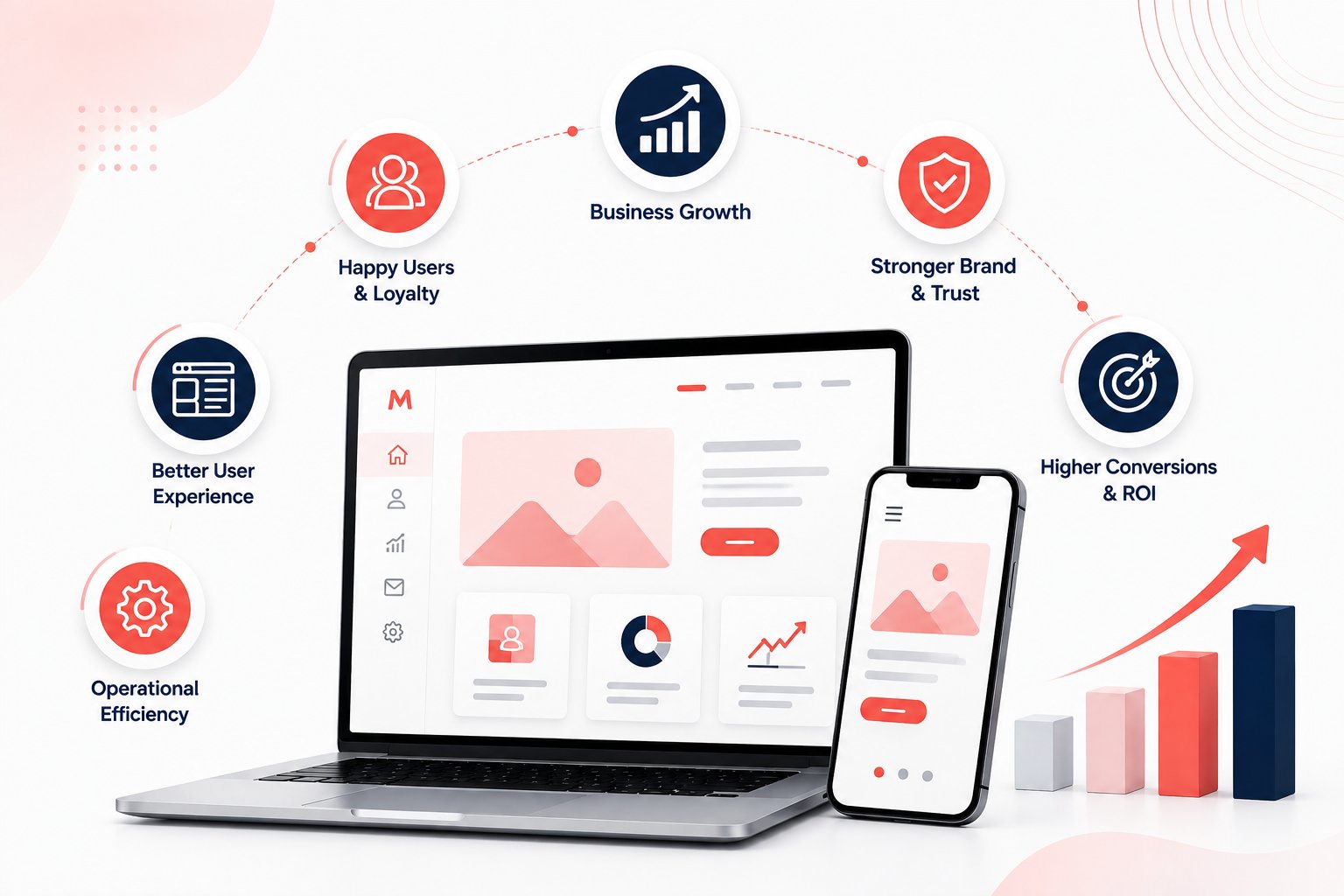
When partnering with an external design agency, the primary focus extends far beyond surface-level visuals. A disciplined agency systematically maps user psychology, eliminates cognitive friction, and creates seamless pathways across mobile and web touchpoints from initial brand discovery directly to the transaction.
This user-centered approach yields quantifiable financial returns. Research demonstrates that every dollar invested in strategic UX design returns an average of $100 - an impressive 9,900% ROI. Clarifying navigation and optimizing checkout funnels directly improve operating margins, whereas neglecting design creates compounding technical debt and high bounce rates.
Reflecting this value, the market for design expertise is surging. According to Mordor Intelligence, the global UI/UX design market is projected to expand from $1.98 billion in 2025 to $11.66 billion by 2031 a 32% compound annual growth rate. This rapid growth confirms that organizations worldwide now treat experience design not as an afterthought, but as a board-level strategic priority.
Traditional Web Design vs. Strategic Enterprise UI/UX
While traditional approaches focus heavily on surface aesthetics, enterprise design builds scalable systems designed for conversion, search visibility, and long-term expansion.
Operational Area | Traditional Web Design | Strategic Enterprise UI/UX Design |
|---|---|---|
Primary Objective | Visual aesthetics and page presentation | Conversion architecture, user intent alignment, and business growth |
System Architecture | Static, page-by-page web templates | Tokenized, reusable component design systems |
Search Engine Compatibility | Basic keyword insertion and meta tags | Generative Engine Optimization (GEO) & entity-based structure |
Development Lifecycle | Disconnected design-to-code handoffs | Integrated Brand Development Lifecycle (BDLC) with agile validation |
Analytics Integration | Surface-level page view metrics | Custom event tracking, GA4 mapping, and performance dashboards |
Scaling Consistency Across Digital Touchpoints
Moving from static templates to a component-driven system does more than optimize internal workflows - it unifies web and mobile interfaces under a single, cohesive design language.
Whether deploying a standalone mobile app UI/UX design or upgrading an enterprise portal, a specialized agency builds scalable design systems that bridge the gap between design and engineering. This structural alignment eliminates friction during code handoffs, ensuring digital assets remain fast, responsive, and brand consistent as your business operations expand.
Essential Evaluation Criteria for an Enterprise UI/UX Design Process
Selecting a design partner requires a structured evaluation framework that goes beyond reviewing visual portfolios. Procurement teams and leadership must evaluate an agency’s UX research and design methodologies, cross-functional team structures, technical capabilities, and historical track record of delivering measurable outcomes.
A thorough enterprise UI/UX design process begins with extensive research before creating a single wireframe. Specialized agencies must demonstrate experience with qualitative user interviews, quantitative heatmap analysis, competitive benchmarking, and end-to-end user journey mapping.
Organizations that prioritize a research-first technique reduce guesswork from the design lifecycle. Every layout change, interaction pattern, and navigation decision is directly guided by documented user behaviors and verified operational friction spots, guaranteeing that the end product achieves tangible business results.
When assessing a leading UX agency in the USA or international design partner, decision-makers should prioritize agencies operating dedicated cross-functional pod models. A dedicated pod comprising product strategists, UI/UX designers, front-end engineers, and analytics specialists ensure design concepts remain grounded in engineering feasibility and business goals.
Analytical Discovery
Evaluating user analytics, heatmaps, and target audience personas to identify conversion bottlenecks.
Information Architecture
Structuring content hierarchy and navigational flows for human visitors and search crawlers.
Interactive Prototyping
Developing interactive wireframes to validate user flows prior to back-end development.
Performance Optimization
Engineering lightweight component interfaces to ensure sub-2-second load speeds and high responsiveness.
Analytics Instrumentation
Mapping custom tracking events within Google Analytics 4 (GA4) to measure post-launch conversion paths.
A major selection criterion is an agency's ability to demonstrate clear commercial outcomes across past enterprise projects. For instance, growth partners such as Make My Brand deploy dedicated cross-functional pods that combine strategy, product design, and full-stack development.
In a digital workspace modernization project for Dublin Technology Center, Make My Brand implemented over 10 strategic UI/UX design enhancements alongside backend infrastructure upgrades. This unified approach delivered sub-2-second page load times across more than 100 indexed pages, driving over 11,000 active users from scratch and scaling lead generation at an acquisition cost of $0.87 per lead.
Architectural Alignment for AI Search Visibility and Generative Search Engines
The digital search ecosystem has undergone a fundamental paradigm shift driven by the rise of generative AI engines such as Google AI Overviews, Perplexity, and ChatGPT.
Consequently, modern website redesign strategies must account for how Large Language Models (LLMs) parse, crawl, and synthesize digital content. User interface design is no longer evaluated solely through the lens of human perception it now functions as a foundational structured data layer that directly determines whether a brand is cited in generative search answers.
By incorporating Generative Engine Optimization principles into UI/UX design, organizations can position their content as a primary authoritative source for AI models. Achieving this requires harmonizing visual front-end layouts with logical, machine-readable data structures.
Architectural Component | Human User Experience Benefit | Generative Search Engine Benefit |
|---|---|---|
Semantic UI Markup | Provides consistent visual feedback and ensures accessibility compliance. | Enables precise Document Object Model (DOM) parsing and contextual indexing. |
Structured Content Layout | Facilitates effortless scanning of complex technical information. | Streamlines direct citation extraction for AI Overviews and answer summaries. |
Entity-Based Navigation | Offers intuitive content categorization aligned with user goals. | Establishes clear entity relationship mapping to build AI topical authority. |
Clear Heading Hierarchy | Establishes a logical reading flow that minimizes cognitive load. | Provides explicit header structures (H1–H4) that simplify content chunking. |
To operationalize these design principles, organizations must build an entity-based information architecture that organizes site content directly around core business topics.
Supporting this structured layout with JSON-LD schema markup, intuitive navigation, and explicit HTML header hierarchies enables search crawlers and AI bots to digest contextual relationships instantly. Ultimately, this unified approach ensures both site visitors and autonomous indexing engines locate key information without encountering digital friction or processing unnecessary clutter.
This dual focus on technical performance and structured content architecture is reflected in digital transformations delivered by Make My Brand. During a complete brand and web architecture revamp for AI technology firm MoogleLabs, Make My Brand created a modular design system containing 20+ reusable UI components.
Combined with performance engineering that boosted page load speed by 40%, the platform achieved a 134% increase in user sessions, expanding its user base from 6,500 to over 21,900 while generating 2.6 million organic impressions through an SEO-first, content-led structure.
Designing Dual-Purpose Digital Touchpoints for AI Agents and Human Visitors
As autonomous AI agents increasingly conduct web research, schedule appointments, and evaluate enterprise software on behalf of buyers, corporate digital touchpoints must seamlessly cater to two distinct audiences human decision-makers and automated AI bots. Modern interface design must deliver compelling visual storytelling for human users while maintaining machine-readable precision for programmatic crawlers.
To achieve this balance, UI/UX design for web and mobile platforms must optimize for two parallel tracks:
Human-Centric UX
Emphasizes responsive layouts, intuitive micro-interactions, distinct value propositions, and frictionless conversion pathways.
Agent-Centric Architecture
Demands clean DOM trees, explicit metadata, accessible input fields, and unambiguous data endpoints that AI tools can parse without visual interference.
In native applications, mobile app UI/UX design requires simple onboarding flows, minimal form fields, and lightweight front-end code. When building complex multi-screen mobile platforms, an experienced agency balances visual polish with streamlined functional workflows.
Human Experience Features
Intuitive navigation menus, visual feedback animations, touch-friendly buttons, and high-contrast typography.
AI Agent Features
Standardized schema markup, explicit button labeling, clear tabular data, and accessible API connections.
Shared Performance Baseline
Sub-2-second load times, mobile-first layouts, zero layout shifts, and high visual stability.
For example, when developing a mobile automotive platform for Cars Centro, Make My Brand created 40+ custom app screens using a Figma-first design workflow. To simplify user interactions, Make My Brand integrated automated vehicle identification number (VIN) scanning features that auto-filled vehicle specifications instantly. This touchless data entry reduced listing friction for vehicle sellers and streamlined booking for buyers while maintaining robust backend data synchronization.
Evaluating UI/UX Design Workflows, and Engagement Models
Understanding the tools, pricing structures, and implementation frameworks that govern design engagements helps simplify partner evaluation. A professional UI/UX design agency operates with structured design workflows, utilizing industry-standard tooling to ensure smooth developer handoffs and product scalability.
Technical Workflows and Component Design Systems
Structural Architecture
The design phase begins with website wireframing to establish structural grids, spatial relationships, and layout hierarchies. Transitioning from static wireframes to interactive UX prototypes enables stakeholders to validate user flows and refine navigation before writing front-end code.
Component-Driven Scalability
Leading design teams rely heavily on Figma prototyping to construct modular component libraries. Tokenized Figma components unify brand colors, typography rules, spatial padding, and button states across both web and mobile platforms.
Engineering Acceleration
This systemic approach drastically accelerates front-end implementation whether deploying custom WordPress website design layouts or headless web frameworks while reducing future technical debt and code maintenance costs.
Strategic Engagement Models
Evaluating UI/UX design partnerships requires balancing upfront execution costs against long-term operational value. Organizations evaluate design partners across three primary engagement models:
Engagement Model | Typical Project Scope | Strategic Business Advantage |
|---|---|---|
Fixed-Scope Redesign | Defined deliverables, set timelines, and fixed costs | Predictable budget allocation for discrete web updates |
Growth-as-a-Service Pod | Iterative monthly sprints, continuous testing, and optimization | Agile adaptability with integrated engineering and marketing talent |
Staff Augmentation | Embedded UX specialists working under internal direction | Flexible team scaling for short-term internal bandwidth gaps |
Leading growth partners, such as Make My Brand, utilize structured frameworks like the Brand Development Lifecycle. This seven-stage framework guides businesses through brand strategy, identity design, digital presence creation, market launch, growth optimization, and market leadership.
Delivering design through structured weekly sprints ensures digital products evolve alongside market shifts, technological advances, and changing user needs.
Selecting a design partner requires balancing upfront pricing against long-term operational value. While budget vendors may offer quick template fixes, a specialized UI/UX design agency delivers robust design architectures that drive sustained customer engagement and measurable revenue growth.
Conclusion
Selecting the most effective UI/UX design agency necessitates assessing research techniques, technological prowess, and demonstrated commercial results. For AI agents and generative search engines, modern digital touchpoints must strike a balance between structured data architecture and intuitive visual experiences for human visitors. By collaborating with an agency that employs component-based design systems, agile execution frameworks, and specialized pod teams, businesses can ensure a strong digital foundation for sustained business expansion.
Loading FAQs
Please wait while we fetch the questions...
Published on August 7, 2026 by Abhishek Vasudev