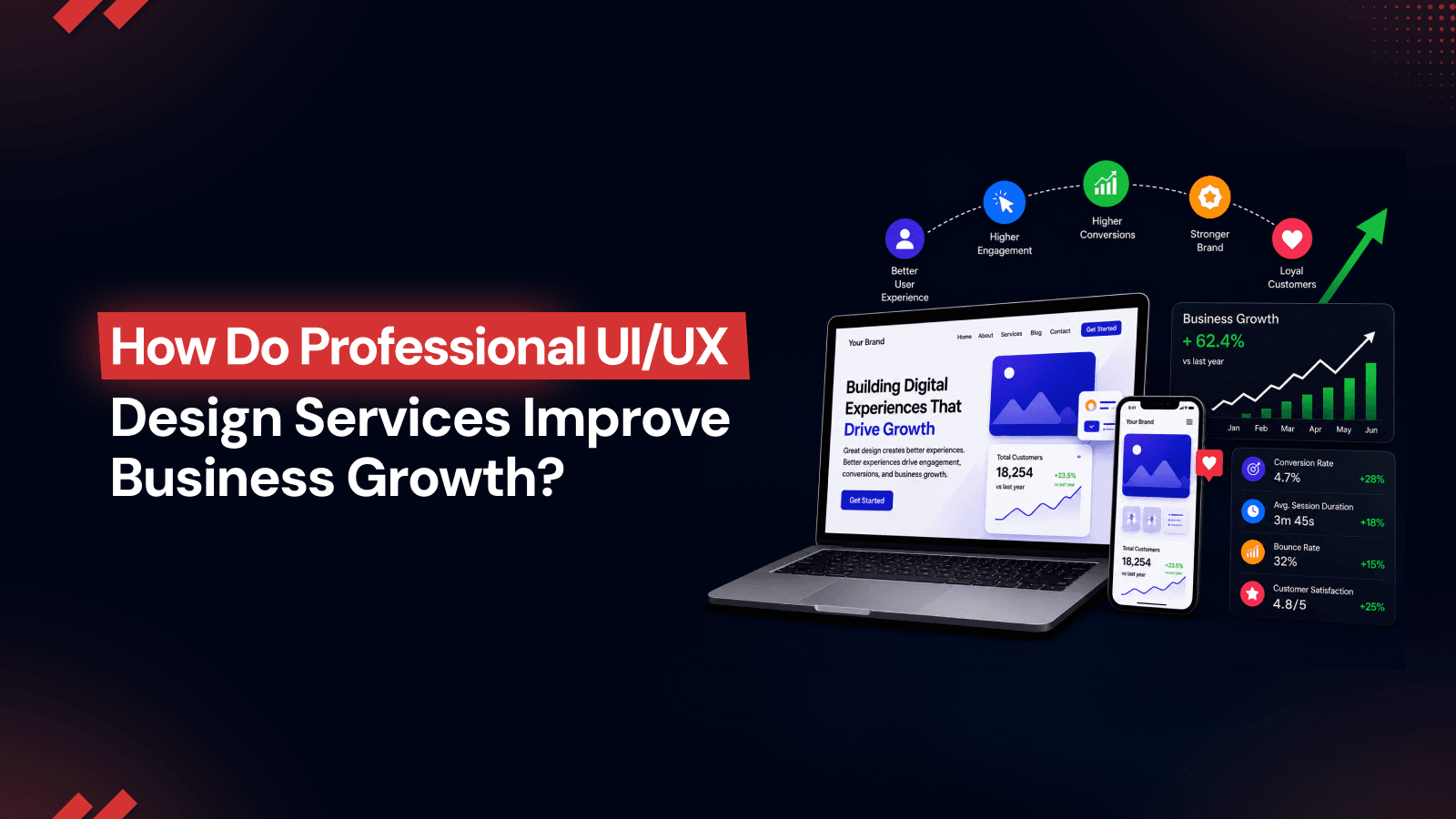
How Do Professional UI/UX Design Services Improve Business Growth?
Professional UI/UX design services drive business growth by improving user experience, increasing conversions, reducing friction, and enhancing customer satisfaction. This blog explores mobile-first design, AI-ready interfaces, and how UX decisions help businesses boost revenue and stay competitive.
In an era where digital interfaces serve as the primary engine for acquisition and retention, professional UI/UX design services have transitioned from aesthetic luxuries to pillars of capital efficiency. Modern platforms must now serve a dual audience: human users seeking intuitive experiences and autonomous AI agents requiring structured, machine readable data. Achieving this balance is no longer optional, it is the baseline for maintaining market share in an environment defined by intelligent automation.
In this blog, we explore how professional UI/UX design bridges the gap between human-centric usability and machine readable architectures for maximum performance.
The Economics of Experience: Quantifying Design-Led Revenue Velocity
To justify capital allocation toward digital transformation, operational leaders rely on empirical data that connects design quality to financial performance. Design-driven enterprises consistently outperform competitors by reducing friction and creating seamless user journeys.
On a transactional level, the optimization of digital interfaces yields a direct, meaningful conversion lift. Conversely, the cost of design negligence remains severe as usability defects lead to lost customers, increased development overhead, and diminished brand equity.
Therefore, when digital assets are structured around human cognitive patterns, conversion optimization occurs naturally. Aligning a digital platform's navigation with the user's existing mental models rather than forcing users to adapt to complex, internal corporate structures is essential for success. This reality underscores why partnering with specialized UI/UX design companies is essential to ensuring that user interface design services are grounded in behavioral data rather than speculative aesthetics.
Mitigating Top UI/UX Mistakes and Reclaiming Lost Conversions
Despite the established correlation between design quality and revenue, many enterprise platforms continue to exhibit persistent usability bottlenecks. Among the top UI/UX mistakes that degrade conversion value are:
Complex multi-stage checkout forms
Forced account registration
Inconsistent navigation patterns
Poor load velocity
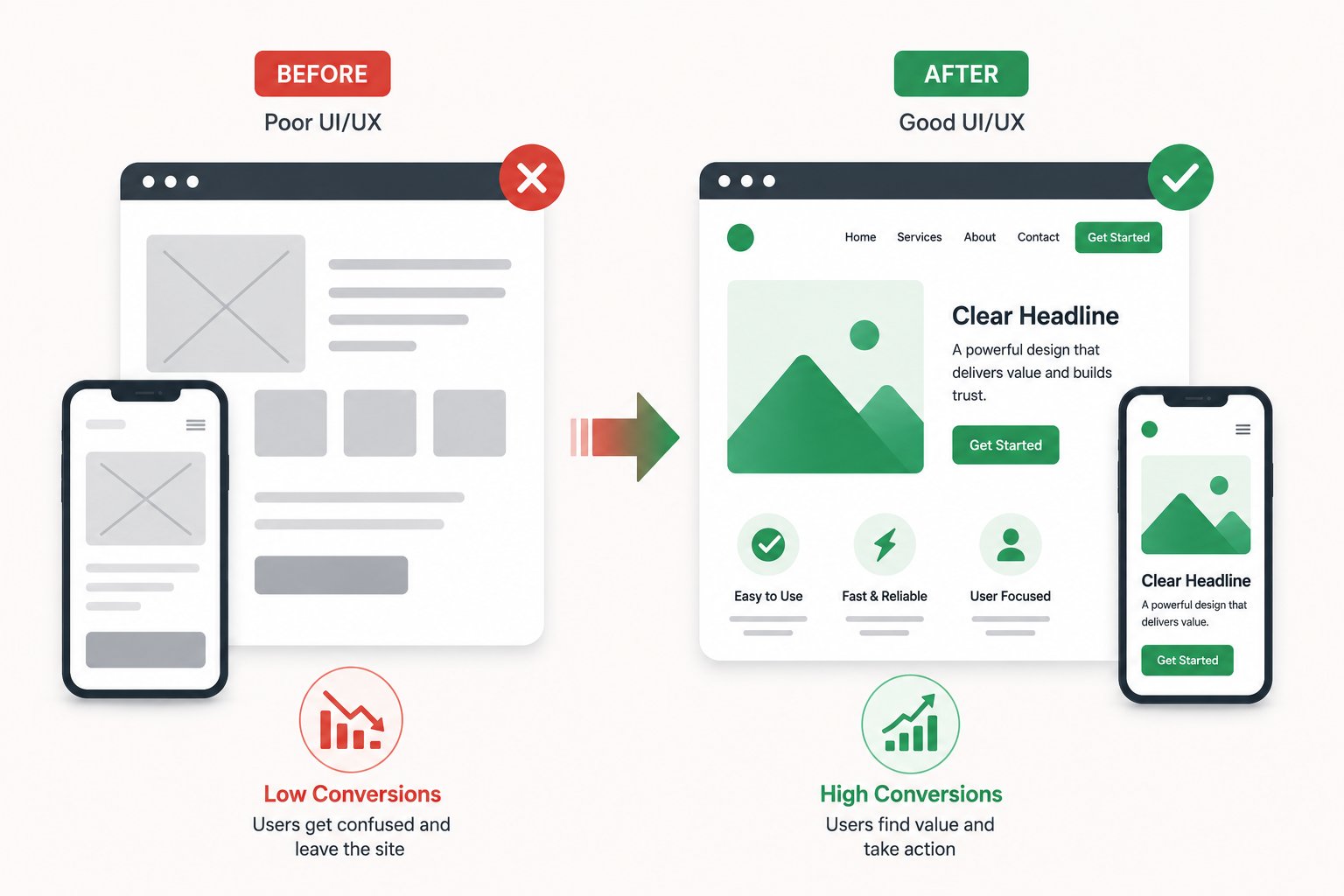
These mistakes are particularly costly on mobile devices. To capture lost revenue, organizations must implement a strict mobile first design philosophy. Rather than treating mobile responsiveness as a secondary development task, experience design should originate on the mobile interface, prioritizing touch-target sizing, critical visual hierarchy, and minimizing latency.
This emphasis on mobile performance and seamless website development was demonstrated by MMB during a comprehensive digital modernization executed for Seasia Infotech. Facing fragmented tracking systems, high desktop-to-mobile bounce disparities, and an outdated legacy platform, the organization partnered with Make My Brand to deploy a unified growth framework.
By combining custom WordPress website design with scalable, mobile-first layouts, optimized localized service structures, and automated CRM tracking, the team transformed an underperforming site into a highly efficient conversion engine.
The Era of Generative UI and Vibe Design: Curation as the New Moat
The launch of platforms such as Google Stitch 2.0 has introduced the industry to "Vibe Design" - a paradigm of professional web design where designers describe desired aesthetic guidelines, functional objectives, or emotional outcomes in natural language to generate high-fidelity, interactive layouts instantly.
Ideation ──> Wireframes ──> Mockups ──> Static Prototypes ──> Hand-off (Weeks)
Intent ──> Prompt ──> Infinite Canvas ──> Live Interactive UI (Minutes)
This shift from manual component creation to AI-assisted layout generation dramatically compresses development timelines. Modern design agents, equipped with infinite canvas environments, voice-critique capabilities, and automated branching models, allow teams to test dozens of layout options in real-time.
However, this democratization of layout generation does not diminish the value of specialized professional UI/UX design services. When UI assets are commoditized, the primary competitive moat shifts from manual component rendering to strategic curation, creative taste, and rigorous usability validation.
While AI can produce 100 layouts in a few minutes, human design experts remain essential to determining which conceptual path aligns with corporate business goals, complies with regulatory requirements, and scales effectively.
The Emerging Frontier: Designing for Agent Experience (AX)
As conversational search engines and autonomous browser agents become the primary way users research products and complete transactions, digital design must expand its focus.
Today’s web layouts must cater to a dual-audience architecture: human users who navigate via visual hierarchies, and AI agents (such as Claude Operator, Gemini, or OpenAI's autonomous agents) that read the underlying structural and semantic layer.
This reality has driven the rise of Agentic Experience (AX) design, a discipline focused on optimizing web for autonomous machine consumers.
To ensure visibility across AI-driven channels, custom website design must incorporate several key machine-legibility standards:
JSON-LD Meta-Tagging
Structuring business facts, product prices, e-commerce inventories, and detailed FAQs in clean, accessible JSON schemas to optimize organic visibility in AI-generated answers.
The LLMs.txt Registry
Place a clean, markdown-formatted llms.txt file at the domain root (e.g., brandname.com/llms.txt). Google's April 2026 integration of an llms.txt compatibility check into Chrome’s Lighthouse auditing tool has turned this simple index into an industry standard for web quality.
Semantic HTML and Accessibility
Structuring interfaces with correct structural HTML5 tags (e.g., <article>, <nav>) and ARIA labels. Since advanced agents rely on accessibility APIs rather than visual screenshot processing, clean accessibility trees ensure much higher automated parsing efficiency.
Web Model Context Protocol (WebMCP)
An open standard backed by Google and Microsoft that lets web servers explicitly declare their backend capabilities to navigating agents, allowing seamless machine-to-machine interactions.
As human interaction patterns grow increasingly sophisticated and artificial intelligence fundamentally redefines software interfaces, the friction present within digital platforms directly dictates an organization’s market share. As a result, modern enterprises view professional UI/UX design services not as aesthetic enhancements, but as foundational investments in capital efficiency.
At the same time, the criteria for experience design are expanding. Navigating this shift demands a highly structured approach to website development, combining responsive web design, custom website design, and machine-readable data structures.
Operationalizing Trust and System Continuity: Case-Based Evidence of Growth
Integrating human usability with machine discoverability requires advanced technical strategy. This multi-layered approach was demonstrated by the specialized growth pods at Make My Brand during their partnership with SkyHi Tech Academy.
SkyHi Tech Academy required a complete digital transformation to expand its online enrollment and clean up its tracking infrastructure. Make My Brand deployed a comprehensive Growth OS framework that unified React-powered responsive web design, localized SEO content clusters, technical indexing corrections, and automated lead-capture workflows.
The resulting interface not only eliminated technical crawl errors but also improved load times across devices. The website attracted a 60% increase in organic users and 819 conversions.
Architectural Paradigm Shift: The Governance and Control Spectrum
As interactive experiences transition toward agentic models, design systems are expanding beyond simple visual layouts. When a digital agent acts on behalf of a user behind the scenes, trust is no longer built on manual confirmations, but on transparent logic and behavioral boundaries.
Consequently, modern UI/UX design for web and mobile systems focuses heavily on governance. Designers must implement decision logs that explain exactly why an agent made a choice, show visible confidence levels for automated actions, and build adjustable autonomy controls that allow users to scale agent permissions from manual approval to complete automation.
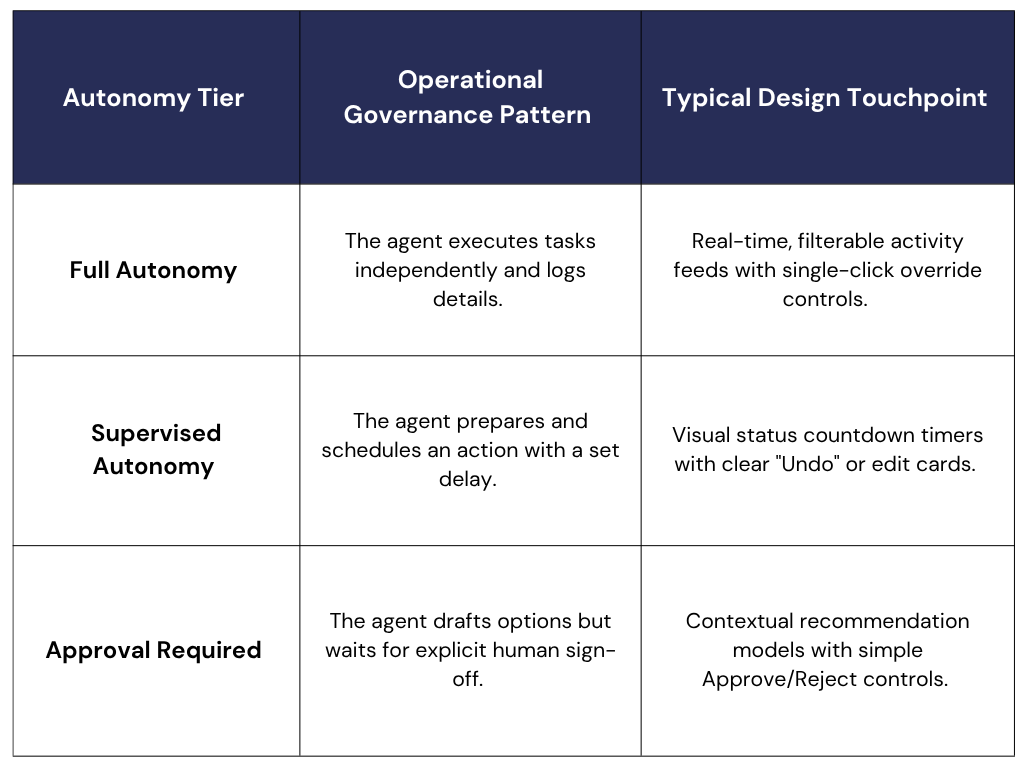
This structural comparison highlights the shift required as web designs evolve to accommodate both humans and machines:
Traditional UX focus
Standard onboarding flow, manual data inputs, step-by-step navigation, human readability, and error-prevention messages.
AX Design focus
Onboarding designed to build agent trust, structured database schemas, action and execution controls, machine readability, and machine-parseable error states.
Conclusion
The connection between design quality and revenue growth is clearer than ever. Across every industry, digital platforms are shifting from static, human-only interfaces into intelligent portals optimized for both human consumers and AI-driven workflows. Managing this transition requires an integration of visual branding, performance engineering, and machine legibility. By partnering with an execution-focused growth partner like Make My Brand, organizations can build custom web experiences that attract high-intent traffic, reduce user friction, and secure long-term digital authority in an increasingly competitive environment.
Ready to optimize your digital presence for both humans and AI? Contact Make My Brand today to deploy a high-performance, growth-driven design strategy.
Loading FAQs
Please wait while we fetch the questions...
Published on June 9, 2026 by Abhishek Vasudev