
EdTech Website Design Strategies for Personalized Learning, Student Retention, and Scalable Growth
Strategic EdTech website design enables educational organizations to deliver personalized learning experiences, improve student engagement, optimize conversions, and build scalable AI-powered platforms that support long-term digital growth and business success.
Digital learning platforms are no longer just static online course catalogs. To compete in today's crowded market, educational organizations are transforming their web portals into active growth ecosystems. Applying advanced EdTech website design strategies allows businesses to turn basic digital assets into highly adaptive learning environments. This strategic change helps companies acquire users more efficiently, build lasting student engagement, and scale their platforms to meet evolving market demands.
Why Have EdTech Websites Evolved from Marketing Assets into Growth Platforms?
Traditional online education portals functioned mostly as simple brochures with basic registration forms. Today, the rapid rise in digital upskilling and corporate learning has fundamentally changed this setup.
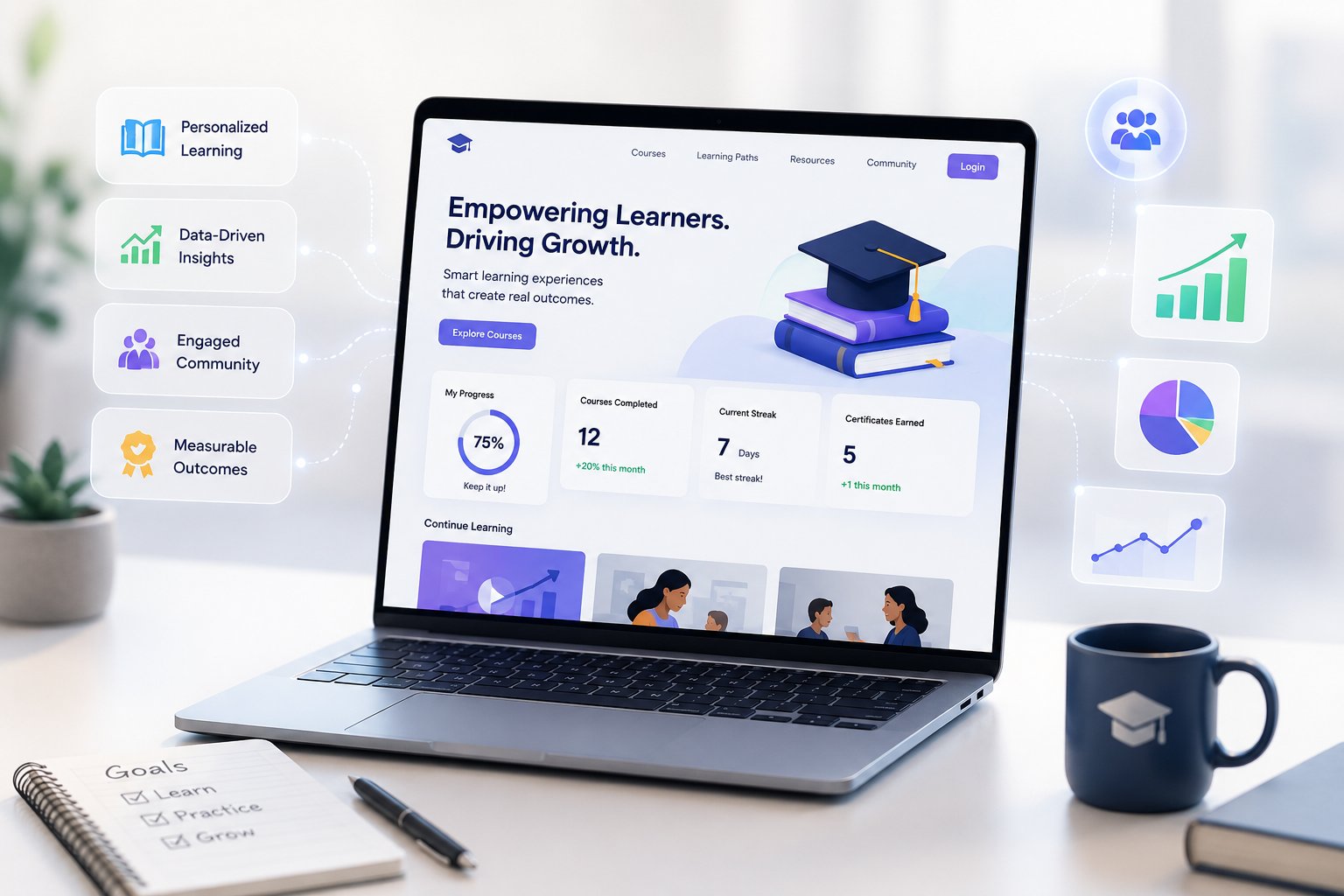
Projections from Statista estimate that the revenue in global online learning market will reach US$199.03bn in 2026, driven by massive shifts toward hybrid work and continuous corporate training. This growth means website design for EdTech companies must do much more than simply describe a curriculum. It must act as both a high converting landing page and a high-performance workspace.
For executive leaders, this shift directly impacts core unit economics, specifically customer acquisition cost (CAC) and customer lifetime value (LTV). When platforms provide poor user interfaces, drop-off rates increase, and paid acquisition budgets are wasted.
Conversely, a customized user experience serves as a powerful engine for organic lead generation. Global brands like Coursera and Udemy have proven that treating design as a business strategy rather than mere decoration creates long-term market authority.
Platforms that align their user interface design with the cognitive needs of their target audience see much stronger initial activation rates and repeat usage. This commercial reality is why experienced growth partners emphasize that every scroll, button placement, and transition must build user trust and lower conversion barriers.
Optimizing Early Interactions Through Strategic UX Design and Telemetry
A student’s learning journey begins the moment they land on a website, making the initial onboarding sequence a critical retention point. Complex registration fields and forced account creation often cause high early drop-off rates.
To address this issue, modern EdTech UX design employs progressive onboarding. This approach reveals complex settings gradually, allowing users to interact with introductory learning modules before completing a full profile.
To continually refine these experiences, growth teams analyze more than standard page-view metrics. They look to behavioral telemetry, which tracks micro-interactions such as:
Scroll depth across key course descriptions.
Cursor hesitation over structural call-to-action (CTA) buttons.
Input retries on interactive forms or quiz modules.
Specific dwell time on curriculum outline pages.
By monitoring these user behaviors, companies can isolate EdTech website design friction points. For instance, a technical team can calculate a normalized user friction score using behavioral inputs.
This relationship allows designers to pinpoint exactly where users struggle and simplify the interface dynamically.
This optimization process is clearly demonstrated in the real-world performance of the digital upskilling provider, SkyHi Tech Academy. When the academy struggled with complex user flows and manual lead drop-offs, the growth specialists at Make My Brand stepped in as a strategic partner.
Using their structured Brand Development Lifecycle (BDLC) framework, the team carried out over twelve major strategic UX design iterations. They developed modular, fast-loading landing pages, resolved indexation crawl errors, and deployed responsive web design frameworks. This technical overhaul resulted in a 60% increase in organic user traffic over three years, while their performance marketing campaigns achieved an exceptionally low average cost-per-click of NZ$0.72.
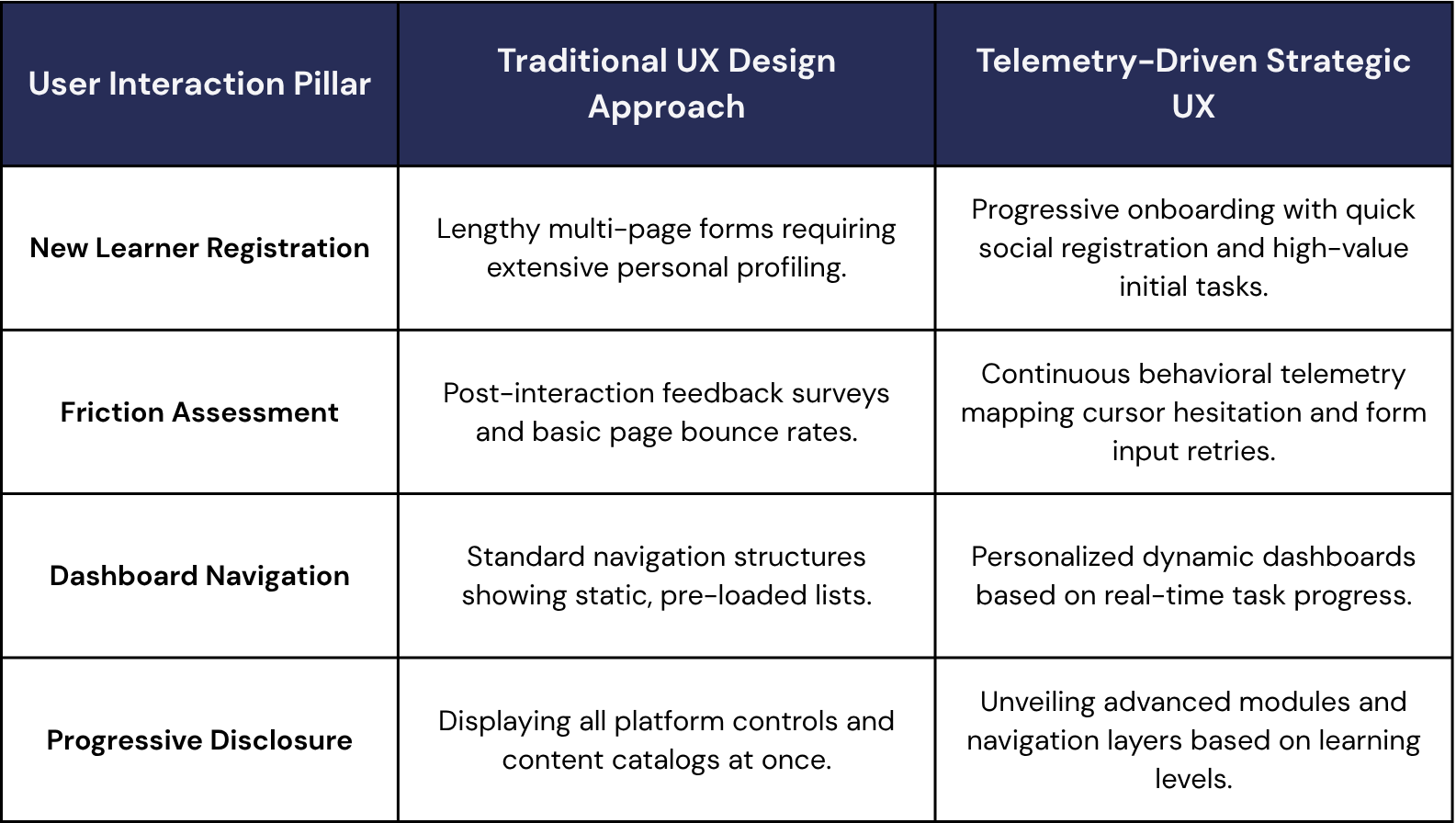
To help visual-first development teams, the table below contrasts traditional UX design models with growth-optimized behavioral telemetry strategies:
Core EdTech Website Design Principles that Enable Adaptive Learning and AI Personalization
The most powerful student retention strategies focus on providing highly personalized learning platforms. Modern AI developments have shifted online learning away from standard, one-size-fits-all formats toward systems that change based on individual learning performance.
In an AI-native learning operating system, personalized pathways are built using persistent AI memory. Traditional platforms treat each user session as an isolated visit, but modern systems utilize episodic memory to remember a student's historical pacing, past mistakes, and preferred learning styles across multiple devices.
As a result, the user interface design acts as a responsive system. If a student shows fatigue or struggles with a long video, the layout can dynamically switch format, suggesting a modular micro-learning session or an interactive, gamified assessment instead.
Implementing these capabilities requires custom website design optimized for:
Adaptive AI pathways
Automatically adjusting content difficulty in real time to match student performance.
Modular content formatting
Structuring lessons into highly flexible pieces that can be easily rearranged by recommendation systems.
Dynamic dashboards
Showing individual progress, current skill gaps, and learning recommendations on a single screen.
Conversation-first interfaces
Using AI voice agents and natural-language chatbots to guide students, answer questions, and provide immediate lesson feedback.
The business impact of these personalization principles is evident in the performance of the blockchain-credentialed learning platform, Knowledger. Seeking to overcome the slow completion rates of traditional learning management systems, they partnered with Make My Brand to engineer a trust-focused, AI-driven educational platform. The technical team built high-fidelity interactive prototypes in Figma, created a highly reusable React component library, and deployed a custom AI recommendation engine.
This personalization engine analyzed student pacing and assessment results in real time to suggest custom course material. These strategic updates helped Knowledger achieve a 40% faster course completion rate while onboarding twenty academic institutions and corporate training programs.
Technical Architecture for Scalable EdTech Platforms
High-quality visual designs must be supported by an equally strong backend architecture. Platforms designed for rapid growth require an API-first and AI-ready infrastructure that can handle heavy user traffic and support advanced integrations without slowdowns.
Modern platforms use microservices and cloud infrastructure to run different functions - like user logins, video streaming, progress tracking, and AI tutoring - on separate, scalable servers. If a platform experiences a sudden influx of users during a exam period, only the assessment and streaming microservices scale up, ensuring the rest of the website remains perfectly stable.
At the same time, responsive web design and mobile-first design are vital business growth pillars. Because more than 60% of digital learners access coursework on mobile devices, platforms must prioritize mobile layouts. This means utilizing flexible grids, optimizing media files to load quickly over limited bandwidth, and designing touch-friendly navigation controls.
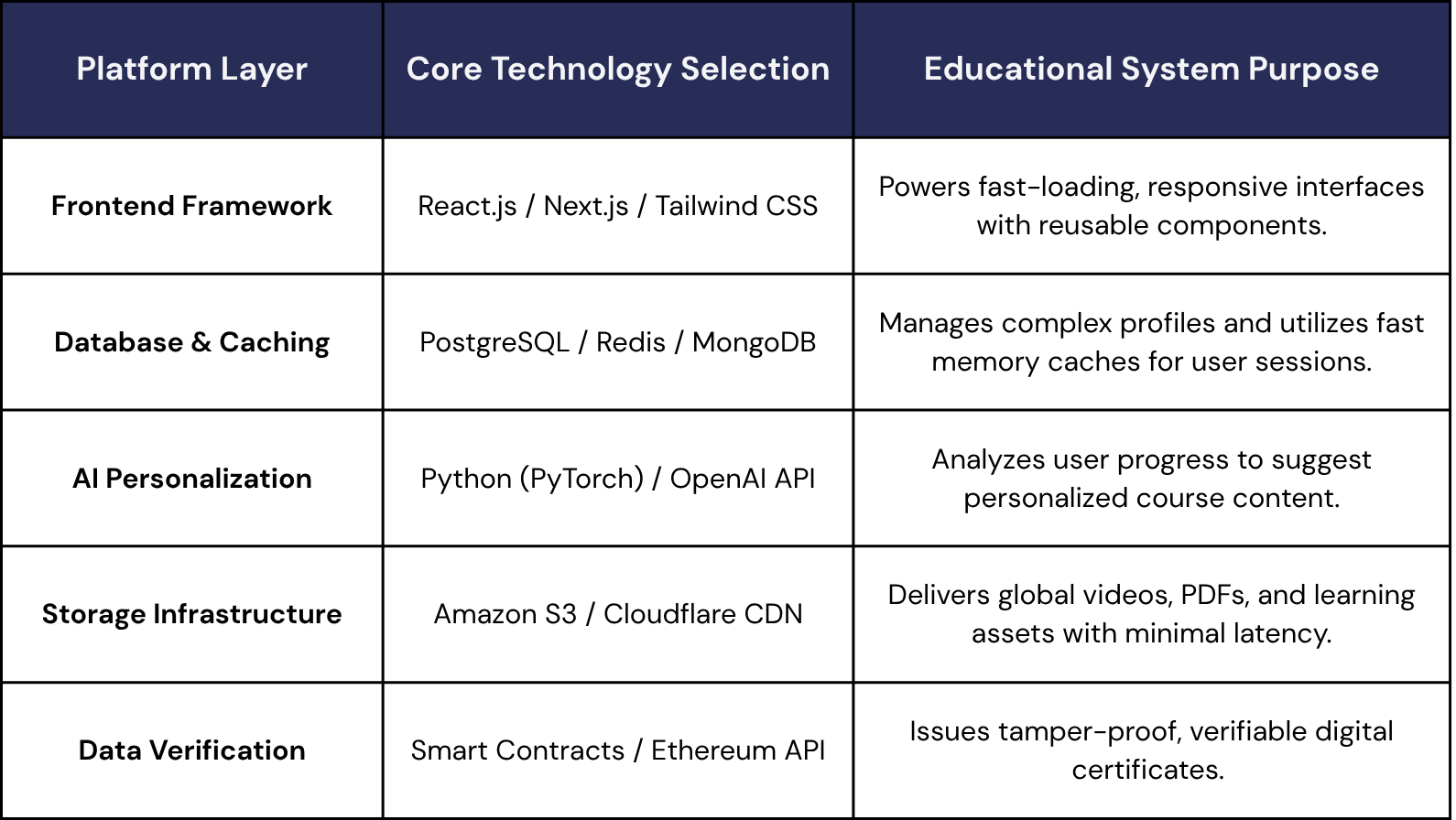
To guide technical teams, the table below maps out a scalable, API-first frontend and backend architecture:
Building this type of multi-sided, device-friendly experience is exactly how the online educator marketplace, Teacher Cool, achieved significant market success. The platform needed to connect students and teachers smoothly across different devices.
To build this, Make My Brand designed dual-sided, mobile optimized dashboards tailored to each group's unique workflow. For educators, the centralized dashboards automated administrative tasks like assignment tracking and earnings reporting, reducing admin work by 40%. For students, the intuitive mobile interfaces and seamless video playback led directly to a 35% increase in course completion rates, proving that a mobile-first approach is key to user satisfaction.
Accessibility, Compliance, and Trust as Strategic Differentiators
For organizations targeting enterprise accounts and school districts, compliance, security, and inclusive design are major competitive advantages, not just legal requirements. When educational institutions evaluate software, they prioritize accessibility first design that aligns with WCAG guidelines, ensuring the site works smoothly with screen readers and keyboard-only navigation.
Furthermore, as generative AI tools become common, leaders are evaluating AI governance alongside AI capabilities. Solid AI governance inside a platform ensures that:
Data privacy is protected.
Minimizing personally identifiable information (PII) to meet strict GDPR, COPPA, and FERPA standards.
Sources are controlled.
Restricting AI models to verified, curriculum-aligned educational databases to prevent inaccurate answers.
Safety guardrails are in place.
Using content filters to catch inappropriate behavior and ensure student interactions remain safe.
When platforms build these compliance and security features directly into their user interface, they establish strong brand authority. Establishing this level of digital trust helps EdTech companies win long-term B2B contracts, reduce customer churn, and scale their platforms with confidence.
Conclusion
Building a successful EdTech website design strategy necessitates a careful blend between visual identity, user-centered design, and reliable technology. Organizations can dramatically reduce user attrition, enhance completion rates, and promote business development by focusing seamless onboarding, mobile responsiveness, and adaptive personalization. To learn more about creating high-converting, compliance platforms, contact the design and growth engineering experts at Make My Brand at www.makemybrandlabs.com.
Loading FAQs
Please wait while we fetch the questions...
Published on July 9, 2026 by Abhishek Vasudev